The 17 SDGs: Where Progress Actually Stands Heading Into 2030
All 17 SDGs, One Page: What’s Working, What’s Not, and What’s Left by 2030
In September 2015, all 193 UN member states signed on to the 2030 Agenda for Sustainable Development. It’s a shared blueprint built around 17 goals and 169 targets. The deadline is close now. The gap between what was promised and what actually happened is hard to ignore.
Some goals show real, measurable wins. Extreme poverty in China is one example. Child vaccination coverage is another. Other goals are moving much slower. Ocean protection and gender parity fall in this group. The UN’s own reporting puts them decades past the 2030 finish line at current rates.
This guide is the entry point to Oak’s full SDG series. Each goal below gets a short summary. Each one also links to a dedicated deep dive. Those cover the official targets, the latest data, and what specific countries and institutions are doing. They also cover where businesses fit in. If you already know which goal you’re after, jump straight to it. If not, the table near the end lays out all 17 side by side.
What the Sustainable Development Goals actually are
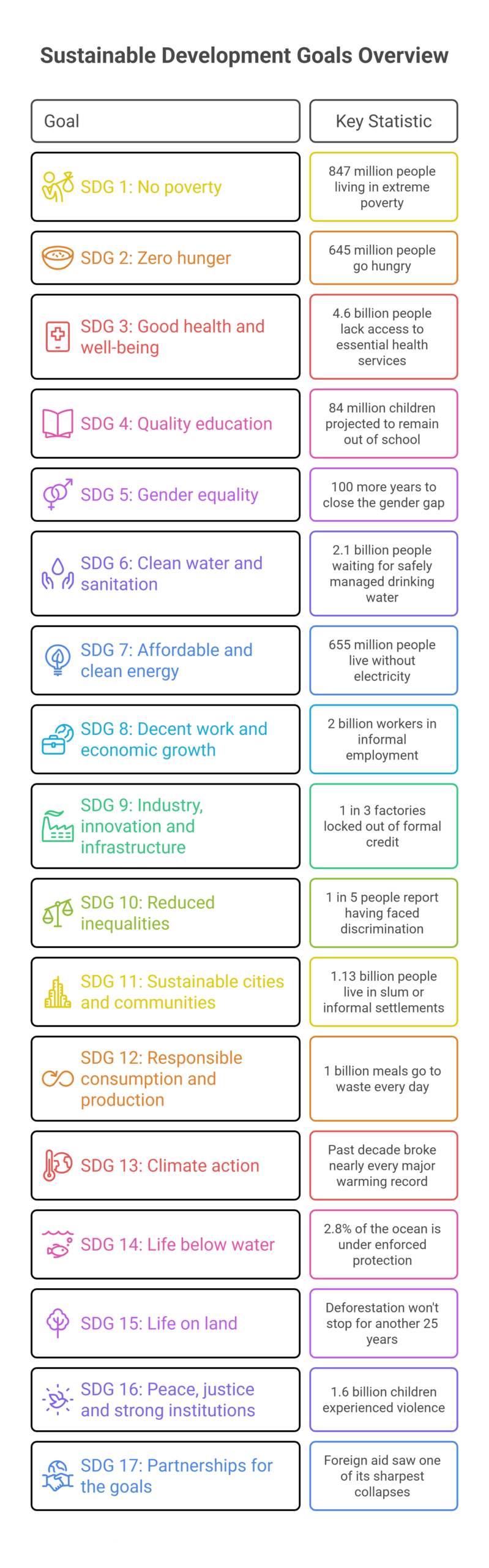
The SDGs replaced the Millennium Development Goals. The MDGs ran from 2000 to 2015 and focused mainly on halving extreme income poverty. The SDGs are broader by design. They cover poverty, hunger, health, education, and gender. They also cover water, energy, work, industry, and inequality. Cities, consumption, climate, oceans, land, peace, and the partnerships needed to fund it all round out the list.
The goals are explicitly interconnected, too. Progress on health depends partly on progress on poverty and water. Slow progress on climate action undercuts nearly everything else on the list.
Each goal breaks down into specific targets with indicators the UN tracks through annual reporting. That level of detail is covered in each individual article linked below, not repeated in full here.
SDG 1: No poverty
An estimated 847 million people were still living in extreme poverty as of a March 2026 World Bank update. That’s after the international poverty line was revised upward to $3.00 a day. Sub-Saharan Africa accounts for roughly two-thirds to three-quarters of that total. The UN says none of SDG 1’s targets are currently on track for 2030. The full article covers the revised poverty line and country-level programs from China to Brazil. It also covers where businesses can realistically contribute. Read the full SDG 1 breakdown.
SDG 2: Zero hunger
645 million people still go hungry. The goal was never just about calories, though. It also covers sustainable agriculture and smallholder productivity. Resilience matters too, since shocks like conflict and climate events push food insecurity back up just as it starts to fall. The dedicated article breaks down which regions are furthest from target, and what’s driving the stall. Read the full SDG 2 breakdown.
SDG 3: Good health and well-being
4.6 billion people still lack access to essential health services. That number captures everything from routine vaccination gaps to the cost barriers that keep people out of clinics entirely. COVID-19 dealt this goal a real setback. Several indicators, including childhood immunization rates, still haven’t fully recovered. The full piece covers where health coverage has genuinely improved, and where it’s still stuck. Read the full SDG 3 breakdown.
SDG 4: Quality education
84 million children and young people are projected to remain out of school without additional intervention. Around 300 million more are expected to lack basic numeracy and literacy, even where they’re enrolled. Pandemic-era learning losses hit four out of five countries studied. Most haven’t fully recovered. The full article looks at what’s driving the gap, and which countries are closing it fastest. Read the full SDG 4 breakdown.
SDG 5: Gender equality
At the current pace, the UN estimates it will take roughly 100 more years to close the gender gap. That covers legal protection, political representation, and equal pay. The dedicated article breaks that estimate down by region. It also covers the specific targets lagging furthest behind, from ending child marriage to equal access to land and financial services. Read the full SDG 5 breakdown.
SDG 6: Clean water and sanitation
2.1 billion people are still waiting for safely managed drinking water at home. The gap is even wider for basic sanitation. The full article covers where investment is actually closing this gap, and where it’s stalling. It also explains what a safely managed water source means under the UN’s own definition. Read the full SDG 6 breakdown.
SDG 7: Affordable and clean energy
655 million people still live without electricity. That’s concentrated heavily in Sub-Saharan Africa, even as renewable capacity expands quickly elsewhere. Some countries have already hit universal electricity access. The full article uses those as a benchmark against countries still building out basic grid infrastructure. Read the full SDG 7 breakdown.
SDG 8: Decent work and economic growth
2 billion workers, close to 60% of the global workforce, remain in informal employment. That means no contracts, no social insurance, and no legal recourse if something goes wrong. The full article covers what’s driving informality at that scale. It also covers which economies are managing to formalize work faster than others. Read the full SDG 8 breakdown.
SDG 9: Industry, innovation and infrastructure
Roughly 1 in 3 factories in developing economies are locked out of formal credit. That caps their ability to invest in equipment, technology, or expansion, regardless of demand. The full article covers what’s behind that credit gap. It also compares the gap across manufacturing hubs. Read the full SDG 9 breakdown.
SDG 10: Reduced inequalities
1 in 5 people worldwide report having personally faced discrimination. That’s on grounds including race, gender, disability, or migration status. The full article breaks down how that figure varies by region. It also covers what “reduced inequalities” actually measures beyond income, including representation and voice in decision-making. Read the full SDG 10 breakdown.
SDG 11: Sustainable cities and communities
1.13 billion people now live in slum or informal settlement conditions. That number has kept climbing, as urbanization outpaces affordable housing supply in many fast-growing cities. The full article covers where city planning is genuinely getting ahead of the problem. It also covers where informal settlements keep expanding. Read the full SDG 11 breakdown.
SDG 12: Responsible consumption and production
About 1 billion meals go to waste every single day. That’s even as hundreds of millions of people remain food insecure in the same period. The full article looks at where that waste actually happens across the supply chain, from farm to household. It also covers which interventions are proving cheapest to scale. Read the full SDG 12 breakdown.
SDG 13: Climate action
The past decade broke nearly every major warming record on the books. That’s from average global temperature to the pace of ice loss, even as renewable energy adoption accelerated in parallel. The full article covers where emissions are actually falling, and where they’re still rising. It also compares national climate commitments against what the science says is needed. Read the full SDG 13 breakdown.
SDG 14: Life below water
Only about 2.8% of the ocean is under protection that’s actually enforced. That’s far short of the 30% target most countries have signed on to for 2030. The full article covers what’s driving the gap between paper protections and enforced ones. It also looks at which marine protected areas are working as intended. Read the full SDG 14 breakdown.
SDG 15: Life on land
At the current rate of tree cover loss, deforestation won’t stop for another 25 years. That’s well past the point most forest ecosystems can recover the biodiversity they’re losing now. The full article breaks down which regions are driving the loss. It also covers where reforestation efforts are actually gaining ground. Read the full SDG 15 breakdown.
SDG 16: Peace, justice and strong institutions
1.6 billion children are estimated to have experienced violence in some form. That’s whether at home, at school, or in conflict settings. The figure touches nearly every other goal on this list, since safety underpins health, education, and economic outcomes alike. The full article covers what’s driving that number. It also covers which institutional reforms are showing measurable results. Read the full SDG 16 breakdown.
SDG 17: Partnerships for the goals
Foreign aid saw one of its sharpest collapses on record recently. That strains the financing model every other goal on this list depends on to some degree. The full article covers what caused the drop, and which donor countries pulled back hardest. It also covers what it means for financing the remaining goals through 2030. Read the full SDG 17 breakdown.
All 17 goals at a glance
| Goal | Focus area | Headline figure | Full article |
| SDG 1 | No poverty | 847 million people in extreme poverty | Read more |
| SDG 2 | Zero hunger | 645 million people go hungry | Read more |
| SDG 3 | Good health and well-being | 4.6 billion lack essential care | Read more |
| SDG 4 | Quality education | 84 million children out of school | Read more |
| SDG 5 | Gender equality | 100 years to close the gap at this pace | Read more |
| SDG 6 | Clean water and sanitation | 2.1 billion still waiting for safe water | Read more |
| SDG 7 | Affordable and clean energy | 655 million without power | Read more |
| SDG 8 | Decent work and economic growth | 2 billion workers unprotected | Read more |
| SDG 9 | Industry, innovation and infrastructure | 1 in 3 factories locked out of credit | Read more |
| SDG 10 | Reduced inequalities | 1 in 5 people face discrimination | Read more |
| SDG 11 | Sustainable cities and communities | 1.13 billion live in slums | Read more |
| SDG 12 | Responsible consumption and production | 1 billion meals wasted daily | Read more |
| SDG 13 | Climate action | Hottest decade of warming records on record | Read more |
| SDG 14 | Life below water | 2.8% of ocean actually protected | Read more |
| SDG 15 | Life on land | 25 more years of deforestation at this rate | Read more |
| SDG 16 | Peace, justice and strong institutions | 1.6 billion children face violence | Read more |
| SDG 17 | Partnerships for the goals | The year foreign aid collapsed | Read more |
Frequently Asked Questions
What are the Sustainable Development Goals?
The SDGs are 17 goals and 169 targets. All 193 UN member states adopted them in 2015 as the 2030 Agenda for Sustainable Development. They cover poverty, hunger, health, education, and gender. They also cover water, energy, work, industry, inequality, cities, consumption, climate, oceans, land, peace, and global partnerships.
Is the world on track to meet the SDGs by 2030?
No, not as a whole. Some individual targets are on track, or already met. Universal electricity access in a growing number of countries is one example. Most targets are behind schedule, though, including poverty, gender equality, and ocean protection, according to the UN’s own annual reporting.
Which SDG is furthest behind?
It depends on the metric used. Ocean protection (SDG 14) and gender equality (SDG 5) both stand out. Only 2.8% of the ocean has enforced protection, against a 30% target. The UN’s current estimate puts full gender parity roughly 100 years away at the present pace.
How are the SDGs different from the Millennium Development Goals?
The MDGs ran from 2000 to 2015. They focused mainly on halving extreme income poverty and a handful of related targets. The SDGs are broader. They cover poverty in all its dimensions, plus 16 additional goals spanning climate, institutions, and infrastructure.
Can businesses actually contribute to the SDGs, or is this government work?
Businesses have a documented role on several goals. That’s particularly true through decent job creation, supply chain wages, financial inclusion products, and responsible sourcing. Each article in this series includes a section on what that looks like in practice for that specific goal.
Where can I read more about a specific goal?
Use the table above, or the links throughout this article, to jump to the dedicated deep dive for any of the 17 goals.
Conclusion
No single goal on this list gets solved in isolation. Slow progress on clean water feeds slow progress on health. Stalled climate action undercuts food security and poverty reduction at the same time. That’s part of why the SDGs were built as one interconnected framework, not 17 separate initiatives.
For a business trying to figure out where it fits, the more useful starting point is usually one specific goal. Pick the one that overlaps with what the business already does, not the full list at once. Oak’s financial consulting services can help build the financial planning and reporting structure behind that kind of work, whatever goal it touches.