SDG 2: Zero Hunger, but 645 Million People Still Go Hungry
SDG 2: Zero Hunger, but the World Is Far From It
Ending hunger was never going to be simple. The 2030 Agenda treats it as inseparable from ending poverty, and SDG 1 and SDG 2 sit side by side for a reason. A household that cannot afford enough food cannot invest in a child’s education. It cannot build savings. It cannot absorb a bad harvest or a price shock without falling further behind. This guide covers what SDG 2 actually commits the world to. It also covers where global progress stands based on the latest reporting, and what specific countries, institutions, and businesses are doing about it. One section looks specifically at where businesses fit into a goal too often treated as a government and aid-agency problem alone.
What is SDG 2
SDG 2, formally titled “End hunger, achieve food security and improved nutrition and promote sustainable agriculture,” is the second of the 17 Sustainable Development Goals. All 193 UN member states adopted it in 2015. It sits inside the same 2030 Agenda framework as SDG 1, and the two are deliberately linked, since hunger is both a cause and a consequence of poverty.
The goal covers more ground than the “zero hunger” shorthand suggests. It addresses four distinct problems at once: chronic hunger and undernourishment, malnutrition in all its forms, the productivity and incomes of small-scale farmers, and the long-term sustainability of agricultural systems. Malnutrition itself spans child stunting and wasting as well as rising obesity. A country can reduce hunger while its agriculture becomes less sustainable. It can also improve caloric intake while obesity rises. SDG 2 tracks all of it.
The official targets and indicators behind SDG 2
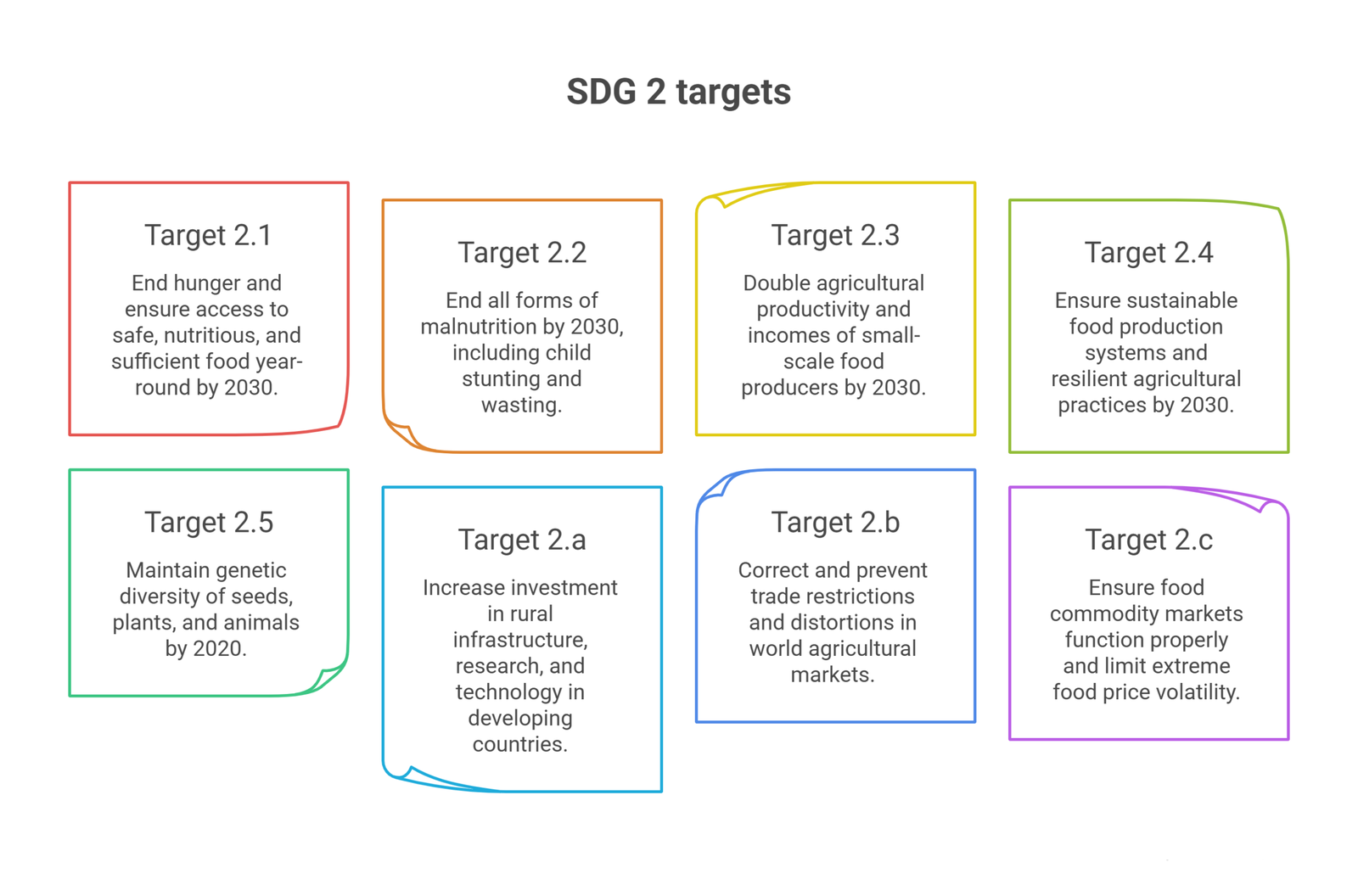
SDG 2 breaks down into eight official targets. Five are outcome targets, numbered 2.1 through 2.5. Three are means-of-implementation targets, numbered 2.a through 2.c. Each has specific indicators the UN uses to track progress:
- Target 2.1: By 2030, end hunger and ensure access by all people, particularly the poor and vulnerable, to safe, nutritious, and sufficient food year-round. Tracked through the prevalence of undernourishment and the prevalence of moderate or severe food insecurity.
- Target 2.2: By 2030, end all forms of malnutrition, including achieving the internationally agreed targets on child stunting and wasting by 2025. It also covers the nutritional needs of adolescent girls, pregnant and lactating women, and older persons. Tracked through child stunting, child wasting and overweight, anaemia in women aged 15 to 49, and minimum dietary diversity.
- Target 2.3: By 2030, double the agricultural productivity and incomes of small-scale food producers, particularly women, indigenous peoples, family farmers, pastoralists, and fishers. This runs through secure access to land, inputs, knowledge, financial services, and markets.
- Target 2.4: By 2030, ensure sustainable food production systems and resilient agricultural practices. These should increase productivity, help maintain ecosystems, strengthen resilience to climate change and disasters, and progressively improve land and soil quality.
- Target 2.5: By 2020, maintain the genetic diversity of seeds, cultivated plants, and farmed and domesticated animals. This includes well-managed seed and plant banks and fair sharing of the benefits from genetic resources.
- Target 2.a: Increase investment in rural infrastructure, agricultural research, technology development, and gene banks to build agricultural productive capacity in developing countries.
- Target 2.b: Correct and prevent trade restrictions and distortions in world agricultural markets. This includes eliminating agricultural export subsidies and equivalent-effect export measures.
- Target 2.c: Adopt measures to ensure food commodity markets function properly and facilitate timely access to market information, including on food reserves, to help limit extreme food price volatility.
Where global progress actually stands
Global hunger is falling for the first time in years, but slowly and unevenly. The State of Food Security and Nutrition in the World 2026 (SOFI 2026), a joint report from FAO, IFAD, UNICEF, WFP, and WHO, put global hunger at 7.8% of the population in 2025. That is down from 8.1% in 2024 and 8.6% in 2022. Around 645 million people were affected by hunger in 2025, a drop of roughly 43 million from 2022. This marks the third consecutive year of decline.
The recovery is not evenly spread. Asia and Latin America and the Caribbean have posted steady improvements. Africa has not kept the same pace. It is now home to about 309 million hungry people, more than Asia’s 292 million. Africa’s share of hunger has edged down slightly, from 20.3% in 2024 to 20.0% in 2025, but rapid population growth keeps working against it.
Broader food insecurity, not just outright hunger, tells a similar story. An estimated 25.8% of the global population, roughly 2.1 billion people, experienced moderate or severe food insecurity in 2025. That is down from 27.1% in 2024, but still above pre-pandemic levels. More than half of Africa’s population, 56.6%, faced this kind of food insecurity in 2025. Compare that with 20.3% in Asia and 8.7% in Northern America and Europe. Rural areas fare worse than urban ones. Women remain more affected than men, though the gap narrowed slightly last year.
The table below compares the 2015 to 2022 window against the most recent figures available.
| Indicator | Earlier figure | Most recent figure |
| Global hunger prevalence | 8.6% (2022) | 7.8% (2025) |
| People facing hunger | ~688 million (2022) | ~645 million (2025) |
| Moderate/severe food insecurity | 28.7% / 2.3 billion (2020) | 25.8% / 2.1 billion (2025) |
| Children under 5 stunted | Not tracked at this granularity | 23.2% prevalence, 150 million children (2024) |
| Cost of a healthy diet (PPP $/person/day) | $2.94 (2017) | $4.28 (2025) |
| People unable to afford a healthy diet | 2.97 billion / 37.4% (2021) | 2.69 billion / 32.7% (2025) |
| Adult obesity prevalence | 12.1% (2012) | 16.2% (2024) |
Source: SOFI 2026, FAO/IFAD/UNICEF/WFP/WHO;UN DESA, Goal 2 progress reporting.
Affordability, not just supply, is a large part of the problem. The average global cost of a healthy diet rose to $4.28 (PPP) per person per day in 2025, up from $2.94 in 2017. The number of people unable to afford one has actually declined, from 2.97 billion in 2021 to 2.69 billion in 2025. But that global average hides a sharp regional split. In Africa, 66.6% of the population could not afford a healthy diet in 2025, more than double the rate in Asia or Latin America. Post-farmgate costs, meaning processing, logistics, and wholesale rather than the farm price itself, make up 70 to 75% of what consumers actually pay. That is why fixing farm output alone rarely fixes affordability.
Nutrition targets are lagging behind hunger targets. Only 30.8% of children aged 6 to 23 months worldwide get a minimally diverse diet. Child stunting, wasting, and low birthweight are all improving, but too slowly to meet the 2030 goals. Adult obesity, which SDG 2 also tracks as a form of malnutrition, has climbed from 12.1% in 2012 to 16.2% in 2024, moving in the wrong direction entirely.
The outlook for 2030 has also worsened. SOFI 2026 projects that 510 to 520 million people could still be facing hunger in 2030. That is up from a pre-conflict estimate of 503 million. The 2026 Middle East conflict has pushed up energy and fertilizer prices, and reduced humanitarian funding and the risk of an El Niño event in 2026 and 2027 add further pressure.
What countries are doing about SDG 2
Progress on hunger looks different depending on where a country starts. The list below runs from the strongest food security records to the countries still working through the hardest structural problems.
European Union
The EU funds food security mainly through the Common Agricultural Policy, a EUR 386.6 billion program covering 2023 to 2027. It gives direct income support to farmers. Around 90% of EU farmland is tied to conditions that protect food supply stability and the environment. The EU school scheme also supplies free fruit, vegetables, and milk to schoolchildren across member states. A new CAP framework for 2028 to 2034 is now in negotiation. Stronger rules against unfair trading practices are also on the table.
Japan‘
Japan has some of the lowest hunger rates in the world, but its food system carries a structural weakness. The government targets a 45% calorie-based food self-sufficiency rate by 2030. The actual rate has held at 38% for four straight fiscal years. Japan imports nearly 60% of its food and ranks as the world’s third-largest food importer. Recent policy has shifted toward smart agriculture and cooperative reform. The goal is drawing more commercial farmers into an aging workforce.
United Arab Emirates

The UAE ranked 23rd globally and first in the MENA region on the Global Food Security Index. That is its most recent published result. That sits behind a wider constraint: the UAE still imports about 90% of its food. Its National Food Security Strategy 2051 targets the top spot on that index by 2051. The strategy backs local production, diversified import sources, and technologies like precision fermentation and vertical farming. The Emirates Food Security Council coordinates the rollout across federal and local government.
Brazil
Brazil’s Fome Zero, launched in 2003 under President Lula, is one of the most studied hunger-reduction programs anywhere. It paired the Bolsa Família cash transfer with a Food Acquisition Program that bought food directly from smallholder farmers. That guaranteed farmers stable income and cut out intermediaries. The program cut malnutrition by 82% between 2003 and 2012. It also helped remove Brazil from the World Food Programme’s Hunger Map. Brazil’s own Zero Hunger Institute found that 13 million Brazilians moved out of food insecurity in 2023 alone.
United States

The US runs SNAP, the world’s largest food assistance program by spending. It served an average of 41.7 million people a month in FY2024, at a federal cost of $99.8 billion. But the trend has reversed sharply. The One Big Beautiful Bill Act was signed in July 2025. It cut roughly $186.7 billion from projected SNAP spending over ten years. It also expanded work requirements and shifted new costs onto states. SNAP enrollment fell by more than 3.5 million people between July 2025 and February 2026. That is the steepest drop in decades. Household food insecurity, which had fallen to a historic low of 10.2% by 2021, is climbing again.
India
India runs PM-Kisan, a direct income-support scheme for farmers. It also runs a public distribution system that remains one of the largest food subsidy programs in the world. During its 2026 BRICS presidency, India pushed inclusive growth and digital public infrastructure. Other developing countries are now looking at that approach for their own food security systems.
Rwanda

The Global Hunger Index 2025 flagged Rwanda for notable hunger reductions since 2016. Mozambique, Somalia, Togo, and Uganda made the same list. The World Food Programme runs cash-based transfer and school meal programs there. It works with the government to make Rwanda’s social protection system more responsive to shocks like drought.
Ethiopia

Ethiopia’s Productive Safety Net Programme links structured cash and food transfers to public works. It is regularly cited alongside Brazil’s and India’s programs as a consistent, measurable model. That distinguishes it from one-off emergency aid. The program still operates under real pressure from conflict and climate shocks in parts of the country.
Bangladesh

Bangladesh has made enough progress on child stunting and wasting that it is on track to meet high-level nutrition targets. It is also graduating from least-developed-country status. But it still faces what WFP calls a triple burden of malnutrition. Undernutrition, micronutrient deficiency, and rising overweight all show up in the same population at once. That combination needs food-system fixes, not just more food aid.
What organizations and institutions are doing
Food and Agriculture Organization (FAO)
FAO, together with IFAD, UNICEF, WFP, and WHO, jointly writes the annual SOFI report that anchors most SDG 2 tracking. FAO also co-runs the Zero Hunger Private Sector Pledge. Its latest count showed more than 40 companies from over 30 countries pledging roughly $345 million toward hunger-reduction projects. The Shamba Centre for Food & Climate coordinates that pledge.
World Food Programme (WFP)
WFP sustained life-saving assistance to more than 45 million people through mid-2026, according to its Global Outlook mid-year update. The same update warns that food insecurity will likely stay at alarming levels for the rest of the year.
UN Global Compact
The UN Global Compact runs a Blueprint for Business Leadership on the SDGs. It frames innovation in agriculture, food, chemicals, and biotechnology as the most direct private-sector lever on Goal 2. That sits alongside its five-part Zero Hunger Challenge. It covers food systems, rural poverty, food waste, healthy diets, and malnutrition.
International Fund for Agricultural Development (IFAD)
IFAD focuses on resilient value chains and rural economies. In the SOFI 2026 release, it argued that turning the report’s evidence into real investment is the actual task ahead. That means partnership with governments and the private sector, not just more reporting.
How businesses can contribute to SDG 2
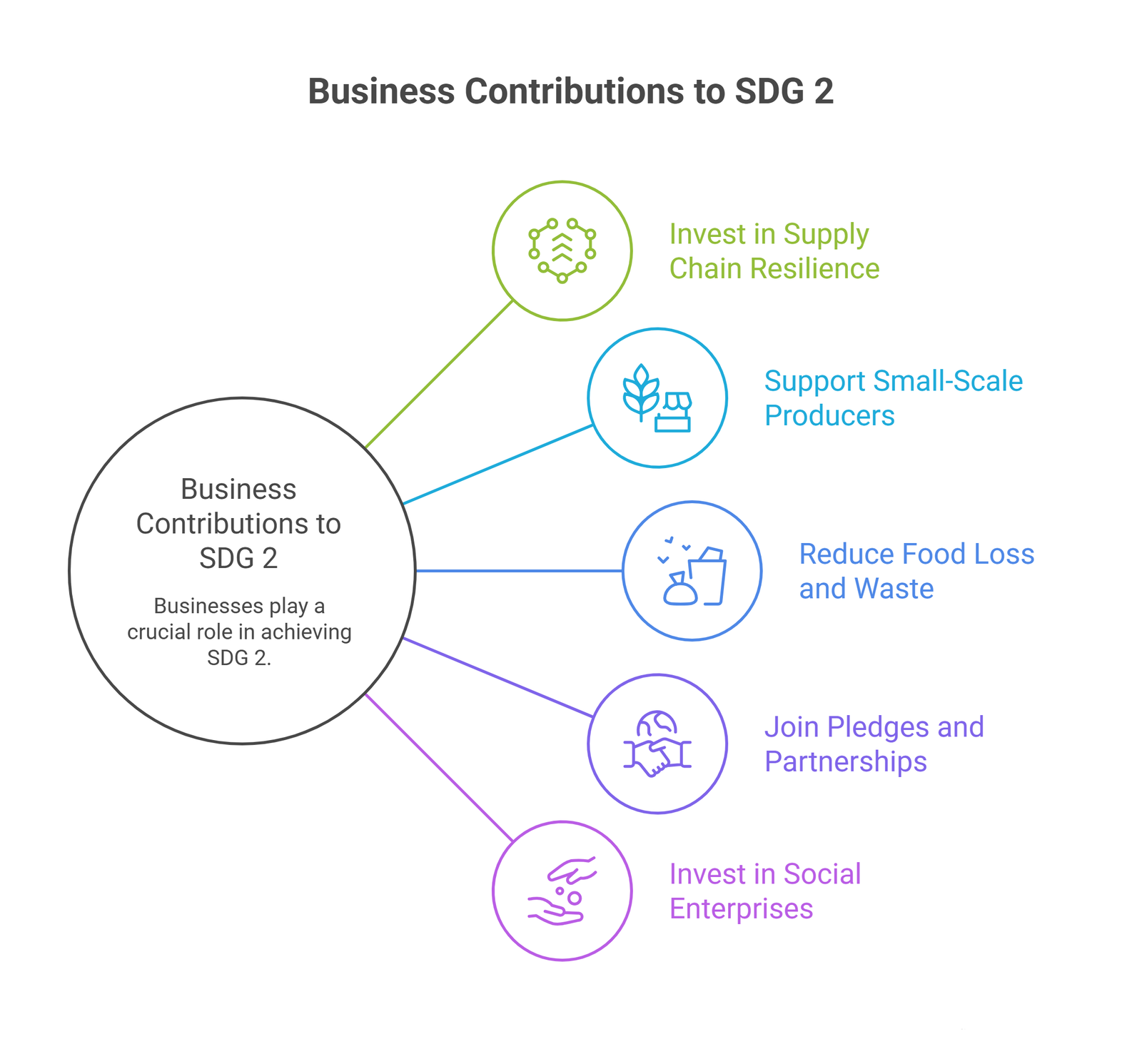
Agriculture and food supply are overwhelmingly private-sector activities, from the largest multinational food companies down to the smallest family farm. That makes SDG 2 one of the goals where business involvement is not optional if the target is going to be hit at all, and the UN Global Compact’s own guidance says so directly. There are several concrete ways businesses, including small and mid-size ones outside agriculture, can contribute.
Invest in supply chain resilience, not just least-cost sourcing. Post-farmgate costs make up 70 to 75% of what consumers pay for food. Businesses that improve logistics, cold-chain infrastructure, and processing efficiency have a direct effect on affordability, which is now a bigger constraint on healthy diets than raw food supply.
Support small-scale producers directly. Target 2.3 calls for doubling the incomes of small-scale food producers. Businesses that buy from smallholders on fair terms, provide access to credit or inputs, or help farmers reach new markets are contributing to a specific, measured SDG target. That is a different thing from generic corporate social responsibility.
Reduce food loss and waste across operations and supply chains. Food loss between farm and market is one of the five pillars of the UN Global Compact’s Zero Hunger Challenge. It is also one of the few areas where a company’s own operational data can show a measurable before-and-after.
Join structured pledges and partnerships such as the Zero Hunger Private Sector Pledge. These give companies a defined framework, an implementing partner, and a way to report measurable commitments, rather than making informal claims about impact.
Invest in or partner with food-focused social enterprises and nonprofits. That can mean direct investment, procurement relationships, or financial planning support for nonprofits working on food security. Many of these organizations need the same budgeting and forecasting discipline any growing business needs. That structure often determines whether a promising program actually scales past its pilot stage.
Frequently Asked Questions
What is the difference between SDG 2 and general “food aid” or hunger relief?
Food aid addresses an immediate shortage. SDG 2 is broader. It targets chronic hunger, malnutrition in all its forms including obesity, the incomes of small-scale farmers, and the long-term sustainability of food production systems, not just emergency response.
Which region has the most people facing hunger today?
Africa, with about 309 million people affected by hunger in 2025. That is more than any other region in absolute terms, even though Africa’s share of hunger as a percentage of population is close to flat year over year.
What is the current cost of a healthy diet, and why does it matter for SDG 2?
The global average is $4.28 (PPP) per person per day as of 2025, up from $2.94 in 2017. Nearly a third of the world’s population, about 2.69 billion people, cannot afford this. SOFI 2026 identifies it as a major constraint on reaching SDG 2, independent of raw food availability.
How many children are affected by malnutrition globally?
An estimated 150 million children under five were still stunted as of 2024. Only 30.8% of children aged 6 to 23 months get a minimally diverse diet.
Can businesses realistically move the needle on SDG 2, or is it mainly a government and NGO problem?
Businesses have a direct, UN-recognized role, particularly since agriculture and food supply are largely private-sector activities to begin with. The Zero Hunger Private Sector Pledge alone has brought in over $345 million in company commitments. Still, the scale of the problem means business action complements government and multilateral funding rather than replacing it.
Conclusion
The headline number, 645 million people still facing hunger, tells only part of the story. The harder problem sitting underneath it is affordability. Nearly a third of the world’s population cannot afford a healthy diet even where food is physically available. That gap is a supply chain and pricing problem as much as a production one. Governments and UN agencies will keep carrying the weight on emergency response, safety nets, and trade policy. Businesses hold real leverage on the cost side of that equation, particularly those touching agriculture, food processing, logistics, or rural finance, and the UN Global Compact has said so directly. If your business is exploring how to structure that kind of work financially, Oak’s financial consulting services can help build the numbers behind it, whether that means a smallholder supply chain investment or a funding model for a food security partnership.