How to Develop a Nonprofit Business Plan: A Full Guide
What Is a Nonprofit Business Plan?
Here is a truth that surprises a lot of first-time nonprofit founders: running a charitable organization is still running a business. The goals are different, the tax status is different, and the motivation is entirely different. But the operational realities, the need for clear strategy, financial discipline, and purposeful planning, are exactly the same.
A nonprofit business plan is a formal document that describes what your organization does, why it exists, how it will operate, and how it will remain financially sustainable while pursuing its mission. It brings together your vision, your programs, your people, and your numbers into one coherent picture.
Think of it less as a bureaucratic requirement and more as a thinking tool. The act of writing the plan forces you to answer hard questions before they become hard problems. Who are we really serving? How will we pay for this five years from now? What does success actually look like? If you cannot answer those questions on paper, you almost certainly cannot answer them in practice.
A good nonprofit business plan is honest, specific, and grounded in real data. It is not a brochure or a fundraising pitch deck. It is the document your leadership team uses to make decisions and the document your funders use to decide whether to trust you with their money.
Why Your Nonprofit Needs a Business Plan
Many nonprofit founders skip the business plan entirely, especially in the early days when there is so much else to do. That is understandable. But it is also one of the most common reasons promising organizations stall out before they ever reach their potential.
Here is what a well-built business plan actually does for a nonprofit.
It aligns your team around a shared vision. When you write down your mission, goals, and strategy in clear language, everyone from your board of directors to your newest volunteer knows what you are working toward and why. Ambiguity is one of the silent killers of nonprofit momentum.
It helps you secure funding. Grantmakers, institutional donors, and foundations do not simply give money to causes they believe in. They give money to organizations they trust to use it well. A thorough, well-reasoned business plan demonstrates that your team has done the work and can be held accountable to measurable outcomes. It is often the single most important document in a grant application.
It forces financial realism. Writing out your financial projections in detail reveals gaps you might not have noticed otherwise. That gap between what you hope to raise and what your programs actually cost? Better to find it during planning than six months into your first operational year.
It serves as a decision-making reference. As your organization grows and faces choices about programs, hiring, or geographic expansion, the business plan gives you a framework for making those decisions consistently and strategically rather than reactively.
It attracts board members and partners. Strong board members are busy people with a lot of options. A credible business plan signals that your organization is serious and worth their time.
How a Nonprofit Business Plan Differs from a For-Profit One
The structure of a nonprofit business plan looks similar to a commercial one, but the underlying logic is different in a few important ways.
A for-profit business plan centers on profit margins, market share, and return on investment. A nonprofit business plan centers on mission impact, community need, and long-term financial sustainability without profit as the goal.
The “revenue model” section of a nonprofit plan looks very different. Instead of sales projections, you are describing a mix of grants, donations, fundraising events, membership fees, and possibly earned income from services. Diversification of funding sources is treated as a strategic priority, not just a nice-to-have.
The “target market” concept also shifts. In a nonprofit, you have two distinct audiences that require separate strategies: the people you serve (beneficiaries) and the people who fund your work (donors, grantmakers, government agencies). Your business plan needs to address both.
Finally, accountability in a nonprofit plan is measured in outcomes, not profit. What changed because of your work? How many people were housed, fed, educated, or supported? Those metrics sit at the center of everything.
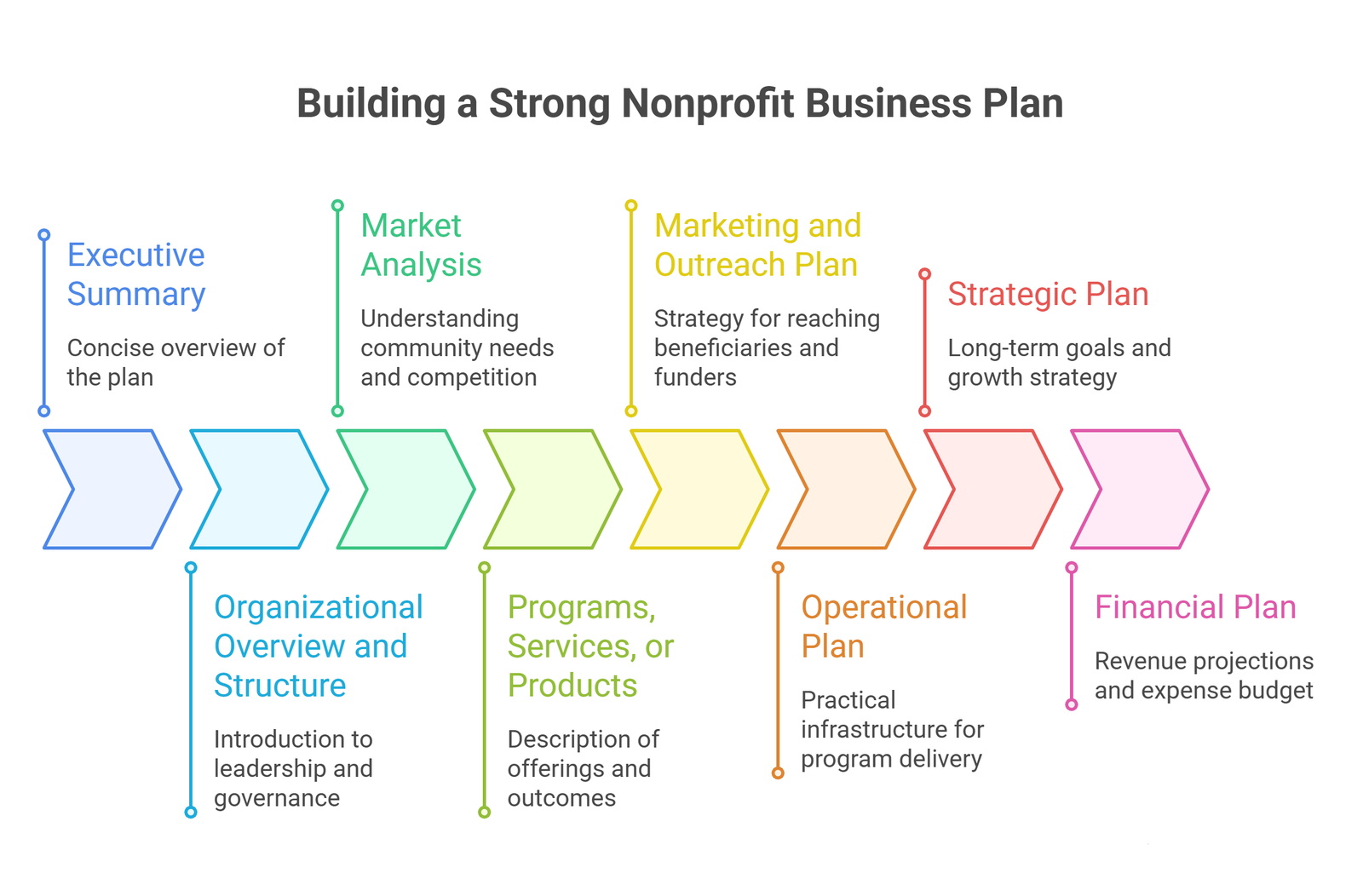
The 8 Core Components of a Nonprofit Business Plan
1. Executive Summary
The executive summary comes first in the document but should be written last. It is a concise overview of the entire plan, usually one to two pages, and it is often the only section that time-pressed funders will read before deciding whether to keep going.
A strong executive summary covers your mission statement, a brief description of the programs or services you offer, the community you serve, the problem you are solving, and a snapshot of your financial position and goals. It should be written in clear, compelling language that makes someone want to read the rest of the document.
Your mission statement deserves particular care here. It should say who you serve, what you do for them, and why it matters, in one or two sentences. Avoid vague language like “making the world a better place.” Be specific enough that a stranger can understand exactly what your organization does after reading it once.
Your vision statement belongs here too. The mission describes what you do today; the vision describes the future you are working toward. Together, they give readers the “why” behind everything that follows.
2. Organizational Overview and Structure
This section introduces your organization as an entity: who runs it, how it is structured, and what makes it capable of delivering on its mission.
Leadership and Management Team. Provide brief profiles of your key staff, their relevant experience, and their roles. Funders and partners invest in people as much as they invest in ideas. If your executive director has spent fifteen years in the field you are working in, say so clearly.
Board of Directors. Describe your board composition, their qualifications, and how they provide oversight and governance. A strong, diverse board is a major credibility signal. Include any relevant professional backgrounds (legal, financial, industry expertise) that strengthen the organization’s capacity.
Legal Status. Confirm your 501(c)(3) status or equivalent, your date of incorporation, and the state or jurisdiction in which you are registered. If you are in the process of applying for tax-exempt status, say that clearly and explain your timeline.
Organizational History. If your organization has been operating for any length of time, briefly describe what you have accomplished. Real results matter more than stated intentions, and even modest early wins can build significant credibility.
3. Market Analysis
You cannot serve a community well if you do not understand it deeply. The market analysis section is where you demonstrate that you have done that understanding work.
Community Needs Assessment. Describe the problem or gap your organization exists to address. Use specific data: statistics, research, local reports, or surveys that quantify the need. Telling a funder that homelessness is a problem in your city is very different from telling them that 4,200 people slept without shelter last winter and that local shelter capacity meets only 60% of that demand.
Target Population. Define clearly who you serve. Include demographic information, geographic boundaries, and any specific characteristics of your beneficiary community. The more specific you are, the more credible your programs will appear.
Competitive Landscape. “Competitive” in the nonprofit world does not mean adversarial. It means understanding who else is working on this problem and how your organization’s approach is distinct. Are you serving a population that other organizations are not reaching? Are you using a different model or methodology? Articulate your unique value clearly.
Stakeholder Mapping. Think about all the parties with a stake in your work: beneficiaries, donors, volunteers, partner organizations, local government, and the broader community. Understanding who they are and what they need from you is foundational to building sustainable relationships.
4. Programs, Services, or Products
This is where you describe what you actually do. Be specific, practical, and outcomes-focused.
For each major program or service, explain what it is and how it works, who it serves and how many people, what it costs to deliver, what outcomes it produces, and how you measure whether it is working.
Tie each program explicitly back to your mission. If you cannot clearly explain how a given program advances your mission, that is worth reflecting on. Mission drift, adding activities that sound good but do not serve your core purpose, is a common and costly problem for nonprofits.
If you have data from existing programs, include it. Outcome metrics, participant numbers, testimonials, and case studies all make this section much stronger than descriptions alone.
5. Marketing and Outreach Plan
Nonprofits need marketing just as much as for-profit companies do, but the goals are different. You are not selling a product. You are building awareness, trust, and relationships with two distinct audiences: the people you serve and the people who fund your work.
Reaching Beneficiaries. Describe how people find out about your programs and how they access them. This might involve partnerships with schools or hospitals, community outreach events, social media, word of mouth, or referral networks. Think practically about where your target population actually is and how to reach them there.
Donor and Funder Engagement. Outline your fundraising strategy. Individual donors, foundation grants, corporate sponsorships, government contracts, and earned income represent different funding streams that each require different cultivation strategies. Describe which you will pursue and how.
Brand and Communications. How does your organization present itself to the world? What tone and values come through in your communications? Consistency in messaging builds trust over time, and trust converts into both program participation and donor retention.
Digital Presence. At minimum, describe your website and social media strategy. In an era where the first thing anyone does is search online, a credible digital presence is non-negotiable for organizational legitimacy.
6. Operational Plan
The operational plan is where vision meets reality. It describes the practical infrastructure that makes everything else possible.
Staffing Model. List your current staff positions and any planned hires. Include volunteers if they play a significant operational role. For each key position, briefly describe the responsibilities and how the role serves the mission.
Facilities and Equipment. Where does your organization operate? Describe your physical space, any equipment you rely on, and how these support your program delivery. If you work virtually or in partner spaces, explain that arrangement.
Technology and Systems. What software, platforms, or tools do you use to manage operations, track program data, communicate with stakeholders, and handle finances? Funders increasingly pay attention to operational infrastructure as a sign of organizational maturity.
Program Delivery Logistics. Walk through how your programs actually get delivered day to day. This might seem like operational detail, but demonstrating that you have thought through the logistics gives funders and partners confidence that you can execute.
Risk Management. Briefly identify key operational risks, whether they are funding shortfalls, staff turnover, or external factors like policy changes, and describe how you plan to manage them. Acknowledging risk thoughtfully is more reassuring than pretending it does not exist.
7. Strategic Plan
The strategic plan looks ahead. While the rest of the document largely describes your current state, this section maps the path from where you are to where you want to be.
Long-Term Goals. Set clear, measurable objectives for a three to five year horizon. These should be ambitious enough to matter and specific enough to be trackable. Vague goals like “grow our impact” are not useful. Goals like “expand service delivery to three additional counties by 2027, reaching 500 additional participants annually” are.
Annual Milestones. Break your long-term goals into annual markers so you can measure progress and adjust as needed. Milestones also make grant reporting much more manageable.
Impact Framework. Describe how you measure your organization’s impact. What are your key performance indicators? How do you collect and analyze that data? Funders increasingly expect rigorous impact measurement, and having a clear framework demonstrates organizational sophistication.
Growth and Sustainability Planning. How do you plan to grow responsibly? And how do you ensure the organization remains financially viable as it grows? These are connected questions. Growth that outpaces funding capacity can be as damaging as no growth at all.
8. Financial Plan
For many nonprofit founders, this is the section that causes the most anxiety. But it is also one of the most important, because it tells funders whether your organization can actually do what it says it will do.
Revenue Projections. Project your income over at least three years, broken down by source: individual donations, foundation grants, government funding, earned income, events, and any other streams. Be realistic and show your assumptions. A projection that assumes 300% donation growth in year one with no explanation will raise red flags.
Expense Budget. Provide a detailed breakdown of your projected expenses, covering both program costs and administrative overhead. Include staff salaries, rent, technology, program materials, marketing, and any other significant line items.
Cash Flow Statement. This is often overlooked, but it matters enormously. Revenue and expenses do not always arrive and leave at the same time. A cash flow projection shows whether you will have enough money on hand to operate through gaps between funding cycles.
Balance Sheet. Provide a snapshot of your organization’s financial position: assets, liabilities, and net assets. This gives funders a picture of your financial health at a given point in time.
Funding Sources and Diversification. Describe your current funding mix and your strategy for diversifying it over time. Over-reliance on a single funder is a significant organizational risk, and most experienced grantmakers will look for evidence that you understand this.
Financial Policies. Briefly describe your financial controls, such as who approves expenditures, how accounts are managed, and whether you conduct annual audits. Strong financial governance is a major trust signal.
How to Write a Nonprofit Business Plan: Step by Step
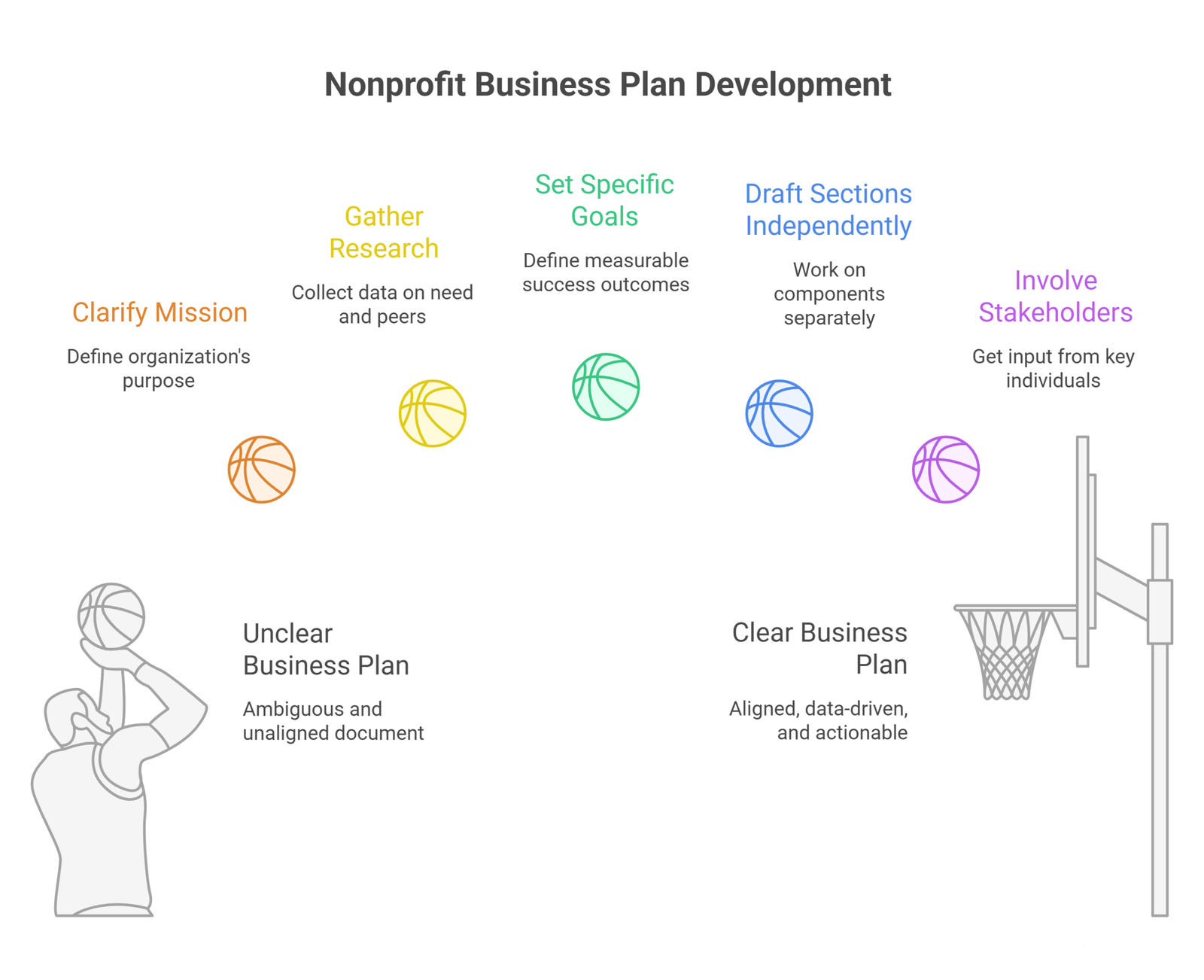
Having the right components is only half the battle. The other half is knowing how to actually sit down and build the document. Here is a practical process that works.
Step 1: Clarify your mission before you write anything else.
Every section of the plan flows from the mission. If your team does not have complete clarity and alignment on why the organization exists and what it is trying to change, that ambiguity will show up throughout the document. Get the mission right first.
Step 2: Gather your research.
Before you write the market analysis or financial projections, you need data. Pull local statistics on the need you are addressing. Look at what similar organizations are doing. Review your own past program data if you have it. Talk to community members who will be affected by your work. The quality of your research determines the quality of your plan.
Step 3: Set specific, measurable goals.
Before describing your strategy, be clear about what success looks like. Work backward from your desired outcomes to the activities and resources needed to achieve them. This helps ensure your strategy is actually aligned with your goals rather than just sounding plausible.
Step 4: Draft each section independently.
Do not try to write the whole plan in one sitting. Work through each component separately, then refine them together. The executive summary should come last.
Step 5: Involve your key stakeholders.
Your board of directors, senior staff, and even community members should have input into the plan. This is not just good governance practice. It produces a better plan, because different people see different gaps and opportunities. It also builds buy-in from the people who will be responsible for implementing it.
Step 6: Build the financial projections collaboratively.
If you have a finance staff member or board treasurer, involve them directly in building the financial section. If you do not have that internal capacity, consider engaging a financial consultant for this piece. Bad financial projections can undermine an otherwise strong plan.
Step 7: Review for clarity, not just accuracy.
Have someone outside your organization read a draft. If they cannot follow your logic or do not understand your programs by the end, the document needs more work. Funders often review dozens of plans at once. Clarity and readability matter.
Step 8: Build in a review cycle.
A business plan should not be a static document written once and filed away. Schedule a formal review at least annually, and update it when significant circumstances change. A plan that reflects reality is useful. One that reflects how things were two years ago is not.
Common Mistakes to Avoid
Writing for funders instead of for your organization. The business plan should reflect what your organization genuinely intends to do. If it is written primarily to sound appealing to grant committees, it will likely be vague and unusable as an internal management tool.
Skipping the financial detail. Rough numbers and approximate budgets signal that your team has not done the planning work. Funders notice.
Overestimating revenue in early years. Projections that require a dramatic fundraising ramp-up with no supporting rationale are a credibility problem. Build realistic projections and explain your assumptions clearly.
Neglecting the operational plan. Strategy without operational detail is just aspiration. Funders want to see that you know how your programs will actually be run.
Being vague about impact. “We will help hundreds of families” tells a funder almost nothing. “We will provide 240 families with 12 weeks of intensive financial coaching, reducing debt by an average of 35% based on our pilot data” tells a funder something they can evaluate and hold you accountable to.
Treating the plan as a one-time exercise. Organizations that use their business plan as a live strategic document, reviewing it regularly and updating it as circumstances change, get far more value from it than those that write it once for a grant application and forget about it.
Tips for Making Your Plan Stand Out to Funders
Lead with the community need, not with your organization. Funders are solving a problem in the world. Your organization is the vehicle for that solution. Framing your plan around the need first, and your organizational capacity second, is more compelling and more accurate.
Use plain language. Jargon, acronyms, and sector-specific shorthand that insiders take for granted can confuse external readers. Write clearly enough that someone unfamiliar with your field could understand the core of your plan.
Show your track record. If you have run a pilot program, conducted a community survey, or launched any programs already, include real results. Even early-stage data is more persuasive than projected outcomes alone.
Address sustainability proactively. Do not wait for a funder to ask how the organization will survive if a major grant ends. Build your answer into the financial section. Show that you are thinking about funding diversification and long-term resilience from the start.
Be honest about challenges. Funders with experience can spot the gaps in an overly optimistic plan. Acknowledging the real challenges you face and explaining how you plan to address them builds credibility rather than undermining it.
Frequently Asked Questions
Does a small or startup nonprofit really need a business plan?
Yes. It is most valuable early on, when you are still defining how programs will be funded and what success looks like. Starting without one means making those decisions under pressure later.
How long should a nonprofit business plan be?
Typically 15 to 35 pages. A focused, clear 18-page plan beats a bloated 50-page one every time. Write what is necessary and nothing more.
How often should the plan be updated?
At minimum once a year. Any major shift in leadership, funding, or organizational direction should also trigger a review. A plan that no longer reflects reality is not useful.
Who should be involved in writing it?
At minimum, the executive director and board leadership. Input from program staff and finance staff makes it stronger, and external consultants can help with sections like financial modeling if that capacity is not internal.
Is a nonprofit business plan the same as a grant proposal?
No. A grant proposal is a targeted funding request tailored to a specific funder. A business plan is a comprehensive internal document covering your whole organization. That said, a solid business plan makes writing grant proposals much faster, since the research and financial data are already done.
Conclusion
Writing a business plan for a nonprofit is not a glamorous task. It takes time, honest reflection, and a willingness to confront hard questions about capacity, funding, and impact. But it is one of the most valuable investments your organization can make, especially in its early years when the decisions you make will shape everything that follows.
A strong nonprofit business plan does several things at once. It sharpens your thinking about what your organization actually does and why it matters. Additionally, it creates alignment among the people who need to work together to make it happen. It builds credibility with the funders and partners who can accelerate your mission. And it gives you a framework for making decisions when circumstances change, which they always do.
The plan is not the destination. The change you create in the world is the destination. But the plan is what gets you there with intention rather than luck.
If your nonprofit does not yet have a business plan, the best time to write one is now. If you have one that has not been reviewed in the past year, dust it off and see how much has changed. Either way, the effort will pay back more than it costs.
Ready to Turn Your Vision Into Funded Reality? Grantmakers and serious donors don’t just fund good intentions—they invest in sound strategies. At Oak Business Consultant, we specialize in transforming your nonprofit’s mission into a bulletproof, data-driven business plan that commands trust and wins funding. Let’s build a roadmap that proves your impact. Schedule Your Free Nonprofit Strategy Session.