How to Start a Farming Business
Steps to Start a Farming Business
Farming is one of the few businesses where passion for the work and the actual economics of the work pull in opposite directions early on. Land, equipment, and inputs all have to be paid for before a single crop sells or a calf reaches market weight. That’s why most new farm businesses run on negative cash flow for at least their first year or two. That’s not a reason to avoid it. It’s the reason a farm business plan needs to do more than describe the dream. It needs to hold up when a lender, a landlord, or your own bank balance starts asking hard questions.
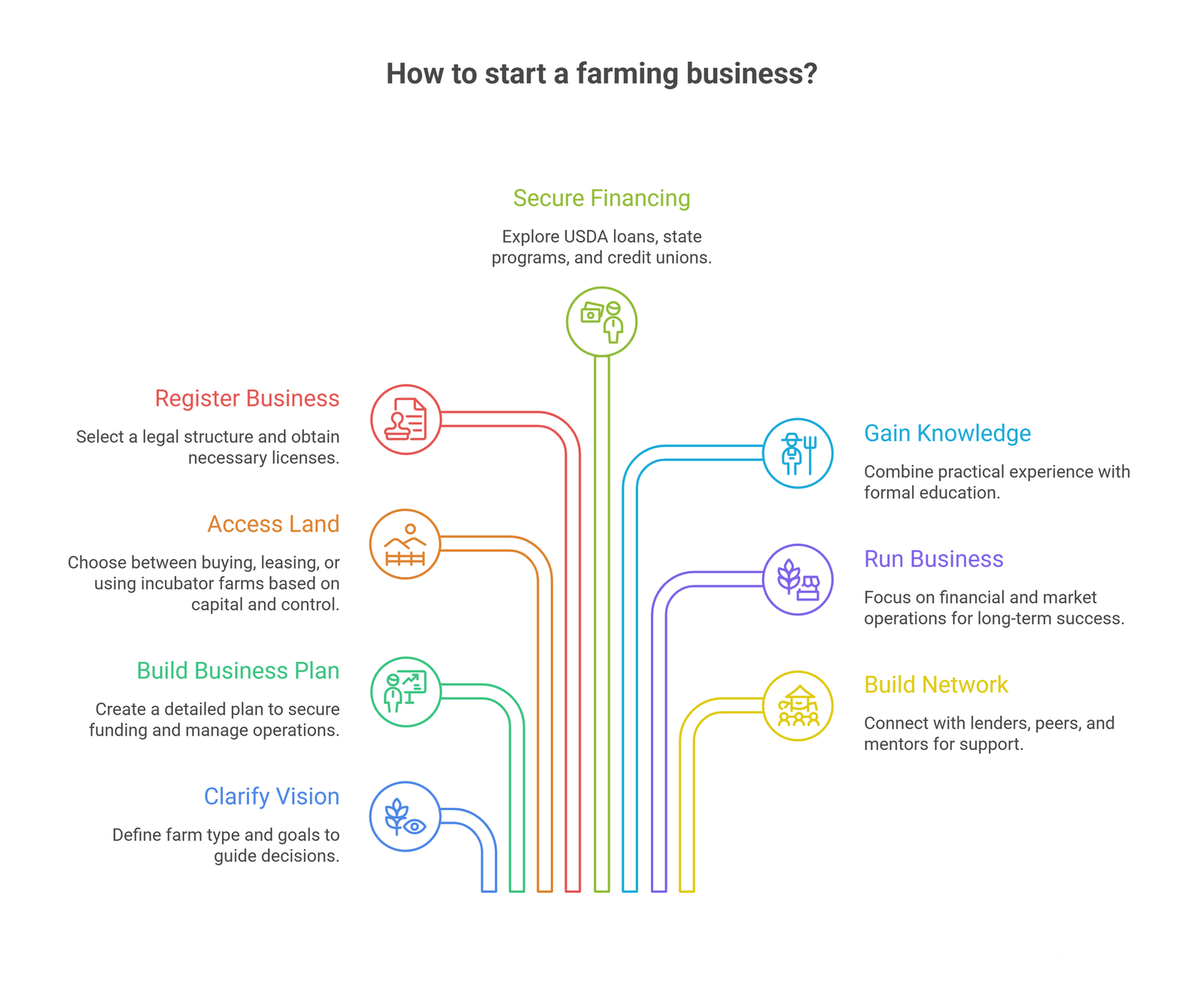
This guide walks through the eight steps of starting a farming business, from clarifying your vision to building the support network that keeps you from making expensive mistakes alone. Along the way, it leans harder on the financial side than most farming guides do, because that’s usually where new farm businesses actually stall.
What you’re getting into
Modern farming rewards more than a love of the land. It requires management skill, market awareness, and enough financial literacy to read your own balance sheet honestly. Beginning farmers today have real support behind them: USDA programs for young and beginning producers, state extension services, and incubator farms that offer land access alongside mentorship. But support isn’t the same as guaranteed profitability. The sector itself is capital-intensive and high-risk in a way that few other small businesses are.
Before committing capital, it’s worth knowing which government agency the Farm Credit Administration counts you as. A “beginning farmer” is anyone with ten or fewer years running an agricultural operation, regardless of age. The typical beginning producer is 35 to 64 and often returning to farming after a career elsewhere, not a 22-year-old straight out of ag school.
Step 1: Clarify your vision and validate the market
Before anything else, get specific about what kind of farm you’re building: crop production, livestock, organic, or a specialty model like agritourism or direct-to-consumer sales. Your reason for farming, profit, lifestyle, environmental stewardship, or some mix, will shape every decision that follows. It will also shape how much risk you’re willing to carry.
Then validate that vision against an actual market. Visit farmers markets and talk to shoppers about what’s missing. Check what your local extension office or land-grant university publishes on crop budgets and regional demand. Skipping this step is the single most common reason first-year farms produce something nobody nearby wants to buy.
Step 2: Build a business plan that survives a loan review
A written business plan isn’t a formality. Farm operators with a documented plan are, according to research from Virginia Tech’s David Kohl, roughly four times more likely to succeed and 21% more profitable than those without one. That gap exists because writing the plan forces decisions that otherwise get made too late, under pressure.
A plan that actually holds up needs more than an executive summary and a mission statement. It needs:
- A market analysis: target buyers, demand, competition, and realistic pricing
- An operational plan: crop rotation or herd management, soil and infrastructure needs, equipment costs
- Real financial statements: a balance sheet, an income statement, and a cash flow budget, not just a paragraph estimating “startup costs”
- A breakeven and scenario analysis: what happens to your numbers if a commodity price drops 15%, or a crop fails, or a planting season runs late
- A marketing and distribution plan: farmers markets, CSAs, wholesale, or direct sales, and how each affects your cash flow timing
That last point matters more than it looks. A CSA model gets you paid before the season starts, which solves a lot of the cash-flow problem that sinks first-year farms. A wholesale model gets you paid on 30- or 60-day terms after delivery, which doesn’t. Building that distinction into your financial model before you commit to one channel is far cheaper than discovering it the hard way in month four.
Step 3: Decide how you’ll access land
Land access is where most beginning farmers hit their first real financial decision. It isn’t automatically “buy if you can afford it.”
| Option | Capital required | Control | Best for |
| Buy | High, usually financed | Full control over land use and long-term investment | Producers with strong capital position and a proven, stable operation |
| Lease | Low to moderate | Limited, terms set by the landowner | Beginning farmers testing a model before committing capital |
| Incubator or shared farm | Lowest, often includes training | Minimal, structured program | First-time farmers who need land, mentorship, and reduced risk together |
Leasing is common among beginning farmers precisely because it reduces the capital tied up before the business proves itself. Whichever route you take, evaluate soil quality, water access and rights, and proximity to your actual market before signing anything. A cheap lease on land two hours from your buyers isn’t cheap once fuel and time are factored in.
Step 4: Register your business and handle licensing
Choose a legal structure, sole proprietorship, partnership, LLC, or corporation, based on liability exposure and tax treatment. Do this ideally with a CPA who understands agricultural income. Sole proprietorships are simplest but expose personal assets. An LLC adds a liability buffer that many operations with hired labor or public-facing sales (a farm stand, a CSA) will want.
From there, expect to need an Employer Identification Number, a state and local business license, and permits specific to your activity. That can mean food sales permits for direct-to-consumer sales, organic certification if you’re pursuing that market, pesticide applicator licenses, and water use or environmental compliance permits where applicable. Your state department of agriculture and local extension office are the fastest way to get a definitive list for your specific operation, since requirements vary significantly by state and activity.
One distinction worth getting right early: the IRS treats a hobby farm differently from a business farm for tax purposes, and the difference affects which expenses you can deduct. If you’re filing Schedule F and expecting to claim losses in early years, know which category you actually fall into before you file, not after.
Step 5: Line up financing and manage risk
Beginning farmers typically combine more than one funding source. USDA offers direct and guaranteed loans for beginning producers, including microloans for smaller operating needs. But many of these require an outside private loan alongside them rather than covering the full cost on their own. State-level young farmer programs and agricultural credit unions fill some of the remaining gap.
When comparing loan offers, the interest rate is only part of the picture. Loan term length and payment structure matter just as much for cash flow. An operating line of credit for seasonal inputs behaves very differently than a real estate mortgage or an intermediate-term equipment loan, so matching the loan type to what it’s actually financing keeps payments aligned with when your farm generates revenue.
Insurance isn’t optional. Crop insurance is often required before a lender will approve a loan. It protects against exactly the kind of bad season that a beginning operation, with limited capital reserves, usually can’t absorb. Beyond crop insurance, expect to need general liability coverage, property insurance for buildings and equipment, and workers’ compensation if you hire anyone.
Lenders who specialize in agriculture will want to see your business plan, balance sheet, income statement, and cash flow budget before they’ll talk numbers seriously. If those documents don’t exist yet, building them properly, rather than assembling them the week before a loan meeting, is usually the difference between a fast approval and a frustrating back-and-forth. This is exactly where CFO services built for early-stage operations earn their cost: getting the financial package right the first time.
Step 6: Build your knowledge and skills
Farming is genuinely dangerous work, and most of the skill involved doesn’t come from a course. Apprenticeships, internships, and time working alongside an experienced operator teach things a webinar can’t: how to read weather risk, how to handle livestock safely, how to catch a problem before it becomes expensive.
Formal education still helps. Cooperative extension programs, produce safety training, and Good Agricultural Practices certification round out the practical experience with the regulatory and food-safety knowledge buyers and inspectors will expect. Treat the two as complementary, not either-or.
Step 7: Run the business, not just the farm
Production quality gets the attention, but the businesses that survive past year three are the ones that also run tight financial and market operations. That means consistent record-keeping, cash flow tracking, inventory management, and compliance documentation, alongside the agronomic work.
Diversifying distribution channels reduces the risk that one bad season or one lost buyer sinks the whole operation. And revisiting your numbers regularly, not just at tax time, catches a shrinking margin while there’s still time to do something about it.
Step 8: Build your support network
No farmer succeeds in isolation. The strongest early-stage support networks tend to include three distinct types of people: a lender or financial advisor who understands agricultural cash flow cycles, peer producers who share what’s actually working on the ground, and extension agents or mentors who can flag a mistake before it’s expensive. USDA Service Centers, state extension offices, and farm bureau organizations are the standard entry points to all three.
Frequently Asked Questions
Do I need farming experience to start a farming business?
Formal agricultural education isn’t required, but hands-on experience is close to essential. Most successful beginning farmers get it through apprenticeships or paid work on an established farm before starting their own operation.
What licenses and permits does a farming business need?
It depends heavily on location and activity, but expect a business license, an EIN, and possibly permits for food sales, pesticide use, water rights, or environmental compliance. Your state department of agriculture can confirm the exact list for your operation.
Is it better to buy or lease farmland as a beginner?
Leasing typically requires far less capital upfront and lets you test a model before committing. That’s why it’s the more common starting point for beginning farmers. Buying makes more sense once the operation has a proven track record and a strong enough capital position to absorb the risk of land ownership.
How much does it cost to start a farming business?
It varies enormously by scale and commodity, but startup costs, and the reality of running on negative cash flow for the first year or more, are the norm rather than the exception. This is exactly why a real financial model, not a rough estimate, matters before you commit capital.
What’s the difference between a hobby farm and a business farm for tax purposes?
The IRS applies different rules to each, which affects which expenses and losses you can deduct. If you plan to claim losses in early years under Schedule F, confirm which category your operation actually falls into before filing, since getting this wrong can be costly.
Where can beginning farmers get support?
USDA Service Centers, the Farm Service Agency, cooperative extension offices, and farm bureau organizations are the standard starting points. Many states also run dedicated beginning farmer coordinators who connect new producers to loans, mentors, and training.
Conclusion
The eight steps above are really one continuous discipline: match every decision, land, structure, financing, distribution, back to numbers you’ve actually tested rather than numbers you’re hoping hold true. Beginning farmers who put a real business plan and financial model behind their vision are consistently the ones who make it past the years when cash flow runs negative. If you’re at the stage of turning a farming vision into numbers a lender will take seriously, explore a business plan built for your operation or speak with an analyst about what your financials need before you approach a bank.