What Is the ICV Certificate?
ICV Certificate
The In-Country Value (ICV) certificate is a game-changer for businesses in the UAE. Think of it as a badge of honor – official proof that your company is actively contributing to the local economy. Whether you’re based in Abu Dhabi, Dubai, or anywhere else across the Emirates, that certificate signals one thing loud and clear: you’re invested in the UAE’s future. And that matters more than you might think.
What Exactly Is the ICV Certificate?
The ICV certificate is an official document issued under the UAE’s National In-Country Value (ICV) Program, managed by the Ministry of Industry and Advanced Technology (MoIAT). It measures and certifies how much economic value your business generates within the UAE – through local procurement, investment in UAE-based assets, hiring Emirati employees, and technology adoption. Your contribution is expressed as an ICV score – a percentage calculated from your audited financial statements.
The higher your score, the more of your business activity is anchored in the UAE economy, and the stronger your position when bidding for government and semi-government contracts. The program was first introduced by ADNOC (Abu Dhabi National Oil Company) in 2018. Following its success, it was expanded nationally in 2021 under MoIAT into a unified framework that now spans all Emirates. Today, 31 federal and local government entities and major national companies participate in the program – and the numbers keep growing.
Why Should Entrepreneurs Care?
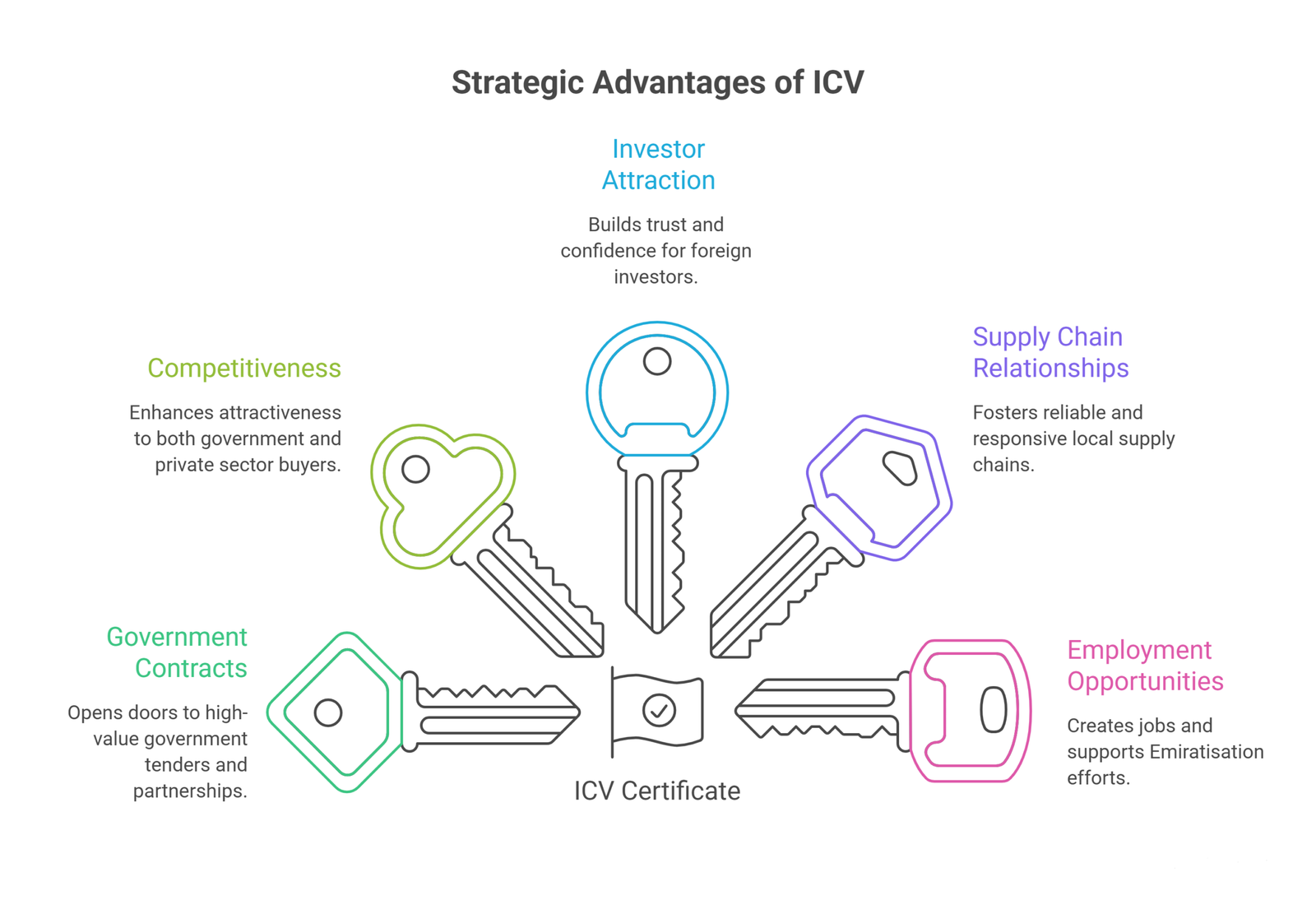
Let’s be honest – running a business in the UAE already comes with a lot on your plate. So why add one more thing to the list? Here’s the simple answer: if government contracts, major tenders, or partnerships with companies like ADNOC or Abu Dhabi Ports are anywhere on your horizon, the ICV certificate isn’t optional. It’s your entry ticket. Here’s a closer look at what it actually does for you.
It Opens the Door to Government Contracts
Imagine getting your foot in the door for those high-value government tenders. The Ministry of Industry and Advanced Technology, ADNOC, Mubadala, ENEC – these are serious players, and they all require suppliers to hold a valid ICV certificate as part of the tender evaluation process. Without one? Your bid is often treated as if it scores zero – which is essentially a non-starter. With one? You’re competing on a level playing field, and a strong score can actively tip the scales in your favor. Government contracts mean stability, long-term revenue, and credibility. They don’t hand those out to just anyone – they want partners who are truly committed to the national economy.
It Levels Up Your Competitiveness
In a competitive market, you need every edge you can get. The ICV certificate functions like a competitive ranking – the higher your score, the more attractive you are to both government buyers and large private sector companies. It’s not just about getting on the list. It’s about getting noticed and prioritized.
It Makes You More Attractive to Investors
Foreign investors entering the UAE market love a company with an ICV certificate. It tells them you’re trusted by the local government, embedded in the national economy, and built for the long term. Think of it as a neon sign that says: this is a solid bet. Your track record of local investment and Emiratisation gives outside investors the confidence to back you.
It Builds Better Supply Chain Relationships
One of the core pillars of ICV is strategic localization – working with local suppliers, logistics providers, and service partners. This isn’t just good for the economy; it’s good for your business. Local supply chains tend to be more reliable, more responsive, and less exposed to global disruptions. You’re building your “dream team” at home instead of searching abroad.
It Creates Real Employment Opportunities
Having an ICV certificate puts your company in a stronger position to hire Emirati talent and build credibility with government agencies. The government actively rewards businesses that are serious about Emiratisation – and the ICV framework is one of the clearest ways to demonstrate that commitment. The numbers speak for themselves: by mid-2024, companies holding the National ICV certificate employed approximately 19,000 UAE nationals in the private sector – a 40% increase over the same period in 2023.
The Numbers Behind the Program
The ICV program isn’t just a regulatory checkbox – it’s driving real economic transformation. Here’s what it has delivered:
- AED 48 billion in local procurement spending by participating entities as of H1 2024
- AED 205 billion in total investments by ICV-certified companies as of H1 2024 – a 20% increase year-on-year
- AED 67 billion redirected into local industries by end of 2023, representing 26% year-on-year growth
- 31 government entities now participating in the unified program These figures make one thing clear: the ICV program is a cornerstone of the UAE’s economic diversification strategy – and the businesses that align with it are the ones winning.
How Is the ICV Score Calculated?
Your ICV score is computed from four core areas, using the MoIAT ICV Scorecard Template:
- Local Procurement – the value of goods and services purchased from UAE-based suppliers (adjusted by each supplier’s own ICV score)
- Investment – the net book value of assets your company holds within the UAE
- Emiratisation – salaries of Emirati employees plus a portion of expatriate salary contributions
- Other Factors – exports, technology adoption, and sustainability metrics that can earn bonus points Manufacturing businesses and service companies follow slightly different formula structures. Your final score is expressed as a percentage, and it’s updated each year when you renew. One important note: certificates are valid for 14 months from the date of your audited financials. Let it expire, and your bid score defaults to zero – so staying on top of renewal isn’t just admin; it’s strategy.
Can Foreign Companies Get ICV Certified?
Yes – and this is a question we hear a lot. Foreign companies operating in the UAE are absolutely eligible for ICV certification. The program is designed to encourage both local and international businesses to embed themselves in the national economy. To qualify, foreign companies need:
- Audited financial statements prepared in accordance with International Financial Reporting Standards (IFRS)
- A demonstrable track record of UAE-based procurement, Emirati employment, and local investment
- A registered presence in the UAE (mainland or free zone) Getting certified as a foreign entity is a powerful signal to government procurement teams – it shows you’re not just here for a transaction. You’re here to contribute.
The Certification Process: Step by Step
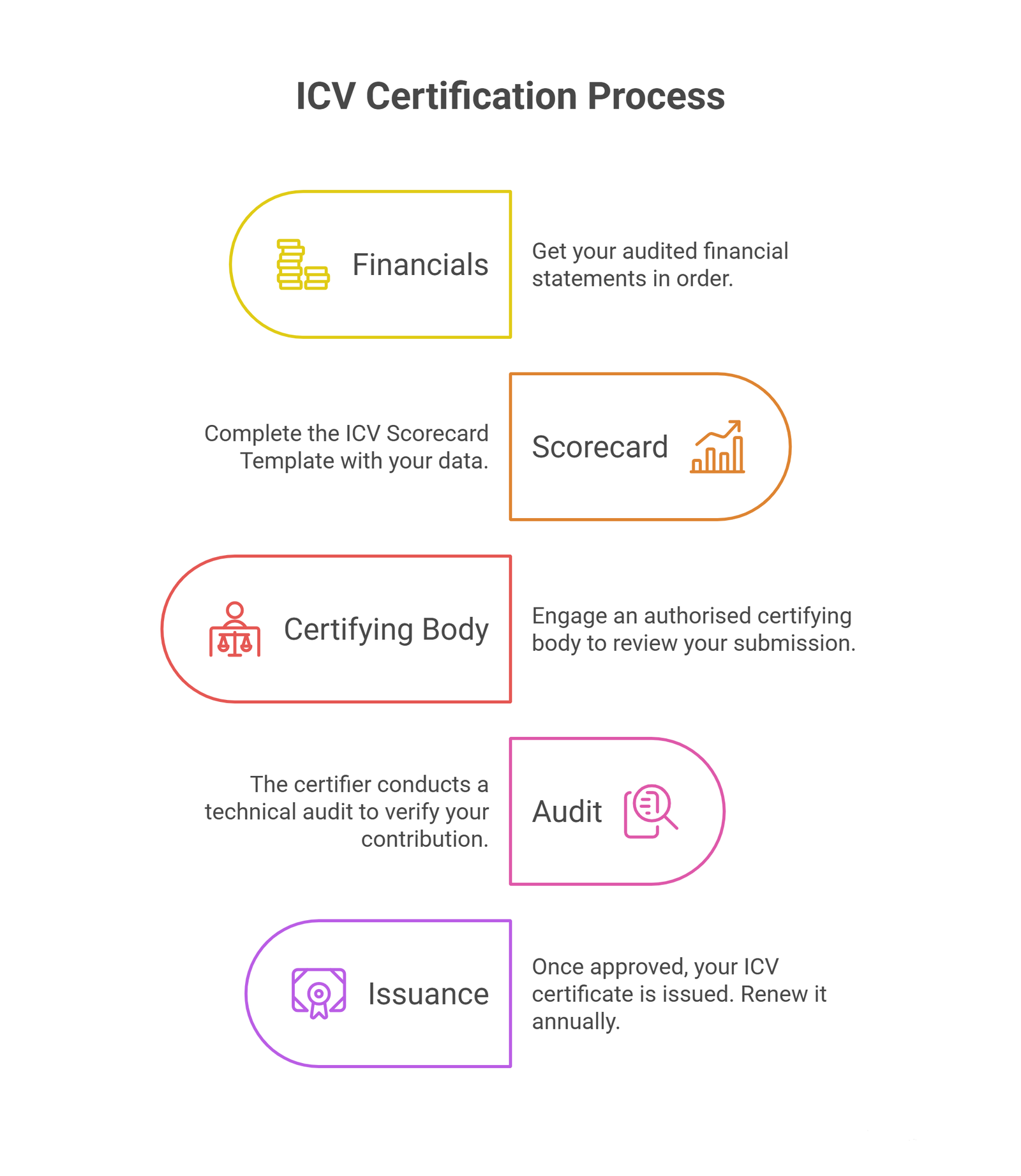
The process is more straightforward than it sounds. Here’s how it works:
Step 1 – Get Your Financials in Order You’ll need audited financial statements (IFRS-compliant) for the relevant fiscal year. Certificates issued in 2025, for example, typically rely on 2023 or 2024 financials.
Step 2 – Complete the ICV Scorecard Template Download the official MoIAT ICV Supplier Submission Template. Fill in your manufacturing costs, third-party spend, investment, manpower data (Emiratis and expatriates), and any sustainability or technology metrics. Every figure must be traceable back to your audited statements.
Step 3 – Engage an Authorised Certifying Body Work with a certifying body approved by MoIAT (or aligned with ADNOC’s ICV framework). They’ll review your submission, verify the data, and calculate your official score.
Step 4 – Evaluation and Audit The certifier conducts a technical audit – checking invoices, contracts, payroll records, and asset documentation. They’re not looking for problems; they’re verifying your contribution.
Step 5 – Certificate Issuance Once approved, your ICV certificate is issued. Renew it annually with updated financials to maintain your standing.
Heads up: The most common reason for rejection after January 2025 is the absence of stand-alone audited financial statements at the legal entity level. Consolidated or combined accounts are frequently rejected – so make sure your books are structured correctly before you submit.
Tips to Maximize Your ICV Score
Think of the ICV score as a game where the rules are actually quite clear – and the rewards for playing well are significant. Here’s how to get ahead:
- Source locally where you can. Every dirham spent with a UAE-based supplier improves your local procurement score.
- Invest in UAE-based assets. Capital investment in local operations adds directly to your score.
- Prioritize Emiratisation. Hiring UAE nationals and investing in their development has one of the highest weightings in the formula.
- Register with NAFIS. This is a platform-level prerequisite under the ICV framework – required even if you currently employ zero Emiratis.
- Plan ahead. Start the certification process well before any expected tender deadlines. An expired certificate at bid time means a score of zero.
- Review annually. Every renewal is an opportunity to improve. Track which factors are dragging your score down and build a strategy around them.
Frequently Asked Questions
What is the ICV Certificate?
It’s an official certification issued under the UAE’s National ICV Program that measures how much economic value your business generates within the UAE. It’s expressed as a percentage score based on your audited financials.
Who issues it?
Certifying bodies approved by the Ministry of Industry and Advanced Technology (MoIAT). The ministry oversees the unified national framework.
Do I need it if I’m not in oil and gas?
Not legally required in every sector, but strategically essential for any business that bids on tenders from government entities, semi-government companies, or major national corporations. If tenders are in your 6–12 month pipeline, ICV planning is non-negotiable.
How long is the certificate valid?
14 months from the date of your audited financials. After that, you need to renew with updated financials.
What happens if I don’t have one during a tender?
Your company typically receives a score of zero for the ICV component of bid evaluation – which makes winning significantly harder.
Can I combine multiple licenses into one certificate?
Only if the licenses are issued in the same Emirate and meet identical criteria. Check the MoIAT guidelines carefully before attempting this.
Conclusion
The ICV certificate isn’t just about ticking a regulatory box. It’s a long-term strategy – a commitment to the UAE’s economic future that pays dividends in credibility, contracts, and competitive positioning. Like planting a tree: the real work happens upfront, but the benefits compound year after year. Whether you’re a fast-growing startup or an established enterprise, securing your ICV certification is one of the smartest business moves you can make in the UAE today. If you’re ready to get started – or want to improve your current score – Oak Business Consultant’s team is here to help. We understand the certification process, the scoring mechanics, and the strategies that actually move the needle. Get in touch today and let’s build your ICV strategy together.