SaaS Financial Model: 8 Steps to Build One
SaaS financial model: how to build one investors will trust
Most SaaS founders build their first financial model the night before an investor meeting. It has a revenue line that climbs 15% a month and a cost line that barely moves. It says nothing about churn, acquisition cost or cash, so the numbers fall apart under the first question.
A good SaaS financial model fixes that. It ties every assumption (signups, trial conversion, price, churn, hiring) to revenue, margin and runway. Change one input and the whole model moves with it.
This guide covers what the model contains, how to build it in eight steps, which metrics to track, and when a template is enough.
What is a SaaS financial model?
A SaaS financial model is a forecast built around recurring revenue. It projects revenue, costs, cash and subscription metrics such as MRR, ARR, churn and customer acquisition cost (CAC).
The difference from a traditional model sounds small but changes almost every line. A traditional business books a sale and moves on. A SaaS customer who signs today keeps paying for months or years, or leaves. The model has to carry that customer forward, remove the ones who cancel and add the ones who upgrade.
| Area | Traditional model | SaaS model |
| Revenue driver | Units sold times price | Paying accounts times ARPA, rolled forward monthly |
| Revenue timing | Booked at the sale | Recurs, and is recognized over the contract term |
| Customer loss | Rarely modeled | Churn modeled every month |
| Existing customers | Repeat purchases | Expansion and contraction MRR |
| Cost of sales | Materials and labor | Hosting, support and payment fees |
| Main question | Margin per unit | Does each customer repay what it cost to win them? |
Why SaaS companies need a financial model
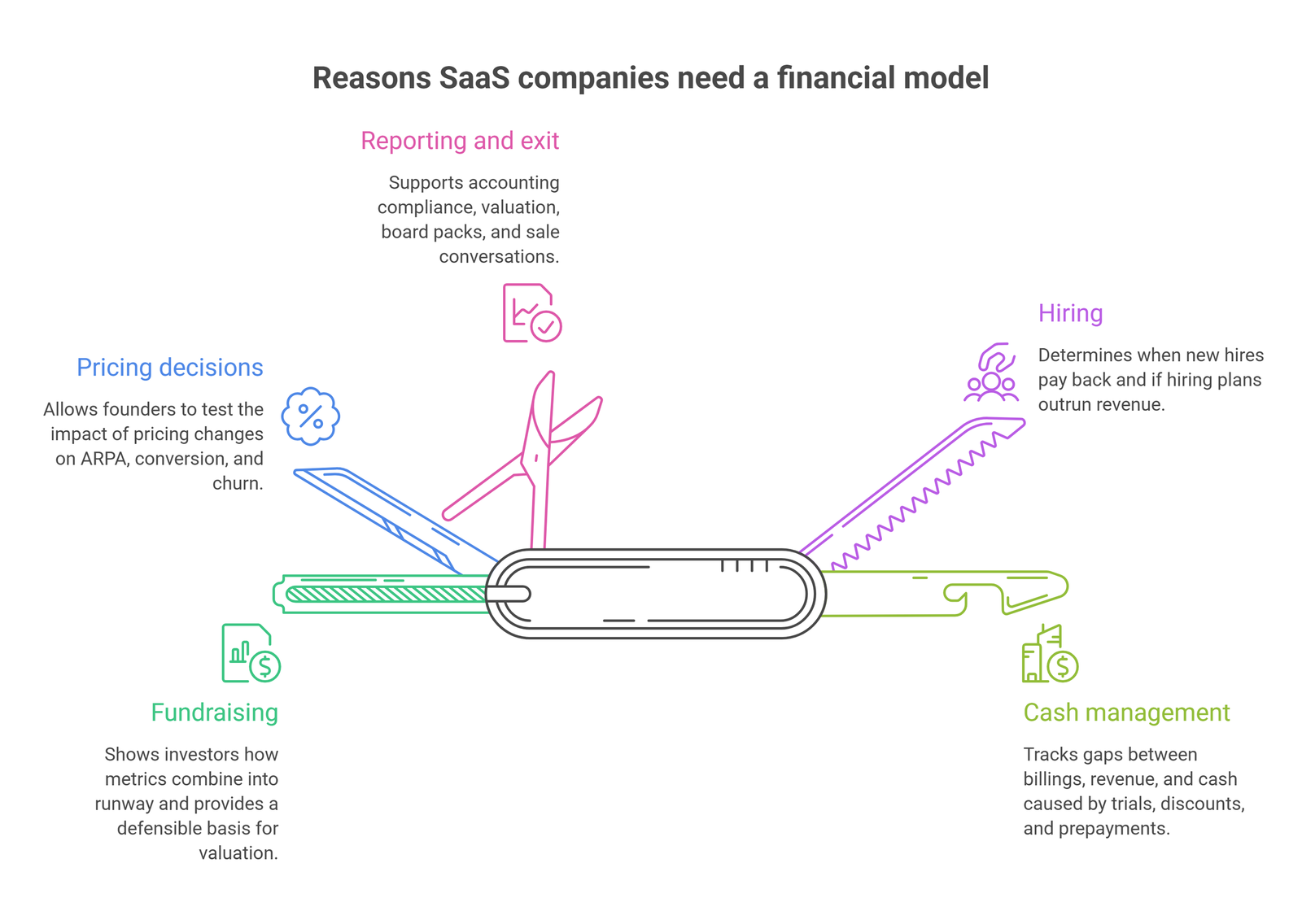
A subscription business can look healthy on a dashboard and still be heading for trouble. A model shows the trouble early. Here is where it earns its place.
Fundraising. Investors want to see how new customers, churn and CAC combine into runway. A model answers “how much do we need to raise to reach $1M ARR?” with numbers instead of a guess. It also gives the founder a defensible basis for the valuation ask.
Cash management. Free trials, discounts and annual prepayment all create gaps between billings, revenue and cash. A trial period adds cost with no revenue. An annual prepayment brings cash in early, but the revenue is earned month by month. Only a connected model shows what the bank balance will do.
Pricing decisions. Moving from two tiers to three, or raising prices 10%, changes ARPA, conversion and churn at once. A model lets a founder test that on paper before shipping it.
Hiring. For most software companies payroll is the largest cost. A model shows when each hire pays back and when a hiring plan outruns the revenue.
Reporting and exit. Subscription revenue follows accounting rules such as ASC 606 and IFRS 15, which spread contract revenue across the service period. The same model supports a valuation, a board pack or a sale conversation later.
Types of SaaS financial models
No single model fits every stage. The focus shifts as the company grows.
| Model type | Best for | Main focus |
| Startup | Pre-revenue and seed stage | Burn rate, capital needed, first revenue assumptions |
| Growth | Companies scaling customers and products | Acquisition spend, hiring, new markets |
| Mature | Stable customer base | Cash flow, profitability, expansion revenue |
| Freemium | Free tier with paid upgrades | Free-to-paid conversion, tier mix |
| Enterprise | Large contracts and custom deals | Contract length, implementation cost, renewals |
How to build a SaaS financial model in eight steps
1. Set your drivers in one place
Put every input on a single assumptions tab: monthly signups, trial conversion, pricing tiers, churn, CAC and hiring. Every formula elsewhere should point back to this tab. Hard-coded numbers buried inside formulas are the most common reason a model cannot be trusted.
2. Separate your signups by channel
Paid ads and organic search are trackable. Word of mouth, PR and brand effects are not. Give each acquisition channel its own row, with its own cost and conversion rate. That shows which channel is cheap, which is slow and which one the company should not depend on.
3. Convert signups into paying customers
Many SaaS companies offer a free trial of 14 or 30 days. Count a customer as paying only when the trial ends and the first payment is due, not when the person signs up. Apply a conversion rate per channel, because a trial from search rarely converts like a trial from a referral.
4. Calculate ARPA and keep price changes separate
Average revenue per account (ARPA) is MRR divided by paying accounts. Keep old and new pricing in separate rows, because a price change affects new and existing customers differently.
Watch out for one trap. A few large accounts can make ARPA look strong while most customers pay little. Break ARPA out by plan tier, and check the median as well as the average.
5. Build the MRR waterfall
The MRR waterfall is the spine of the model. It starts with last month’s MRR, adds new and expansion revenue, and subtracts contraction and churn.
| Line | Example (monthly) |
| Beginning MRR | $50,000 |
| New MRR | + $6,000 |
| Expansion MRR | + $2,000 |
| Contraction MRR | – $500 |
| Churned MRR | – $1,000 |
| Ending MRR | $56,500 |
| ARR (ending MRR times 12) | $678,000 |
These figures are illustrative, not client data. The structure is what matters: each movement gets its own line, so the model shows whether growth comes from selling, upselling or simply losing fewer customers. For the churn lines, see our guide to MRR churn rate.
6. Add costs and headcount
Split costs into cost of goods sold (hosting, third-party software, support, payment processing) and operating expenses (sales and marketing, research and development, general and administrative). Separate one-time costs, like a company setup fee, from recurring ones.
Model headcount at its fully loaded cost: salary plus payroll taxes, benefits and equipment. Salary alone understates the real cost of every hire.
7. Connect the three statements
Link the income statement, balance sheet and cash flow statement so one change flows through all three. This is where the SaaS-specific accounting shows up. A customer who pays $1,200 upfront for a year adds $1,200 to cash today, but only $100 to revenue each month. The rest sits on the balance sheet as deferred revenue. Our guide to an integrated three-statement financial model walks through the linking in detail.
8. Add unit economics and scenarios
Calculate CAC, lifetime value (LTV), the LTV:CAC ratio and CAC payback from the revenue and cost tabs, so they update automatically. Then build three cases: base, best and worst. Flex churn, pricing and CAC in each, and watch what happens to cash. If the worst case runs out of money in nine months, the founder needs to know that before an investor points it out.
Metrics your SaaS financial model should output
| Metric | Formula | What to watch |
| MRR and ARR | MRR is monthly subscription revenue. ARR is MRR times 12. | Growth rate and the mix of new, expansion and churn |
| Gross MRR churn | (Churned MRR + contraction MRR) / starting MRR | Aim for under 2.5% a month at scale |
| Net revenue retention | (Starting MRR + expansion – contraction – churn) / starting MRR | Above 100% means the base grows without new sales |
| CAC | Sales and marketing spend / new customers won | Compare by channel, not just in total |
| LTV | (ARPA times gross margin) / monthly churn rate | Very sensitive to the churn input |
| LTV:CAC | LTV / CAC | 3:1 or better is the usual target |
| CAC payback | CAC / (ARPA times gross margin) | Months to recover acquisition cost |
| Burn multiple | Net cash burned / net new ARR | Lower means growth is cheaper to fund |
| Rule of 40 | Growth rate % + profit margin % | A rule of thumb of 40 or more, not a hard threshold |
A quick worked example shows how the unit economics connect. Take ARPA of $100, gross margin of 80%, monthly churn of 3% and CAC of $800.
- LTV = ($100 x 0.80) / 0.03 = about $2,667
- LTV:CAC = $2,667 / $800 = about 3.3:1
- CAC payback = 800/(100 x 0.80) = 10 months
Now change churn to 5%. LTV drops to $1,600 and the ratio falls to 2:1. One assumption moved the verdict. That is why churn deserves the most scrutiny in any SaaS model.
For churn benchmarks, ChartMogul data published in TechCrunch in 2022 put the best-performing companies below 2.5% gross MRR churn a month. Treat that as a reference point rather than a rule, and compare yourself against companies with a similar ARPA.
Modeling usage-based and hybrid pricing
Many SaaS products now charge for something metered: API calls, storage, transactions or seats above a limit. A flat-MRR assumption breaks here.
Model each metered product as units consumed times rate, driven by an adoption curve. Then add that variable revenue on top of the recurring base. Hybrid pricing needs both the subscription waterfall and a usage forecast running side by side, and churn should cover plan cancellations as well as falling consumption.
Template or custom model?
A template is a good starting point in three situations: the company is pre-revenue, the pricing is simple (one product, two or three tiers), and the goal is a quick sanity check on the numbers. Oak offers SaaS financial model templates for exactly that.
A custom model makes more sense when any of these apply:
- Several products, regions or legal entities sit in one forecast
- Pricing is usage-based or hybrid
- The model supports a funding round, valuation or due diligence
- A board or investor needs to audit every assumption
The risk with any template is inheriting assumptions you did not choose. Read every input before trusting an output.
Common mistakes in SaaS financial models
- Growth that stays at a fixed percentage every month while CAC never rises
- One churn rate for every plan, when small plans usually churn faster than large ones
- Counting trial signups as customers
- Treating billings as revenue when customers pay annually upfront
- Leaving out payment processing fees and hosting, which grow with revenue
- Using a single ARPA when a few large accounts distort the average
Oak built a five-year model for a restaurant-management software company that struggled with several of these. The SaaS financial model case study shows how the model, market research and investor reporting fit together.
Frequently Asked Questions
How far ahead should a SaaS financial model forecast?
Three to five years is common for investor-facing models. Many founders forecast monthly for the first two or three years and annually after that. Early-stage assumptions get shaky beyond 24 months, so show the later years as a direction, not a promise.
What is a good LTV:CAC ratio?
A ratio of 3:1 or higher is the usual target. A ratio near 1:1 means the company only breaks even on acquisition, before any operating cost. Always read it together with CAC payback, since a healthy ratio with a 30-month payback can still strain cash.
How do you forecast MRR?
Build it month by month: beginning MRR, plus new MRR, plus expansion MRR, minus contraction MRR, minus churned MRR, equals ending MRR. Multiply ending MRR by 12 for ARR. Each movement should have its own driver on the assumptions tab.
Can I build a SaaS financial model in Excel or Google Sheets?
Yes, and most early-stage companies do. A spreadsheet works until pricing models multiply, several people edit it, or the numbers need to match live billing data. At that point errors creep in and a custom build or dedicated software pays for itself.
How often should I update the model?
Update actuals against forecast every month. Review the assumptions quarterly, or sooner after a price change, a product launch or a funding round. A model that is never reconciled to actuals stops being a forecast.
What is the difference between a SaaS financial model and a budget?
A budget sets spending limits for a period. A financial model forecasts how revenue, costs and cash respond to different decisions over several years. The budget usually comes out of the model, not the other way around.
The model is only as honest as its churn number
A SaaS model can look polished and still mislead if churn and CAC are set too kindly. The most useful habit is to start from your real numbers, not the ones you hope to reach, and let the best case be a scenario rather than the base. Hiring a finance lead early also helps: our guide to the SaaS CFO role explains when that makes sense.
Need a model built, reviewed or stress-tested before you raise? Oak’s team can do it. Explore our SaaS financial model services or book a free consultation.