What Actually Goes Into A Financial Model For A Small Online Business
Small online business financial model: what a generic template misses
A small online business is cheap to open. It is not cheap to run before it turns profitable. The domain costs little. The drain comes later. Ads are paid before the sale. Every order carries a card fee. Refunds follow, and payouts arrive late. CB Insights reviewed startup post-mortems. Aspire’s summary says founders cited running out of cash in 29% of failures.
A generic template tracks revenue and costs. It rarely tracks those leaks. This guide shows what a small online business financial model needs. It covers five online business types and the input to test first in each. The worked examples are invented to show the method. The fee, return and churn figures come from the sources named.
Five online models at a glance
| Model | How it earns | Where cash leaks | Test this first |
| Online store | Orders times average order value | Returns, shipping, ad cost per order | Return rate |
| Subscription (software or paid community) | Subscribers times monthly price | Churn, failed card payments | Monthly churn |
| Course or digital product | Buyers per launch times price | Refund window, launch ad spend | Conversion rate |
| Marketplace or directory | Transaction value times take rate | Disputes, payment fees, slow supply growth | Take rate after fees |
| Online service (remote consulting, bookkeeping, design) | Billable hours times rate | Unbilled time, one large client | Share of revenue from the top client |
Pick the row that matches your business. If you run two, model each revenue stream on its own.
Four online costs a generic template misses
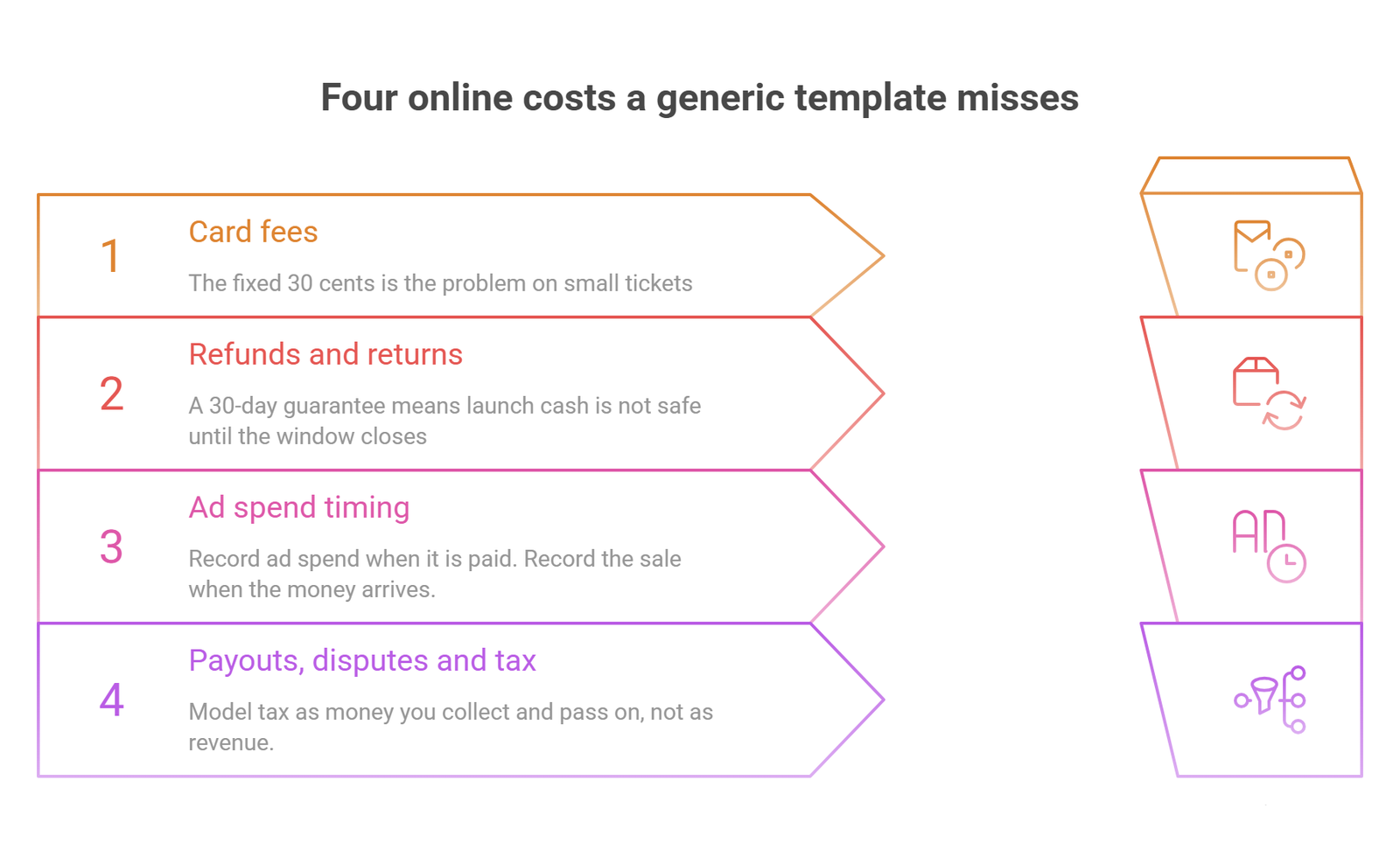
Card fees hit small orders hardest
Stripe’s published US rate for a domestic card is 2.9% plus 30 cents per successful charge. International cards add 1.5%, and currency conversion adds another 1%. The fixed 30 cents is the problem on small tickets.
| Price | Fee | Fee as a share of price |
| $9 | $0.56 | 6.2% |
| $29 | $1.14 | 3.9% |
| $199 | $6.07 | 3.1% |
A $9 monthly plan loses more than twice the share of a $199 course. Put the fee formula in the model, not a flat percentage.
Refunds and returns
NRF and Appriss Retail reported that 17.6% of online merchandise sales were returned. In stores the figure was about 10%. A later NRF and Happy Returns estimate put online returns near 20%. Digital products have the same issue in a different form. A 30-day guarantee means launch cash is not safe until the window closes.
Ad spend comes before revenue
A customer costs money before the first payment. Suppose the model books ad spend in the same month as the revenue it later brings. The cash gap disappears from view. Record ad spend when it is paid. Record the sale when the money arrives. The gap between the two is the working capital the business needs.
Payouts, disputes and tax
Published Stripe pricing lists a 1% fee for instant payouts, against a standard wait of about two business days. Payout timing varies by processor, country and account history, so check yours. The same pricing lists $15 per dispute.
Sales tax or VAT can apply when you sell across state or country lines. Rules and thresholds differ by place. Model tax as money you collect and pass on, not as revenue.
The parts every model shares
Five parts appear in all five models.
- Assumptions on one sheet. Prices, conversion, churn, refund rate and payment timing sit in one place, and every formula reads from it.
- Bottom-up revenue. Build it from visitors, leads or customers, not from a share of a market.
- Direct costs apart from operating costs. Fees, shipping, hosting per user and contractor time sit above the gross margin line. Software, insurance and your own pay sit below it.
- One-time costs on their own lines. Domain setup, a first build, equipment and a launch budget should not distort monthly burn.
- Monthly cash flow with timing. Show when money arrives and leaves, not only when it is earned.
The small online business Excel financial model puts these parts in one workbook and includes receivable and payable days for payment timing.
Online store
A store lives on contribution per order. That is the order value minus everything that scales with the order.
This example is invented. Take a $50 average order. Assume a 2.9% plus 30 cent card fee and an 18% return rate, close to the NRF figure above. Assume returned goods can be resold, the fee is not refunded and the shop pays return shipping.
| Line | Per order |
| Order value | $50.00 |
| Product cost | $20.00 |
| Shipping and packing | $7.00 |
| Card fee | $1.75 |
| Contribution before returns | $21.25 |
| Expected return cost (18% of $15.75) | $2.84 |
| Contribution after returns | $18.41 |
If ads cost $18 per first order, the shop keeps 41 cents. Push returns to 25% and the first order loses about 69 cents. Profit has to come from repeat orders, so repeat purchase rate is the second input to test.
Include these lines: product cost, shipping, card fees, return rate, ad cost per order, repeat purchase rate and inventory cash. Stock bought ahead of sales is cash that has left the account. Oak’s e-commerce financial model service builds these drivers around your own catalog.
Subscription: software or paid community
A subscription earns slowly and loses quickly. Churn decides which wins.
Kalungi puts churn for small and medium businesses billed monthly at 3% to 7%. Sources disagree on exact figures, so test a range. The next table is invented but follows from the arithmetic. Assume a $29 monthly plan, a $1.14 card fee and $3 of hosting and support per customer. That leaves $24.86 a month. Assume $150 to acquire a customer, and average lifetime of one divided by monthly churn.
| Monthly churn | Customers lost in a year | Average lifetime | Lifetime contribution | Lifetime contribution vs $150 acquisition cost |
| 3% | 31% | 33 months | $829 | 5.5 to 1 |
| 5% | 46% | 20 months | $497 | 3.3 to 1 |
| 7% | 58% | 14 months | $355 | 2.4 to 1 |
Payback on the $150 takes about six months in every row. What changes is how much comes after.
Model failed card payments on their own line. Recurly reports average involuntary churn at 1.25% across industries, as cited by Orb. That is a cost of the billing system, not a decision by the customer. A model with one churn number cannot tell the two apart. Oak’s SaaS financial model service covers cohort-based churn and expansion revenue.
Course or digital product
A course front-loads the work. The build costs time or money once, then each sale costs little to deliver.
This example is invented. A creator emails 2,000 subscribers. Assume 3% buy at $199, which is 60 buyers and $11,940 in sales. Card fees are $6.07 a sale, or $364 in total. Assume 10% ask for a refund, which returns $1,194 and, by assumption, not the fees.
Cash from the launch is $11,940 minus $1,194 minus $364. That is $10,382. Halve the conversion rate and cash halves, while the build cost and any ad spend stay the same.
Separate the build cost from delivery cost. Spread the build across the launches you expect to run, not across the first one. Otherwise the first months look far worse than the business really is. Hold launch cash as pending until the refund window ends.
Marketplace or directory
A marketplace earns a slice of other people’s sales. The slice is smaller than it looks once payments are paid for.
This example is invented. A platform takes 10% of a $100 booking, which is $10. The card fee on $100 is $3.20. If the platform pays that fee from its take, it keeps $6.80. One dispute at $15 costs more than the net from two bookings. Payout products for platforms can add fees of their own, so use your processor’s actual rate card.
The harder problem is the ramp. A marketplace earns only where supply and demand overlap, so model each side as its own input. Buyers need something to buy. Sellers need buyers before they stay. Plan a longer runway than a one-sided business would need. Oak’s online marketplace financial model separates the two sides.
Online service
A remote service business sells capacity. Revenue is billable hours times the rate, and hours you work are not hours you bill.
This example is invented. Say a consultant bills 100 hours a month at $60, which is $6,000. Software and insurance cost $600, and the owner draws $3,000. The monthly surplus is $2,400. One client takes 30 of those hours, or 30% of revenue. If that client leaves, revenue falls to $4,200 and the surplus falls to $600.
Model the top client leaving. That one scenario shows how much cash cushion a one-person practice needs. Also model unbilled time for admin, sales and gaps between projects.
Run three scenarios before you trust the model
Build a base case, a slow case and a stress case. Change the input from the first table that matters for your model. For a store, raise returns. For a subscription, raise churn. For a course, cut conversion. For a service, remove the top client.
Then read the cash line, not the profit line. Runway is cash on hand divided by net monthly burn. With $12,000 in the bank and $2,000 of net burn, runway is six months. If returns or churn push burn to $3,000, runway drops to four. A clear cash flow analysis shows the month the balance runs out, which a profit figure never does.
Frequently Asked Questions
What should a small online business financial model include?
It should include assumptions on one sheet, a bottom-up revenue forecast, direct and operating costs, one-time costs and a monthly cash flow with timing. Add card fees, refunds, ad spend and payouts. Most online businesses leave those out.
Do I need a financial model or is a budget enough?
A budget records what you plan to spend. A model asks what happens to cash when growth is slower, a client leaves or refunds rise. That forward view is what catches a cash shortfall before it happens.
How far ahead should I project?
Go monthly for the first 12 months, since that is the window where your inputs are real. Add a lighter yearly view for years two and three to judge whether the business can grow.
How much do payment fees cost a small online business?
Stripe’s published US rate is 2.9% plus 30 cents per successful domestic card charge. International cards and currency conversion cost extra. The 30 cents weighs most on small prices, so model it as a formula.
What is a normal churn rate for a subscription business?
Kalungi puts small and medium business subscriptions billed monthly at 3% to 7% a month. Other sources give different figures, so run your model at the low, middle and high ends.
Is a template enough or do I need a custom model?
A template works for a single revenue stream with simple pricing. Mixed models, tiered pricing or two-sided marketplaces usually need a model built around their own mechanics.
How often should I update the model?
Compare it with your real numbers every month. Forecasts drift from reality as soon as you start trading, and an unchecked model becomes fiction within a quarter.
Conclusion
Choosing the right small online business matters less than most lists suggest. What decides survival is whether the founder knows which single assumption can end the business. Find that number in your model and make it 20% worse. If the business still has cash, you have a plan. If not, you have found the problem while it is still cheap to fix.
Oak builds that model around your revenue mechanics. That could be a store, a subscription, a course, a marketplace or a service practice. See our startup financial model services or start with the small online business template above.