What Are CFO Services? Driving Strategic Financial Excellence
What are CFO services? What you get, what they cost, and when to hire
Most owners don’t go looking for CFO services. They get there by accident. The books are up to date, but the cash position is still a guess. The forecast lives in a spreadsheet nobody trusts. Hiring and pricing decisions get made on instinct, because no one can say what the numbers support.
That gap, between having financial data and being able to act on it, is what CFO services close. They are the strategic finance work a Chief Financial Officer normally does. An in-house executive, an outsourced firm, or a fractional or interim arrangement can deliver it. This guide covers what is included, how an engagement runs, what it costs, and the signs it is time to bring one in.
CFO services vs bookkeeping, accounting, and a controller
Finance roles get lumped together, and that is where many hiring mistakes start. Each one answers a different question.
| Role | Question it answers | Typical work |
| Bookkeeper | What happened? | Records transactions, tracks expenses, sends invoices |
| Accountant | Are we compliant? | Prepares statements, reconciles accounts, files taxes |
| Controller | Are the numbers right and on time? | Runs the month-end close, sets internal controls, produces reports |
| CFO services | What should we do next? | Builds forecasts, manages cash, plans funding, advises on pricing and growth |
Most growing companies climb this ladder in order. A bookkeeper comes first, then an accountant or controller, then a CFO once the decisions outgrow the reporting. A business that skips the lower rungs often finds its CFO spending the first month cleaning up records instead of planning.
CFO services sit on top of the accounting function. They don’t replace it. The CFO sets the standards and reviews the output, while a bookkeeper or controller still does the daily work.
What CFO services cover
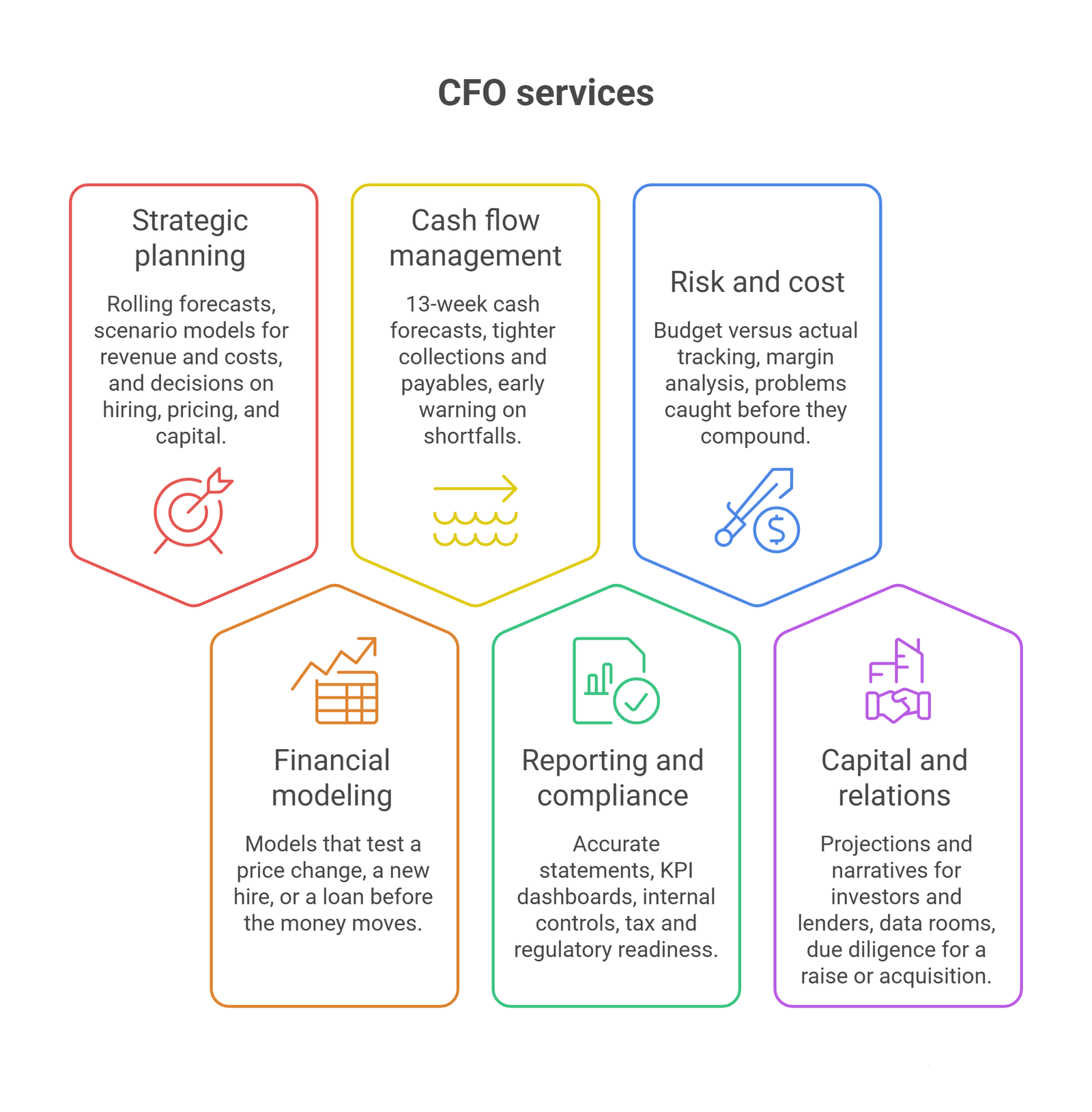
CFO services scale to the business. A startup might need a forecast to close a funding round. An established company might need full financial oversight. Either way, the work falls into six areas.
| Area | What it looks like in practice |
| Strategic planning and forecasting | Rolling forecasts, scenario models for revenue and costs, and decisions on hiring, pricing, and capital |
| Financial modeling | Models that test a price change, a new hire, or a loan before the money moves |
| Cash flow and working capital | 13-week cash forecasts, tighter collections and payables, early warning on shortfalls |
| Reporting, compliance, and controls | Accurate statements, KPI dashboards, internal controls, tax and regulatory readiness |
| Risk and cost control | Budget versus actual tracking, margin analysis, problems caught before they compound |
| Capital and investor relations | Projections and narratives for investors and lenders, data rooms, due diligence for a raise or acquisition |
A CFO also chooses and sets up the accounting and reporting systems the business runs on. That means the right accounting platform, automated reconciliation, and dashboards that show cash runway and margin trends without someone building a report by hand.
Cash flow is usually the first thing a CFO fixes. It is where owners feel the pain, and it is often a collections or pricing problem rather than a lack of capital.
One role, several labels
Virtual, fractional, outsourced, interim, and full-time describe how the role is delivered. They don’t describe what it does. Virtual is about location: the work runs remotely through cloud tools. Fractional is about time: the business gets a slice of a senior person’s week. Outsourced is about the employment relationship: the person sits outside payroll. One provider is often all three.
Oak’s guide on what a virtual CFO is and how it helps your business covers the remote model in depth.
The part-time model has its own explainer in what is a fractional CFO, including how the hours are scoped.
What really varies between providers is the number of hours and the seniority of the person doing the work. It also matters whether they know a business like yours. The title tells you more about how the provider markets itself than about what you get.
| Fractional, virtual, or outsourced CFO | Interim CFO | Full-time CFO | |
| Time commitment | Part-time, ongoing | Full-time, temporary | Full-time, permanent |
| Typical duration | No fixed end date | A few months | Open-ended |
| Best for | A steady strategic need without a full-time workload | A vacant CFO seat during a transition | Complexity that fills a full working week |
| Time to start | Weeks | Days to two weeks | Months, because of executive search |
| Equity and severance exposure | Minimal | None | Typical for the role |
Most growing businesses have a fraction of a full-time week of real CFO-level work, not forty hours. That is the gap a fractional or virtual arrangement fills.
Interim CFOs solve a different problem. The seat is empty now, and the business can’t operate without someone full-time while it hires. Oak’s piece on the interim CFO role and when to hire one explains how those engagements work.
What a CFO services engagement looks like
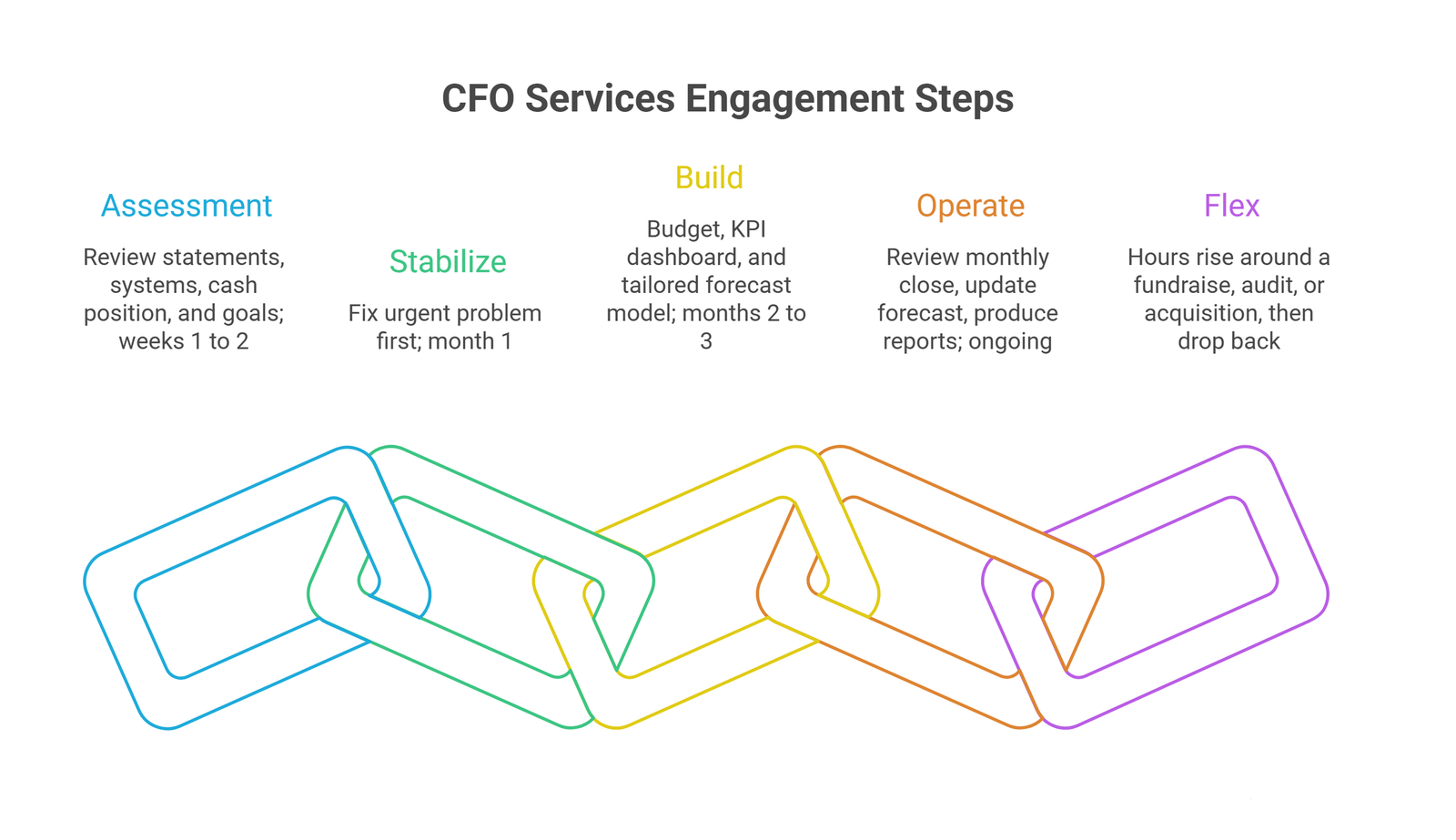
The shape of an engagement is fairly predictable. Most follow the same five steps, though the timing shifts with the state of the books.
- Assessment (weeks 1 to 2). Review the financial statements, systems, cash position, and goals to set a baseline.
- Stabilize (month 1). Fix the most urgent problem first. That is usually a 13-week cash forecast or a reporting cleanup.
- Build (months 2 to 3). Put in place a budget, a KPI dashboard, and a forecast model tailored to the business.
- Operate (ongoing). Review the monthly close, update the forecast, and produce lender- or board-ready reports on a set schedule.
- Flex. Hours rise around a fundraise, audit, or acquisition, then drop back to the normal level.
A business with clean books skips most of step two. A business with messy records may spend its first two months there, and that is time well spent.
What CFO services cost
Cost is usually the first practical question, and most guides dodge it. Pricing follows a few structures.
| Engagement type | Typical cost | What you get |
| Fractional, virtual, or outsourced retainer | About $3,000 to $15,000 a month (most small and mid-sized businesses pay $3,000 to $10,000) | Roughly 8 to 30 hours a month of senior strategic finance work, with no fixed end date |
| Hourly support | About $200 to $500 an hour | Narrow, defined work such as a board pack or audit preparation |
| Project-based work | About $5,000 to $30,000 | A set deliverable such as a fundraising model or due diligence support |
| Interim CFO | A higher monthly rate than a retainer | Full-time coverage for a few months, usually to fill a vacancy |
| Full-time in-house CFO | Commonly $250,000 to $600,000 or more a year all in | Salary, bonus, benefits, and equity for a permanent executive |
The monthly retainer is the most common model. Hourly billing tends to reward slow, meeting-heavy work over fast decisions, and it makes costs hard to predict. Most ongoing engagements are priced as a retainer with a defined scope, then reviewed every few months.
Several things move the price. The number of legal entities and the condition of the books both matter. So do the hours needed, the seniority of the person, and the complexity of the industry. A business with one entity and clean records pays less than one with three entities and a backlog.
A fractional engagement also avoids the equity dilution, severance exposure, and months-long search that come with a permanent hire.
When to bring in CFO services
The decision is usually triggered by a specific event, not a slow realization. These are the signals that most often point to “now.”
- Revenue has crossed a complexity threshold, often around $2 million. Whoever keeps the books is now making pricing, cash, and hiring calls.
- Nobody can answer “how much cash will we have in 13 weeks” with confidence.
- A fundraise, loan, or acquisition is 6 to 12 months away. Investors and lenders judge the finance function almost as closely as the business, and a clean model built early can change the terms.
- Several revenue streams or high fixed costs make monthly performance hard to read.
- Reports arrive late, conflict across systems, or leave leadership doubting its margins.
- More time goes to reconciling past numbers than to planning the next quarter.
If none of these fit yet, a strong bookkeeper or part-time controller is usually the better next step. CFO services solve a strategy problem, not a data-entry one.
CFO services for businesses in the UAE
For companies operating in the UAE, the scope often includes VAT and corporate tax readiness on top of the usual forecasting and cash work. Founders setting up a Dubai entity or expanding into the region also need financial models for the setup and clean reporting for banks and regulators.
Oak’s page on CFO services in Dubai covers how that support works in practice.
How to choose a CFO services provider
A good provider is easy to test with a few direct questions.
- Which businesses like mine have you worked with, and what changed for them?
- What will I receive each month, and in what format?
- Who does the work: the senior person I meet, or a junior team?
- How is pricing structured, and what falls outside the scope?
- Can I speak to a current client?
Watch for vague deliverables, no industry experience, no references, and bookkeeping sold under a CFO title. Oak’s guide on how to choose a virtual CFO has the full checklist.
Frequently Asked Questions
How much do CFO services cost?
Most ongoing fractional, virtual, or outsourced engagements run about $3,000 to $15,000 a month. Small and mid-sized businesses usually land between $3,000 and $10,000. Hourly support runs about $200 to $500, and a permanent in-house CFO costs several times more per year.
What is the difference between CFO services and accounting or bookkeeping?
Bookkeeping records what happened, and accounting prepares statements and handles compliance. CFO services look forward. They cover forecasting, cash strategy, funding, and decision support. Most businesses need the accounting foundation in place before a CFO adds much value.
How quickly can a business start with CFO services?
Fractional and virtual engagements typically start within a few weeks, because there is no executive search or relocation. Interim CFOs can often start within days for an urgent vacancy. A permanent hire usually takes several months.
When should a small business consider outsourcing CFO services?
The clearest signals are unclear or volatile cash flow and a funding round or acquisition on the horizon. Others are forecasts the team can’t produce reliably, and owners who spend more time on financial administration than on running the business.
Do CFO services include tax preparation?
Generally no. Tax preparation and filing are accounting functions, usually handled by a CPA or accounting firm. CFO services focus on tax planning, such as how decisions affect tax exposure, and they coordinate with whoever files the returns.
Are CFO services only for large companies?
No. Fractional and virtual models exist so that startups and small businesses can get executive-level financial leadership without a full-time salary. The scope shrinks to fit the business.
Conclusion
The label on an engagement matters less than the fit. A business with ten hours of real strategic finance work a month doesn’t need a full-time executive. A business in the middle of a transition can’t wait for a part-time one. Match the structure to the actual workload, not to whichever title sounds most impressive.
If you’re not sure which model fits, Oak Business Consultant can test the signals above against your real numbers. It will then recommend a structure sized to your stage. Explore Oak’s CFO services to see how an engagement would work for your business.