What Makes a Great Virtual CFO? 6 Qualities to Look for When Hiring
What to look for in a virtual CFO: 6 qualities and how to test each
Most owners can describe the CFO they want. Far fewer can tell, in a 45-minute call, whether the person on screen is that CFO. CVs read alike, and every candidate says “strategic” and “hands-on.”
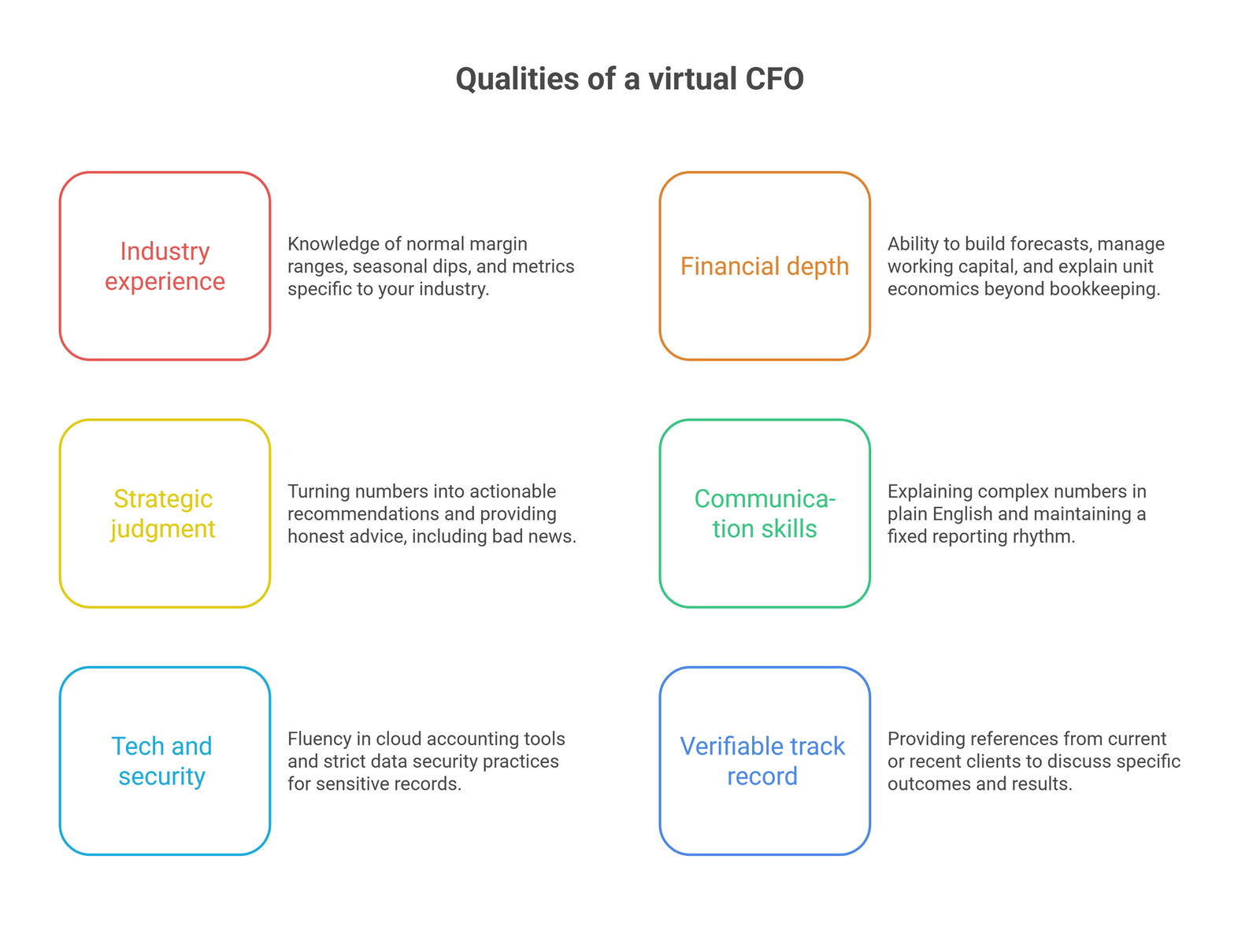
So what do you look for in a virtual CFO that a sales pitch cannot fake? Six things: industry experience, financial depth, strategic judgment, clear communication, tech and data discipline, and a track record you can check. Each section below covers what good looks like and the question that tests it. It also shows how a strong answer sounds next to a weak one, and names the red flag that should end the call.
This guide is about vetting a candidate. If you are still deciding whether to hire at all, start with the reasons to hire a virtual CFO. If you want the full selection process, from written brief to 90-day review, see how to choose a virtual CFO.
The six qualities at a glance
| Quality | Ask this | Red flag |
| Industry experience | “Which clients like mine have you served, and what changed in their numbers?” | An answer that would fit any industry |
| Financial depth | “Here is a one-page P&L. What would you check first?” | Talks only about tax filing or past reports |
| Strategic judgment | “Tell me about a recommendation a client rejected.” | No example, or only good news and no downside |
| Communication | “Explain our cash position to a board member with no finance background.” | Jargon, long answers, no reporting rhythm |
| Tech and data discipline | “Which systems do you use, and who can see our data?” | Shared logins or no clear answer on access |
| Verifiable track record | “Can I speak with two current clients?” | Logos and slogans, but no references |
Score each candidate from 1 to 5 on every row. A score of 3 or below on any quality is worth a follow-up question before you decide.
1. Industry experience that shows up in the numbers
A restaurant pays for ingredients daily and gets paid daily. A software company bills a year up front and recognizes the revenue monthly. Their cash problems look nothing alike, and neither do the fixes.
A virtual CFO who has worked in your industry already knows the normal margin range, the seasonal dips, and the metrics investors ask about. That cuts the learning curve from months to weeks. Adjacent experience counts too. A CFO from wholesale distribution can often adapt to e-commerce, because both live on inventory and payment terms.
To test it, ask which clients like yours the candidate has served and what changed in their numbers. A strong answer names specific metrics, such as gross margin by product line, days sales outstanding, or customer payback period. A weak answer stays general: “I’ve worked with lots of businesses like yours.” The red flag is an answer that would fit any industry.
2. Financial depth beyond bookkeeping
Bookkeeping records what happened. A CFO decides what to do about it. That takes more than tax knowledge. The candidate should be comfortable building a three-statement forecast, managing working capital, and explaining unit economics to someone who has never read a balance sheet.
Credentials help but do not settle the question. A degree in finance or accounting is the baseline, and a CPA or CMA designation is a useful signal. What matters more is whether the person can read your numbers quickly.
So run a short exercise. Send a one-page profit and loss statement before the call and ask what the candidate would check first. Here is an illustrative example of what that page might show:
| Illustrative figures | Last year | This year |
| Revenue | $480,000 | $566,000 |
| Gross margin | 46% | 41% |
| Net profit | $31,000 | $38,000 |
| Year-end cash | $92,000 | $41,000 |
| Days sales outstanding | 38 | 61 |
A strong candidate spots three things within a few minutes. Profit rose, but cash fell by more than half. Gross margin slipped five points, so each new dollar of sales earns less. And customers now take 23 days longer to pay, which locks cash inside receivables. That is a business that looks healthy on paper and runs short of money in practice.
A weak candidate comments on revenue growth and moves on. Good CFOs usually ask about cash before profit, meaning when money arrives versus when bills fall due. The red flag is a candidate who talks only about tax filing or past-period reports.
3. Strategic judgment, including bad news
Controllers keep the books accurate. CFOs turn the same numbers into a recommendation: raise prices, close an underperforming service line, or delay a hire by a quarter. That judgment is the main reason to pay for a CFO instead of another accountant.
Ask the candidate to describe a recommendation a client rejected, and what happened next. A strong answer is specific and honest about the outcome, including when the candidate was wrong. Someone who has never been overruled has probably never given hard advice. Then ask how they would build a 12-month plan for your business and what they would need from you to start.
Pay attention to how they handle downside. An overly optimistic outlook, or a promise of high returns with no risk, is a warning sign. A CFO who brings only good news will miss the problems you hired them to catch. Watch for anyone who offers a fixed package before asking about your goals. Strategy starts with listening.
4. Communication and teamwork
Virtual means most contact happens by call, email, and shared dashboards. A CFO who cannot explain a number in plain English will lose you quickly, because you will stop reading the reports.
Look for three habits: a fixed reporting rhythm, short written summaries that end in a recommendation, and a willingness to work with your accountant and bookkeeper. A collaborative CFO makes your existing team better instead of replacing it.
To test it, ask the candidate to explain your cash position as if speaking to a board member with no finance background. A strong answer takes under a minute and ends with what to do. A weak one is full of terms like EBITDA and working capital with no conclusion. Then ask how often you would hear from them and what happens when they disagree with your bookkeeper.
Pay attention to the sales process itself. Slow replies and vague follow-ups before you sign rarely improve afterward.
5. Tech fluency and data discipline
Cloud accounting tools such as QuickBooks Online, Xero, and Sage Intacct are standard in virtual CFO work. The candidate should know which one suits your business and be able to guide a migration if your current setup is holding you back.
The less obvious part is data security. A CFO sees your bank accounts, payroll, and customer records. Ask who on their team can see your data, how access is removed when the engagement ends, and whether they use shared logins. A strong answer describes individual accounts, limited permissions, and a written offboarding step. Shared logins are an easy red flag to spot. The FTC’s cybersecurity guidance for small businesses also lists questions worth asking any vendor that handles your data.
Also ask about coverage. If your CFO is sick or on holiday, who steps in? Some firms use a buddy system, where a second CFO shadows the lead and learns the client’s business. That setup offers continuity that a solo practitioner may struggle to match.
6. A track record you can verify
Testimonials on a website are curated. References are not. A verifiable track record means the candidate can put you in touch with current or recent clients and let them talk.
Ask for two references, ideally from businesses of a similar size, and call them yourself. Five questions get you most of what you need:
- What was the CFO hired to do?
- What changed as a result?
- Did deadlines hold?
- How did they handle bad news?
- Would you hire them again?
Specific outcomes carry more weight than praise. A cash forecast that caught a shortfall, or a month-end close that dropped from three weeks to one, tells you more than “great to work with.” The red flag is a candidate who offers logos and slogans but no references, or who cannot say what changed for a past client.
A 45-minute vetting call that covers all six
You do not need six separate meetings. One structured call is enough to screen a candidate.
- Minutes 0 to 5: explain your business, your main problem, and what a good result looks like.
- Minutes 5 to 20: walk through the P&L exercise and ask your communication test question.
- Minutes 20 to 30: ask for the rejected-recommendation story, then the 12-month plan question.
- Minutes 30 to 40: cover systems, data access, backup coverage, and reporting rhythm.
- Minutes 40 to 45: ask for two references and agree on next steps.
Score the candidate right after the call, while the answers are fresh.
How to weigh the six qualities for your situation
All six matter, but not equally at every stage. Your current problem should decide which one gets the most weight. If you are not sure your business is ready yet, see which businesses need a virtual CFO.
| Your situation | Weigh most heavily |
| Raising capital in the next 6 to 12 months | Financial depth and a track record with investor-ready models |
| Books are messy and reporting is late | Communication and tech fluency |
| Entering a new market or product line | Industry experience and strategic judgment |
| Preparing to sell the business | Track record and financial depth |
Check the scope as well as the talent
A strong candidate with the wrong scope is still the wrong hire. Before signing, get in writing which services are included, how many hours per month you are buying, and how often reports arrive. If you are unsure what a CFO should cover, read about what a virtual CFO does before the first call.
Five red flags that justify walking away
- A proposal arrives before any discovery conversation.
- The candidate guarantees an outcome, such as a funding round or a fixed return.
- There is no written scope or list of deliverables.
- The answer on data access and security is vague.
- The contract has a long lock-in and no exit clause.
Any one of these is a reason to pause. Two or more is a reason to leave.
Frequently Asked Questions
What qualifications should a virtual CFO have?
A degree in finance or accounting and several years of senior finance experience are the baseline. A CPA, CMA, or similar designation is a helpful signal but not a requirement. Experience with businesses of your size and industry matters more than any single certificate.
How do I tell a good virtual CFO from a good accountant?
An accountant reports what happened and keeps you compliant. A virtual CFO uses the same data to forecast cash, plan the next 12 months, and recommend decisions. If a candidate only talks about filings and past reports, you are speaking to an accountant.
Does a virtual CFO need experience in my industry?
Ideally yes, but adjacent experience can work. What you want is familiarity with your margin structure, cash cycle, and the metrics that matter in your sector. Ask for specific examples rather than accepting a general claim.
Should I hire an individual or a firm?
Individuals can offer closer personal attention. Firms offer backup coverage and access to specialists such as tax advisers. Either works if you know who does the work and who covers when they are unavailable.
What should I ask in the first call?
Start with the six questions in the table above. Add two more: how they would spend their first 30 days, and what they would need from you. Candidates who ask good questions back are usually the stronger hires.
How long before I know if the fit is right?
Give it 60 to 90 days. By then you should have a working cash forecast, reports arriving on schedule, and at least one decision made differently because of their advice. If none of those has happened, raise it directly.
The best test is the hiring process itself
A candidate who listens, replies promptly, and gets specific before being paid is showing you how the engagement will feel. One who stays vague until the contract is signed is showing you the same thing. Treat the hiring process as the first month of work, because in many ways it is.
Oak Business Consultant provides virtual CFO services for startups and small businesses, including cash flow forecasting, budgeting, and fundraising support. Book a call with the team to talk through what your business needs from a CFO and which of these six qualities should weigh most.