What is a Virtual CFO, and How Can They Help Your Business?
What is a virtual CFO? Definition, services and cost
Your bookkeeper closes the month. Your accountant files the taxes. Then a bigger question lands on your desk: can you afford two more hires, a loan, or a second location? Neither of them is paid to answer it. That gap is where a virtual CFO works.
A virtual CFO is a senior finance professional who provides CFO-level planning, forecasting, and cash management remotely, usually part time or on contract. The work can come from an individual or from a firm. The core job is the same as an in-house CFO’s. The difference is how much time you buy and how it is delivered.
What a virtual CFO does
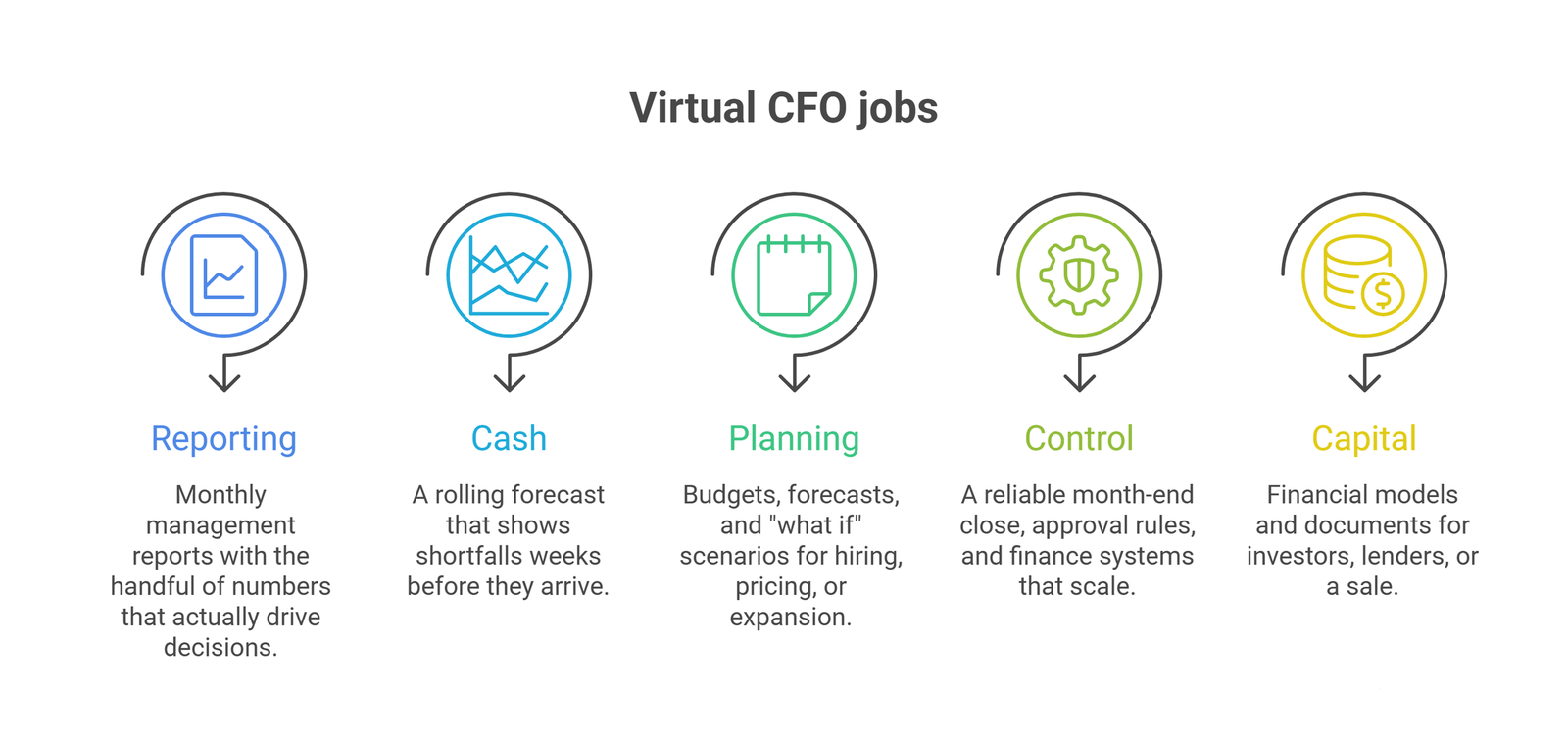
Most engagements center on five jobs:
- Reporting: monthly management reports with the handful of numbers that actually drive decisions.
- Cash: a rolling forecast that shows shortfalls weeks before they arrive.
- Planning: budgets, forecasts, and “what if” scenarios for hiring, pricing, or expansion.
- Control: a reliable month-end close, approval rules, and finance systems that scale.
- Capital: financial models and documents for investors, lenders, or a sale.
Virtual CFO vs other finance roles
The titles overlap, so a side-by-side view helps. For the in-house question in particular, see virtual CFO vs in-house CFO.
| Role | Main job | Time commitment | Best for |
| Virtual CFO | Strategy, forecasting, cash, reporting | Part time, scalable | Growing businesses that need senior judgment without a full-time seat |
| Fractional CFO | The same work, sold as a share of a week | Fixed days or hours per month | The same businesses, with a fixed schedule |
| Interim CFO | Cover a gap or a transition | Often full time for a set period | A departed CFO, a merger, a fundraise |
| In-house CFO | Leads the whole finance function | Full time, salaried | Larger or more complex companies |
| Controller | Accurate books, close, internal controls | Part time or full time | Businesses whose main problem is reporting accuracy |
| Bookkeeper | Records transactions | Hours based on volume | Day-to-day recordkeeping |
| Accountant | Tax, compliance, year-end statements | Seasonal or ongoing | Filing and compliance |
If you are weighing a controller against a CFO, this comparison of controller and CFO roles explains the difference.
Virtual, fractional, and interim
“Virtual” describes how the work is delivered, which is remotely. “Fractional” describes how much time the CFO gives you, which is a fraction of a week, and the guide to what a fractional CFO is goes deeper. “Interim” describes a temporary role, covered in the interim CFO role and its benefits. Most providers offer remote and part-time work together, so virtual and fractional usually point to the same arrangement. You may also see “outsourced CFO,” explained in this guide to outsourced CFOs, and “virtual finance officer.” Both mean the same thing.
Virtual CFO vs management consultant
A management consultant usually takes on a defined project, such as a market entry plan or an operations review, and hands over recommendations. A virtual CFO runs an ongoing finance function: reports arrive monthly, forecasts get updated, and decisions get tracked. Some firms offer both. If you want advice on one big question, a consultant may fit. If you need someone to own the numbers every month, you need a CFO.
What a virtual CFO costs
Price depends on scope, hours, and how complex your industry is. Retainers typically run from about $3,000 to $15,000 per month, and most small and mid-sized businesses pay between $3,000 and $10,000. Ad hoc work is usually billed by the hour or by the project.
A full-time CFO costs far more once you add benefits, payroll taxes, and recruiting time. The fractional CFO cost guide breaks down the pricing models, and the guide to hiring a virtual CFO compares the two side by side.
Benefits and limits
The benefits are easy to name. You get senior judgment without a salary, the engagement can grow or shrink with your needs, and an outside view helps when you are too close to the business. A good provider can also start in weeks, not months.
The limits are worth knowing too:
- A virtual CFO is not in the office every day, so response times and meeting rhythm need to be agreed in writing.
- The advice is only as good as the data. If your books are late or inaccurate, fixing that comes first.
- Some candidates lack depth in your industry. Ask for examples before you sign.
- Your CFO likely serves other clients, so confirm who covers when they are unavailable.
Signs your business is ready
You do not need a minimum revenue figure. Complexity matters more than size. Consider a virtual CFO when:
- Cash flow has surprised you more than once.
- Major decisions rely on gut feel because the numbers arrive too late.
- An investor or lender asks for a model or forecast you do not have.
- Growth is outpacing your finance systems.
- Your accountant cannot help with strategic questions.
If two or more of these sound familiar, see which businesses need a virtual CFO to find your situation.
What the first 90 days usually look like
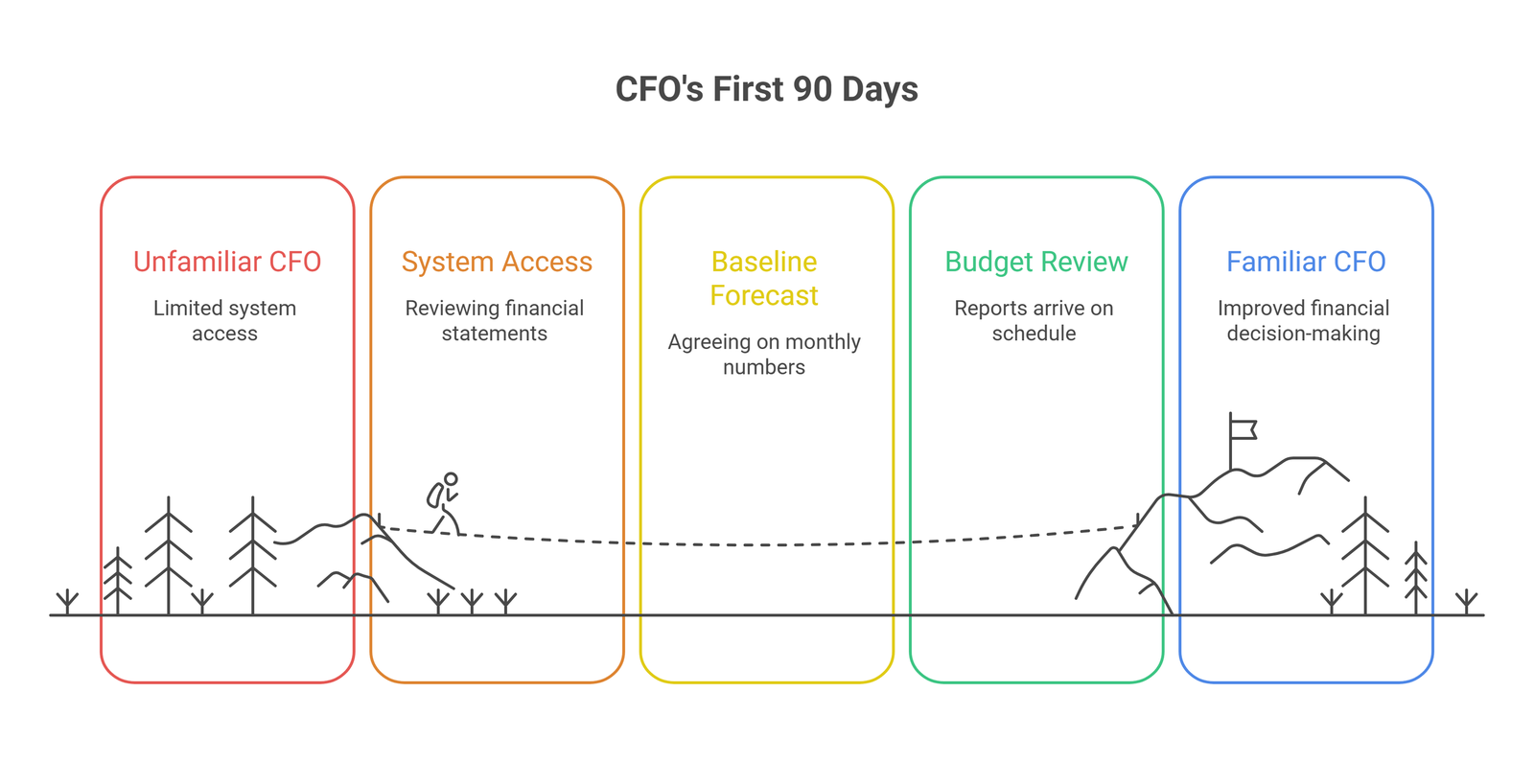
- Weeks 1 to 2: the CFO gets access to your systems and reviews the last 12 months of statements.
- Weeks 3 to 4: a baseline cash forecast and a short list of monthly numbers are agreed.
- Month 2: reports start arriving on a fixed schedule, and the first budget review takes place.
- Month 3: a review checks whether forecasts, reports, and decisions are improving, and the scope is adjusted if needed.
The step-by-step guide to choosing a virtual CFO explains how to set this up before you sign.
Frequently Asked Questions
Is a virtual CFO the same as an outsourced CFO?
Yes. The terms describe the same service: CFO-level work delivered by someone outside your payroll. “Virtual” stresses remote delivery, and “outsourced” stresses that the role sits outside your company.
Can a virtual CFO do my bookkeeping?
Some firms offer bookkeeping alongside CFO services, but the roles are different. A bookkeeper records transactions. A virtual CFO uses the records to forecast and advise. Keeping the two separate, or at least clearly scoped, avoids paying CFO rates for data entry.
How many hours a month does a virtual CFO work?
It varies. A light engagement may be a few hours for monthly review and a call. A growth-stage engagement may involve several days a month. Hours often rise during fundraising, audits, or year-end, then fall again.
What is the difference between a virtual CFO and an accountant?
An accountant keeps you compliant and reports what happened. A virtual CFO uses that information to plan what happens next. Most businesses need both.
How do I become a virtual CFO?
Providers typically have years of senior finance experience, often with a CPA, CMA, or similar credential, plus a track record that clients can verify. Building a client base is the harder part. It usually starts with referrals from past employers and professional networks.
A virtual CFO fits when you need judgment more than records
If the numbers exist but nobody is turning them into decisions, that is the job a virtual CFO does. Start with the problem you most need solved, then choose the engagement that fits it.
Oak Business Consultant provides virtual CFO services for startups and growing businesses, from interim support to ongoing planning. Book a call with the team to talk through what your business needs.