External vs Internal CFO: What Works Best for Your Business?
External CFO vs in-house CFO: cost, control and when to switch
Cash flow gets harder to read. Investors ask for numbers you cannot produce in a day. A bookkeeper and a basic accountant stop being enough. That is when the question arrives: do you hire a full-time CFO, or bring in an external one?
The answer depends on three things. How complex your finances are, how much day-to-day control you need, and what you can spend each month. This guide compares both models on those points, then shows when each one fits.
The short version: most startups and growing SMEs get better value from an external CFO. Businesses with a large finance team, constant regulatory pressure or operations in several countries usually need someone in house.
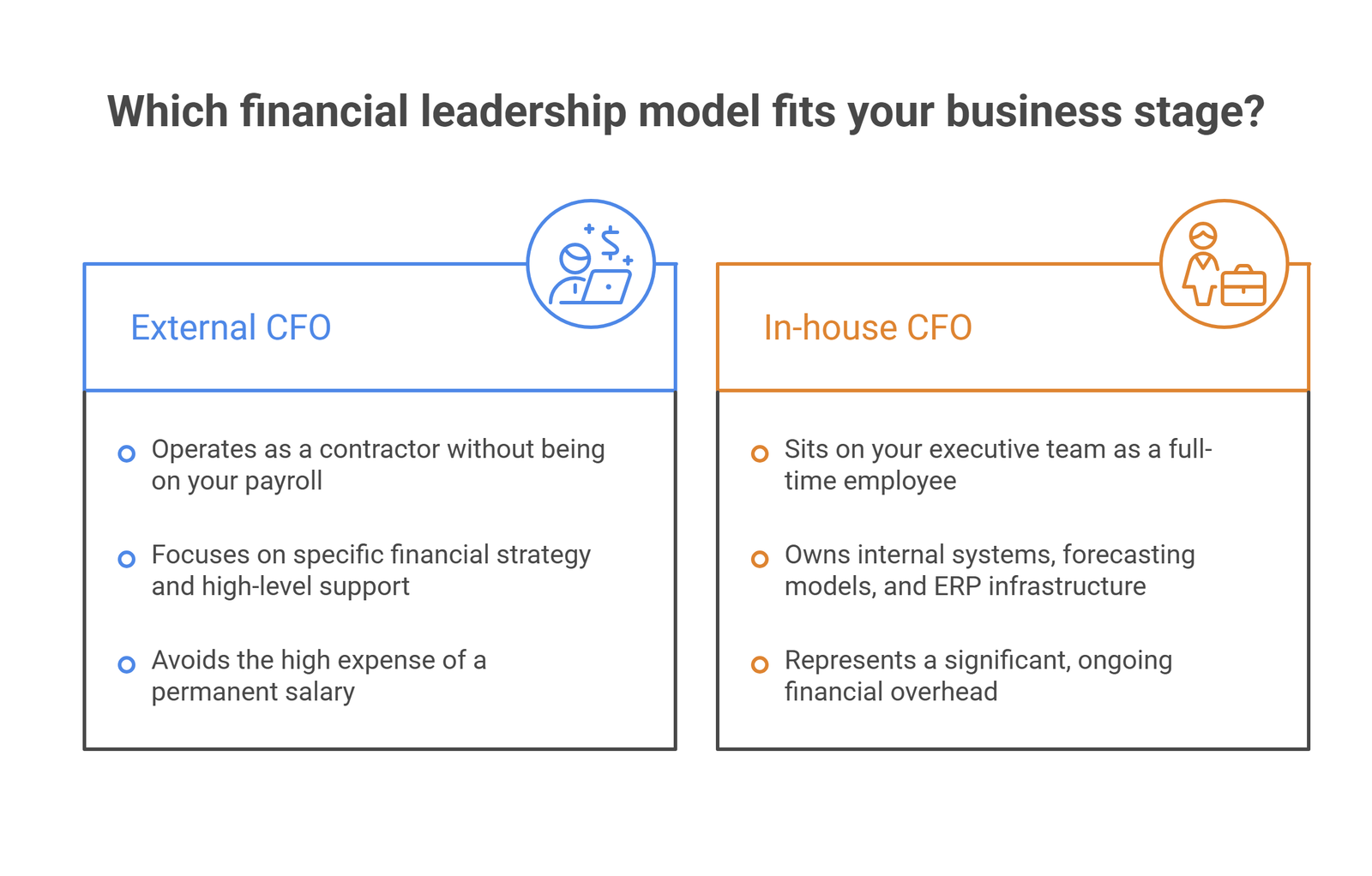
What is an external CFO?
An external CFO, sometimes called an external chief financial officer, is a senior finance professional. They work for your business without being on your payroll. They work part time, on a single project, or on a monthly retainer.
The job is the same as an in-house CFO’s: financial strategy, planning, reporting, cash flow, risk, compliance and support on big decisions. Only the engagement model changes.
The terms get used loosely. Virtual, outsourced and external CFO usually mean the same thing: a CFO who is not your employee. “Virtual” stresses that the work is remote. A fractional CFO gives you a fixed share of their time, such as two days a week. An interim CFO covers a gap, for example between one CFO leaving and the next one starting. So a search for “virtual CFO vs full-time CFO” is the same decision this guide covers.
What does an in-house CFO do?
A full-time CFO sits on your executive team. They attend every leadership meeting, lead the finance team and own the systems, from forecasting models to the ERP. Lender and board relationships run through them.
Over time they learn your systems, your people, your customers and your history. That continuity is worth a lot. It is also expensive, and for many startups and founder-led companies the overhead makes no sense yet.
External CFO vs in-house CFO: side-by-side comparison
| Factor | External CFO | In-house CFO |
| Typical cost | About $3,000 to $10,000 per month for most small and mid-sized scopes | $300,000+ per year before benefits, bonus and equity |
| Flexibility | Scale up or down as needed | Fixed full-time commitment |
| Time to start | Days to a few weeks | Months to recruit and onboard |
| Industry view | Broad, across several sectors | Deep, in one company |
| Objectivity | High, with an outside view | Can develop internal blind spots |
| Availability | Scheduled, part time or project based | Full time, always in the building |
| Day-to-day control | Shared with other clients | Direct and immediate |
| Team behind them | Often a controller and analysts | One executive hire |
| Continuity | Depends on the contract | High, with deep institutional memory |
| Best for | Startups, SMEs, growth-stage businesses | Large or complex operations |
What each model costs
Salary benchmarks vary by survey. Published US averages for CFO base pay run from about $300,000 to more than $430,000 a year. Several providers cite Salary.com for those figures. Benefits, bonus, equity and recruiter fees come on top. Hiring also takes months, and a wrong hire at this level is costly to undo.
External CFO retainers commonly start near $3,000 a month and reach about $10,000 for small and mid-sized scopes. A capital raise or acquisition can cost more. That works out to roughly $36,000 to $120,000 a year, against $300,000 or more before extras. Our breakdown of the cost of a fractional CFO shows what drives the price.
The bigger difference is flexibility. You can scale an external CFO up for a funding round and back down when things are steady. You cannot do that with a salary.
When an external CFO is the better fit
An external CFO is not a cheaper copy of a full-time hire. In these situations, they are often the better choice.
- You are raising capital. They know how to read a term sheet, structure debt or equity, and present a model investors trust.
- Cash flow is hard to read. They arrive with forecasting models and reporting templates, so the problem gets worked from the first week.
- Reporting is late or unreliable. A team behind them, often a controller and analysts, can fix the process behind the numbers.
- Big decisions are being made without a financial model or risk analysis.
- Receivables are slipping and margins are shrinking, and you want an outside view that will say so.
- A specific project needs CFO support, such as an acquisition, a restructure or a new market.
- Your CFO left suddenly. An interim CFO covers the gap and gives you time to hire carefully rather than fast.
- You want CFO-level clarity but cannot carry the salary yet.
An external CFO usually works with several businesses at once. That means they have seen where companies like yours tend to get stuck.
When an in-house CFO is the better fit
Some businesses need a CFO in the room every day.
- The company is large or operationally complex, with several divisions or a big headcount.
- The finance team is big enough to need daily senior leadership.
- Your industry is heavily regulated and needs constant, embedded oversight.
- You operate across several entities or countries.
- You sell physical products and need someone close to stock, receipts and supplier bills each day.
- Sensitive financial data or proprietary systems should stay with employees.
- You have outgrown the hours an external CFO can give you.
- Your board or investors require a permanent CFO.
Complexity matters more than revenue. A simple business with high revenue may not need a full-time CFO, while a mid-sized one with several entities may. At enterprise scale, a full-time CFO is a necessity, not a luxury.
Risks of an external CFO and how to manage them
An external CFO is not the right answer every time. Their time is shared, so response times can be slower than an employee’s. They need weeks to learn your business. If they move on, you lose context unless the work is documented. Most of this is fixed in the contract. Set response times, deliverables, a reporting rhythm and a handover process before the work starts.
On decision rights, an external CFO can carry the same accountability as an employee, but only if the agreement says so. Write down which decisions they make, which ones they recommend, and who signs off. Some owners keep final approval. Others hand over more authority once trust is built.
On data, a virtual CFO needs remote access to your accounts and financial records. Use multi-factor authentication and a VPN for remote logins. Give access only to the systems the work needs. Keep a log of who opened what. Sign a non-disclosure agreement before any data moves. A breach of financial records is expensive, so these steps are cheap insurance.
The hybrid approach
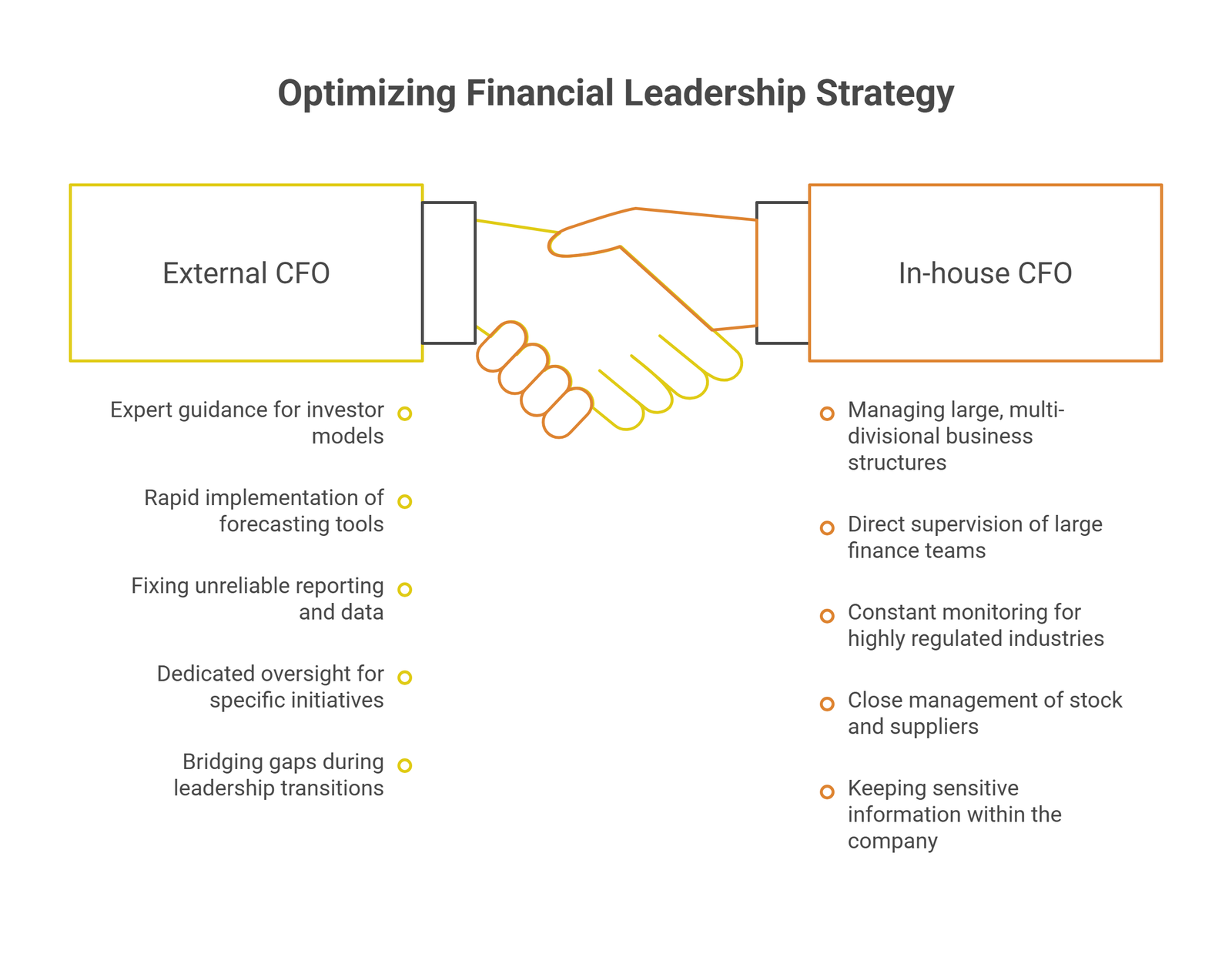
Many businesses land somewhere in the middle. A solid internal team handles daily accounting and reporting. An external CFO handles strategy, funding rounds and one-off projects.
This setup is common among startups and scaling companies. For timing, see when a startup should hire a CFO. It gives you senior financial leadership without the full-time cost. When complexity justifies it, the external CFO can help recruit and hand over to a permanent successor.
Five questions to ask before you decide
- What do you need most in the next 12 months: fundraising, reporting, cash control or compliance?
- How many decisions each week need a finance leader in the room that day?
- Who runs the finance function today, and can they grow into the role?
- What monthly commitment can you carry without strain?
- Can you define deliverables and a date to review the arrangement?
If the answers point to a specific need and a limited budget, start external. If they point to constant daily demand, start looking for a full-time hire.
Frequently Asked Questions
Is a virtual CFO the same as an external CFO?
Usually, yes. Both describe a CFO who is not on your payroll. Virtual points to remote work. Fractional points to a fixed share of their time. An interim CFO is a temporary stand-in, often while you recruit.
How much does an external CFO cost compared with a full-time CFO?
Retainers commonly start near $3,000 a month and reach about $10,000 for small and mid-sized scopes. Complex projects can cost more. A full-time CFO often costs $300,000 or more a year before benefits, bonus and equity.
Can an external CFO make decisions for the company?
Yes, if you give them the authority. Many act as advisers and leave final approval to the owner or board. Put decision rights in writing at the start.
When should I switch from an external CFO to an in-house CFO?
Switch when you need full-time presence, a large finance team under one leader, or your board requires a permanent CFO. A good external CFO will help you hire and hand over.
Is it safe to give an external CFO remote access to financial data?
It can be, with controls. Use multi-factor authentication, a VPN, limited access by role, activity logs and a signed non-disclosure agreement.
How fast can an external CFO start?
Usually within days to a few weeks. A full-time hire often takes months once searching, interviews and notice periods are counted.
Choosing for your stage, not forever
This is a decision about where your business is now. Most companies start with an external CFO and move to an in-house hire once complexity demands it. The best external CFOs plan for that handover from the first month.
Oak Business Consultant provides virtual CFO and strategic advisory services, with interim, ongoing and project-based options. If you want to see which fits your business, book a call and talk it through with the team.