Comptroller vs. Controller: Key Differences and Responsibilities
Controller vs comptroller: same job, different employers
A business owner reads a job post for a “comptroller” and wonders if it is a senior finance role or a typo. A city employee sees “controller” on a vendor’s invoice and wonders the same thing. Both are reasonable questions, because the two titles look different and are pronounced almost the same way.
Here is the short version. The jobs overlap heavily, but the titles split by sector. This guide explains where each one is used, how the work differs, and which title matters for your business.
The short answer
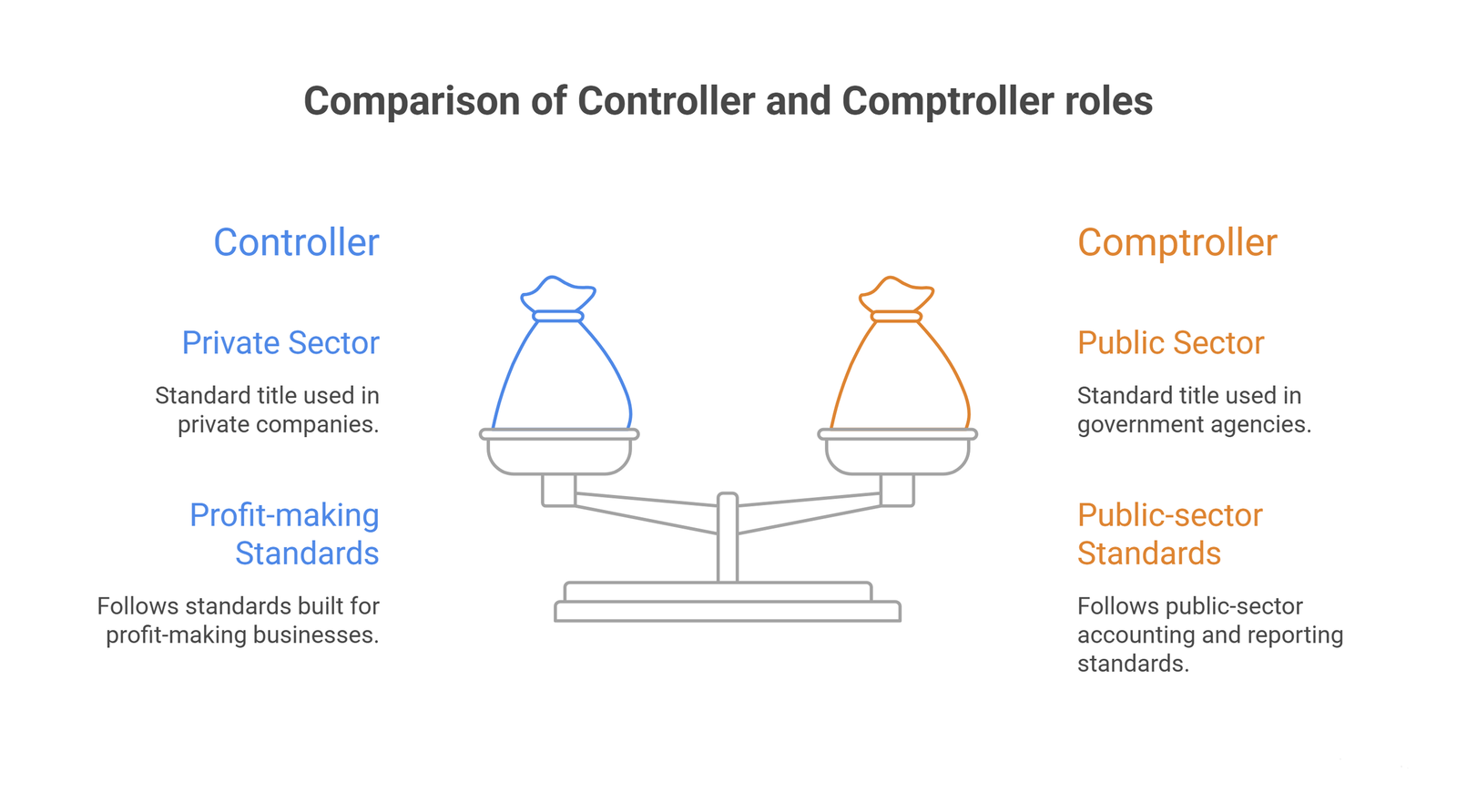
A controller and a comptroller both run accounting and financial reporting. Controller is the standard title in private companies. Comptroller is the standard title in government agencies, and it also appears in some nonprofits and a few private firms. The biggest practical difference is the rulebook. Government comptrollers follow public-sector standards, while private controllers follow standards built for profit-making businesses.
| Controller | Comptroller | |
| Where it is used | Private companies, most nonprofits | Federal, state and local government, some nonprofits, a few private firms |
| Main job | Accurate books, reports and internal controls | The same, plus budget compliance and public accountability |
| Reporting standards | GAAP (US) or IFRS | GASB for state and local government, FASAB for federal agencies |
| Accountable to | Owner, CEO, CFO, lenders, investors | Elected officials, agency heads, legislatures and the public |
| Main goal | Profit and sound decisions | Legal use of public money and transparency |
| Common credentials | CPA, CMA | CPA, CGFM (Certified Government Financial Manager) |
What a controller does
A controller is the head of accounting in a business. The job starts with the month-end close. The controller makes sure transactions are recorded, accounts are reconciled and the financial statements are ready on time.
A typical controller also handles:
- the general ledger and chart of accounts
- accounts payable and receivable oversight
- budget tracking and variance reports
- internal controls that catch errors and fraud
- audit preparation and tax coordination
- supervision of bookkeepers and accountants
In most private companies, the controller reports to the CFO or, in smaller firms, to the owner or CEO. For a closer look at how that relationship works, see this guide to controller vs CFO.
What a comptroller does
A comptroller does the same core accounting work. The difference is who the money belongs to. In government, the funds come from taxpayers, so the job carries extra duties.
A government comptroller usually:
- tracks every appropriation and makes sure spending stays within it
- approves payments and audits claims before money goes out
- prepares the annual financial report for the public
- oversees payroll, debt and investments held on behalf of the public
- enforces procurement and spending rules set by law
Some comptrollers are appointed. Others are elected. Many US states and cities have an elected comptroller who acts as the chief fiscal officer, and the role can be partly political. A private controller answers to the company. A public comptroller answers to voters.
Where the word comes from
The two words share one root. “Comptroller” comes from the Anglo-French word for a copy of a register, used to check the original. That sense of checking one record against another is still the heart of the job.
The spelling is a historical accident. English writers later linked the word to the verb “compute” and added a “p.” The spelling stuck, but the pronunciation did not follow. Most people say “comptroller” like “controller,” and many dictionaries accept that pronunciation. Some speakers say the “p” aloud, as in “komp-troller.” Either one is acceptable.
The real difference: reporting standards
If the work is so similar, why does the title matter? The answer is the accounting rulebook.
Private companies in the US follow generally accepted accounting principles (GAAP), set by the Financial Accounting Standards Board. Companies outside the US often follow IFRS. These rules aim to show profit, assets and cash flow to owners, lenders and investors.
State and local governments follow standards from the Governmental Accounting Standards Board (GASB). Federal agencies follow standards from the Federal Accounting Standards Advisory Board. These rules answer a different question: did the government spend public money legally and for its stated purpose?
That change shows up in the statements themselves. Under GASB Statement 34, a government produces government-wide statements, mainly a Statement of Net Position and a Statement of Activities. Those replace the balance sheet and income statement a business would use. Governments also split their activities into governmental and business-type categories, and they track money in separate funds.
Fund accounting is the other big shift. A government keeps separate pots of money for roads, schools, utilities and other purposes. Each pot has its own rules. A private controller deals with one set of books built around profit. A comptroller manages many sets built around restrictions.
Where each title shows up in practice
Titles are not random, so it helps to know where you will meet each one.
Government. State comptrollers, city comptrollers and county comptrollers hold the top financial post in their governments. At the federal level, the Comptroller General of the United States leads the Government Accountability Office (GAO), which audits federal spending for Congress. The Comptroller General serves a single 15-year term, which keeps the office independent of any one administration.
Nonprofits. Practice varies. Many nonprofits use controller, because they follow standards close to business rules. Others use comptroller, especially when they receive heavy government funding or have ties to a public agency.
Private companies. Controller is far more common. A few older or traditional firms use comptroller as a style choice, and the job is the same. If you see “comptroller” on a private company’s org chart, treat it as a controller unless the posting says otherwise.
How the career paths compare
The paths start in the same place. Both roles usually begin with an accounting degree and several years of experience as an accountant or senior accountant.
From there, the routes split. A private controller often moves up to VP of finance or CFO. A government comptroller often moves toward a larger government, an elected position or a role such as chief financial officer of a public agency.
Credentials follow the sector:
- CPA. Valued in both sectors, and often required for senior roles.
- CMA. Common in private industry, with a focus on management accounting.
- CGFM. Built for public-sector finance, and common among government comptrollers.
On pay, the US Bureau of Labor Statistics reported a May 2024 median wage of $134,180 for financial managers. For those working in government, it was $124,440. Those figures cover financial managers broadly, not controllers or comptrollers alone. Actual pay depends on location, organization size and the scope of the job.
When the titles mean the same thing
Plenty of times, the choice of word makes no difference. A company can call its head of accounting a controller or a comptroller and the day-to-day work will look the same. A hiring manager should read the job description rather than the title. The tasks, the reporting line and the standards used matter more than the spelling.
Three questions help you decode any posting:
- Is the employer a government body or a company?
- Which standards does the finance team follow: GAAP, IFRS or GASB?
- Who does the role report to: a CFO, a board or an elected official?
The answers tell you more than the title does.
What this means for a growing business
If you run a private business, you need a controller, however you spell it. The real question is when and how. Many small companies cannot justify a full-time hire. Instead, they bring in an outsourced controller to run the close, review the books and keep reporting on schedule. This is often part of accounting and bookkeeping services built for growing firms.
When the business needs planning and funding advice on top of clean books, a fractional CFO can fill that gap on a part-time basis. The cost of a fractional CFO is usually far lower than a full-time executive, so it suits many companies under $30 million in revenue.
A government vendor or contractor has one more reason to care. Public agencies often require invoices, audits and reports in a specific format. A finance lead who understands both private and public reporting avoids rejected paperwork and slow payments.
Frequently Asked Questions
Is a comptroller the same as a controller?
In function, mostly yes. Both oversee accounting, reporting and internal controls. In practice, the title differs by sector. Comptroller is the usual government title, while controller is the usual private-sector title.
Which is higher, a controller or a comptroller?
Neither outranks the other, because they sit in different types of organizations. Rank depends on the employer. A state comptroller is a top official in state government, and a controller in a small company may report to the owner. Compare the reporting lines, not the titles.
How do you pronounce comptroller?
Most people say it like “controller,” with the stress on the first syllable. Some say the “p” aloud. Both are accepted, and the “p” is only a spelling relic.
Do comptrollers and controllers use different accounting rules?
Often, yes. Private controllers usually follow GAAP or IFRS. State and local government comptrollers follow GASB standards, and federal agencies follow FASAB standards. Nonprofits typically follow GAAP with extra rules for their sector.
Can a controller become a comptroller?
Yes. The core skills transfer well. A move into government usually requires learning fund accounting and public-sector reporting, and a credential such as the CGFM can help.
Does a small business need a comptroller?
A small business needs the function, not the title. Someone has to own the books, the close and the controls. That person can be a staff accountant, an outsourced controller or a part-time finance lead, depending on size and complexity.
What is the difference between a comptroller and a CFO?
A comptroller or controller focuses on accurate records, reports and controls. A CFO looks ahead at cash, funding and strategy. The CFO usually sits above both roles in a company.
Choosing the right label for your team
The word you pick matters less than the job behind it. For a private business, controller is the clear choice, since it matches how lenders, auditors and candidates read the role. For a government body or a public-facing nonprofit, comptroller may be the better fit, because it signals public accountability.
One more point is worth adding. If your team is deciding between an in-house hire and outside help, start with the problem you need solved. Late or unreliable books point to a controller. Unclear plans for cash and growth point to a CFO. Many companies need both before they can afford either one full-time.
Oak Business Consultant provides CFO services that include fractional and virtual CFOs and outsourced controller support. To talk through which finance setup fits your business, book a call with the Oak team.