How is the CFO Role Transforming the Media and Entertainment Industry?
The media and entertainment CFO: managing streaming margins
A decade ago, an entertainment CFO funded a slate, tracked box office and closed the quarter. Today the same CFO prices subscription tiers, models ad revenue, decides how content costs hit the P&L and answers board questions about AI.
The change is not cosmetic. BCG’s 2026 analysis found that profits in the US video value chain fell by $15.6 billion, or 31 percent, between 2018 and 2025. Streaming turned profitable in that period. It still did not close the gap.
The CFO sits in the middle of that gap. This guide explains what changed, the revenue models and KPIs that now matter, and how production companies and media startups can get CFO-level help without a full-time hire.
Why the old media CFO model stopped working
Streaming broke the economics that media finance was built on. It disrupted the pay-TV bundle, collapsed the release windows that let rights owners earn from the same title many times, and gave audiences more reasons to stay home.
BCG’s numbers show where profit moved:
| Value chain segment | Change in US profit, 2018 to 2025 |
| Cable networks | Down $13.8 billion |
| Film studios | Down $3.8 billion |
| Theaters | Down $2.2 billion |
| Streaming | From a $1 billion loss to an $8.4 billion profit |
BCG’s conclusion is blunt: streaming profits will not offset the losses elsewhere. A CFO cannot rely on one growth engine to rescue the whole portfolio.
The pandemic boost and what followed
COVID gave streamers an easy burst of subscribers. Many companies added customers at low cost. Keeping them proved harder. As a 2021 CFO Dive analysis noted, retention now needed fresh content and affordable pricing, and acquisition costs were set to rise.
That is why the CFO job moved from cost control to growth planning. Finance now shapes pricing, content spend and distribution strategy.
Revenue models a media CFO has to manage
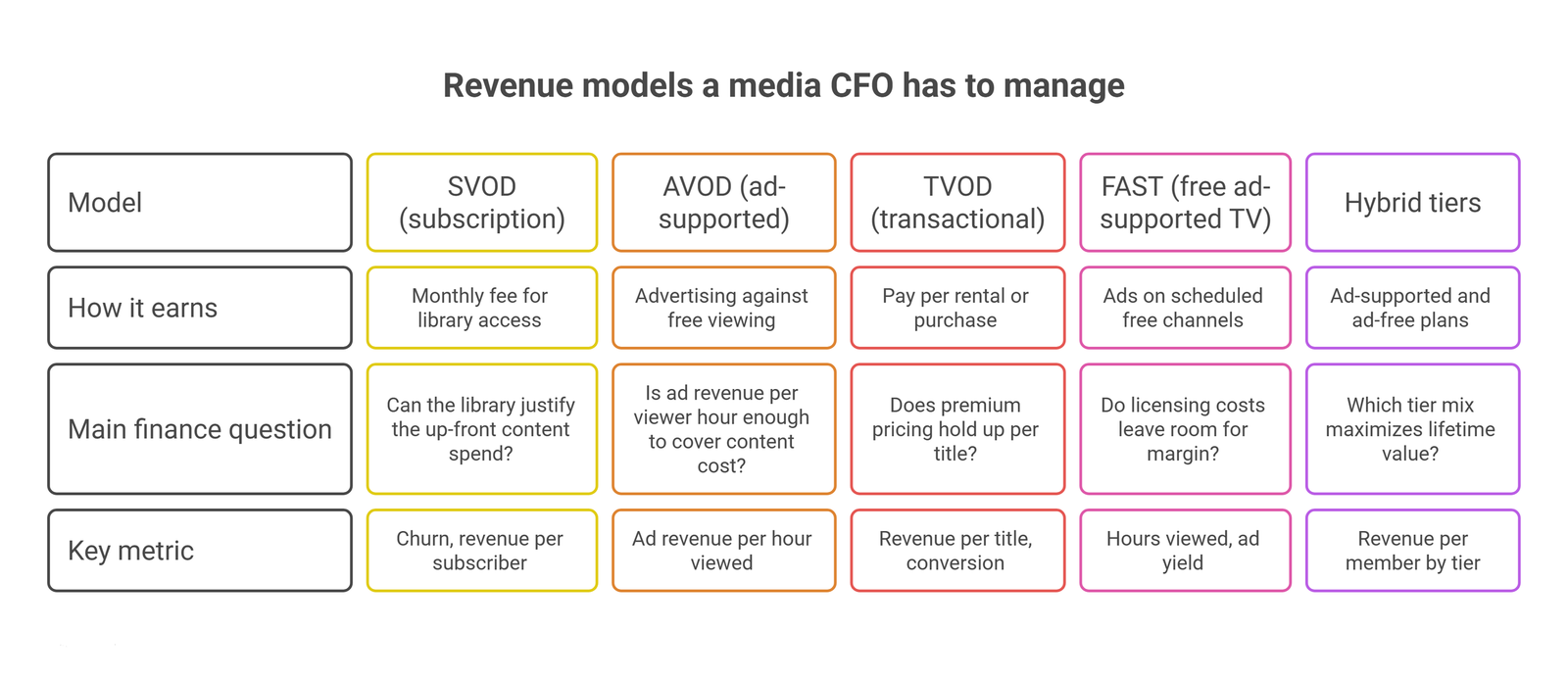
SVOD, AVOD, TVOD and FAST are business models, not CFO inventions. They came from platform strategy and consumer behavior. The CFO’s job is to model each one, set the mix and judge the risk.
| Model | How it earns | Main finance question | Key metric |
| SVOD (subscription) | Monthly fee for library access | Can the library justify the up-front content spend? | Churn, revenue per subscriber |
| AVOD (ad-supported) | Advertising against free viewing | Is ad revenue per viewer hour enough to cover content cost? | Ad revenue per hour viewed |
| TVOD (transactional) | Pay per rental or purchase | Does premium pricing hold up per title? | Revenue per title, conversion |
| FAST (free ad-supported TV) | Ads on scheduled free channels | Do licensing costs leave room for margin? | Hours viewed, ad yield |
| Hybrid tiers | Ad-supported and ad-free plans | Which tier mix maximizes lifetime value? | Revenue per member by tier |
SVOD gives steady, predictable revenue, but it needs a large library before it can attract subscribers. TVOD earns more per title for premium content and depends less on advertising. A SVOD financial model helps test these trade-offs before money is committed.
Most companies now blend models. A viewer who will not subscribe may still rent a title or watch with ads. The CFO decides which titles go where.
Content costs, amortization and cash
Content is the largest cost in most media businesses, and its accounting is not intuitive. Companies capitalize content as an asset and then amortize it over the period it is expected to generate revenue. Cash leaves the business first. The expense shows up later.
That timing gap is why public streamers discuss cash content spend relative to amortization in their shareholder letters. A CFO tracks three things:
- Cash content spend. What is going out the door this year.
- Amortization. How much of past spend hits the P&L.
- Impairment risk. Titles that underperform may need to be written down.
Talent adds another layer. CFOs model participations, residuals and guarantees at the title level, so a hit does not create a surprise liability.
Cost discipline can work without hurting audience results. Paramount Skydance reported that average production cost per episode fell nearly 10 percent year over year for the 2025-26 broadcast season. Its share of the top 20 series still rose.
Long-range forecasts for each title
Studios and funds build forecasts that follow a title across every window: theatrical, SVOD, AVOD, FAST, pay TV and international licensing. These “ultimates” models update as actual results arrive. Good bookkeeping and a clean chart of accounts keep those forecasts honest.
The KPIs that replaced subscriber counts
Subscriber totals no longer tell the full story. AlixPartners’ 2026 predictions report notes that Netflix and Disney+ stopped disclosing subscriber numbers. Investor attention moved to average revenue per member, profitability and engagement.
| KPI | What it tells the CFO |
| Average revenue per member (ARM) | Whether pricing and tier mix are working |
| Churn | How quickly the base leaks |
| Customer lifetime value (CLV) | What a subscriber is worth over time |
| Customer acquisition cost (CAC) | Whether growth spend still pays back |
| Hours viewed | Engagement, and a leading indicator of churn |
| Content cost per hour viewed | Whether the library earns its cost |
A short list of CFO KPIs reviewed on a fixed schedule beats a long dashboard nobody reads.
Consolidation and portfolio decisions
Media is in a structural reset. EY’s 2026 outlook describes legacy companies separating declining linear networks from faster-growing streaming and studio businesses. The large digital platforms have also joined the consolidation conversation, competing for scarce intellectual property.
AlixPartners expects more deals in 2026 than 2025, but smaller ones, aimed at assets that strengthen technology capabilities.
Each of these moves lands on the CFO’s desk:
- Valuing the separate businesses and setting their capital structures
- Running due diligence and integration plans
- Deciding which networks, libraries or services to keep, sell or merge
The role has become a route to the top. CNBC has reported on media CFOs, including Warner Bros. Discovery’s Gunnar Wiedenfels and Comcast’s Mike Cavanagh, who moved into broader operating leadership.
AI: efficiency gains and an authenticity risk
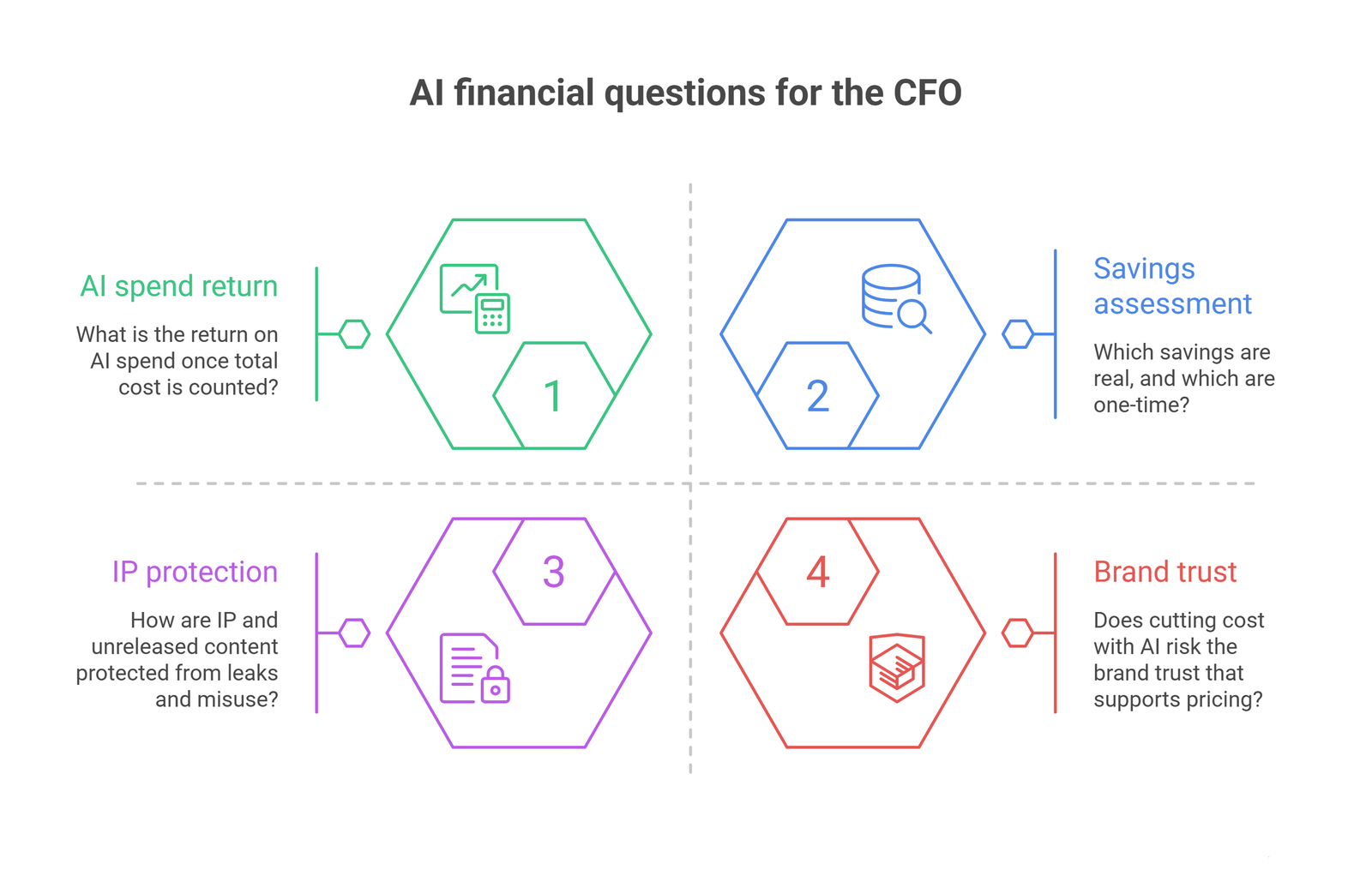
AI is spreading across the media value chain, including post-production, dubbing, localization and marketing. EY calls the productivity gains real. It also warns that trust is falling and that audiences are tired of low-quality synthetic content.
BCG’s survey adds a number: 56 percent of consumers said they prefer human-generated content. BCG expects value to split, with a premium tier for content that is certified as human-made.
For the CFO, AI raises practical questions:
- What is the return on AI spend once total cost is counted?
- Which savings are real, and which are one-time?
- How are IP and unreleased content protected from leaks and misuse?
- Does cutting cost with AI risk the brand trust that supports pricing?
Piracy and pre-release leaks remain financial risks. CFOs fund access controls and monitoring, and they set the budget for rights protection.
Live experiences and creators: new revenue lines
BCG measured revenue per hour of consumer time across media types. The spread is wide.
| Media type | Revenue per hour of consumer time |
| Location-based entertainment | $3.47 |
| $0.74 | |
| Gaming | $0.70 |
| Social media | $0.69 |
| Video | $0.39 |
| Audio | $0.19 |
Source: BCG, October 2026.
Live experiences earn far more per hour than video, which explains why EY calls the experience economy a strategic priority. It also describes a creator economy that is maturing into real business partnerships, with shared data and transparent economics. A CFO evaluating these lines has to model different cost structures, capital needs and revenue-sharing terms.
Why many production companies choose a virtual or fractional CFO
Entertainment has long been secretive. Production companies worried that an outside CFO might leak sensitive information or disrupt the creative process. Remote work and secure cloud tools have changed that. Confidentiality can now be handled with strict NDAs, controlled access and clear data rules.
A virtual CFO suits several situations:
- Single-project production companies that need budgeting and cash control for one title at a time. A special purpose CFO fits this case.
- Content startups that need investor-ready forecasts but cannot afford a full-time CFO.
- Established studios that need extra capacity for a deal, a restructure or a new revenue line.
An industry-specific entertainment financial model is often the first deliverable. It gives founders and investors the same set of assumptions.
Frequently Asked Questions
What does a CFO do in media and entertainment?
A media CFO manages budgets, content investment, revenue models, forecasting and reporting. Today the role also covers pricing strategy, subscription and advertising economics, M&A, AI investment decisions and capital raising. The CFO links creative ambition to financial reality.
How do streaming companies make money?
They use four main models: subscriptions (SVOD), advertising (AVOD), pay-per-title rentals or purchases (TVOD) and free ad-supported channels (FAST). Many combine them, such as a cheaper plan with ads and a premium plan without. The CFO chooses the mix and monitors results.
What is content amortization?
Content amortization spreads the cost of a film or series across the period it is expected to earn revenue. The company records the content as an asset, pays cash up front, and expenses it over time. If a title underperforms, it may need a write-down.
Why did streamers stop reporting subscriber numbers?
AlixPartners reports that Netflix and Disney+ no longer disclose subscriber totals. Investor focus moved to average revenue per member, profitability and engagement. These measures show financial health better than raw subscriber counts, especially with ad tiers and price changes in the mix.
Can a small production company use a fractional CFO?
Yes. A fractional or virtual CFO can build the production budget, manage cash flow, prepare investor reports and model distribution revenue. This is often more practical than a full-time hire, especially for companies that work project by project.
How is AI changing the media CFO role?
AI adds new cost lines and new savings. The CFO evaluates return on AI spend, protects IP, and weighs efficiency gains against audience trust. BCG found most surveyed consumers prefer human-made content, so quality and authenticity still affect revenue.
Conclusion
The media and entertainment CFO has moved from cost controller to strategic partner. With video profits under pressure, the winners will be companies that price carefully, manage content spend with discipline and make deliberate portfolio choices.
Oak Business Consultant supports media and entertainment companies with virtual CFO services covering forecasting, financial modeling, content budgeting and investor reporting. Book a call to discuss your slate, your streaming economics or your next raise.