Cleaning Company Business Plan: From First Client to Profitability
Business plan for a cleaning service company (with break-even math)
A cleaning company rarely fails because people stop wanting a clean home. It fails because the price per visit does not cover labor, drive time, and the weeks it takes to fill a schedule. Startup costs are low, so many owners skip the plan and set prices by copying a neighbor.
A business plan for a cleaning service company fixes that. It turns hours, wages, and travel into a price you can defend and a break-even number you can track. This guide covers each section and ends with a worked example built on simple arithmetic.
What the plan needs to cover
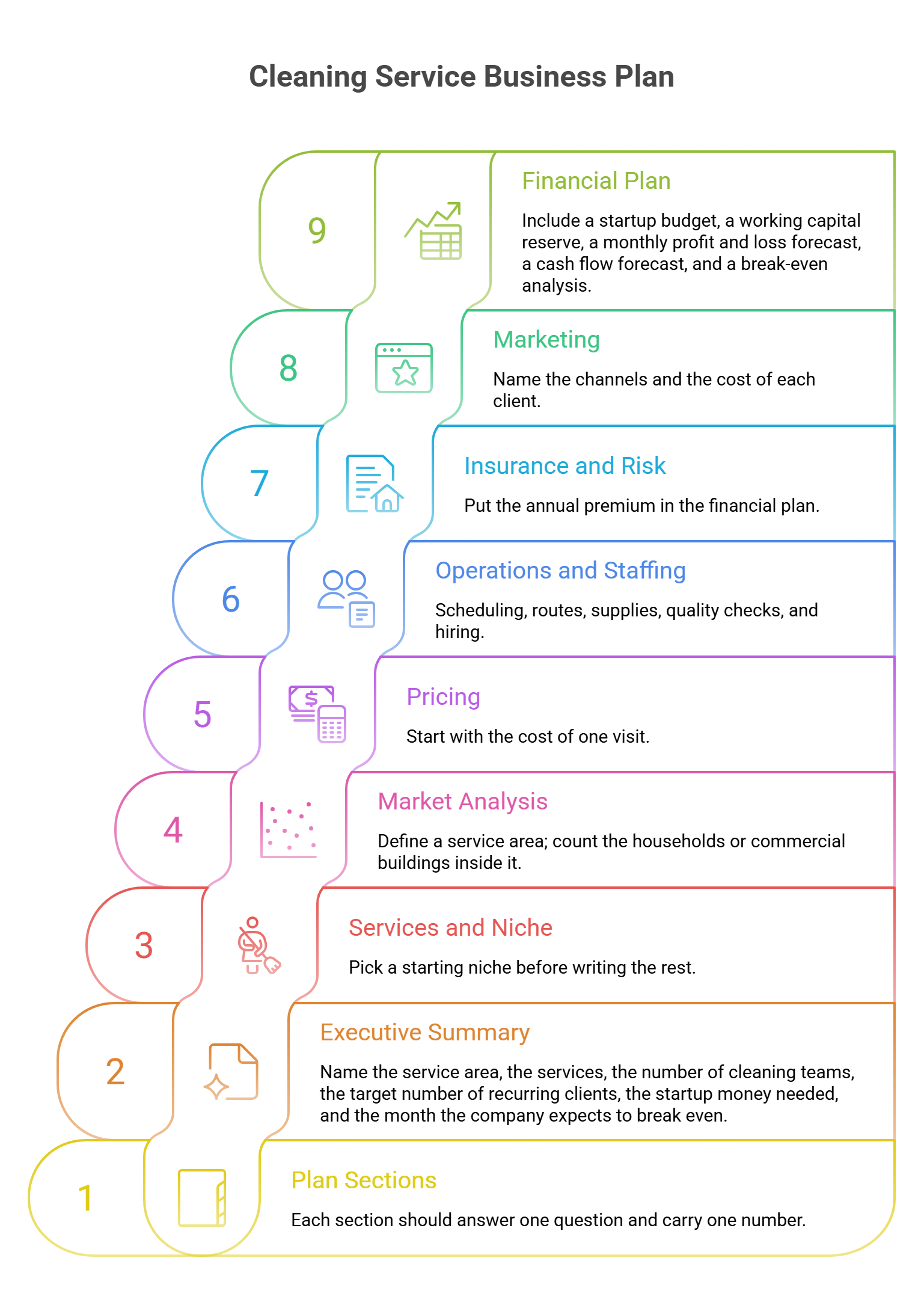
Each section should answer one question and carry one number. A section without a number usually means the owner has not worked it out yet.
| Section | The question it answers | The number to include |
| Executive summary | Why this company, and when does it pay off? | Month of break-even |
| Services and niche | Who do you clean for? | Share of recurring versus one-time jobs |
| Market analysis | Is there enough local demand? | Households or buildings in your service area |
| Pricing | What does one visit cost, and what do you charge? | Price per visit and contribution margin |
| Operations and staffing | Who cleans, and how many visits fit in a month? | Visits per team per month |
| Insurance and risk | What happens when something breaks or goes missing? | Annual premium |
| Marketing | How do clients find you? | Cost per new recurring client |
| Financial plan | Will it make money, and how much cash comes first? | Break-even visits per month |
Executive summary
Write the executive summary last, even though it opens the document. By then the pricing and break-even figures exist, so the summary can state them.
Keep it to one page. Name the service area, the services, the number of cleaning teams, the target number of recurring clients, the startup money needed, and the month the company expects to break even. A goal such as “30 recurring clients within six months” gives a lender something to check.
Services and niche
Pick a starting niche before writing the rest. The segment you choose decides how steady the income is, how fast clients pay, and what insurance you need.
| Segment | How the revenue behaves | Main trade-off |
| Recurring residential | Repeat visits, often paid by card on file | Clients leave when they move or cut budgets |
| Commercial and janitorial | Contracts, evening work, invoiced | Slower payment and tougher bidding |
| Move-in and move-out | One-time jobs at a higher price | No repeat business and uneven demand |
| Short-term rental turnover | Frequent jobs tied to guest bookings | Tight deadlines and last-minute changes |
| Post-construction and specialty | High price per job | Needs equipment, and damage risk is higher |
Recurring residential work is a common starting point, because the visits repeat and payment is quick. Other owners start in a niche where competitors are few. Whichever you choose, say why it fits your budget and your local market.
Market analysis
Cleaning is a local business, so the market analysis should be local. Define a service area, such as a 20-minute drive from your base. Count the households or commercial buildings inside it, then estimate how many already pay for cleaning. A short survey of neighbors or a count of competitor reviews can stand in for hard data.
Then turn demand into something your company can actually serve. A single team can complete only so many visits a month, which caps the number of clients it can hold.
- Visits per team per month ÷ visits per client per month = clients per team
If a team completes 44 visits a month and each client is cleaned twice a month, one team serves about 22 recurring clients. That number is your realistic share of the market. For a deeper method, read how to do a market analysis.
Next, study five to ten competitors. Record their price per visit, minimum booking, whether they bring supplies, and any extra fee for deep cleaning. Read their reviews for repeat complaints, such as late arrivals, missed spots, and no-shows. Those complaints show where a new company can win.
Pricing
Cleaning companies price by the hour, by square foot, by flat rate per visit, or by a mix. The method matters less than the math behind it. Start with the cost of one visit.
- Cost of a visit = cleaner hours × loaded hourly wage + supplies + travel
- Price = cost of a visit ÷ (1 − target margin)
Loaded wage means pay plus payroll taxes and workers’ compensation. Count every hour you pay for, including training time and, where the rules require it, travel between jobs. Price per square foot or per room is fine for quoting, but check each quote against the hours the job really takes.
Competitor prices are a useful ceiling and floor. They are a poor starting point, because a rival may have lower wages, a different mix of clients, or no plan at all. The cost formula tells you the lowest price that still works.
Operations and staffing
The operations section shows how visits get done on time, week after week. It should cover scheduling, routes, supplies, quality checks, and hiring.
Capacity. Assume a two-person team cleans two homes a day, with drive time between them. Over 22 working days, that is about 44 visits a month. Your plan should state this number, because it limits revenue until you add a second team.
Scheduling and routes. Book clients in clusters by neighborhood to cut drive time. Scheduling software helps with reminders, rebooking, and route order.
Supplies. Decide whether clients provide supplies or the company brings its own. Buy in bulk and track the cost per visit.
Quality. Use a written checklist for each service. Add a callback policy, so a missed spot gets fixed quickly and the client stays.
Employees or contractors. The rules differ by state and country, and a wrong classification can bring back taxes and penalties. Confirm the rules with a local adviser, then state your choice in the plan, because it changes labor cost. Payroll, sales tax, and monthly books also need an owner, and bookkeeping support can keep them clean from the first month.
Insurance and risk
Cleaners work inside other people’s property, so insurance is part of the cost of doing business. Ask a broker which cover applies to you.
- General liability covers accidental damage and injury at the client’s site.
- Workers’ compensation applies once you hire staff, in most places.
- Commercial auto matters if company vehicles carry equipment.
- A janitorial bond protects commercial clients against theft by staff, and some clients require it.
Put the annual premium in the financial plan. Also write down your incident process: how a damage claim gets reported, who pays the deductible, and how you keep the client’s trust.
Marketing
A cleaning company needs a steady flow of new recurring clients, so the marketing plan should name the channels and the cost of each client.
Start with a Google Business Profile and a short, clear website with online booking. Ask every happy client for a review after the visit. Offer a referral credit to existing clients. Build ties with property managers, real estate agents, and short-term rental hosts, who send repeat work. A small discount for a recurring plan turns one-time buyers into steady revenue.
Then track cost per new client: marketing spend ÷ new recurring clients. If $600 a month brings in ten clients, each one costs $60. In the example below, a client cleaned twice a month adds about $113 of contribution a month, so that $60 returns within the first two visits.
Financial plan
This section tells a lender or partner how much money the company needs and when it pays back. It should include a startup budget, a working capital reserve, a monthly profit and loss forecast, a cash flow forecast, and a break-even analysis. Oak’s cleaning service financial model provides a five-year structure for these statements if you prefer not to build one from scratch.
Two formulas carry most of the weight.
- Contribution margin per visit = price − labor − supplies − travel − payment fees
- Break-even visits per month = fixed monthly costs ÷ contribution margin per visit
Cash flow needs its own forecast. Payroll goes out every week or two, while a commercial client may pay an invoice 30 days later. Seasonal swings also matter, since demand often rises before holidays and falls in slow months. A profit on paper does not help if payroll is due on Friday and the invoice is not paid. A professional financial plan can test these timing risks before they happen.
If you plan to seek outside funding, a lender will ask for the plan, the startup budget, and the cash flow forecast. For investor conversations, Oak also offers a cleaning service pitch deck.
Worked example: a residential cleaning company
Take a hypothetical company that sends two-person teams to clean homes for three hours. The figures are illustrative assumptions. Replace them with your own quotes and local wages.
| Line item per visit | Amount |
| Price per visit | $210.00 |
| Labor (2 cleaners × 3 hours × $21 loaded wage) | $126.00 |
| Supplies | $9.00 |
| Travel (fuel and vehicle wear) | $12.00 |
| Card fee (assumed 2.9% + $0.30) | $6.39 |
| Contribution margin per visit | $56.61 |
The price comes from the pricing formula: $147 of cost before fees, divided by 0.70, gives $210 for a 30% target margin. After card fees, the real margin lands at 27%. Labor is 60% of revenue, which is why wages and hours deserve the most attention.
| Fixed monthly cost | Amount |
| Insurance | $250 |
| Scheduling and booking software | $120 |
| Marketing | $600 |
| Vehicle costs | $450 |
| Part-time scheduler | $1,200 |
| Accounting | $150 |
| Phone and other | $180 |
| Total | $2,950 |
Divide $2,950 by $56.61, and the company needs about 53 visits a month to break even, or roughly $11,130 in revenue. That is a useful result, because one team completes only about 44 visits a month. In this example, a single team cannot reach break-even, so the plan has to include a second team.
A second team adds fixed cost. Assume another $550 a month for a vehicle and insurance. Fixed costs rise to $3,500, and break-even moves to about 62 visits, or 70% of the capacity of two teams. This figure excludes owner pay, so the owner must cover that from profit above break-even or work in the business.
Small changes move the result fast:
- A $10 price increase lifts contribution to $66.32 and cuts break-even to 45 visits on the original cost base.
- A $2 rise in the hourly wage drops contribution to $44.61 and pushes break-even to 67 visits.
Now the startup budget.
| Startup item | Amount |
| Equipment (vacuums, caddies, tools) | $1,800 |
| Initial supplies | $400 |
| Insurance, first quarter | $750 |
| Registration and licenses | $500 |
| Website and booking setup | $800 |
| Uniforms and branding | $400 |
| Setup subtotal | $4,650 |
| Working capital (two months of fixed costs plus two weeks of team payroll) | $8,460 |
| Total cash needed | $13,110 |
Some guides stop at the setup subtotal. The reserve is the larger number, and it is the one that keeps payroll covered while the schedule fills.
Milestones and KPIs
Tie each milestone to a date and a number. A first-year plan might aim for 15 recurring clients by month three, 30 by month six, and the second team hired once visits reach 40 a month.
Track a short list each week: recurring clients, clients lost, revenue per labor hour, labor cost as a share of revenue, rebook rate, cost per new client, and average review score. Check them against the plan every month and revise the assumptions that missed.
Common mistakes
Five mistakes are common. Owners copy competitor prices instead of costing a visit. They forget unpaid time such as training and travel. They launch without a cash reserve. They delay the second team until the owner is exhausted. They skip a cancellation policy, so late cancellations eat the margin.
Each one has a plain fix: cost the visit, count every paid hour, fund the reserve, plan the hire in advance, and write the cancellation terms into the booking.
Frequently Asked Questions
How profitable is a cleaning business?
Profit depends on price, labor cost, and how full the schedule is. In the example above, each visit leaves a 27% contribution margin, and the company earns a profit only after about 53 visits a month. Those figures are illustrative, so test your own.
How much does it cost to start a cleaning business?
Setup costs for equipment, supplies, insurance, and branding can stay modest. The bigger need is working capital for payroll while clients are added. The example needs $4,650 for setup and about $8,460 in reserve.
What should I charge for cleaning services?
Cost the visit first: cleaner hours × loaded wage + supplies + travel. Then divide by one minus your target margin. Compare the result with local competitors, and adjust only if the market allows a higher price.
Do I need a business plan to get a loan?
Most lenders ask for one. They usually want the startup budget, a cash flow forecast, and a break-even analysis, along with a description of the services and the market.
Should cleaners be employees or contractors?
The answer depends on local rules and on how much control the company has over the work. Check with a local adviser, then record the choice in the plan, since it changes payroll taxes and insurance.
What insurance does a cleaning company need?
Most carry general liability, add workers’ compensation when they hire, and add commercial auto when vehicles carry equipment. Commercial clients may also ask for a janitorial bond. A broker can confirm what applies in your area.
A cleaning company is limited by the hours in a day
Unlike a store, a cleaning company cannot sell more by adding stock. Each team has a fixed number of hours, so revenue per labor hour is the number that tells you the most. Price, schedule density, and drive time all feed into it, and a plan that tracks it will show problems early.
Oak Business Consultant writes investor-ready business plans for service companies, including cleaning businesses, with the financial forecasts behind them. To have a plan prepared and checked by financial advisers, see the Oak business plan service.