Virtual CFO for Startups | Strategic Financial Leadership & Growth
Introduction: Why Startups Can’t Afford to Go Without Financial Leadership
In the high-stakes arena of early-stage business, where cash is the lifeblood and runway is everything, access to sophisticated financial expertise is not a luxury. It is a survival requirement. Yet the cost of hiring a full-time Chief Financial Officer remains prohibitive for most startups. In the United States alone, a full-time CFO commands a median base salary of $437,000, with total compensation including equity, bonuses, and benefits frequently exceeding $500,000 per year.
The data on startup failure is equally sobering. According to the Global Startup Ecosystem Report 2025, nine out of ten startups fail within their first five years. Among the most frequently cited causes: poor financial management ranks in the top three. A 2024 industry survey found that over 80 percent of SME failures are directly linked to cash flow problems, and 70 percent of startup failures trace back to inadequate budgeting. Nearly half of failed ventures underestimated their own operating costs.
These are not random misfortunes. They are the predictable consequences of operating without strategic financial leadership.
This is precisely why the Virtual CFO for Startups has emerged as one of the most critical executive functions available to early-stage and growth-stage companies. A Virtual CFO, also referred to as an outsourced CFO or fractional CFO, delivers senior-level financial guidance remotely and on a flexible basis. The result is the same caliber of strategic financial leadership that drives unicorns and funded ventures, without the fixed-cost commitment that would drain a startup’s runway before it reaches its next milestone.
This guide covers everything founders, operators, and investors need to understand about the Virtual CFO model: what it is, what it costs, what it delivers, and how to choose the right partner.
What Is a Virtual CFO for Startups?
A Virtual CFO is a seasoned finance professional who provides high-level CFO services to a company remotely, on a part-time or project basis. Unlike a full-time internal hire, the Virtual CFO integrates into the founding team as a strategic partner, translating complex financial data into clear, actionable decisions that move the company forward.
The role goes far beyond accounting or bookkeeping. A Virtual CFO is responsible for the forward-looking financial strategy of the business. They think in terms of runway, growth rate, capital efficiency, and investor readiness. Their mandate is not to reconcile last month’s ledger but to build the financial infrastructure the company needs to scale, secure investment, and achieve sustainable long-term success.
Key characteristics of the Virtual CFO model:

Remote and Flexible Engagement. Virtual CFOs work from outside your office, using cloud-based accounting software, video conferencing, and shared financial platforms to remain fully integrated with the leadership team.
Part-Time or Retainer-Based Structure. Engagements are typically structured as monthly retainers, hourly arrangements, or project-based agreements. The startup pays only for the expertise it actually needs, and can scale involvement up or down as circumstances change.
Strategic Orientation. While a bookkeeper records what happened and an accountant ensures compliance, the Virtual CFO focuses on what should happen next. Their value lies in financial insight, strategic advice, and executive-level decision support.
Cross-Industry Perspective. Because Virtual CFOs typically serve multiple clients simultaneously across different sectors, they bring a breadth of experience that a single in-house hire rarely matches. Their exposure to multiple fundraising rounds, business models, and financial challenges gives them pattern recognition that is invaluable for startups navigating unfamiliar territory.
The terms “Virtual CFO,” “fractional CFO,” and “outsourced CFO” are often used interchangeably. While subtle distinctions exist (fractional tends to emphasize the part-time, shared nature of the role, while virtual emphasizes the remote, technology-driven delivery), in practice the services and value proposition are functionally identical.
Virtual CFO vs. Full-Time CFO: The Definitive Comparison
The decision between a Virtual CFO and a full-time hire is not simply a cost question. It is a strategic decision about what stage of financial leadership your company actually needs, and whether the economics of a permanent executive make sense at this point in your trajectory.
| Feature | Virtual CFO for Startups | Full-Time CFO |
| Annual Cost | $36,000 to $120,000 (retainer) | $300,000 to $500,000+ (salary, benefits, equity) |
| Time to Onboard | Days to two weeks | Three to six months (recruiting, interviewing, onboarding) |
| Breadth of Experience | Cross-industry exposure from multiple client engagements | Limited to the prior roles of a single individual |
| Availability | Scalable: increase hours for fundraising, reduce during steady periods | Fixed commitment regardless of workload fluctuation |
| Strategic Focus | 100% focused on financial leadership and value creation | Often occupied by administrative, managerial, and operational tasks |
| Equity Requirement | None or minimal | Typically 0.5% to 1.5% equity stake expected |
| Break-Even Risk | None: no termination costs, no severance | High: a mis-hire at the executive level costs months of runway |
| Technology Stack | Uses best-in-class cloud tools; not tied to any internal legacy system | May bring entrenched preferences or require expensive system changes |
For most startups operating before Series B, and for many beyond it, the cost-benefit analysis strongly favors the Virtual CFO model. The savings alone, typically 60 to 80 percent less than a full-time hire, can extend runway by months, which in many cases is the difference between finding product-market fit and running out of capital.
The 7 Core Services a Virtual CFO Delivers for Startups

1. Cash Flow and Runway Management
Cash flow is the heartbeat of any startup. A single misstep in cash planning, whether a missed receivable, an accelerated expense, or a delayed funding round, can terminate a company that was otherwise on a sound trajectory.
A Virtual CFO establishes disciplined cash flow monitoring and forecasting from the outset. This includes:
Burn Rate Analysis. The Virtual CFO calculates and tracks your monthly burn rate in real time, distinguishing between gross burn and net burn. They establish dashboards that give founders a clear, current view of how much runway remains under current and projected spending scenarios.
Dynamic Cash Flow Forecasting. Rather than a static spreadsheet, a Virtual CFO builds rolling 13-week cash flow forecasts and longer-range projections, updated as new information arrives. This allows the leadership team to anticipate liquidity gaps weeks or months before they materialize, creating time to adjust spending, accelerate revenue, or begin the fundraising process.
Working Capital Optimization. Virtual CFOs identify opportunities to improve cash conversion, including negotiating better payment terms with vendors, tightening accounts receivable collection cycles, and improving the timing of billing and collections. Each of these levers, often invisible to founders, can meaningfully extend runway without requiring additional capital.
Scenario Planning. Operating in a dynamic environment, startups face constant uncertainty. The Virtual CFO models multiple financial scenarios, base case, downside, and upside, so the leadership team can make contingency decisions in advance rather than reacting under pressure.
2. Investor Readiness and Capital Raising
According to Embroker, U.S. venture capital investment reached $190.4 billion in 2024, a 30 percent increase from the previous year. The startup funding ecosystem is active, but highly competitive. Investors conduct rigorous due diligence, and companies with clean, credible, professionally structured financial documentation win a decisive advantage.
A Virtual CFO is your most important asset during the fundraising process. Their role includes:
Investor-Ready Financial Models. A Virtual CFO builds detailed, defensible financial models that project revenue, expenses, headcount, and cash flow under realistic assumptions. These models include the sensitivity analyses and scenario outputs that sophisticated investors expect to see. They tell your growth story in the language of numbers.
Clean Financial Statements. Due diligence begins with the balance sheet and income statement. A Virtual CFO ensures your financial statements are prepared on the correct basis, reconciled accurately, and presented in a format that passes investor scrutiny without raising questions.
Pitch Deck Financials. The financial slides in a pitch deck are among the most scrutinized pages in any investor presentation. A Virtual CFO ensures the numbers are accurate, internally consistent, and compelling. They can also advise on how to frame the financial narrative for different investor audiences, including angel investors, venture capital firms, and strategic partners.
Due Diligence Management. When a term sheet arrives, the due diligence process begins, and it moves fast. A Virtual CFO coordinates the financial documentation process, responds to investor queries, and ensures that no data room request exposes inconsistencies or gaps that could slow or derail the close.
Ongoing Investor Reporting. After funding is secured, the relationship with investors continues. Virtual CFOs manage board reporting, monthly investor updates, and financial covenant tracking, ensuring transparency and building the long-term credibility that positions the company well for subsequent rounds.
Capital Structure Advice. From equity versus debt tradeoffs to the dilution implications of different term sheet structures, a Virtual CFO provides objective counsel on financing decisions that founders, often encountering these structures for the first time, may not be equipped to evaluate independently.
3. Financial Forecasting and Strategic Planning
Strategy without financial grounding is aspiration. A Virtual CFO bridges the gap between a founder’s vision and the hard numbers required to pursue it responsibly.
Integrated Financial Planning. The Virtual CFO leads strategic planning sessions in which operational goals are translated into financial commitments: headcount plans become salary expense, marketing ambitions become customer acquisition cost assumptions, and revenue targets become unit economics exercises. The result is a comprehensive financial plan that aligns the entire team around a common set of assumptions.
Annual Budgeting and Quarterly Reforecasting. A Virtual CFO establishes a budgeting cadence that keeps the company grounded without becoming bureaucratic. Annual budgets are built collaboratively with department heads. Quarterly reforecasts update those plans in light of actual results, market developments, and strategic pivots.
Financial Planning and Analysis (FP&A) Function. For many startups, the Virtual CFO establishes and leads the FP&A function from scratch, building the systems, processes, and reporting infrastructure that will support data-driven decision-making as the company scales.
Growth Modeling. Startups frequently need to evaluate major strategic decisions: entering a new market, launching a new product line, acquiring a competitor, or hiring ahead of revenue. A Virtual CFO builds the financial models that quantify the costs, risks, and potential returns of each option, transforming what might otherwise be intuitive decisions into analytically grounded ones.
4. Financial Modeling and Unit Economics
Unit economics are the foundation of a fundable, scalable startup. Understanding the true cost to acquire a customer, the lifetime value they generate, and the contribution margin of each product or service is not optional for any company seeking to raise capital or achieve profitability.
A Virtual CFO brings rigorous financial modeling capabilities to these questions. They build three-statement financial models (income statement, balance sheet, cash flow statement) integrated with driver-based assumptions. They design models that can be stress-tested, scenario-run, and easily updated as conditions change.
For SaaS companies, this means tracking MRR, ARR, churn rate, CAC payback period, and LTV/CAC ratio. Additionally, for marketplace businesses, it means understanding take rate, GMV, and supply-side economics. For consumer businesses, it means analyzing cohort retention, payback period, and contribution margin by channel. A Virtual CFO brings the right modeling framework for your specific business model, rather than applying a generic template.
5. System Implementation and Internal Controls
Scaling a startup without the right financial infrastructure in place is like building a skyscraper on an unstable foundation. Sooner or later, the structural weaknesses become visible, often at the worst possible moment.
A Virtual CFO is responsible for building the financial systems and controls that allow the company to operate efficiently and report accurately as it grows:
Cloud Accounting Software Selection and Implementation. The Virtual CFO selects and implements the appropriate accounting platform for the company’s stage and complexity. Tools such as QuickBooks Online, Xero, or Zoho Books provide real-time financial visibility and integrate with downstream reporting tools. The right choice at an early stage avoids expensive migrations later.
FP&A and Business Intelligence Tools. Beyond accounting, sophisticated startups need tools for budgeting, forecasting, and reporting. Virtual CFOs implement FP&A platforms or configure business intelligence tools such as Power BI or Mosaic to give the leadership team real-time visibility into key metrics.
Internal Controls and Financial Policies. A Virtual CFO establishes the approval workflows, segregation of duties, expense policies, and audit trails that protect company assets and ensure financial data integrity. These controls also satisfy the expectations of investors and auditors, reducing friction at every subsequent financing event.
Payroll and Payments Integration. Platforms such as Gusto for payroll and Stripe for revenue processing are integrated with the accounting system, eliminating manual data entry and reducing error risk. A Virtual CFO maps out the full financial operations stack and ensures every component works together.
6. KPI Tracking and Business Performance Management
What gets measured gets managed. A Virtual CFO establishes the key performance indicator framework that gives the leadership team the financial insight needed to run the business with precision.
This includes defining the right KPIs for the company’s stage and business model, building dashboards that update automatically from connected data sources, and establishing a cadence of management reporting that keeps the team aligned on performance against plan.
For early-stage startups, the critical financial KPIs typically include monthly burn rate, cash runway, month-over-month revenue growth, gross margin, and customer acquisition cost. As the company matures, the Virtual CFO expands this framework to include operating leverage, EBITDA margin progression, working capital efficiency, and return on invested capital.
Regular business performance reviews, led by the Virtual CFO, create accountability, surface issues early, and ensure that the leadership team is making decisions based on accurate, timely information rather than gut feel.
7. Tax Strategy and Compliance Oversight
Early-stage companies often leave significant value on the table by failing to optimize their tax position. A Virtual CFO brings awareness of the key tax levers available to startups:
R&D Tax Credits. For technology and product-development companies, the Research and Development Tax Credit represents a meaningful source of non-dilutive capital that many startups overlook. A Virtual CFO identifies qualifying activities and ensures the credit is properly claimed.
Entity Structure Optimization. The choice of legal entity, jurisdiction of incorporation, and ownership structure have substantial tax implications. A Virtual CFO advises on these decisions at formation and re-evaluates them as the company’s structure evolves.
Sales Tax Compliance. As startups scale across geographies, particularly in the United States where sales tax rules vary by state, compliance complexity increases rapidly. A Virtual CFO establishes the systems and processes needed to stay compliant without disrupting operations.
International Tax Considerations. For startups with customers, employees, or operations in multiple countries, a Virtual CFO helps navigate transfer pricing, permanent establishment risk, and VAT/GST obligations.
When Does a Startup Need a Virtual CFO?
Many founders assume that financial leadership is something they can defer until the company is larger. This instinct is understandable but frequently costly. The right time to engage a Virtual CFO is earlier than most founders expect.
Consider engaging a Virtual CFO when:
You are preparing to raise your first or next funding round. Investors expect institutional-quality financial documentation, defensible projections, and clean historical records. The time to build these is before you enter investor conversations, not after you receive your first due diligence request.
You are experiencing rapid growth. Growth is a financial event. Hiring, procurement, working capital, and revenue recognition all become more complex as the company scales. A Virtual CFO provides the infrastructure and oversight needed to sustain growth without creating financial chaos.
Your founder is spending significant time on financial tasks. A CEO or COO managing spreadsheets, bank reconciliations, or investor reporting is an expensive misallocation of talent. A Virtual CFO reclaims those hours for the company’s core priorities.
You have received funding and have financial reporting obligations. Board reporting, investor updates, and covenant tracking create recurring financial responsibilities that benefit from professional management.
You are approaching break-even or profitability. Managing the transition from growth spending to operating leverage requires strategic financial guidance, particularly in optimizing the timing of investments and the management of working capital.
You are facing a major strategic decision. M&A activity, international expansion, a new product launch, or a pivot each carry significant financial implications. A Virtual CFO provides the analytical framework to evaluate these decisions rigorously.
How a Virtual CFO Drives Growth: Stage-by-Stage Impact
The contribution of a Virtual CFO looks different at each stage of a startup’s lifecycle:
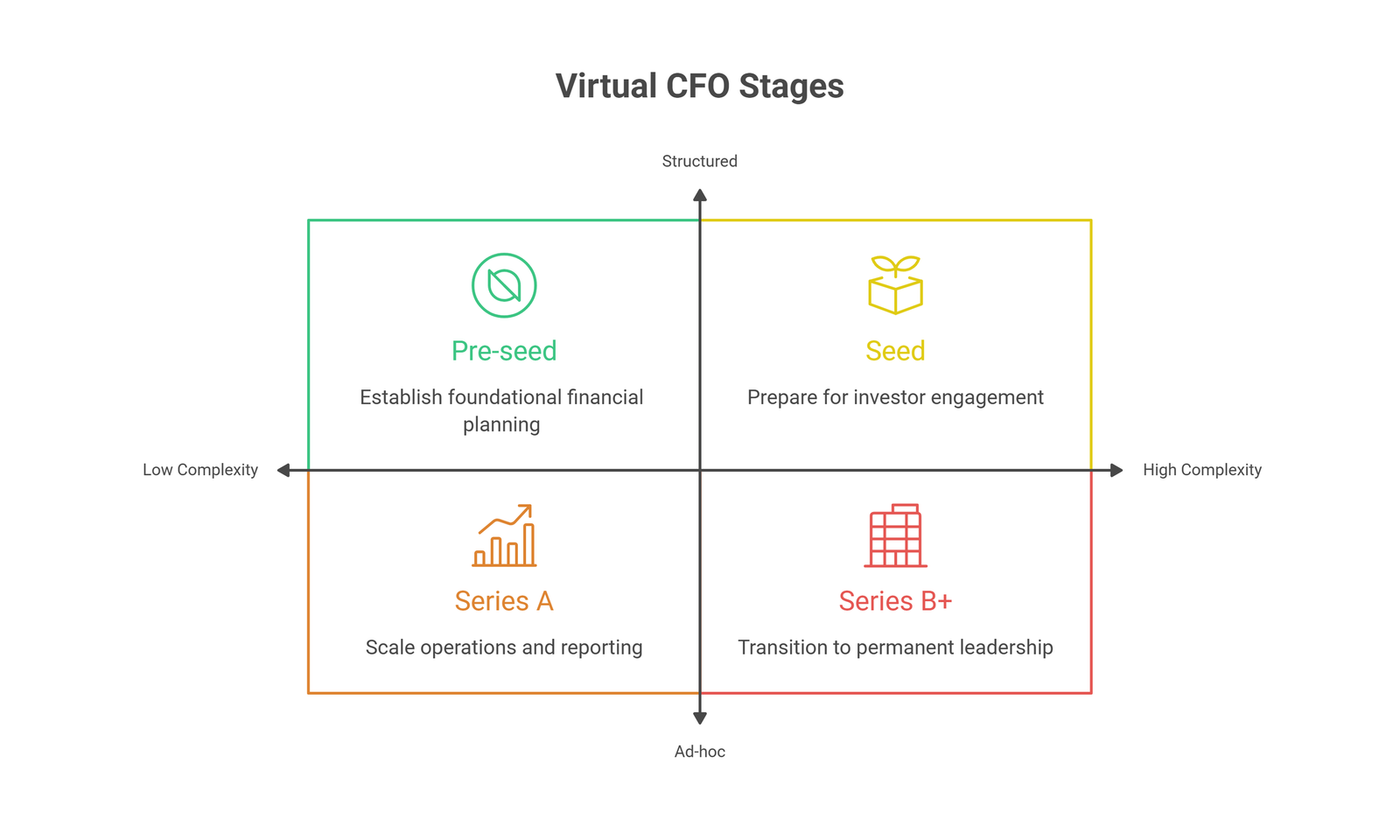
Pre-Seed and Seed Stage. At this stage, the Virtual CFO establishes the financial foundation: setting up the accounting system, building the first financial model, establishing the budget, and preparing the company for its first institutional fundraise. Clean records and a credible financial plan at this stage dramatically improve the founder’s ability to raise capital on favorable terms.
Series A. The Series A process involves intensive financial due diligence. The Virtual CFO leads preparation: reconciling historical records, building the three-year financial model, preparing the data room, and coaching the founding team on the financial questions investors will ask. Post-close, they establish the board reporting infrastructure and manage investor relations on the financial side.
Series B and Growth Stage. At this stage, the company’s financial complexity has increased substantially. The Virtual CFO manages a growing team of accountants and analysts, leads the annual budgeting process, drives FP&A discipline across the organization, and begins preparing the company for a potential exit or IPO. They evaluate strategic investments in new markets, products, and talent, translating strategy into financial commitments.
Pre-Exit or IPO Preparation. As the company approaches an exit event, whether a strategic acquisition or a public offering, the Virtual CFO takes on a central role in preparing the company’s financial records, managing the due diligence process, and working alongside investment bankers and legal counsel to execute a successful transaction.
Virtual CFO Pricing: What Startups Can Expect to Pay
One of the most frequently asked questions founders have about Virtual CFO services is cost. The answer depends on the scope of services, the company’s complexity, and the structure of the engagement.
Pricing Structures
Monthly Retainer. The most common arrangement for ongoing Virtual CFO engagements. Retainers typically range from $3,000 to $10,000 per month, with the most common range for comprehensive startup support falling between $5,000 and $7,500 per month. This covers a defined set of hours and deliverables each month.
Hourly Rate. For project-based or periodic support, hourly rates typically range from $150 to $450 per hour, with most engagements falling in the $175 to $300 range. Hourly arrangements work well for one-off projects such as financial model reviews or fundraising preparation.
Project-Based Pricing. Specific projects, such as building a full three-statement financial model for a funding round or managing a due diligence process, are often priced on a fixed-fee basis. A fundraising-ready financial model typically costs $5,000 to $15,000. M&A support or exit preparation commands significantly higher fees.
Cost Comparison
| Engagement Type | Annual Cost to Startup |
| Full-time CFO (salary, benefits, equity) | $300,000 to $500,000+ |
| Virtual CFO (monthly retainer, $5,000/month) | $60,000 |
| Virtual CFO (monthly retainer, $7,500/month) | $90,000 |
| Virtual CFO (hourly, 10 hours/month at $250/hour) | $30,000 |
A startup paying $5,000 per month for a Virtual CFO spends approximately $60,000 per year. That is roughly 15 to 20 percent of what a full-time CFO would cost in base salary alone, before benefits, equity, and bonuses. For a company still finding product-market fit, those savings translate directly into extended runway.
Research indicates that companies receiving strategic CFO guidance demonstrate 23 percent higher profit margins than those relying solely on transactional accounting services. A 2024 industry survey found that 78 percent of SMEs that used Virtual CFO services in the prior three years reported improved profitability and greater financial control. The ROI from professional financial leadership is measurable.
How to Choose the Right Virtual CFO Service

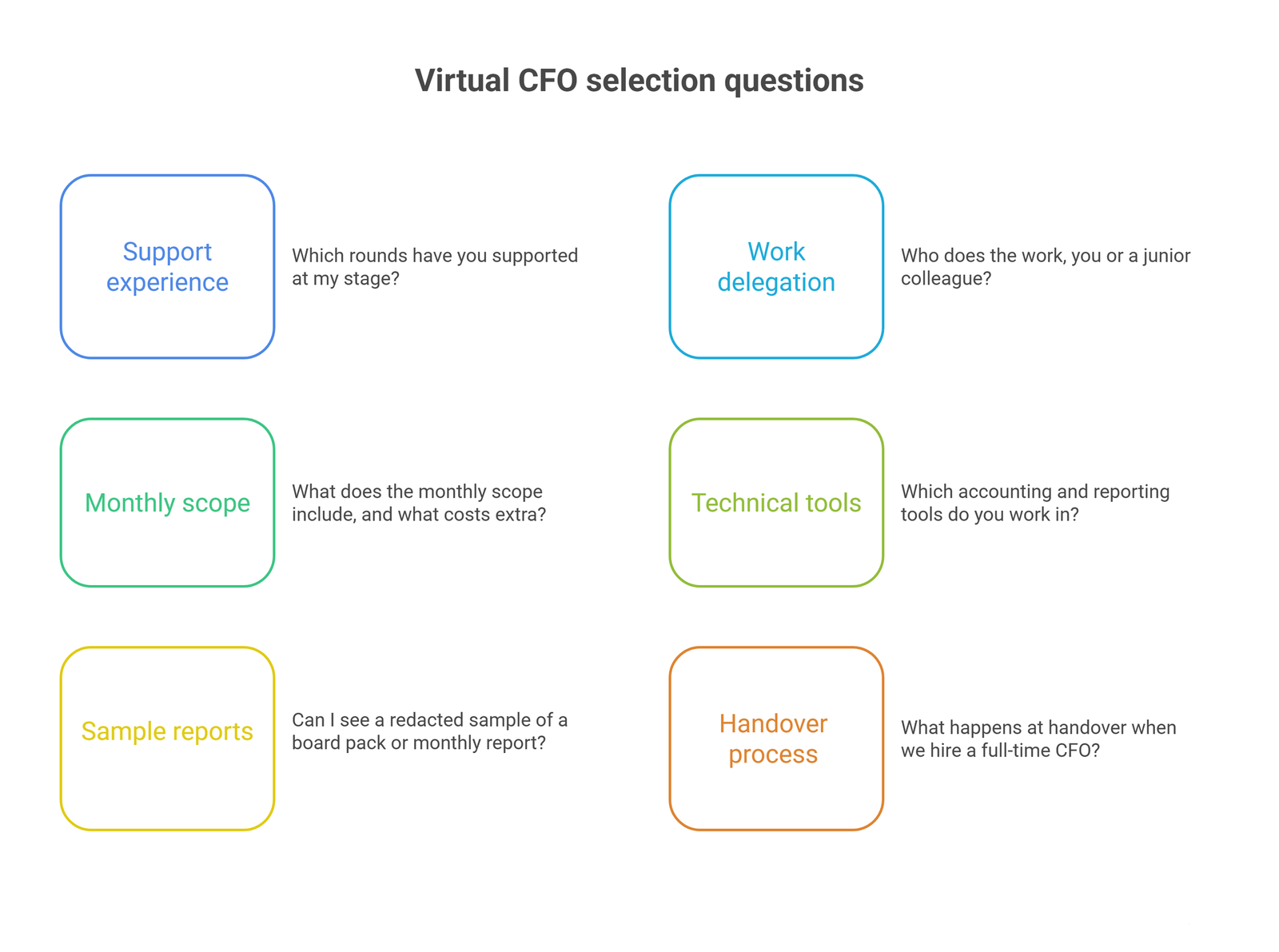
Not all Virtual CFO providers are equal. Selecting the right partner requires diligence across several dimensions:
Industry and Stage Experience.
Look for a provider with a documented track record of supporting companies at your specific stage and in your sector. A Virtual CFO who has guided multiple SaaS companies through Series A and B fundraises brings a different, and more relevant, perspective than one whose background is in retail or manufacturing.
Fundraising Track Record.
If capital raising is a near-term priority, ask specifically about the provider’s experience in preparing companies for investment. Request examples of companies they have helped raise capital, the rounds they have supported, and the types of investors they have worked with.
Technology Proficiency.
Confirm that the Virtual CFO is fluent in the tools your company uses or plans to use: QuickBooks Online, Xero, or your preferred accounting platform; your payroll provider; and the FP&A or BI tools that will support management reporting. Technology proficiency directly affects how quickly the engagement delivers value.
Communication Style and Availability.
The Virtual CFO needs to function as a genuine member of the leadership team, not a periodic advisor who is difficult to reach. Clarify expectations around response time, meeting cadence, and how they will remain integrated with the team.
Service Scope and Scalability.
Confirm exactly what the engagement includes: What deliverables will be produced each month? What does the reporting cadence look like? Can the scope be expanded during intensive periods such as fundraising or audit preparation? What happens if you need more or fewer hours than anticipated?
References and Client Testimonials.
Ask for references from clients at a similar stage. Testimonials specifically mentioning fundraising support, cash flow management, and strategic planning are indicators of the experience that matters most.
Pricing Transparency.
The engagement terms should be clear and documented. Understand exactly what is included in the retainer, what triggers additional fees, and how the agreement can be modified as the company’s needs evolve.
Avoid the common mistake of engaging a general-purpose accountant or bookkeeper for a role that requires strategic financial leadership. The two functions are related but fundamentally different. A bookkeeper records what has happened. A Virtual CFO shapes what happens next.
Real-World Impact: Key Metrics and Outcomes
Organizations that invest in strategic financial leadership consistently outperform those that treat finance as a back-office function. Consider these benchmarks:
Failure Rate Reduction. With disciplined financial management in place, including real-time cash flow monitoring, rigorous budgeting, and proactive runway management, startups dramatically reduce their exposure to the cash flow failures that end most ventures.
Fundraising Success. Companies entering investor conversations with investor-ready financial documentation, clean historical records, and defensible financial models shorten their fundraising timelines and improve their terms. Poorly prepared financial materials, conversely, raise investor concerns that can kill deals entirely.
Profit Margin Improvement. Companies working with strategic CFO services report 23 percent higher profit margins on average compared to peers relying on transactional accounting alone. This gap reflects the impact of better pricing decisions, improved working capital management, and disciplined cost control.
Runway Extension. A startup paying $5,000 per month for a Virtual CFO and saving $200,000 or more annually versus a full-time hire can extend its runway by four to six months at a typical early-stage burn rate. Those months represent the difference between reaching a fundable milestone and running out of capital.
Global Virtual CFO Market Growth. According to Business Research Insights, the global Virtual CFO market was valued at approximately $3.91 billion in 2024 and is projected to reach $8.17 billion by 2032, growing at a compound annual rate of 9.6 percent. This sustained growth reflects the increasing recognition among founders and investors alike that outsourced financial leadership is not a compromise, but often a superior strategic choice.
Frequently Asked Questions
Can a Virtual CFO replace a bookkeeper or accountant?
No. The Virtual CFO provides strategic financial leadership and relies on the bookkeeper or accountant to maintain accurate day-to-day records. The Virtual CFO uses that data to build forecasts, models, and strategy.
How does a Virtual CFO help with fundraising?
A Virtual CFO prepares investor-ready financial models, cleans historical financial records, builds the financial slides for the pitch deck, manages the due diligence data room, and advises on capital structure and deal terms throughout the fundraising process.
What tools does a Virtual CFO typically use?
Modern Virtual CFOs leverage cloud accounting software such as QuickBooks Online or Xero, FP&A tools, and business intelligence platforms such as Power BI for real-time reporting. They also work within payroll systems, CRM tools, and any other platforms that generate financially relevant data.
How quickly can a Virtual CFO engagement begin?
Most Virtual CFO engagements can be structured and active within one to two weeks, compared to the three to six months typically required to recruit, interview, and onboard a full-time CFO.
Do I need a Virtual CFO before my first fundraise?
Ideally, yes. Engaging a Virtual CFO three to six months before entering investor conversations gives you the time needed to clean up historical records, build a credible financial model, and prepare the documentation that due diligence will require.
What is the typical length of a Virtual CFO engagement?
Engagements range from project-specific arrangements lasting a few weeks to ongoing retainer relationships that continue through multiple funding rounds and years of growth. Most startups benefit from at least a 12-month engagement to establish and stabilize their financial infrastructure.
Conclusion
For any startup seeking maximum long-term success, financial discipline is not optional. The Virtual CFO for Startups model delivers exactly what early-stage and growth-stage companies need: strategic financial leadership, investor-ready documentation, rigorous cash flow management, and scalable financial infrastructure, at a cost aligned with startup economics.
The statistics make the case clearly. Ninety percent of startups fail. Eighty percent of failures involve cash flow problems. Companies with professional financial leadership report 23 percent higher profit margins. And a Virtual CFO engagement costs a fraction of a full-time hire, typically $60,000 to $90,000 per year versus $300,000 to $500,000 for an in-house executive.
The question for most founders is not whether they can afford a Virtual CFO. It is whether they can afford to operate without one.
Ready to bring financial clarity, control, and investor confidence to your startup? Schedule a confidential strategy session with Oak Business Consultant and discover how a dedicated Virtual CFO can extend your runway, strengthen your investor story, and build the financial discipline required to scale.