Coffee Cafe Business Plan: From Startup Costs to Daily Sales Targets
Coffee cafe business plan: the break-even math most guides skip
Most coffee cafe business plans spend ten pages on atmosphere and half a page on money. Lenders read them the other way round. They turn to the numbers first, then check whether the story matches.
Many guides list the right sections. Fewer show the arithmetic behind them. This guide covers every section a bank, investor or landlord expects. It also works through one full break-even example. That way the plan answers the question every reader has: how many sales a day does this cafe need?
Why a cafe needs a written plan
Opening a cafe means dozens of tasks that depend on each other. The lease affects the layout. The layout affects the equipment. The equipment affects electrical and plumbing work, which affects the budget. A plan puts those steps in the right order before any money is spent.
It also has three readers. A lender wants proof the loan can be repaid. A landlord wants proof the tenant will last. The owner needs a reference when the first month goes badly. For a general primer on how a plan is built, see Oak’s business plan basics guide.
Choose the concept before writing a word
Start with one sentence. “A coffee shop” is too vague to guide a decision. “A cozy cafe for remote workers” is better. It implies fast Wi-Fi, plenty of outlets, bigger tables and customers who stay for hours.
Coffee culture helps here. Second-wave shops sell consistent espresso drinks, often with syrups and flavors, in the style of the big chains. Third-wave shops treat coffee as a craft product. They focus on single-origin beans, small-batch roasting and brewing methods such as pour-over. Neither is better. They attract different customers, and the plan should say which one it is chasing.
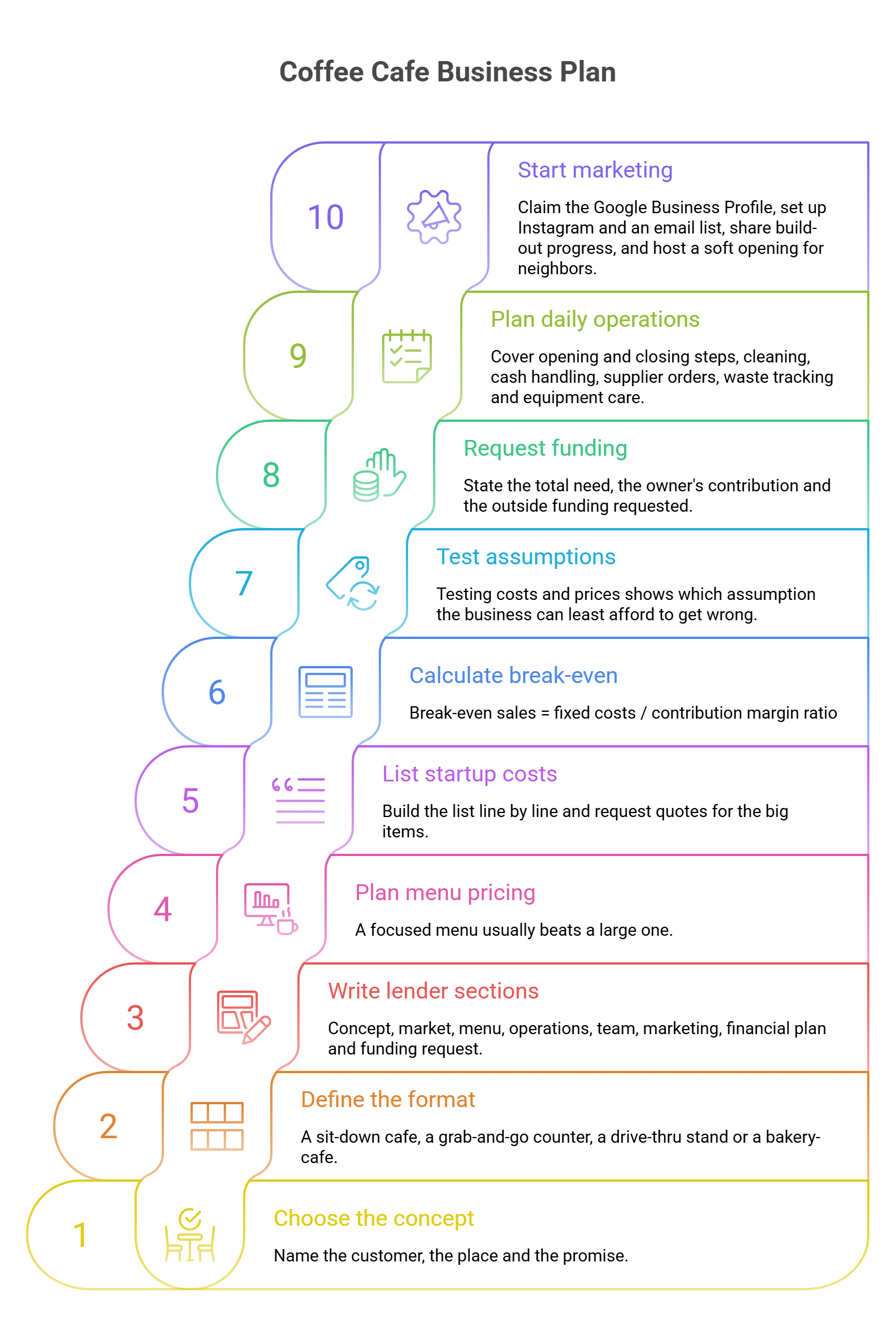
Then pick the format. Common options are a sit-down cafe, a grab-and-go counter near offices or transit, a drive-thru stand and a bakery-cafe. Each format changes labor, floor space and equipment. A useful positioning statement names the customer, the place and the promise. For example: “A third-wave pour-over bar for students near campus, open late, with seating for thirty.”
The sections a lender expects
The table below shows what each section must answer. The right-hand column shows where first-time plans usually go wrong.
| Section | What it must answer | Common weak spot |
| Executive summary | What is the concept, who is it for, and how much funding is needed? | Vague claims like “the best coffee in town” |
| Company overview | Who owns it, where is it, and how will it run? | Ownership and legal structure left out |
| Market analysis | Who lives, works or studies nearby, and who already serves them? | Treating every cafe as a competitor |
| Menu and pricing | What is sold, at what price, and at what cost? | A menu too big for the team |
| Operations | How does a normal day run, from opening to closing? | No plan for waste, cleaning or repairs |
| Team | Who is hired, when, and how are they trained? | Labor cost underestimated |
| Marketing | How will the first customers hear about it? | “We will use social media” with no detail |
| Financial plan | What does it cost to open, and when does it break even? | Optimistic sales in month one |
| Funding request | How much is needed, from whom, and for what? | No contingency reserve |
Market analysis deserves extra time. Walk the neighborhood at different hours. Count foot traffic and note the nearby offices, schools, gyms and apartments. Then separate direct rivals from neighbors. A sweet-drink chain next door may not compete with a pour-over bar, because they draw different people. The real rivals are the specialty cafes chasing the same customers. Read their reviews too. Long waits and too few seats are gaps a new cafe can fill.
Menu and pricing: plan for speed, not variety
A focused menu usually beats a large one. Every item adds ingredients to stock, steps to train and equipment to buy. A core list of espresso drinks, brewed coffee, cold brew and tea is enough for launch. Seasonal specials can come later.
Food needs a separate decision. Pastries and sandwiches raise the average ticket. They also add storage, display, waste tracking, food safety rules and sometimes extra permits. For each item, write down the ingredient cost, preparation time, equipment needed and shelf life. If an item cannot be made quickly at peak hour, it does not belong on the first menu.
Pricing should match the concept. A premium third-wave bar can charge more per cup and expects fewer, slower orders. A commuter counter needs lower prices, speed and volume. State the position in the plan. Rough price bands are enough at this stage.
Startup costs: build a list, not a guess
Generic averages for cafe startup costs are close to useless. Rent, buildout, equipment and permits vary too much by city and by space. Build the list line by line and request quotes for the big items.
Most cafes need to budget for a lease deposit and first rent, design and permits, and construction. Plumbing, electrical work, furniture and fixtures come next. Add the espresso machine, grinders and brewers, plus refrigeration, an ice machine and water filtration. Then count the POS system, cups, lids and smallwares, opening inventory, signage, insurance, pre-opening payroll and working capital.
Put a contingency line on top. Buildouts run late and utility upgrades cost more than expected. A plan with no buffer tells the lender the owner has not been through an opening before. Oak’s guide to creating a startup financial model shows how to organize these costs in a spreadsheet.
The break-even math
Break-even tells a reader how much the cafe must sell each month to cover its costs. The formula has two parts.
Break-even sales = fixed costs / contribution margin ratio
Fixed costs are the bills that arrive whatever the sales. Examples are rent, base payroll, insurance, software and loan payments. The contribution margin ratio is the share of each sale left after variable costs such as milk, beans, cups and card fees.
Here is an illustrative example. The numbers are placeholders, in any currency. Replace them with real quotes before using them in a plan.
| Fixed cost | Monthly amount |
| Rent | 3,000 |
| Payroll | 7,500 |
| Utilities | 600 |
| Insurance and licenses | 300 |
| POS and software | 200 |
| Marketing | 400 |
| Loan payment | 1,000 |
| Total | 13,000 |
Assume an average ticket of 6.00 and variable costs of 35% of sales. The contribution margin ratio is 65%.
Break-even sales are 13,000 divided by 0.65, which is 20,000 a month. At 6.00 a sale, that is about 3,333 sales a month, or about 111 a day over 30 days. Across a ten-hour day, that is roughly 11 sales an hour.
Sales rarely arrive evenly. A cafe that does half its volume in the morning rush needs staff and equipment sized for that peak. The average is the wrong target.
Now test the assumptions.
| Scenario | Fixed costs | Average ticket | Sales a day to break even |
| Base case | 13,000 | 6.00 | about 111 |
| Rent 1,000 higher | 14,000 | 6.00 | about 120 |
| Lower ticket | 13,000 | 5.00 | about 133 |
The higher rent raises the traffic needed by about 8%. The lower ticket raises it by about 20%. Most plans test only sales volume. Testing costs and prices shows which assumption the business can least afford to get wrong. A full plan shows a conservative, a moderate and an optimistic case.
Break-even is not the same as cash. A cafe can pass break-even on paper and still run short in the early months. Sales ramp slowly. Rent and wages do not. The plan needs a monthly cash forecast beside it. Oak’s cash flow modeling guide explains how to build one.
Funding: say how much, from whom and for what
Cafes are funded through owner savings, partners, bank loans, equipment financing, or a mix. Whatever the route, the plan should state the total need and the owner’s contribution. It should also give the outside funding requested, the use of funds, the repayment assumptions and the contingency amount.
Keep the numbers identical across every section. A lender who finds two different startup totals stops trusting the rest. For how the financial strategy fits into the whole plan, see Oak’s piece on how to formulate a solid business plan.
Staffing, operations and marketing
Labor is usually the largest cost an owner can influence. Set staffing by hours and volume. State how many people work each shift, what training covers, and who handles scheduling and payroll. Train baristas in hospitality and speed as well as drinks.
Write down the daily routine too. Cover opening and closing steps, cleaning, cash handling, supplier orders, waste tracking and equipment care. Short written procedures make training easier and keep quality steady as the team grows.
Marketing starts before opening day. Claim the Google Business Profile, set up Instagram and an email list, share build-out progress, and host a soft opening for neighbors. Partner with nearby offices, schools and local artists. Name each platform, the posting frequency and the goal. “Use social media” is not a plan.
Common mistakes in cafe business plans
- Underestimating buildout costs and opening delays
- Choosing a location on rent alone, not customer demand
- Writing a menu the team cannot execute at peak hour
- Buying equipment before designing the workflow
- Overestimating first-month sales
- Skipping working capital and contingency
- Signing the lease before checking permits, zoning and utilities
Frequently Asked Questions
What should a coffee cafe business plan include?
An executive summary, company overview, market analysis, menu and pricing, operations plan, staffing plan, marketing plan, financial projections with break-even, and a funding request. Add a risk section and an opening timeline if a lender will read it.
How long should a cafe business plan be?
Long enough to carry the numbers, short enough to be read. A bank loan usually needs full financial statements. A one-page summary works for a landlord or a partner.
Do I need a business plan to open a coffee cafe?
Usually not by law, though requirements vary by country and by lender. Banks and investors almost always ask for one. Writing it also forces decisions on pricing, staffing and location before a lease is signed.
How much does it cost to open a coffee cafe?
It depends on the location, the size and condition of the space, and the menu. Build a line-by-line budget with quotes instead of using an average. Include a contingency and working capital.
How do I calculate break-even for a cafe?
Divide monthly fixed costs by the contribution margin ratio to get break-even sales. Divide that by the average ticket to get the number of sales. The worked example above shows each step.
How do cafes get funding?
Through owner savings, partners, bank loans, equipment financing, or a mix. Lenders want to know how much is needed, what it pays for and how it will be repaid.
Conclusion
A cafe plan is most useful when it says no early. A weak location, an oversized menu or a high rent shows up on paper long before it shows up in the bank balance. Run the break-even math on each option, and the decision often makes itself.
Oak Business Consultant writes investor-ready business plans for new cafes and other small businesses. Each plan includes the financial plan, SWOT analysis and marketing plan. See Oak’s business plan service for small businesses, or ask about a financial model that covers startup costs, break-even and cash flow.