How to Start a Healthcare Business
How to start a healthcare business: get the structure right from day one
Most healthcare startups do not fail because the idea was weak. They stall because the founder picked the wrong ownership structure, underestimated how long payer credentialing takes, or built a referral network that quietly violated federal fraud laws. Healthcare is one of the few industries where the business model, the legal structure, and the regulatory framework are locked together from the first decision you make. Get the sequence wrong and you rebuild from scratch months in.
This guide walks through what actually determines whether a healthcare business gets off the ground: the business model, the ownership structure most guides skip, the licensing and credentialing timeline, the compliance rules beyond HIPAA, and how payers are reshaping the revenue model itself.
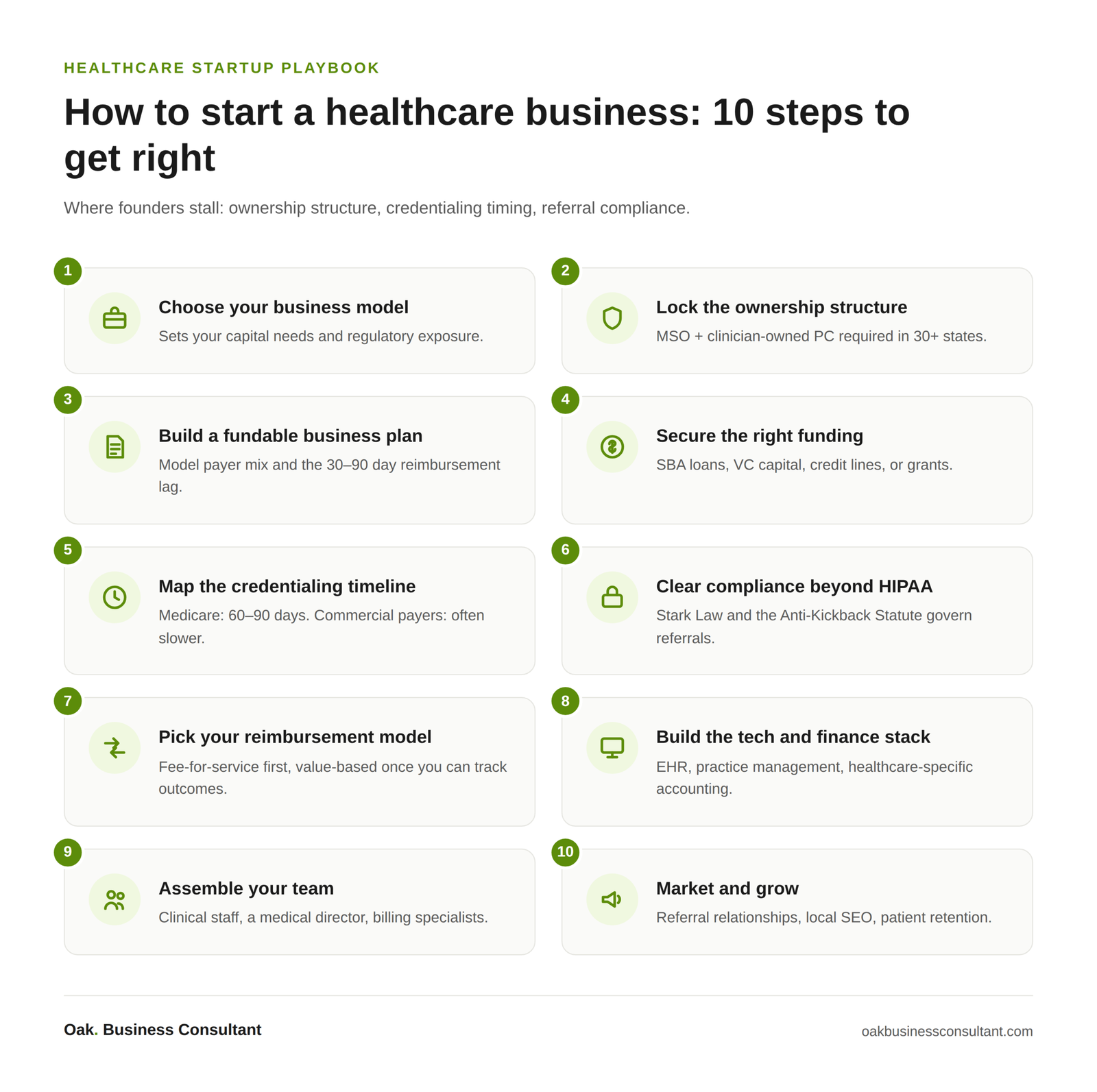
Choose your business model first
Your business model determines your capital needs, your regulatory exposure, and who can legally own equity in the company. Broadly, healthcare businesses fall into a few categories.
Home healthcare agencies provide in-home nursing, therapy, and personal care. Startup costs range from $40,000 to $350,000 depending on whether you pursue Medicare certification. Telehealth platforms need HIPAA-compliant video infrastructure and licensed clinicians, and the sector is projected to exceed $800 billion by 2035. Medical billing services require minimal clinical infrastructure and can run remotely, which is why they are one of the lower-barrier entry points into healthcare entrepreneurship. Mental health services, from virtual counseling to outpatient clinics, have grown alongside reduced stigma and expanded insurance coverage. Medical device and diagnostics businesses require significant technical expertise and a long runway through FDA clearance.
| Business model | Typical startup capital | Regulatory complexity |
| Medical billing service | Low ($5,000–$25,000) | Low to moderate |
| Telehealth platform | Moderate to high ($100,000+) | High (multi-state licensing) |
| Home healthcare agency | Moderate to high ($40,000–$350,000) | High (Medicare certification) |
| Outpatient clinic or practice | High ($150,000–$500,000+) | High (facility licensure, CPOM) |
| Medical device company | Very high | Very high (FDA clearance) |
Your model choice is not just a market decision. It determines which legal ownership structure is even available to you, which is where most first-time healthcare founders get stuck.
Get the ownership structure right
Here is the piece nearly every healthcare startup guide skips: in most states, non-clinicians cannot own a clinical practice outright.
More than 30 states enforce some version of the Corporate Practice of Medicine doctrine, which bars non-physicians from owning or controlling clinical decision-making through a business entity. If you are a non-clinician founder, or you are bringing in outside investors who are not licensed providers, a standard LLC will not satisfy this rule for a clinical business.
The workaround used across the industry is a dual-entity structure. A Management Services Organization, typically an LLC or C-Corp, owns and operates everything non-clinical: billing, staffing, marketing, facilities, and technology. A separate Professional Corporation or Professional Limited Liability Company, owned by a licensed clinician, holds the clinical practice itself. The two entities are connected through a Management Services Agreement that defines what the MSO provides and how it is paid, without giving the MSO control over patient care decisions.
This structure needs to be documented carefully. A poorly drafted MSA, or one that gives the management company effective control over clinical decisions, can void the entire arrangement and expose the business to civil penalties. Enforcement varies significantly by state. California’s Medical Board scrutinizes MSAs closely, while other states apply the doctrine more loosely, but “loosely enforced” is not the same as “does not apply.”
If your business model does not involve direct clinical care, such as a medical billing service, a health data analytics company, or a medical device business, the Corporate Practice of Medicine doctrine typically does not apply, and a standard LLC or corporation works fine.
Build a business plan that gets funded
Your business plan needs to do two things: prove the market opportunity and prove you understand the regulatory and payer landscape well enough to actually operate.
Beyond the standard executive summary, market analysis, and financial projections, healthcare-specific business plans should show the payer mix you expect (commercial insurance, Medicare, Medicaid, private pay) since this determines your actual collection rate, not just your billed revenue. Include a break-even analysis that accounts for the gap between service delivery and payment, since insurance reimbursement can take 30 to 90 days after a claim is filed. A medical clinic business plan template built specifically for healthcare covers this structure rather than forcing a generic template to fit.
Secure funding for a capital-intensive business
Healthcare ventures typically need more upfront capital than a comparable business in most other sectors, and the revenue cycle is slower because of insurance reimbursement delays.
Traditional bank loans require strong credit and collateral, and work best for established practices with predictable cash flow. SBA loans often offer better terms for startups specifically, with lower rates than conventional financing. Angel investors and venture capital fit high-growth digital health models, though this means giving up equity, and any outside equity investor in a clinical business needs to fit within your MSO/PC structure. A business line of credit covers ongoing operational costs and the gap between billing and collection. Healthcare-specific grants exist for rural care expansion, telehealth infrastructure, and services for underserved populations through programs like HRSA.
Licensing, credentialing, and accreditation: what the timeline actually looks like
This is where founders most often lose months they did not plan for.
Credentialing and payer contracting are two separate processes that get bundled together in casual conversation but run on different clocks. Credentialing verifies a provider’s licensure, malpractice history, and education. Contracting is the legal process of enrolling your practice into a payer’s network at an agreed fee schedule. Medicare credentialing typically takes 60 to 90 days. Commercial payers often take longer and batch applications on monthly cycles. Start this process as early as possible, since you cannot legally bill a payer until both are complete.
Beyond general licensing, several specific certifications apply depending on your services. CLIA certification is required if you perform any diagnostic testing, even something as routine as a rapid strep test or urinalysis. DEA registration is required if your clinicians prescribe controlled substances, and both the individual provider and, in some cases, the facility need separate registrations. Facility licensure from your state health department applies to clinics, surgery centers, and home health agencies.
Accreditation is often voluntary, but it can be the difference between getting a payer contract and not. Bodies like The Joint Commission, AAAHC, NCQA, and CARF signal a higher standard of care to both payers and patients. Some state Medicaid programs will not contract with behavioral health organizations without accreditation, and it strengthens your negotiating position with commercial payers even where it is not mandatory.
Compliance goes well beyond HIPAA
Most first-time healthcare founders know they need HIPAA compliance. Fewer know about the federal fraud and abuse laws that shape how they can structure referrals, marketing, and staffing arrangements.
The Stark Law prohibits physicians from referring patients to entities in which they hold a financial interest, unless a specific exception applies. The Anti-Kickback Statute makes it illegal to exchange anything of value for patient referrals. These laws are interpreted broadly enough that well-intentioned arrangements, like a shared marketing agreement or a below-market office lease with a referring provider, can trigger violations. If your business model depends on physician referrals, any financial relationship with a referring provider needs to be documented at fair market value and reviewed by healthcare counsel before it goes live.
HIPAA compliance itself requires a documented risk assessment, signed Business Associate Agreements with every vendor that touches patient data (your billing company, your cloud host, your telehealth platform), and ongoing staff training, not a one-time policy document. OSHA’s bloodborne pathogen standard and ADA accessibility requirements apply on top of clinical regulations and are frequently overlooked until an inspection.
Fee-for-service or value-based care
The reimbursement model you build around changes your entire operational focus, and increasingly, payers are pushing toward value-based arrangements.
Fee-for-service reimburses per visit or procedure. It is the model most founders default to because it is simple to understand and bill against. Value-based care ties a portion of reimbursement to outcomes: readmission rates, quality metrics, or shared savings against a spending benchmark. Entry points include the Medicare Shared Savings Program for primary care and state Medicaid ACOs. Value-based arrangements can be more profitable over time, but only if you have invested in the data infrastructure to track quality measures and manage patient risk proactively. Committing to value-based contracts before you can report on outcomes reliably is a common way new practices end up absorbing losses instead of earning the incentive payments.
Build the technology and financial infrastructure
An EHR system and practice management software are not back-office conveniences. They are what makes billing, documentation, and payer reporting function at all. Choose systems that support your specific care model rather than the cheapest option, since switching EHRs after launch is expensive and disruptive to both billing and patient care.
Your accounting setup needs to reflect healthcare’s specific revenue cycle, including the gap between billed charges and actual collections, and tracking a chart of accounts built for the healthcare industry makes that gap visible instead of hidden inside a generic ledger. For businesses that need investor-ready projections from day one, a healthcare-specific financial model accounts for payer mix, reimbursement lag, and staffing ratios that a generic startup model will not capture.
Build your team
Clinical staffing depends entirely on your model: physicians, nurse practitioners, and therapists for direct care, and a medical director for regulatory oversight if your structure requires one. Administrative staff, particularly medical billers who understand your specific payer mix, often have more impact on cash flow than any other early hire. Credential every clinical hire thoroughly, including malpractice history and disciplinary record, since this is both a patient safety issue and a liability issue if something goes wrong later.
Market and grow the business
Referral relationships with physicians, hospitals, and specialists remain the strongest acquisition channel for most clinical businesses, but they need to be built on genuine value, like faster access or better follow-up, not incentive payments that risk an Anti-Kickback violation. Digital marketing, including local SEO, a complete Google Business Profile, and patient reviews, drives volume for practices that patients find on their own rather than through referral. Track patient retention and satisfaction as closely as acquisition, since replacing a lost patient costs more than keeping one.
Common challenges
High startup costs can be managed by starting with a narrower service line and expanding once cash flow is proven, or by leasing equipment instead of buying it outright. Regulatory complexity is best handled by budgeting for healthcare-specific legal and compliance counsel from day one rather than treating it as an expense to defer. Reimbursement delays strain cash flow in nearly every healthcare business during the first year, so working capital reserves need to account for a 60 to 90 day lag, not the immediate payment founders expect from other industries.
Frequently Asked Questions
How long does it actually take to start billing insurance?
Plan for 60 to 90 days for Medicare credentialing alone, and commercial payers are often slower since many batch applications monthly. Credentialing and contracting are separate processes and both need to finish before you can bill.
Is accreditation worth pursuing if it’s not legally required?
Often, yes. Some state Medicaid programs and commercial payers require it for certain specialties, and even where it’s optional, it strengthens payer negotiations and signals quality to patients. Budgeting for it within the first 18 to 24 months is common practice.
What’s the difference between the Stark Law and the Anti-Kickback Statute?
The Stark Law specifically addresses physician self-referral to entities they have a financial interest in. The Anti-Kickback Statute is broader, covering any exchange of value in return for referrals, regardless of specialty. Both apply to Medicare and Medicaid billing and carry serious civil and criminal penalties.
Should I build around fee-for-service or value-based care?
Most new practices start with fee-for-service because it’s simpler to bill and predict. Value-based arrangements can be more profitable but require data infrastructure to track quality metrics and manage risk, which is worth building toward rather than committing to before you’re ready.
What’s the biggest funding mistake healthcare founders make?
Underestimating the reimbursement lag. Founders often model cash flow as if payment arrives when the service is delivered, when in practice it can take 30 to 90 days after a claim is filed. This gap is what working capital reserves and lines of credit are meant to cover.
Conclusion
The healthcare businesses that make it past year one are rarely the ones with the most original idea. They are the ones that got the ownership structure right before signing a lease, budgeted for a credentialing timeline that runs in months rather than weeks, and built compliance into the business model instead of bolting it on after a payer audit. The regulatory weight is real, but it is also predictable, which means it can be planned for.
If the financial side of that planning, cash flow forecasting, billing cycle management, or investor-ready projections, is where the plan gets fuzzy, Oak Business Consultant’s medical practice CFO services are built specifically around the reimbursement timelines and payer mix complexity that make healthcare businesses different from a standard startup.