...

What is an Outsourced CFO: The Comprehensive Guide to Understanding the Role and Benefits

what is an outsourced CFO

What is an Outsourced CFO: The Comprehensive Guide to Understanding the Role and Benefits

What Is an Outsourced CFO? 

Table of Contents

Every growing business eventually hits a financial inflection point where the complexity of decisions outpaces what a bookkeeper, accountant, or even a financial controller can handle. Revenue projections, fundraising strategy, cash flow modelling, investor reporting, and risk management all require a different level of expertise. Hiring a full-time Chief Financial Officer is the obvious answer, but for most small and mid-sized businesses the cost is prohibitive. The median annual compensation for a full-time CFO in the United States now sits above $400,000 when salary, bonuses, equity, and benefits are included, before accounting for the $25,000 to $50,000 typically spent on executive recruitment.

An outsourced CFO solves this problem. It delivers the strategic financial leadership a business needs at a fraction of the cost, on a flexible engagement model that adapts to the company’s stage and budget. Demand for this model has grown dramatically: hiring of interim and outsourced CFOs increased by more than 100 percent between 2023 and 2024, and the trend has continued into the present as businesses of every size recognize the value of senior financial guidance without full-time overhead.

This guide explains exactly what an outsourced CFO is, what they do, how they compare to other engagement models, when a business needs one, what it costs, and how to choose the right partner.

What Is an Outsourced CFO?

An outsourced CFO is a senior financial executive engaged on a contract, part-time, or project basis to provide high-level strategic financial leadership to a business. They bring the same expertise, seniority, and analytical capability as a full-time Chief Financial Officer but operate under a flexible arrangement that matches the company’s actual needs and budget rather than a fixed employment structure.

The term “outsourced CFO” is an umbrella that includes several related models: fractional CFOs who work a defined number of hours per week or month, virtual CFOs who deliver services entirely remotely, interim CFOs who step in full-time for a defined transition period, and outsourced CFO firms that assign a team of professionals rather than a single individual. What unifies all these variations is the core value proposition: C-suite financial leadership without a permanent executive hire.

Unlike a bookkeeper or accountant who records and reports what has happened, an outsourced CFO focuses on what should happen. Their work is forward-looking, strategic, and connected to the overall direction of the business. They sit at the intersection of finance and strategy, helping leaders understand the financial consequences of the decisions they are making and the decisions they should be considering.

An outsourced CFO’s engagement typically starts with an assessment of the company’s current financial state, including the quality of reporting, cash flow health, existing financial systems, and the gaps between where the business is and where it needs to be. From that baseline they develop priorities, implement improvements, and provide ongoing guidance across all dimensions of financial management.

Outsourced CFO vs Fractional CFO vs Virtual CFO

The terms outsourced CFO, fractional CFO, and virtual CFO are often used interchangeably in the market, but they describe meaningfully different arrangements. Understanding the distinction helps a business choose the right model for its situation.

Fractional CFO

A fractional CFO works part-time for one or more companies simultaneously, dedicating a defined number of hours per week or month to each engagement. The term “fractional” refers to the fraction of a full-time position the CFO fills. This model suits businesses that need ongoing strategic financial leadership but not a full-time presence. Engagements are typically ongoing and can extend for years. The fractional CFO becomes deeply embedded in the business, attending leadership meetings, interacting with investors and lenders, and contributing to strategic decisions on a regular cadence.

Virtual CFO

A virtual CFO performs the same strategic functions as a fractional CFO but operates entirely remotely, without visiting the client’s offices. The “virtual” descriptor refers to the delivery mode rather than the scope of work. Virtual CFO services are well-suited to businesses with distributed teams, digital-first operations, or those in locations without easy access to senior financial talent. The cost structure is similar to fractional CFO services, though it can be marginally lower because there are no travel costs.

Outsourced CFO (Broad Term)

When used as the broadest category, “outsourced CFO” captures any arrangement where CFO-level services are delivered by an external party rather than a full-time internal hire. This includes fractional, virtual, and interim models. It also includes outsourced CFO firms, which provide a team of professionals, typically including a CFO-level strategist, a controller, and financial analysts, under a single engagement agreement. The firm model reduces dependency on any single individual and provides cross-trained coverage if personnel changes occur.

Interim CFO

An interim CFO fills the CFO role on a temporary but full-time basis. This model is used during executive transitions, post-acquisition integrations, turnaround situations, or periods where the company needs intensive financial leadership before a permanent hire is made. Interim engagements typically last three to twelve months and cost significantly more per month than fractional or virtual arrangements because of the full-time commitment.

Summary Table

ModelTime CommitmentDeliveryBest For
Fractional CFOPart-time, ongoingIn-person or hybridOngoing strategic support
Virtual CFOPart-time, ongoingFully remoteDigital-first or distributed businesses
Interim CFOFull-time, temporaryIn-personTransitions, turnarounds, M&A
Outsourced CFO FirmVariableIn-person, hybrid, or remoteBusinesses needing a team rather than one person

Outsourced CFO vs Full-Time CFO: A Side-by-Side Comparison

Understanding the practical differences between an outsourced and a full-time CFO helps businesses make a clear-eyed decision about which model their situation actually calls for.

FactorFull-Time CFOOutsourced CFO
Annual cost (US)$400,000 to $600,000+ total$47,000 to $190,000 (fractional)
Time to value3 to 6 months onboardingOften 2 to 4 weeks
FlexibilityFixed role, fixed costScales with business needs
Industry breadthOne company’s experienceMultiple clients, cross-industry patterns
Daily availabilityFull-time, full accessDefined hours per engagement
Benefit obligationsYes (equity, health, bonus)No
Recruitment cost$25,000 to $80,000Minimal or none
Continuity riskHigh if executive departsMitigated by firm-based models

A full-time CFO makes sense for a business with revenues above approximately $50 million, or for companies where the CFO role requires daily involvement in operations, investor relations, or regulatory reporting at scale. For most SMEs, startups, and high-growth businesses below that threshold, an outsourced model delivers better value per dollar spent and greater flexibility as the business evolves.

One frequently underestimated advantage of the outsourced model is the breadth of cross-industry experience it delivers. An outsourced CFO who works across multiple clients simultaneously has seen more financial scenarios, more fundraising structures, more operational crises, and more growth patterns than a counterpart who has worked inside a single company for years. That exposure translates into better pattern recognition and more grounded strategic advice.

Core Responsibilities of an Outsourced CFO

Core Responsibilities of an Outsourced CFO

The specific work an outsourced CFO undertakes depends on what the business needs at the time of engagement. The role adapts to the company’s priorities. However, the following areas represent the most common and consequential responsibilities.

Strategic Financial Planning

The outsourced CFO develops a long-term financial strategy aligned with the company’s business objectives. This includes building multi-year financial models, scenario planning for different growth trajectories, assessing capital requirements, and translating strategic goals into financial targets. Strategic planning is not a one-time event but an ongoing process that the CFO updates as market conditions, competitive dynamics, and internal performance evolve.

Budgeting and Forecasting

Accurate budgets and rolling financial forecasts are foundational tools for business leadership. An outsourced CFO builds these frameworks, ensures they reflect operational reality, and uses them to keep leadership teams focused on the right metrics. Forecasting work includes revenue modelling, expense planning, headcount projections, and sensitivity analysis showing how the business performs under different assumptions.

Cash Flow Management

Cash flow is the operational lifeblood of any business. An outsourced CFO monitors cash positions, builds cash flow projections, identifies periods of potential shortfall in advance, and implements strategies to optimize the timing of receivables and payables. For businesses with tight liquidity, this function alone justifies the engagement.

Financial Reporting and Analysis

The outsourced CFO oversees the preparation of financial statements, ensures accuracy and completeness, and interprets results for leadership. Beyond basic reporting, they build dashboards and KPI frameworks that give management real-time visibility into the metrics that matter most. This includes gross margin analysis, unit economics, departmental cost tracking, and variance analysis comparing actuals to budget.

Capital Raising and Investor Relations

Raising debt or equity capital requires a CFO who can prepare investor-grade financial materials, build credible projections, structure the deal, and manage the relationship with lenders or investors through due diligence to close. An outsourced CFO with fundraising experience brings significant value at exactly this stage. They ensure the business’s story is supported by numbers that hold up to scrutiny, and they manage the process so the founder or CEO can continue running the business.

Risk Management and Internal Controls

An outsourced CFO identifies financial, operational, and compliance risks and puts controls in place to mitigate them. This includes designing segregation of duties within the finance function, implementing access controls over financial systems, establishing reconciliation procedures, and building governance frameworks that promote accountability and transparency. Strong internal controls also reduce fraud risk and improve audit readiness.

M&A Support and Exit Preparation

Companies planning an acquisition, merger, or sale of the business need CFO-level expertise to navigate the transaction. An outsourced CFO can lead financial due diligence on acquisition targets, build merger models, manage the data room, and coordinate with lawyers, accountants, and bankers throughout the process. For companies preparing for a strategic exit, the CFO begins the process of cleaning up financial records, normalizing earnings, and building a financial narrative that maximizes valuation.

Financial Systems and Technology

Many growing businesses operate on financial systems that were adequate at an earlier stage but create limitations as the business scales. An outsourced CFO evaluates the existing technology stack, recommends improvements, and manages the implementation of better accounting software, ERP systems, or financial planning tools. This work creates infrastructure that makes the entire finance function more efficient and accurate.

Team Leadership and Development

In engagements where the company has an internal accounting or finance team, the outsourced CFO provides leadership to that team, mentors junior staff, defines roles and responsibilities, and builds the internal capability that ultimately reduces dependency on external support over time.

Industries That Benefit Most

Outsourced CFO services are industry-agnostic in principle, but certain sectors see particularly strong value from the model.

Startups and Venture-Backed Companies. Early-stage companies need investor-ready financials, credible projections, and a CFO-level voice in fundraising conversations. Most cannot afford a full-time hire at this stage. Outsourced CFO services give them the financial credibility they need to raise capital and manage it responsibly after it arrives.

SaaS and Technology Companies. These businesses require sophisticated unit economics analysis, including monthly recurring revenue, churn rate, customer acquisition cost, and lifetime value. An outsourced CFO with SaaS experience understands how to model these metrics and use them to guide pricing, customer success, and growth investment decisions. CFO services for SaaS companies address these requirements with specialized reporting frameworks built around recurring revenue.

Professional Services Firms. Law firms, consulting firms, marketing agencies, and similar businesses often have complex revenue recognition, high staff costs as a percentage of revenue, and significant working capital needs tied to the timing of client billing and collections. An outsourced CFO brings the financial discipline to manage margins and cash flow effectively in these environments.

Healthcare and Life Sciences. Regulatory complexity, reimbursement structures, and the capital intensity of clinical operations create financial challenges that benefit from specialized CFO-level oversight.

Manufacturing and Distribution. Inventory management, supply chain finance, cost of goods analysis, and capital expenditure planning are all areas where an outsourced CFO adds significant value in these sectors.

Real Estate and Property Development. Project-level financial modelling, debt structuring, investor reporting, and asset management require CFO-level expertise that many smaller developers and operators access through outsourced arrangements.

Non-Profit Organizations. Non-profits with restricted funding, grant compliance requirements, and board reporting obligations benefit from outsourced CFO services that bring rigour to financial management without the cost of a full-time hire.

Signs Your Business Needs an Outsourced CFO

Signs Your Business Needs an Outsourced CFO

Recognizing the right moment to engage an outsourced CFO can mean the difference between scaling smoothly and hitting financial roadblocks that stall growth. The following situations are reliable indicators that CFO-level support is needed.

You are preparing to raise capital. Investors expect clean financials, credible projections, and a coherent financial narrative. Without a CFO preparing or validating these materials, founders spend valuable time correcting inconsistencies during investor conversations instead of building momentum. Many deals fall apart in due diligence because the financial records cannot withstand scrutiny.

You do not have clear visibility into your cash position. If you regularly find yourself surprised by cash shortfalls, or if you cannot answer with confidence how many months of runway the business has, your financial function is operating reactively. An outsourced CFO builds the forecasting infrastructure that changes this from reactive to proactive.

You are growing fast and the financial function cannot keep up. Rapid growth amplifies every financial problem. Margin pressure, working capital needs, hiring costs, and infrastructure investment all accelerate simultaneously. Without senior financial oversight, fast-growing companies routinely run out of cash precisely at the moment they appear most successful from the outside.

Your bookkeeper or accountant has reached the limits of their role. Accountants and bookkeepers are excellent at recording and reporting historical transactions. They are not trained or positioned to provide strategic financial leadership. If the person managing your finances is focused primarily on compliance and record-keeping rather than forward-looking analysis, there is a gap that an outsourced CFO fills.

You are approaching a significant financial event. Acquisitions, mergers, major debt raises, regulatory audits, IPO preparation, and equity recapitalizations all require CFO-level expertise. Attempting these events without a CFO is a significant risk.

Your financial reporting is unreliable or delayed. If monthly financial statements are consistently late, contain errors, or are not used by leadership to make decisions, the finance function is underperforming its purpose. An outsourced CFO rebuilds the reporting infrastructure and makes financial data a usable management tool.

Investors or board members are asking questions you cannot answer confidently. If conversations with existing investors, lenders, or board members feel uncomfortable because you lack the financial depth to answer their questions, that is a direct signal that CFO-level support is needed.

You are entering a new market or launching a new product line. Expansion decisions require rigorous financial modelling to assess the capital requirements, risk profile, and expected returns. Making these commitments without that analysis significantly increases the chance of a costly mistake.

Most venture-backed startups bring on CFO-level support after a seed or Series A funding round, when investor relations, cash runway analysis, and financial modelling become too complex for the founding team or a controller to manage alone. Bootstrapped businesses often find the same need arises when revenue surpasses approximately $2 million to $3 million and financial decisions begin to have material consequences.

What an Outsourced CFO Is Not

There are several common misconceptions about outsourced CFO services that lead businesses to have misaligned expectations.

An outsourced CFO is not a bookkeeper. They do not manage day-to-day transaction recording, payroll processing, accounts payable, or accounts receivable unless these activities are included explicitly in the scope of a broader engagement. These functions are typically handled by an internal team or an outsourced accounting service working alongside the CFO.

An outsourced CFO is not a tax accountant. While a CFO works closely with the company’s tax advisors and ensures that tax strategy is integrated into broader financial planning, they do not prepare tax returns. These are distinct functions requiring separate expertise.

An outsourced CFO is not a controller. A controller manages the accuracy of financial records and ensures compliance with accounting standards. A CFO uses those records as inputs to strategic analysis and decision-making. The controller function is operational; the CFO function is strategic. Many outsourced CFO firms provide both as part of a bundled engagement.

An outsourced CFO does not guarantee results. They provide expertise, analysis, and recommendations. The business still has to act on those recommendations and execute. An outsourced CFO who identifies a cash flow problem and proposes a solution cannot force the business to implement the change. Their value is maximized when leadership is engaged and willing to act on financial guidance.

How an Outsourced CFO Engagement Works

How an Outsourced CFO Engagement Works

Understanding the typical structure of an outsourced CFO engagement helps businesses set realistic expectations and get the most from the relationship.

Initial Assessment

Most engagements begin with a diagnostic phase in which the CFO reviews the company’s financial statements, accounting systems, existing processes, and strategic context. This assessment surfaces the most pressing problems and opportunities and forms the basis for the engagement plan.

Scope Definition

Based on the assessment, the CFO and the business agree on the specific scope of work, the time commitment required, the key deliverables, and the reporting structure. Scope can be defined broadly for ongoing strategic support or narrowly for a specific project such as fundraising or M&A preparation.

Ongoing Engagement

In a fractional or virtual CFO engagement, the CFO typically works a defined number of hours per week or attends a defined set of meetings per month, with additional availability for ad hoc issues. They provide a regular cadence of financial analysis, attend leadership and board meetings, and serve as the primary financial advisor to the CEO and leadership team.

Reporting and Communication

A strong outsourced CFO maintains clear and regular communication with leadership, delivers financial reporting on an agreed schedule, and flags issues proactively rather than waiting for the next scheduled meeting. The frequency and format of reporting should be defined at the outset of the engagement.

Engagement Duration

Engagements vary widely in duration depending on the purpose. A project-based engagement for a capital raise might last three to nine months. An ongoing fractional CFO relationship supporting a growing business might continue for several years. Virtual CFO engagements focused on specific outcomes such as audit readiness or financial system implementation typically run six to twelve months. There is no standard duration; the right length is whatever serves the business’s needs.

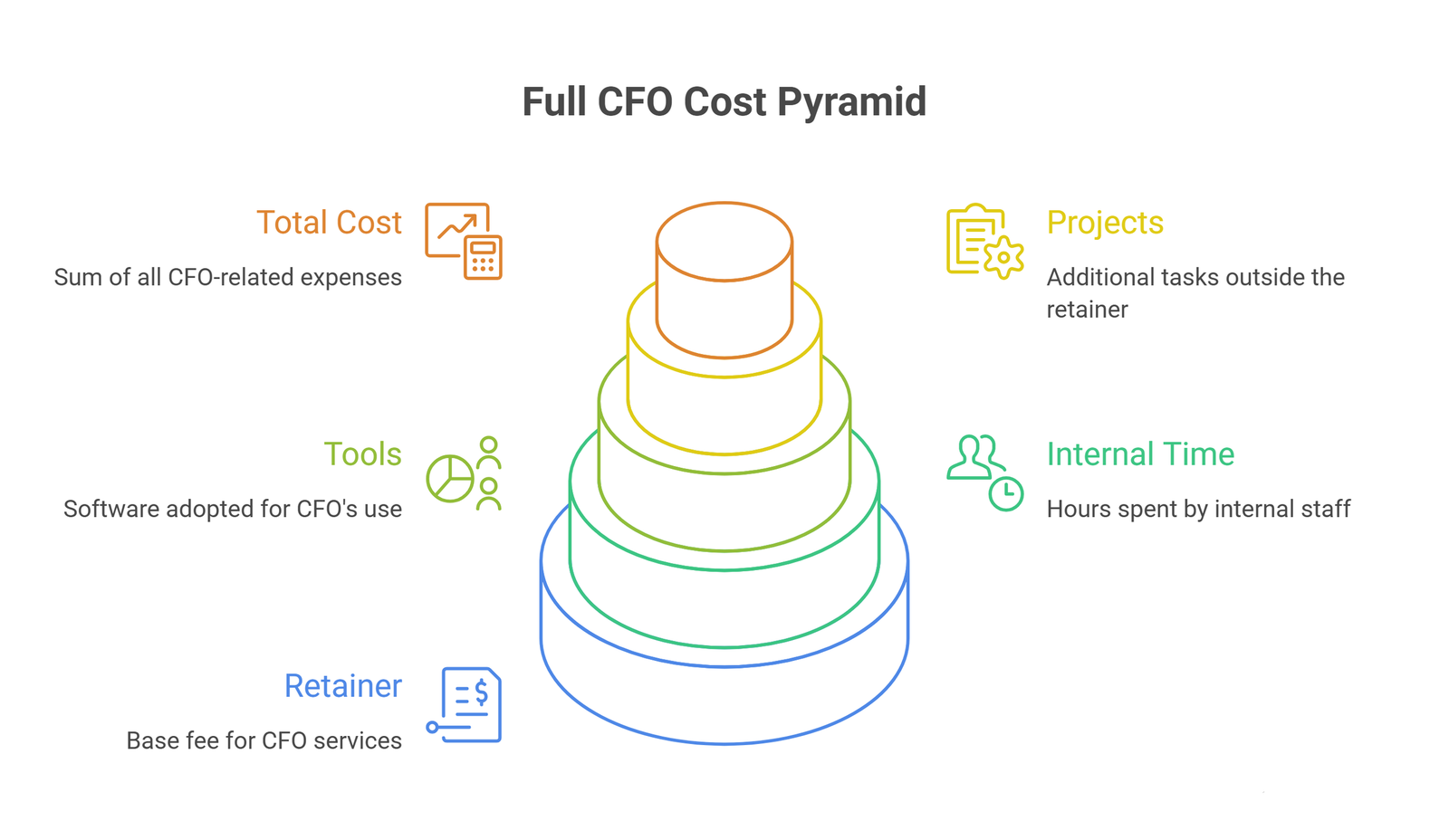
Cost of an Outsourced CFO

The cost of outsourced CFO services varies significantly based on the model, scope, hours required, geographic market, and the seniority and industry experience of the professional involved.

Typical Cost Ranges

  • Fractional CFO (monthly retainer): $5,000 to $15,000 per month for an ongoing engagement covering regular strategic support, financial reporting oversight, and leadership advisory. The total annual cost typically falls between $47,000 and $190,000 depending on hours and scope.
  • Virtual CFO: Similar to fractional CFO pricing, often slightly lower due to reduced overhead from remote delivery. Ranges from $3,000 to $10,000 per month for most engagements.
  • Interim CFO (full-time temporary): $15,000 to $40,000 per month for a full-time temporary engagement. This model is significantly more expensive per month but is used for a defined, intensive period.
  • Hourly rates: When billed hourly, operational-level outsourced CFOs typically charge $186 to $275 per hour. Strategic-level CFOs with deep specialist expertise charge $330 to $600 per hour in the United States market.
  • Outsourced CFO firm (team model): Pricing for a firm-based engagement that includes both CFO-level and controller-level support ranges from $6,000 to $20,000 per month depending on scope and the size of the finance function being managed.

Cost Comparison with Full-Time Hire

Cost ComponentFull-Time CFOOutsourced CFO
Base salary$250,000 to $400,000Included in retainer
Benefits and payroll taxes20% to 30% of salaryNone
Bonus and equity$50,000 to $150,000+None
Recruitment fee$25,000 to $80,000None or minimal
Total year-one cost$350,000 to $600,000+$47,000 to $190,000
Cost savings60% to 80%

Beyond direct cost savings, the outsourced model avoids the three-to-six-month onboarding delay typical of a full-time CFO hire. An outsourced CFO typically delivers strategic value within two to four weeks of engagement start, which matters significantly for businesses facing time-sensitive financial decisions.

Benefits of Hiring an Outsourced CFO

Benefits of Hiring an Outsourced CFO

Cost Efficiency

The most immediate benefit is access to C-suite financial expertise at a fraction of the cost of a full-time hire. For a business with revenue of $5 million to $30 million, a full-time CFO at $400,000 per year represents a significant percentage of operating costs. An outsourced CFO delivering the same strategic value at $8,000 to $12,000 per month is a fundamentally more efficient use of capital.

Strategic Clarity

Many founders and CEOs are not trained financial strategists. They are product builders, salespeople, or operators. An outsourced CFO brings the financial perspective that balances their strengths, ensuring that growth ambitions are grounded in financial reality and that the business is building toward sustainable profitability rather than running on borrowed time.

Cross-Industry Experience

An outsourced CFO who works with multiple clients simultaneously develops pattern recognition that a single-company CFO never accumulates. They have seen more fundraising scenarios, more cash flow crises, more pricing strategy experiments, and more M&A deals across a wider range of industries. This breadth of experience makes their analysis sharper and their advice more grounded.

Flexibility and Scalability

The engagement scales with the business. A startup might begin with ten hours per month of outsourced CFO support and increase to twenty or thirty hours as fundraising or rapid growth creates more demand. A company that has completed a capital raise and is in a steadier operational phase can reduce the engagement scope. This flexibility is impossible with a full-time hire.

Faster Time to Value

Because outsourced CFOs are experienced professionals accustomed to rapid onboarding with new clients, they deliver useful insights and actionable recommendations within weeks rather than months. For businesses facing urgent financial challenges or upcoming capital events, this speed matters.

Investor and Lender Credibility

Having a credentialled, experienced CFO presenting or backing your financial materials significantly increases credibility with investors and lenders. It signals that the business is being run with financial discipline and that the numbers in front of them have been prepared and validated by a senior professional.

Improved Internal Controls

An outsourced CFO designs and implements the governance and control systems that reduce fraud risk, improve financial accuracy, and build the audit trail necessary for external audits or due diligence. This is infrastructure that continues to pay dividends long after the initial engagement.

Objective Perspective

An outsourced CFO is not emotionally invested in internal politics or legacy decisions. They bring an objective, external viewpoint that can surface uncomfortable financial truths that an insider might be reluctant to raise. This objectivity is particularly valuable when a business needs to make a difficult decision about a product line, a market exit, or a cost reduction.

Risks and Limitations to Consider

Outsourced CFO services deliver significant value in most situations, but they are not without limitations and potential risks.

Limited availability. A fractional CFO is not available full-time. If a business encounters a financial crisis or a fast-moving transaction that demands intensive daily involvement, the part-time structure can create friction. Defining a clear escalation protocol and response time expectation at the start of an engagement mitigates this risk.

Integration challenges. An outsourced CFO who does not take time to understand the company’s culture, internal dynamics, and team relationships may produce technically correct analysis that nobody acts on. Cultural fit and communication style matter as much as financial credentials.

Dependency on a single individual. If an engagement is structured around one person and that person is unavailable or moves on, continuity is disrupted. Working with a firm-based provider that cross-trains multiple professionals on the account is the most effective way to manage this risk.

Scope creep. Without a clearly defined scope, outsourced CFO engagements can drift into areas that should be handled internally or by other specialists, increasing cost without proportional value. A well-defined statement of work and regular review of priorities keeps the engagement focused.

Not a substitute for an internal finance function. An outsourced CFO provides strategic leadership but typically cannot replace the need for an internal bookkeeper, accountant, or controller who handles day-to-day financial operations. Most successful engagements involve the CFO working with and elevating an existing internal team.

How to Choose the Right Outsourced CFO

How to Choose the Right Outsourced CFO

Choosing the right outsourced CFO firm or individual professional is one of the most important decisions a business makes when establishing this function. The following framework ensures a rigorous evaluation.

Define Your Needs First

Before approaching any provider, articulate clearly what problem you are trying to solve. Is it fundraising preparation? Cash flow management? Building a financial reporting function from scratch? Preparing for a sale? The answer shapes which CFO skills and experience are most relevant and what scope of engagement you need.

Evaluate Industry Experience

A CFO who has worked extensively with software companies brings different expertise than one who specializes in manufacturing or healthcare. Ask every candidate or firm about their experience in your specific industry and at your revenue stage. A firm that exclusively serves $50 million companies brings limited practical value to a $3 million business.

Assess Strategic vs Operational Orientation

Some CFOs are primarily operators who focus on controls, reporting, and process. Others are primarily strategists who focus on fundraising, M&A, and growth planning. The best outsourced CFOs do both, but most have a natural emphasis. Match the orientation to your most pressing need.

Ask Who Will Actually Do the Work

This is the most important question when evaluating a firm. Many outsourced CFO firms sell with senior professionals but staff engagements with junior associates once the contract is signed. Ask specifically who will lead your engagement, what their credentials are, and how much time they will personally spend on your account each month.

Request References

Ask for references from companies at a similar revenue stage and in a similar industry. A CFO who has guided three SaaS companies through successful Series B raises brings a very different value profile from one whose experience is primarily in audit preparation. Speaking directly with reference clients provides context that no marketing material can replicate.

Evaluate Communication Style

The relationship between a founder or CEO and their CFO requires trust, directness, and strong communication. In an initial conversation, assess whether the candidate communicates financial concepts clearly, pushes back constructively when they disagree, and listens carefully before forming a view. A CFO who only validates what you already believe is not providing the external perspective the role is meant to deliver.

Clarify Reporting Structure and Deliverables

Before engaging, agree on what will be delivered, how frequently, and in what format. Who does the CFO report to? How often do they meet with the CEO? What does a standard monthly financial package include? How quickly do they respond to ad hoc requests? These details determine whether the relationship works in practice.

Understand the Fee Structure

Outsourced CFO pricing comes in several forms: monthly retainer, hourly rate, project-based fee, or a combination. A monthly retainer provides predictability and aligns incentives toward ongoing value creation. An hourly rate works for project-based needs. Understand exactly what is included in the fee and what triggers additional charges before signing any agreement.

Consider a Trial Engagement

Many outsourced CFO providers offer a short initial project, such as a financial assessment or a three-month pilot, before committing to a longer engagement. This allows both parties to evaluate fit, communication, and the quality of work before a longer-term commitment is made.

Frequently Asked Questions

What is the difference between an outsourced CFO and an accountant? 

An accountant records and reports past transactions. An outsourced CFO uses that output for forward-looking strategy. Both are needed; they serve different purposes.

Can a startup afford an outsourced CFO? 

Yes. A part-time engagement at 10 hours per month is a fraction of the cost of a full retainer and is often sufficient to build investor-ready financials and manage early cash flow responsibly.

How long does a typical engagement last? 

Project-based work such as a capital raise runs three to nine months. Ongoing fractional or virtual CFO relationships frequently continue for several years. Interim engagements during executive transitions typically last three to twelve months.

What happens when my business eventually needs a full-time CFO? 

The outsourced CFO typically helps recruit and onboard the permanent hire, then transitions out. The financial infrastructure they built makes the handover straightforward.

How quickly can an outsourced CFO add value? 

Most deliver substantive analysis within two to four weeks, compared to the three to six months a full-time executive hire typically needs to reach full productivity.

Is an outsourced CFO the same as a virtual CFO? 

Not exactly. A virtual CFO is a delivery mode (fully remote). An outsourced CFO is the broader category covering virtual, fractional, interim, and firm-based models.

How does an outsourced CFO help with fundraising? 

They prepare investor-grade financial models, validate projections, manage due diligence, and advise on deal structure, signalling to investors that the business’s numbers are credible and well-governed.

Does an outsourced CFO replace an external auditor? 

No. They are separate functions. An outsourced CFO does, however, improve audit readiness through clean records and strong internal controls, making audits faster and less expensive.

Conclusion

An outsourced CFO gives growing businesses access to C-suite financial leadership without the cost or commitment of a full-time executive hire. The model typically delivers 60 to 80 percent cost savings versus a permanent CFO while providing broader cross-industry experience and faster time to value. For businesses between $1 million and $50 million in revenue, and for startups preparing to raise capital, it is often the most effective financial leadership structure available. The businesses that benefit most are those that engage CFO-level support proactively, before a crisis forces the issue, and use that foundation to scale with clarity and confidence.

A brilliant revenue growth plan won’t mean much if your venture runs out of operational cash runway next month. Scaling successfully requires a deliberate balance between forward-looking strategy and daily cash discipline. We bridge that gap for you. Oak Business Consultant provides strategic Outsourced CFO services designed to de-risk your venture: corporate structuring advice, pitch-ready financial modeling, and advanced margin optimization. Get the elite financial architecture you need to win over banks and investors, without the full-time C-suite cost. Schedule a  free consultation with our financial advisory team

Empower your business with an Outsourced CFO: strategic financial expertise, cost-effective solutions, and tailored growth guidance, all at your fingertips.

An Outsourced CFO from us offers specialized financial expertise and strategic guidance, pivotal for emerging and evolving businesses. This cost-effective solution provides the prowess of a seasoned CFO, ensuring meticulous financial management, insightful analysis, and strategic growth planning, all tailored to your unique business needs.

Share this post