What Is MRR Churn In SaaS Financial Model?
MRR churn rate: formula, gross vs net, and what a good number looks like
A SaaS company can lose 2% of its customers in a month and 19% of its revenue. The gap comes down to who leaves. MRR churn rate measures the revenue loss directly, which is why finance teams and investors watch it more closely than customer churn.
This guide covers the formula, the difference between gross and net MRR churn, what counts as churn, and which benchmarks to compare against.
What is MRR churn?
MRR churn is the monthly recurring revenue a SaaS company loses from existing customers in a period. The loss comes from two events: cancellations and downgrades.
The MRR churn rate is that lost revenue divided by MRR at the start of the period. Most teams measure it monthly. New customers never enter the calculation, because churn only looks at the base you already had.
MRR churn vs customer churn
Customer churn counts how many accounts leave. MRR churn counts how much revenue leaves. They can tell very different stories.
Take a company with 50 customers and $2,600 in MRR.
| Plan | Customers | Price | MRR |
| Basic | 40 | $20 | $800 |
| Pro | 8 | $100 | $800 |
| Enterprise | 2 | $500 | $1,000 |
| Total | 50 | $2,600 |
| Event | Customer churn | MRR churn |
| Two Basic customers cancel | 4.0% | 1.5% |
| One Enterprise customer cancels | 2.0% | 19.2% |
Losing one Enterprise account looks small by headcount. By revenue it is the worse month by a wide margin. Customer churn is useful for spotting product and onboarding problems. MRR churn is the number that belongs in a forecast.
Gross MRR churn rate
MRR churn counts only what you lose.
Gross MRR churn rate = (churned MRR + contraction MRR) / MRR at start of period x 100
Churned MRR is the full monthly value of cancelled accounts. Contraction MRR is the drop from downgrades, meaning the old price minus the new one.
Example: a company starts the month with $50,000 MRR. Cancellations remove $1,000 and downgrades remove $500.
($1,000 + $500) / $50,000 = 3.0% gross MRR churn
Gross churn can never fall below 0%. It shows how much revenue is leaking, regardless of any upsells that offset it.
Net MRR churn rate
Net MRR churn subtracts the revenue you gain from existing customers. That gain is expansion MRR from upgrades and add-ons. If you track reactivations, subtract those too.
Net MRR churn rate = (churned MRR + contraction MRR – expansion MRR) / MRR at start of period x 100
Same company, but existing customers also upgraded by $2,000 during the month.
($1,000 + $500 – $2,000) / $50,000 = -1.0% net MRR churn
The result is negative. Existing customers now add more revenue than the company loses. This is called net negative churn, and it is the situation SaaS founders aim for. In theory, the business can grow without signing a single new customer.
| Gross MRR churn | Net MRR churn | |
| Counts cancellations and downgrades | Yes | Yes |
| Subtracts expansion revenue | No | Yes |
| Can be negative | No | Yes |
| Compared with the other | Always higher or equal | Always lower or equal |
| Best used for | Spotting revenue leakage | Forecasting and judging overall health |
What counts as churn and what does not
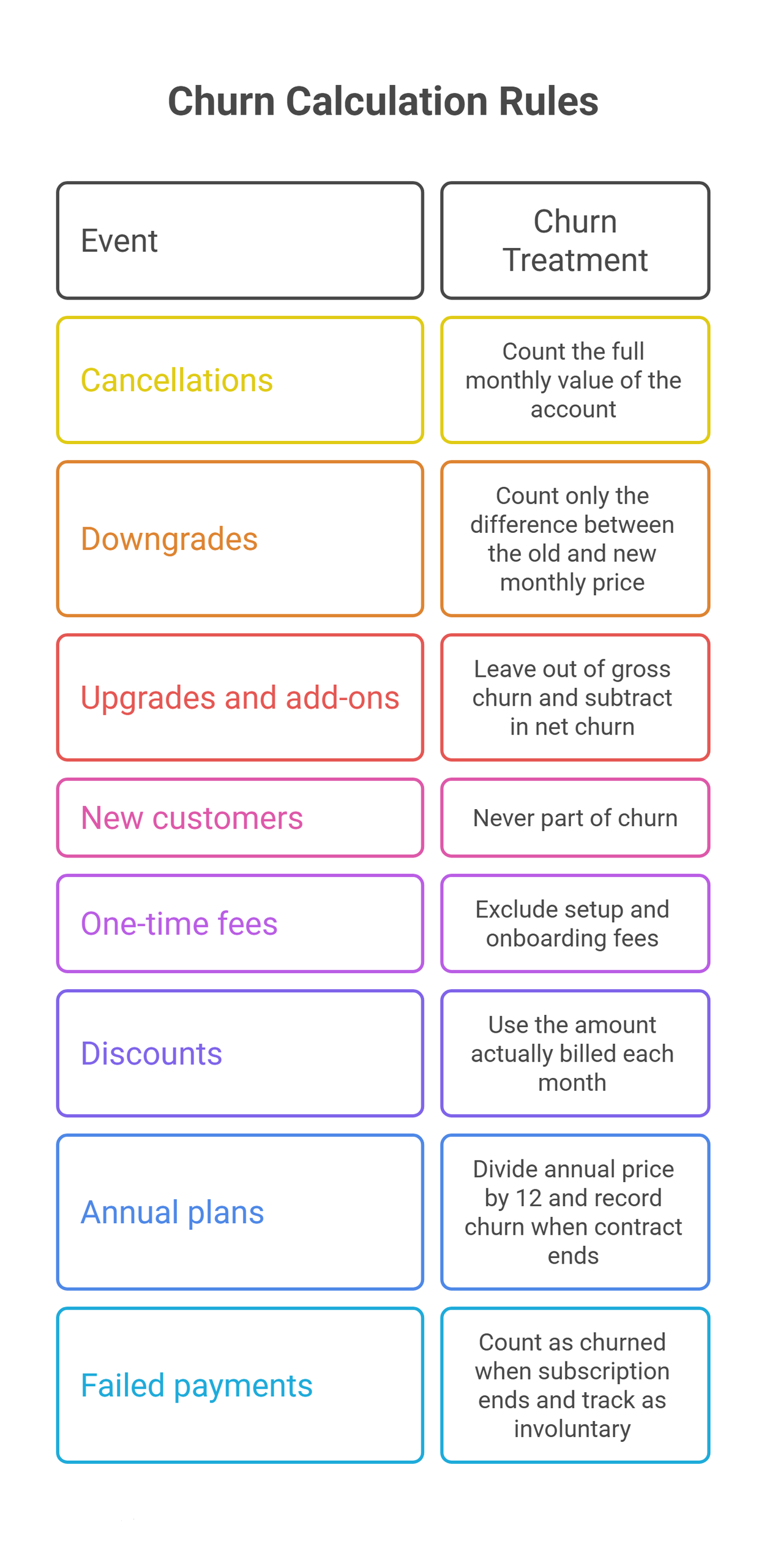
Most calculation errors come from unclear rules. Decide these once and apply them every month.
- Cancellations: count the full monthly value of the account.
- Downgrades: count only the difference between the old and new monthly price.
- Upgrades and add-ons: these are expansion MRR. Leave them out of gross churn and subtract them in net churn.
- New customers: never part of churn.
- One-time fees: setup and onboarding fees are not recurring, so exclude them.
- Discounts: use the amount actually billed each month, and keep that rule consistent.
- Annual plans: convert to monthly by dividing the annual price by 12, then record churn in the month the contract ends without renewal.
- Failed payments: count the account as churned when the subscription actually ends, and track this separately as involuntary churn.
Monthly churn vs annual churn
A small monthly number compounds into a large annual one. Do not multiply by 12. Use this instead:
Annual churn = 1 – (1 – monthly churn)^12
| Monthly churn | Annual churn |
| 1% | 11.4% |
| 2% | 21.5% |
| 3% | 30.6% |
| 5% | 46.0% |
| 11% | 75.3% |
At 3% a month, a company that stops selling today would see $50,000 of MRR shrink to about $34,700 in a year. At 11% a month, it loses roughly three-quarters of its revenue base.
What is a good MRR churn rate?
The most cited public benchmarks come from ChartMogul, published in TechCrunch in April 2022. They used anonymized subscription data from January to March 2022, so treat them as a reference and not a rule.
- Companies with ARPA under $100 a month should target gross MRR churn below 3.5%. Above $100, the target is below 2.5%.
- Median gross MRR churn was 8.9% for ARPA of $0 to $10 and 2.5% above $500. Higher-priced products lose fewer customers.
- Early companies with under $10,000 MRR had a median of 8.6%. It settled at about 4% to 5% as they grew.
- The best companies at any stage kept gross MRR churn under 2.5% a month.
- Close to a quarter of companies at any MRR level had net negative churn. Among companies with ARPA above $500, 53.4% did.
The practical lesson is to compare yourself against companies with a similar price point. A $15 consumer plan and a $600 team plan live in different churn worlds.
How to use MRR churn in a SaaS financial model
Apply churn to starting MRR each month, and keep expansion as a separate line. Use a different churn rate for each plan tier or customer segment instead of one blended number. Small plans usually churn faster than large ones, and a single average hides that.
Churn also drives lifetime value. LTV equals ARPA times gross margin, divided by monthly churn, so a small change in the churn input moves LTV a lot. Our guide to building a SaaS financial model shows where each churn line sits in the full forecast. The free SaaS metric framework template is a good place to start tracking these numbers.
Oak built a subscription model for an SVOD client that tracked MRR, ARR, churn, CAC and customer lifetime value together. The subscription financial model case study explains how.
How to reduce MRR churn
Not all churn has the same cause, so start by splitting it.
Involuntary churn happens when a payment fails and the account lapses. Card retries and short dunning emails recover many of these without a conversation. This is often the cheapest churn to fix.
Voluntary churn is a customer deciding to leave. Look at which plan, which acquisition channel and which signup month the cancellations come from. Patterns there point to a pricing, onboarding or fit problem.
Three changes tend to help:
- Offer a downgrade or pause before the cancel button, so a customer who cannot justify the price still pays something
- Push annual plans, which remove 11 chances a year to cancel
- Build an expansion path with add-ons, seats or higher tiers, because expansion revenue is what pushes net churn below zero
Frequently Asked Questions
What is MRR churn rate?
MRR churn rate is the share of monthly recurring revenue lost from existing customers in a period. You divide churned and downgraded MRR by the MRR you had at the start of the period.
What is the difference between MRR churn and revenue churn?
Revenue churn is the broader term for recurring revenue lost to cancellations and downgrades. MRR churn is the same measure on a monthly basis. The same idea measured on annual contracts is ARR churn.
Can MRR churn be negative?
Net MRR churn can be negative when expansion revenue from existing customers exceeds the revenue lost. Gross MRR churn cannot be negative, because it only counts losses.
How do you calculate MRR churn with annual plans?
Convert each annual contract to monthly value by dividing by 12. Record the churn in the month the contract ends without renewal, not spread across the year.
Should I track MRR churn or customer churn?
Track both. Customer churn tells you how many accounts leave, which is a product and onboarding signal. MRR churn tells you what that costs in revenue, which is what a forecast needs.
How often should I measure MRR churn?
Monthly is the standard. Review it by plan tier and by signup cohort each quarter, since a stable blended number can hide a weak segment.
A churn number needs a cause attached
A churn percentage on its own tells a founder very little. The useful version has a plan, a channel and a reason beside it. Even a short cancellation survey, read monthly, turns a vague 3% into a list of fixes.
If you want churn modeled properly in your forecast, or a second opinion on your numbers before a raise, Oak can help. See our SaaS financial model services, or talk to our team about CFO services for SaaS companies.