Entertainment Industry Accounting: Navigating the Numbers Behind the Scenes
Entertainment Industry Accounting
A film can gross hundreds of millions of dollars and still show a loss on paper. A touring musician can sell out arenas and still struggle to reconcile a single month’s payroll. Entertainment accounting is not a stricter version of standard business bookkeeping. It runs on project-based revenue, contested profit definitions, and expenses that keep accruing long after a production wraps. Getting it right protects both the company’s cash position and its credibility with talent, investors, and rights holders.
This guide covers how entertainment accounting actually works: revenue recognition across box office, streaming, and licensing; production cost tracking; royalty and profit participation structures (including why “net profit” is one of the most disputed terms in the industry); a usable chart of accounts; tax treatment of production costs; and the cash flow pressures unique to media and entertainment businesses.
Why entertainment accounting works differently
Most businesses recognize revenue on a predictable cycle: sell a product, record the sale, move on. Entertainment companies rarely get that simplicity. A single film or show can generate revenue from a dozen sources, each on its own timeline and each governed by its own contract terms.
A studio might earn money from theatrical box office, a streaming license, an international distribution deal, merchandising, and a soundtrack release, all tied to the same title. Box office revenue is typically recorded when tickets sell. A licensing fee might be recognized over the life of the license rather than all at once. Subscription revenue on a streaming platform gets spread across the subscription period rather than booked as a lump sum. Tracking all of this accurately requires an accounting system built for multiple revenue streams running in parallel, not a generic setup borrowed from retail or services.
Expenses follow the same project-based logic. A production’s costs do not stop when filming wraps. Marketing, distribution, residual payments, and royalty obligations continue for years after release, which is part of why entertainment accounting relies so heavily on ongoing cost tracking rather than a single closing entry.
Revenue recognition across box office, streaming, and licensing
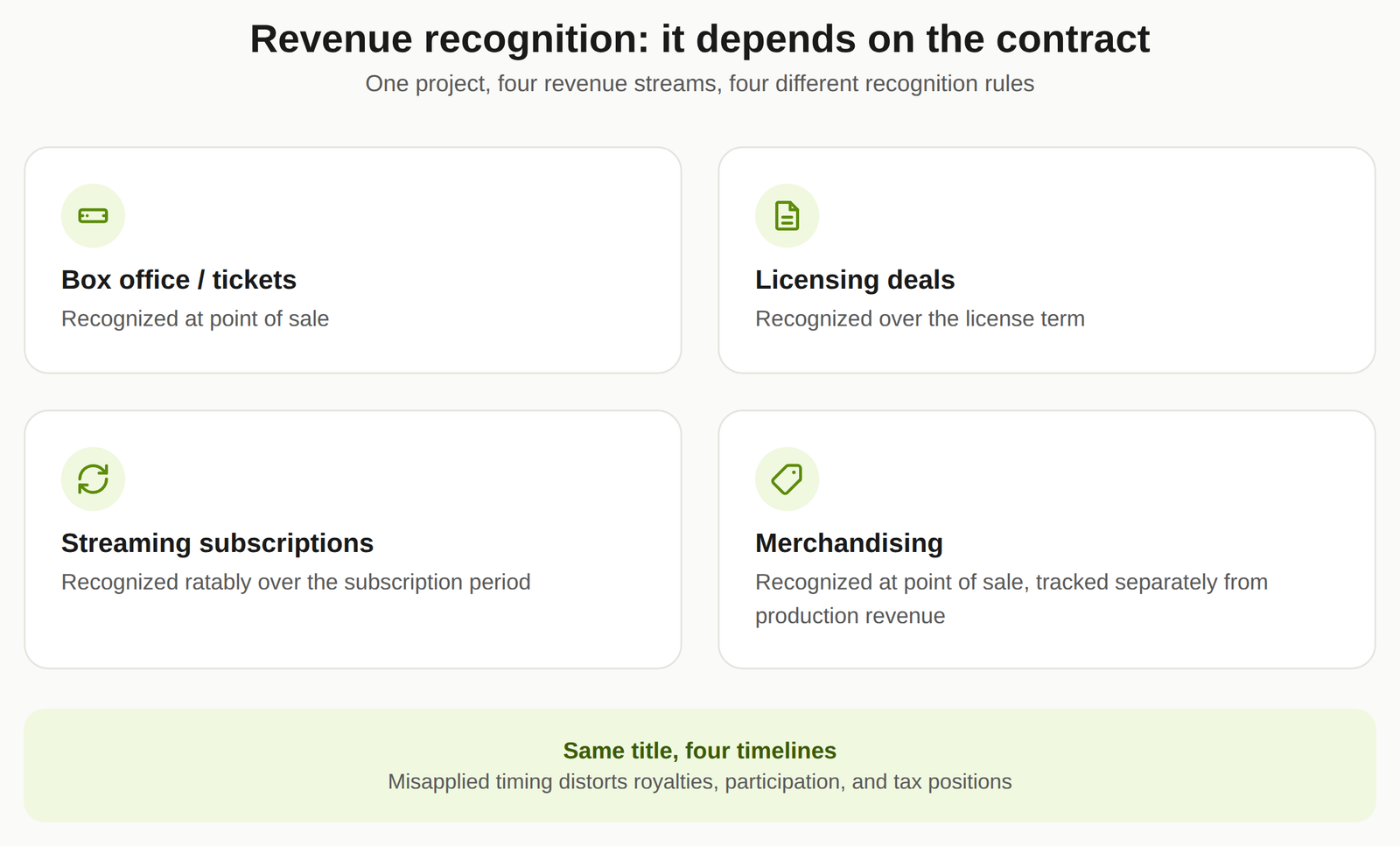
Entertainment revenue recognition depends on the nature of each contract and when the performance obligation is satisfied, not on when cash arrives. A distribution agreement, a streaming license, and a merchandising deal attached to the same project can each trigger revenue at a different point.
A few patterns show up consistently:
- Box office and ticket revenue is generally recognized at the point of sale.
- Licensing revenue (a title licensed to a broadcaster or streaming platform for a fixed term) is typically recognized over the license period rather than upfront, since the licensor’s obligation extends across that term.
- Subscription revenue on streaming platforms is recognized ratably over the subscription period, which is a meaningful shift from the one-time sale model older entertainment businesses were built around.
- Merchandising and ancillary revenue is usually recognized when the sale occurs, similar to standard retail treatment, but still needs to be tracked separately from core production revenue for reporting and participation purposes.
Getting this wrong is not a minor bookkeeping error. Misapplied revenue recognition distorts the numbers used to calculate royalties, profit participation, and tax positions, all of which depend on an accurate, well-timed revenue picture.
Production accounting: tracking costs department by department
Production accounting is the operational backbone of entertainment finance. It means tracking daily expenses across every department involved in a production and comparing actual spend against budget in something close to real time, not at month end.
A typical production budget breaks costs into departments such as:
- Cast and crew payroll
- Camera and equipment
- Locations and permits
- Wardrobe, hair, and makeup
- Post-production (editing, sound, visual effects)
- Marketing and distribution
Production accountants prepare cost reports comparing actuals to budget for each department, which lets producers catch overruns while there is still time to act rather than discovering them after the fact. On larger productions, this work happens alongside a completion guarantor, whose job is to make sure the production finishes on budget or covers the shortfall if it does not.
Royalty accounting and profit participation
This is where entertainment accounting diverges furthest from standard business finance, and it is also where the most disputes happen. Two separate but related concepts sit here: royalty accounting and profit participation.
Royalty accounting
It tracks payments owed to talent, songwriters, authors, and other rights holders based on how a project performs commercially. Royalty structures often include advances, escalators (rates that increase after certain sales or streaming thresholds), and recoupment provisions (where the rights holder does not see further payment until an advance is paid back). Streaming has made this more data-intensive, not less, since royalty calculations now depend on aggregating enormous volumes of stream counts across platforms and territories.
Profit participation,
sometimes called a backend deal or “points,” entitles a stakeholder to a share of a project’s profits, on top of or instead of an upfront fee. The complexity is not the math. It is the definition of what counts as profit in the first place, and that definition is heavily negotiated because it changes the outcome dramatically.
| Participation type | What it’s based on | Who typically gets it | Payout likelihood |
| Gross participation | A percentage of total revenue, before most deductions | A-list talent, directors with major leverage | High, but rare to negotiate |
| Adjusted gross participation | Gross revenue minus specific, capped deductions (distribution fees, P&A costs) | Mid-tier talent, some producers | Moderate |
| Net profit participation | Revenue after all production, marketing, and distribution costs are deducted | Most cast, crew, and writers with backend deals | Low, and frequently the subject of disputes |
The gap between gross and net participation is the reason “Hollywood accounting” has its own reputation. Because net profit definitions can include broad categories like overhead allocations and internal distribution fees, a project can generate very large box office revenue and still report no net profit under the specific formula in a given contract. This is not a hypothetical risk. It has driven real, public disputes between talent and studios over how costs were allocated against a film’s revenue. For any business handling profit participation, three practices reduce that risk substantially:
- Define “net profit” explicitly in every contract, in plain terms, before the deal closes.
- Keep the same profit definition consistent across all participants on a project to avoid one party being quietly favored over another.
- Prepare detailed, auditable participation statements that show revenue sources, allowable deductions, and the resulting calculation, since reliable bookkeeping is what makes those statements defensible if a rights holder exercises audit rights.
A chart of accounts built for entertainment companies
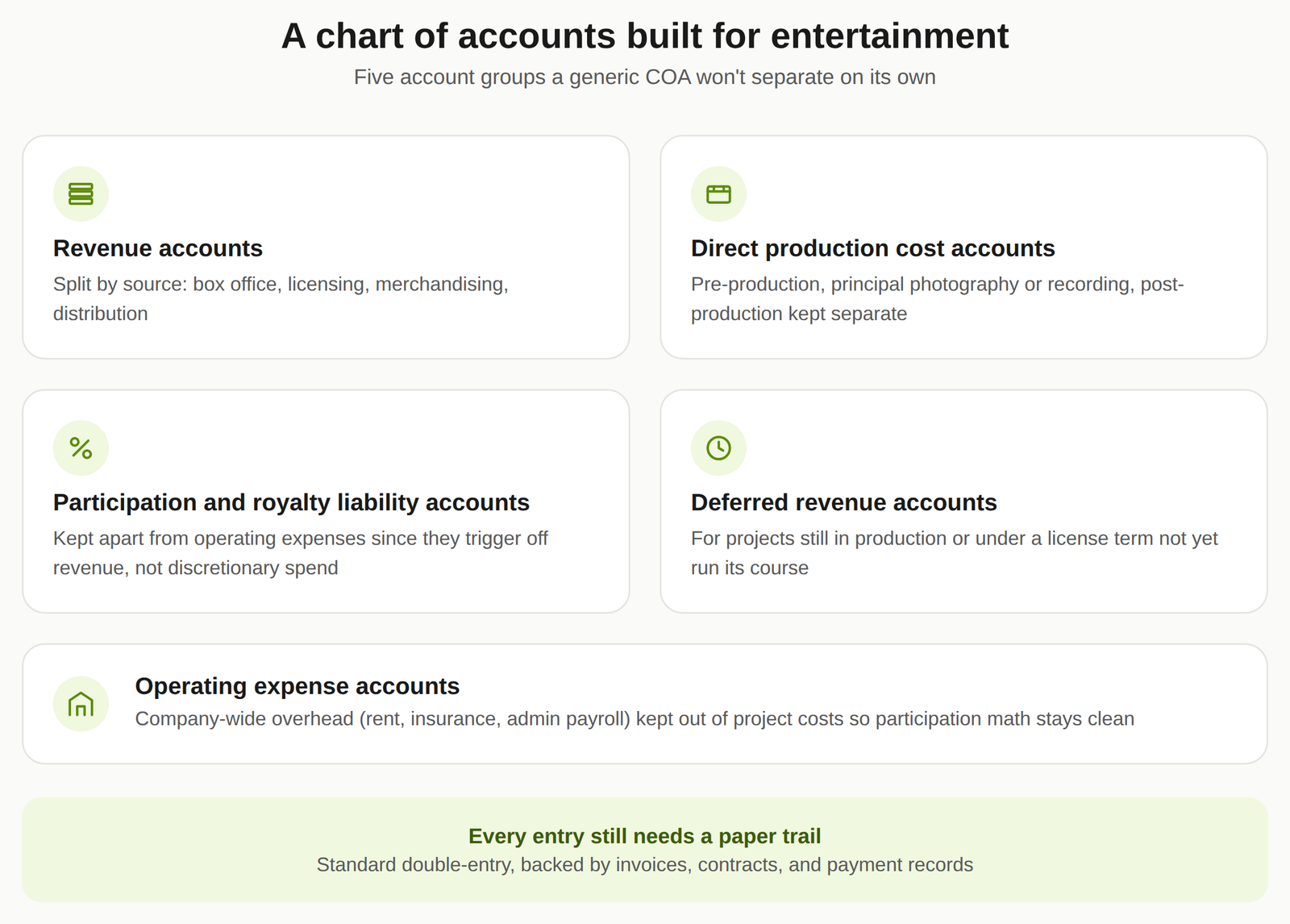
A generic chart of accounts will not capture what an entertainment business actually needs to report on. At minimum, an entertainment company’s chart of accounts should separate:
Revenue accounts, split by source (box office, streaming licensing, merchandising, international distribution) rather than lumped into one general sales account, since each source may have a different recognition timeline.
Direct production cost accounts, covering pre-production, principal photography or recording, and post-production separately, so a company can see where budget is actually being spent.
Participation and royalty liability accounts, tracked separately from operating expenses, since these are contractual obligations tied to specific revenue triggers rather than discretionary spend.
Deferred revenue accounts, for payments received on projects still in production or under a license term that has not yet run its course.
Operating expense accounts, covering overhead that is genuinely company-wide (rent, insurance, administrative payroll) and kept separate from project-specific costs so profit participation calculations are not muddied by unrelated overhead.
For a full breakdown of account categories and how to structure them for a media or production company, see Oak’s dedicated guide to charts of accounts for the entertainment industry. Every entry should still follow standard double-entry principles, with supporting documentation (invoices, contracts, payment records) for each transaction, since that documentation is exactly what gets pulled if a participant or auditor requests a review.
Tax treatment of production costs
Production costs represent a large upfront investment, and how a company chooses to expense them has a real effect on tax liability. Two approaches are common in U.S. entertainment tax planning:
- Immediate expensing under Section 181, which in qualifying circumstances allows certain film, television, and theatrical production costs to be deducted in the year they’re incurred rather than spread over time.
- Amortization over projected revenue, where production costs are capitalized as an asset (the IRS treats intellectual property like film and sound recordings as suitable for this treatment) and written off in proportion to the revenue the project is expected to generate. A company anticipating a decade of revenue from a title, for example, might allocate roughly a tenth of production costs against each year’s results.
Which method makes sense depends on the company’s cash position, whether the production qualifies under Section 181’s requirements, and how revenue is actually expected to play out. This is a case where working with an accountant experienced in entertainment finance is worth the cost of getting it reviewed properly before the return is filed, not after.
International productions add another layer. Many jurisdictions offer production tax credits or rebates to attract filming, and companies that shoot across multiple countries need a system built to track currencies, local tax rules, and credit eligibility without losing accuracy in consolidation.
Cash flow challenges specific to entertainment businesses
Three cash flow pressures come up consistently across media and entertainment companies.
Payment timelines have stretched. Brands and advertisers increasingly expect extended payment terms from content producers and agencies, while production costs are due up front. Bill collection that once took around 45 days can now stretch to three months, which puts real strain on a producer’s working capital even when the underlying business is healthy.
Cash transactions remain common in parts of the industry. Venues still pay some performers in cash, and productions on location frequently pay vendors the same way. Cash is harder to track and more vulnerable to error or fraud than electronic payments, and reconciliation takes longer as a result. Moving toward electronic payment and collection systems where possible improves both transparency and security.
Growth adds financial complexity. As entertainment companies expand into new markets or merge with other operations, financial consolidation becomes harder. A single reporting structure and, where an organization operates across borders, a unified banking relationship, both make it easier to keep visibility over cash position instead of losing it in the noise of multiple entities.
Choosing systems that fit how entertainment companies actually operate
Standard small-business accounting software rarely covers the ground entertainment companies need. Look for systems (or an outsourced accounting partner who already works inside one) that can handle:
- Multi-entity accounting, so intercompany transactions between a production company, a financing vehicle, and a distribution partner consolidate cleanly instead of requiring manual reconciliation.
- Multi-currency functionality for productions or licensing deals spanning multiple countries.
- Royalty and rights management features capable of handling escalators, recoupment, and waterfall calculations rather than flat percentage splits.
- Real-time cost reporting against budget, so overruns surface during production rather than at wrap.
Managing financial risk beyond the ledger
Entertainment accounting also intersects with risk management in ways most industries do not encounter. Completion bonds protect financiers by guaranteeing a production will finish on budget or the bond issuer covers the shortfall, which is often a condition of financing for independent productions. Errors and omissions insurance protects against claims related to content, from copyright disputes to defamation. Neither of these sits neatly inside a standard chart of accounts, but both need to be factored into a production’s overall financial plan, since a claim against either can affect a project’s reported profitability and, by extension, participation calculations.
Frequently Asked Questions
Why do profitable films sometimes report a net loss?
Because “net profit” in most entertainment contracts is defined narrowly and can include broad deductions for overhead, distribution fees, and interest charges. A project can generate substantial revenue and still show no net profit under the specific formula written into a given contract, which is why gross participation is considered far more valuable, and far harder to negotiate, than net participation.
What is Section 181 and does it apply to every production?
Section 181 is a U.S. tax provision that allows certain qualifying film, television, and theatrical productions to expense production costs immediately rather than amortizing them over time. Eligibility depends on the specifics of the production and current IRS guidance, so it should be evaluated with a tax professional before a company assumes it applies.
How does streaming change royalty accounting?
Streaming replaces discrete sales transactions with continuous, high-volume stream counts across platforms and territories, each carrying its own royalty rate. That data volume makes automated royalty tracking systems far more important than they were in a physical-sales or broadcast-royalty world.
What should a small production company prioritize first?
Separate, source-specific revenue accounts and disciplined production cost tracking against budget. Both are foundational: without them, royalty calculations, participation statements, and tax positions all inherit the same inaccuracies.
Do independent productions need entertainment-specific accounting software?
Not always at the smallest scale, but as soon as a project involves more than one revenue stream, an outside investor, or a profit participation agreement, generic accounting software becomes a liability rather than a convenience. The reporting granularity these deals require is difficult to reconstruct after the fact.
Conclusion
Entertainment accountants are not just processing numbers behind the scenes. They are the ones who make sure a production’s revenue is recognized correctly, its costs are tracked against budget in real time, and its royalty and profit participation obligations are calculated in a way that holds up if a rights holder ever asks for an audit.
Oak Business Consultant provides accounting and bookkeeping services built around the reporting entertainment companies actually need, along with CFO-level financial strategy for productions and media businesses navigating growth, financing, or multi-entity structures. Contact Oak Business Consultant to get your production’s or media company’s finances on solid ground while you focus on the work in front of the camera, not the numbers behind it.