A Guide to Entertainment Industry Financial Budgeting
Entertainment Industry Budgeting: An Expert Guide
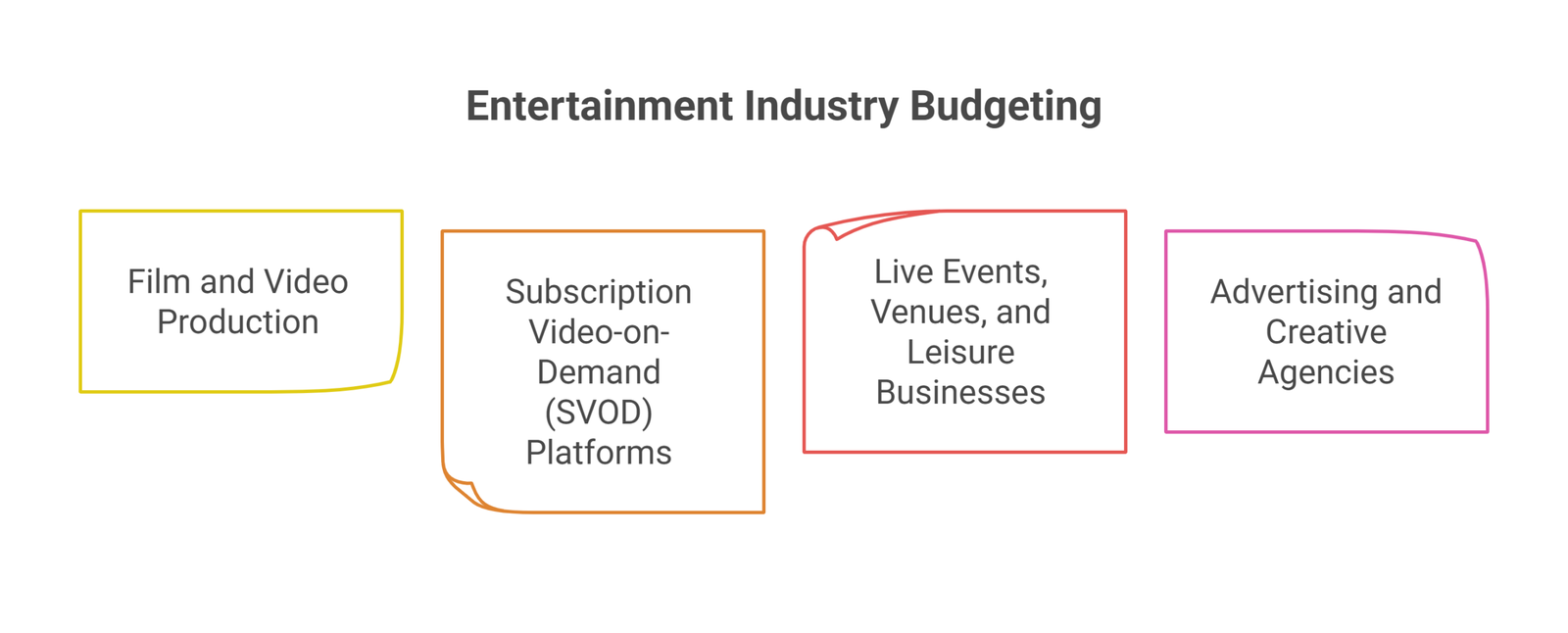
“Entertainment” covers a film studio, a streaming platform, a nightclub, and an ad agency, and each one budgets in a completely different way. A film producer thinks in above-the-line and below-the-line costs. A streaming platform lives or dies on churn and customer acquisition cost. A venue owner cares about break-even attendance. Treating “entertainment budgeting” as one method, the way generic guides often do, misses the specific numbers that actually decide whether each of these businesses survives.
Below is what a real budget looks like for the main entertainment business models, and the metrics that lenders, investors, or your own management team will expect to see.
Film and video production
Every professional film budget follows the same structure: above-the-line (ATL) costs for the director, producers, and principal cast, and below-the-line (BTL) costs for crew, equipment, locations, and day-to-day production spend. Post-production and “other” costs, including insurance and legal fees, sit as their own categories. This four-part split is not optional formatting. It’s what a financier, distributor, or bond company expects to see summarized on a single topsheet before they’ll discuss financing.
Two numbers matter more than founders often expect. First, contingency: the industry standard is roughly 10% of the total budget set aside for the unexpected, and skipping it is one of the fastest ways to run out of cash mid-shoot. Second, a completion bond, a financial guarantee that the film will finish on time and on budget, is typically required once institutional money (foreign pre-sales, film funds, gap loans) is involved.
On the revenue side, a rough industry benchmark holds that a film needs to gross about 2.5 times its production budget to break even, once marketing, distribution, and exhibitor fees are factored in. It’s a heuristic, not a precise formula, since streaming deals and international pre-sales change the math, but it’s a useful gut check before greenlighting a project.
Subscription video-on-demand (SVOD) platforms
Streaming and subscription entertainment businesses run on a different set of numbers entirely, and they interlock. Average revenue per user (ARPU) tells you how much each subscriber is worth per period. Customer acquisition cost (CAC) tells you what it costs to win that subscriber. Customer lifetime value (CLV) combines ARPU with how long a subscriber typically stays, and the ratio of CLV to CAC tells you whether the business actually compounds or is just running in place.
Churn is the number that ties it together, and it’s not one figure. Voluntary churn (someone actively cancels) and involuntary churn (a payment fails) have different causes and different fixes, so a budget that tracks only blended churn hides which problem you’re actually solving.
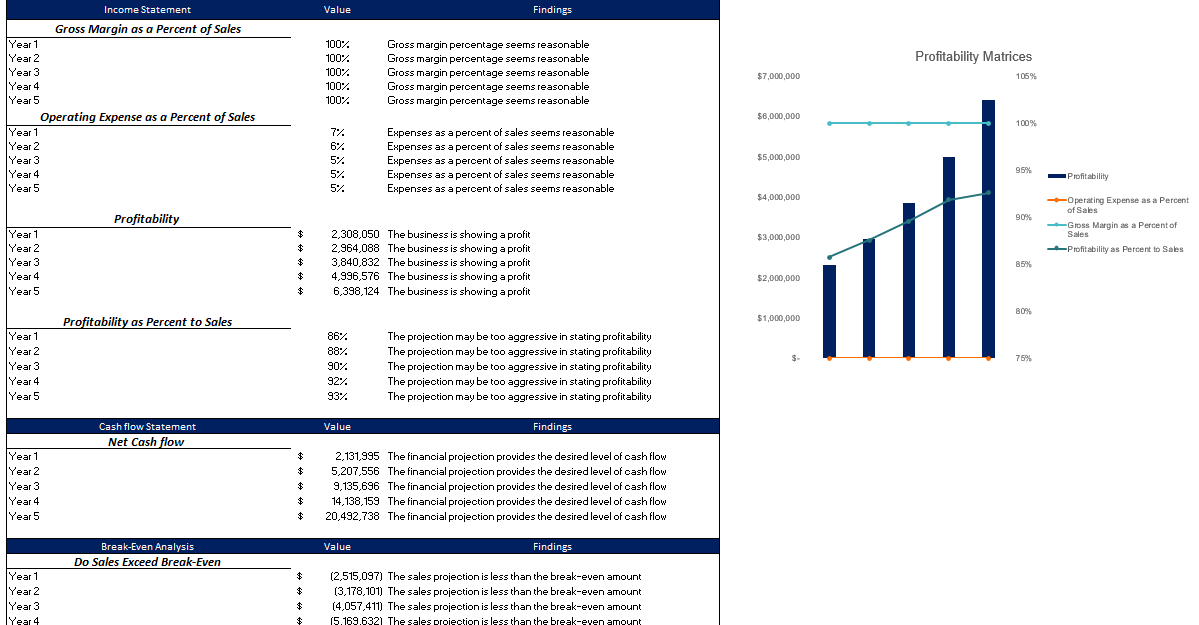
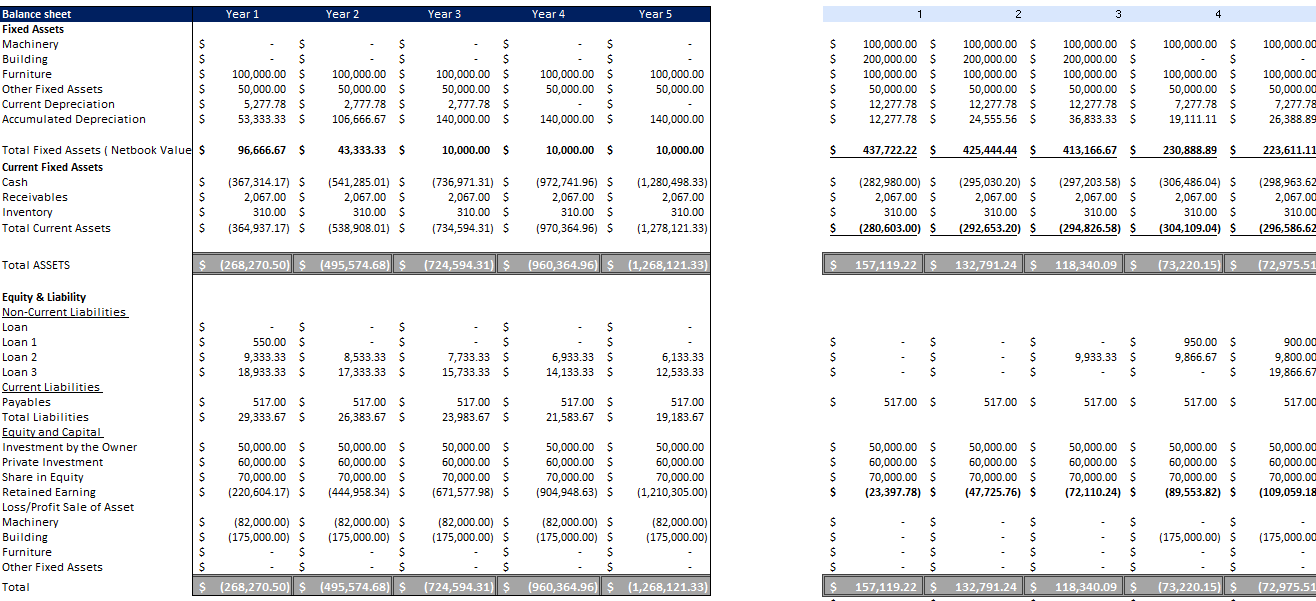
Oak Business Consultant built a financial model for an SVOD client that tracked all four of these metrics and linked them directly into the income statement, cash flow, and balance sheet, rather than leaving them in a separate dashboard disconnected from the actual financials. That structure is what makes a subscription entertainment budget usable for both day-to-day decisions and investor conversations. You can read the full SVOD case study for the details.
Live events, venues, and leisure businesses
Nightclubs, music festivals, theme parks, and similar venue-based entertainment businesses budget around a fixed capacity and variable attendance, which makes break-even analysis the central tool. Fixed costs (rent, licensing, core staff, insurance) don’t move whether ten people show up or a thousand. Variable costs (bar staff, security, cleanup, artist fees for some events) scale with attendance.
The budgeting mistake in this category is usually pricing tickets or cover charges to match a competitor without first calculating the attendance level needed to cover fixed costs. A venue that needs 400 attendees to break even but only markets to a mailing list of 300 has a marketing problem the budget should have caught before opening night, not after.
Advertising and creative agencies
Agencies budget around utilization rate, the percentage of billable staff hours actually billed to clients, since that number drives whether the agency is profitable at its current headcount. A team that’s fully staffed but only 60% utilized is carrying overhead that isn’t being paid for by client work.
The other budgeting risk specific to agencies is client concentration. A budget built around one client providing 40% or more of revenue needs a contingency plan for that client leaving, not just a revenue projection that assumes they stay. Retainer-based revenue is more predictable than project-based revenue, and a healthy agency budget usually blends both rather than relying entirely on one-off projects.
What every entertainment budget needs, regardless of segment
Across all four business models, a few things separate a usable budget from an optimistic guess:
- Revenue forecasting grounded in comparables. Whether it’s comparable film box office, comparable subscriber growth curves, or comparable venue attendance, a forecast built on your own optimism instead of real comparables is the most common reason budgets miss.
- A contingency reserve. 10% is the film industry norm, and it’s a reasonable starting point for any entertainment business with unpredictable revenue timing.
- Cash flow timing, not just totals. Entertainment revenue tends to arrive in lumps (a box office opening weekend, a festival’s ticket window, a subscriber surge after a hit release) while costs are often steady or front-loaded. A budget that only shows annual totals hides the months where cash runs short.
| Business model | Core budgeting structure | Key metric | Common budgeting mistake |
| Film and video production | Above-the-line / below-the-line, topsheet | Contingency %, breakeven multiple | Skipping the contingency reserve |
| SVOD platforms | Subscription revenue tied to 3-statement model | ARPU, CAC, CLV, churn | Tracking blended churn only |
| Live events and venues | Fixed vs. variable costs | Break-even attendance | Pricing off competitors instead of break-even math |
| Ad and creative agencies | Retainer vs. project revenue mix | Utilization rate | Over-reliance on one client |
Frequently Asked Questions
How much should an entertainment business set aside for contingency?
The film industry standard is 10% of total budget. It’s a reasonable default for other entertainment businesses with volatile or unpredictable revenue, though the right number depends on how much historical data you have to forecast against.
What’s the single most important metric for a streaming or subscription entertainment business?
None of ARPU, CAC, CLV, or churn works well in isolation. The ratio of CLV to CAC is usually the number investors ask for first, since it answers whether the subscriber base is actually growing the business or just replacing losses.
Do small, self-funded entertainment businesses need a formal budget?
Yes. A budget matters most when there’s no outside investor to force the discipline. A venue or small production that skips budgeting tends to discover its cash shortfall in the moment it’s least able to fix it.
Is the 2.5x breakeven rule accurate for every film?
No. It’s a rough heuristic for theatrical releases. Streaming deals, international pre-sales, and ancillary licensing revenue all shift the real breakeven point, sometimes significantly.
How is agency budgeting different from a production or venue budget?
Agencies don’t have a single product or event driving revenue. The budget centers on staff utilization and client mix instead of a single break-even calculation, which makes people costs the primary lever rather than a secondary one.
What should I bring to a first conversation with a CFO about an entertainment industry budget?
Whatever data you already have on past projects, subscriber numbers, or attendance, plus your cost structure. A fractional CFO can build the model around your actual numbers rather than a generic template.
Conclusion
The entertainment businesses that raise money and stay funded aren’t the ones with the most exciting pitch. They’re the ones whose numbers hold up when someone asks what happens if attendance, subscribers, or box office comes in below plan. Different entertainment business models need genuinely different budgeting structures, not one template relabeled four ways.
If you’re building a financial model for a film, streaming platform, venue, or agency, Oak’s financial modeling services can build it around your actual numbers, drawing on entertainment industry financial model templates as a starting structure where useful. For ongoing budget oversight beyond a single model, Oak’s fractional CFO services cover forecasting, cash flow management, and investor-readiness. And if you’re tracking performance after the budget is built, our guide to entertainment industry KPIs covers what to measure once the model is live.