SDG 1: No Poverty, but 847 Million People Still Live in It
SDG 1: No Poverty, but the Goal Remains Out of Reach
Ending poverty was the first goal the United Nations set when it adopted the 2030 Agenda in September 2015. That order matters. Every other goal in the framework, health, education, gender equality, decent work, gets harder to reach while extreme poverty persists. This guide covers what SDG 1 actually commits the world to. It also covers where global progress stands based on the latest reporting, and what specific countries and institutions are doing about it. One dedicated section covers where businesses fit into a goal that’s too often treated as a government-only problem.
What is SDG 1
SDG 1, formally titled “End poverty in all its forms everywhere,” is the first of the 17 Sustainable Development Goals. All 193 UN member states adopted it in 2015. It sits inside the broader 2030 Agenda for Sustainable Development. That’s the UN’s plan to address the world’s most pressing social, economic, and environmental challenges by 2030.
Poverty, under this framework, isn’t defined narrowly as a lack of income. The goal addresses poverty “in all its dimensions.” People can be income-poor, education-poor, health-poor, or shut out of land and financial systems, often at the same time. This multidimensional framing is part of what separates SDG 1 from earlier anti-poverty efforts like the Millennium Development Goals, which ran from 2000 to 2015.
The official targets and indicators behind SDG 1
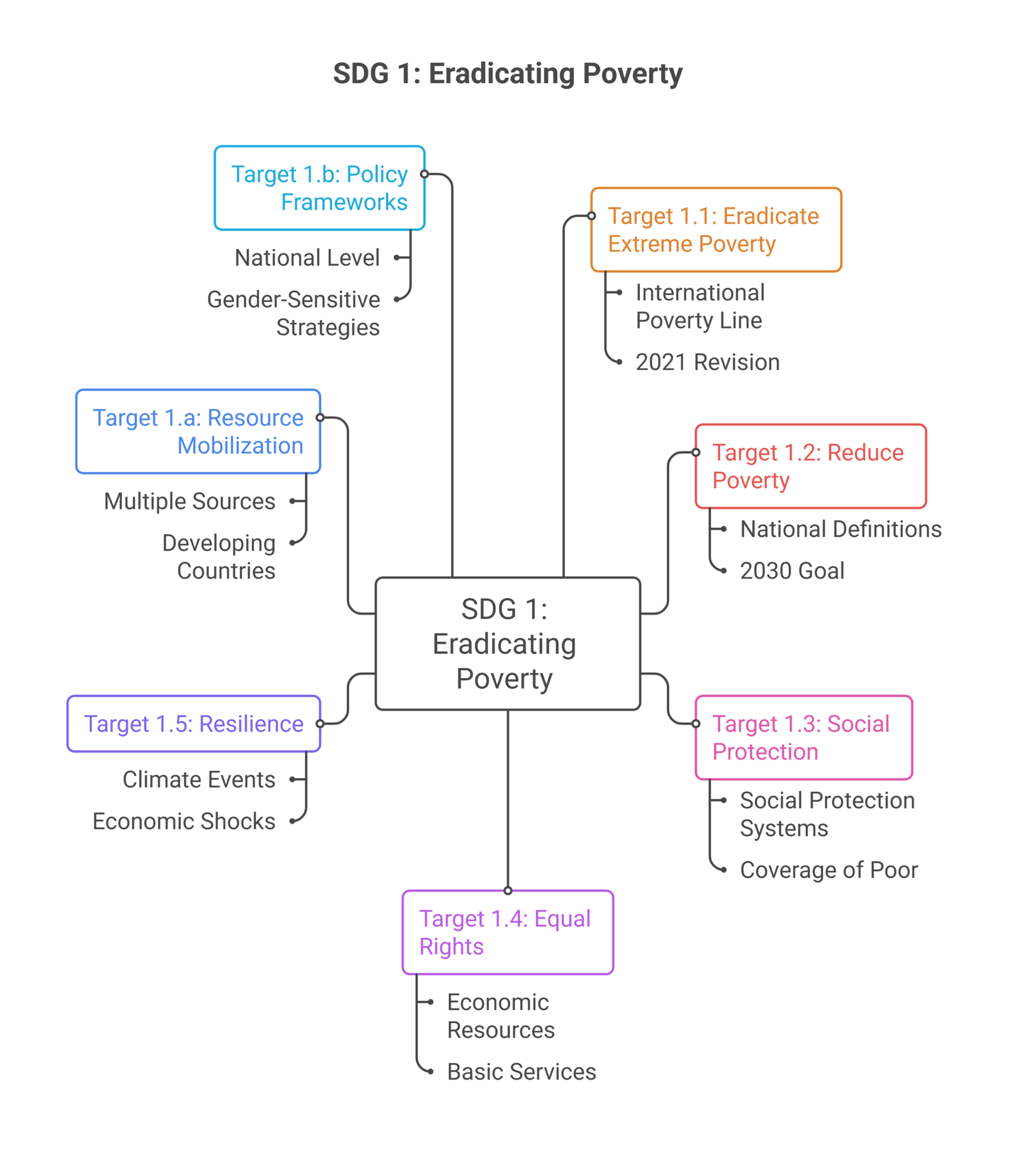
SDG 1 breaks down into seven official targets, each with specific indicators the UN uses to track progress:
- Target 1.1: Eradicate extreme poverty for all people everywhere. This is measured against the international poverty line, most recently revised to $3.00 per day in 2021 purchasing power parity terms, up from the earlier $2.15 threshold.
- Target 1.2: By 2030, reduce at least by half the proportion of people living in poverty according to national definitions, across all its dimensions.
- Target 1.3: Implement nationally appropriate social protection systems for all, including floors, and achieve substantial coverage of the poor and vulnerable.
- Target 1.4: Ensure all people, particularly the poor and vulnerable, have equal rights to economic resources, basic services, land ownership, inheritance, financial services, and technology.
- Target 1.5: Build the resilience of the poor and vulnerable to climate-related extreme events and other economic, social, and environmental shocks.
- Target 1.a: Mobilize resources from multiple sources to give developing countries adequate means to implement programs ending poverty.
- Target 1.b: Create sound policy frameworks at national, regional, and international levels, based on pro-poor and gender-sensitive development strategies, to support accelerated investment in poverty eradication.
Where global progress actually stands
Extreme poverty is higher than previously estimated, not lower. In June 2025, the World Bank revised its global poverty estimates. It used updated price data and national poverty lines from more than 160 countries, raising the international poverty line from $2.15 to $3.00 a day. Under this new threshold, an estimated 808 million people were living in extreme poverty in 2025, up from a previous estimate of 677 million. That’s roughly 9.9%, or 1 in 10 people, of the world’s population. A separate March 2026 World Bank update put the figure at approximately 847 million people still in extreme poverty. Sub-Saharan Africa accounts for around 67% of that global total.
The 2030 target is unlikely to be met. According to the UN Statistics Division’s own reporting, none of the SDG 1 targets are currently on track to be fully achieved by 2030. Only about one in five countries is projected to halve its national poverty rate by 2030 at current rates of progress.
Poverty is concentrated in specific regions. More than three-quarters of the world’s extreme poor now live in Sub-Saharan Africa or in fragile, conflict-affected countries, per the UN Statistics Division’s 2025 SDG report. In the least developed countries, nearly 3 in 10 workers lived in extreme poverty as of 2024. That compares to about 2 in 10 in landlocked developing countries. Small island developing states saw their working poverty rate rise from 8.9% in 2015 to 9.5% in 2024, one of the few regions moving in the wrong direction.
The table below pulls together the headline indicators, comparing the 2015 baseline against the most recent figures available.
| Indicator | 2015 baseline | Most recent figure |
| People in extreme poverty (revised $3.00/day line) | Not applicable under old line | ~847 million (March 2026) |
| Working poverty rate (below $2.15/day) | 8.4% | 6.9% (2024) |
| Social protection coverage (at least one benefit) | 42.8% | 52.4% (2023) |
| People with no social protection coverage | Not tracked at this granularity | 3.8 billion |
| Sub-Saharan Africa share of extreme poor | Roughly half | Roughly two-thirds to three-quarters |
| Small island states’ working poverty rate | 8.9% | 9.5% (2024) |
Source: UN Statistics Division, 2025 SDG progress report;World Bank, March 2026 update.
Social protection coverage passed a milestone, but the gap is still enormous. For the first time on record, more than half the world’s population had access to at least one social protection benefit. That’s up from under 43% a decade earlier, per UN Statistics Division figures. High-income countries are approaching universal coverage at 85.9%. Low-income countries have barely moved, sitting at just 9.7%. Closing this gap in low- and middle-income countries would require an estimated additional $1.4 trillion a year, about 3.3% of their combined GDP.
Land rights remain informal for most of the developing world. Based on data from 85 countries reported by the UN, roughly two-thirds of people believe they have secure rights to their land. Only 43% actually hold official documentation, dropping to just 15% across Sub-Saharan Africa. That leaves an estimated 1.4 billion adults in developing regions shut out of formal land markets and unable to use land as collateral for credit.
Government spending patterns still favor wealthier nations. Advanced economies spend an average of 60% of government budgets on essential services like education, health, and social protection. Emerging and developing economies spend 43%. That gap has held steady at roughly 20 percentage points for two decades, per the UN’s 2025 SDG progress data.
What countries are doing about SDG 1
Poverty reduction plays out very differently depending on a country’s starting point, economic structure, and policy choices. The list runs from countries closest to solving SDG 1 to those still building the basics. It’s not a strict ranking. Poverty gets measured differently across income levels. But the order shows how far each country has moved toward ending it at home.
China
China achieved SDG target 1.1, eradicating extreme poverty domestically, roughly ten years ahead of the UN’s 2030 schedule. It lifted an estimated 800 million people out of poverty since the early 1980s. The tools were market-oriented reform and targeted rural investment, according to a World Bank poverty synthesis report. China has since exported elements of its approach internationally. One example is Juncao technology, a low-cost method for growing mushrooms using grass instead of wood. More than 40 African countries, including Rwanda, have adopted it to diversify rural income sources.
United Arab Emirates
The UAE doesn’t fit the same mold as the rest of this list. Domestic extreme poverty was never its main challenge. Its SDG 1 story runs on two tracks instead. One is a domestic social support system for citizens. The other is an outsized global aid role. At home, the government has been shifting its model. It’s moving from direct welfare toward sustainable social development. Emiratis can get housing aid, social assistance, and land support. These come through bodies like the Ministry of Community Empowerment and the Ministry of Presidential Affairs. That’s according to the UAE’s official government platform. Abroad, the picture looks different.
The UAE has given a cumulative AED 360 billion, about $98 billion, in foreign aid since 1971 through mid-2024. That’s according to its Ministry of Foreign Affairs. On the OECD’s more recent numbers, the UAE gave an estimated $3.4 billion in official development assistance in 2025. That’s about 0.61% of GNI, up sharply in real terms from 2024. That puts it among the few donor countries still tracking toward the UN’s 0.7%-of-GNI aid target. Most wealthy donor nations have missed that bar for decades. Most of that aid goes to countries facing high or extreme fragility. The Middle East and Africa are the largest recipients.
Germany
Germany runs one of Europe’s largest basic-income safety nets. Its Bürgergeld benefit supported around 5.2 million people as of late 2025, including 1.4 million children. That’s according to reporting from The Local. Single recipients currently receive €563 a month plus a per-child supplement, but the program is being replaced. The German cabinet has approved a successor scheme called Neue Grundsicherung. It’s due to take effect from July 1, 2026, pending a Bundestag vote. That’s according to the same outlet. The reform keeps benefit amounts roughly the same. But it tightens sanctions for recipients who miss job-center appointments or turn down work. Critics argue that could push vulnerable households further into hardship. Supporters say it will speed labor-market re-entry.
Canada
Canada runs the Guaranteed Income Supplement, a monthly benefit for low-income seniors. It reached nearly 2 million people in a single year. Canada pairs it with a National Housing Strategy. The strategy aims to expand affordable housing for seniors, people fleeing domestic violence, and other vulnerable groups.
United Kingdom
The UK published its first dedicated Child Poverty Strategy in December 2025. It’s built around three themes: boosting family incomes, cutting the cost of essentials, and strengthening local support. That’s per the House of Lords Library. The most consequential change is the removal of the two-child limit on Universal Credit’s child element. That took effect in April 2026. Before that, families got no extra support for a third or later child. The Child Poverty Action Group estimates that change will lift 550,000 children out of poverty by 2029/30. That’s combined with free school meal expansion. The government has also raised the National Living Wage. It cut the maximum Universal Credit deduction rate from 25% to 15% of a household’s standard allowance. The UK government says that change already supports 1.2 million households.
United States

The US doesn’t run a single flagship anti-poverty program the way Brazil or Ethiopia do. Instead, it leans heavily on the tax code. The Earned Income Tax Credit and Child Tax Credit, used together, are the country’s two most effective anti-poverty tools. The Center on Budget and Policy Priorities tracked the impact. The two credits combined lifted 8.2 million people above the poverty line in 2024. They also softened poverty for another 17.5 million people. On its own, the federal EITC delivered roughly $64 billion to 23 million working families in 2024. The design has a gap. Workers without children get a far smaller credit. Under current law, low-paid workers with no kids at home can end up taxed deeper into poverty. That gap is currently unresolved at the federal level, though several states have expanded their own EITCs to cover it.
Brazil
Brazil built one of the most studied cash-transfer programs in the world through Bolsa Família. It ties direct payments to low-income families to school attendance and healthcare visits. A separate Continuous Cash Benefit targets elderly and disabled citizens. That’s according to the Borgen Project’s review of national poverty programs. Research has linked the program to real reductions in both poverty and income inequality. Brazil also launched the G20 Social Policy Portal during its 2024 G20 presidency. The goal was to encourage international knowledge-sharing on social protection design.
India
India runs PM-Kisan, a direct income-support program for farmers, alongside a broader social protection push during its 2026 BRICS presidency. That push has pitched inclusive growth and digital public infrastructure as a model other countries can adapt. Despite the progress, India’s population size is huge. It still accounts for a large share of the world’s poor in absolute terms. Its national poverty rate has fallen steadily.
Ethiopia
Ethiopia’s Productive Safety Net Programme sits alongside Brazil’s and India’s programs. It’s one of the more consistent, measurable models for reducing poverty at scale. It works through structured cash and food transfers linked to public works. Ethiopia’s extreme poverty rate still remains far higher than any other country on this list. That reflects its place among the least developed economies, still building basic social protection.
Nepal
Nepal offers a smaller-scale example through its Micro Enterprise Development Programme, originally implemented with UNDP support starting in 1998. It built entrepreneurial and vocational skills directly with people living in poverty. The government fully absorbed it into its own structures by 2013.
What organizations and institutions are doing
A wide network of multilateral institutions, UN agencies, and cross-sector initiatives coordinate the global push on SDG 1:
World Bank Group
The World Bank Group remains the largest single financing actor, primarily through its International Development Association, which provides low- or no-interest financing to the world’s poorest countries. An expanded IDA21 replenishment in 2024 was pitched as necessary to keep momentum against extreme poverty going.
UNDP and the International Labour Organization
UNDP and the International Labour Organization have jointly led much of the UN’s technical analysis and reporting on SDG 1. That includes co-authoring the background research used at UN High-Level Political Forum reviews of the goal.
Joint SDG Fund
The Joint SDG Fund finances cross-agency projects that connect public budgets, private investment, and local implementation. One example is a Zanzibar, Tanzania initiative, where the UN Resident Coordinator, together with the FAO, UNDP, IFAD, and the World Food Programme, strengthened seaweed farming value chains. The tools were blended financing, digital market access, and stronger cooperatives, aimed largely at women and youth.
UN Global Compact
The UN Global Compact, through its SDG Blueprint for business leadership, frames decent job creation as one of the most effective private-sector levers against poverty. It encourages companies to scale operations responsibly in the least developed countries in ways that generate secure local employment.
International Day for the Eradication of Poverty
The UN’s International Day for the Eradication of Poverty, observed every October 17, continues to bring together governments, NGOs, and the private sector. Country-level events are run in partnership with UNDP and the World Bank.
How businesses can contribute to SDG 1
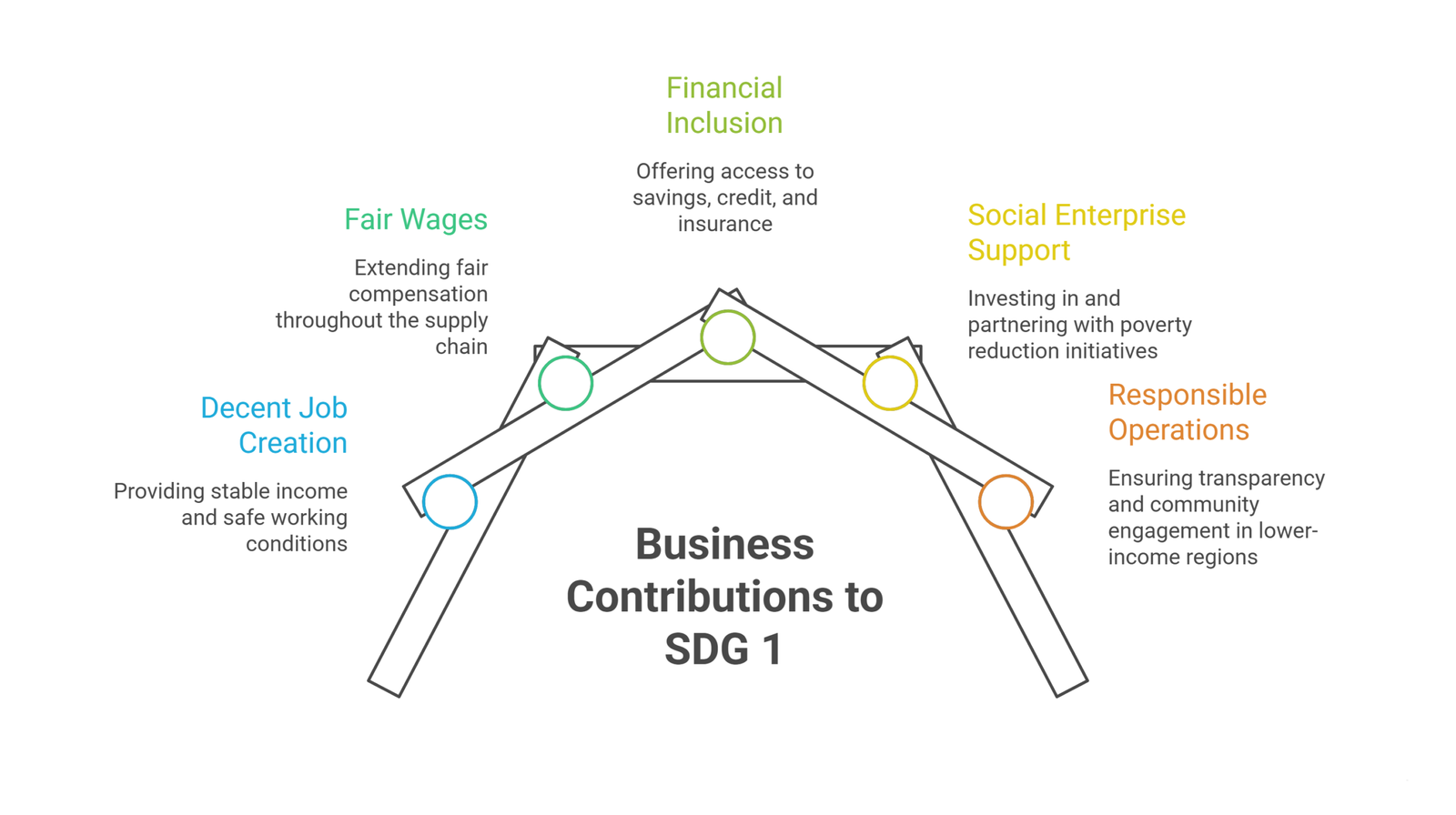
Most conversations about SDG 1 assume the responsibility sits entirely with governments and large multilateral institutions. In practice, the UN Global Compact’s own guidance says net job creation is an area where the private sector can lead, not merely support. There are several concrete ways businesses, including small and mid-size ones, can contribute.
Create decent jobs, not just any jobs. Stable income, safe working conditions, and reasonable job security do more to lift people out of poverty than one-time charitable giving. That’s especially true when a business scales operations in regions with high poverty concentrations.
Extend fair wages and benefits through the supply chain, not just to direct employees. A large share of global poverty sits with informal and gig-economy workers. They’re connected to larger businesses indirectly, through suppliers and subcontractors.
Support financial inclusion. Products and services that give low-income individuals access to savings, credit, or insurance address a specific gap. Roughly 1.4 billion adults in developing regions are currently excluded from formal financial systems because they lack land documentation or credit history.
Invest in or partner with social enterprises working directly on poverty reduction. That can mean direct investment, procurement relationships, or mentorship and financial planning support for nonprofits. Many nonprofits and social ventures need the same rigor around budgeting and forecasting that any startup does. That structure is often what determines whether a poverty-focused program actually scales.
Build responsible, transparent operations in lower-income regions. The UN Global Compact’s guidance specifically calls out transparency and stakeholder engagement, particularly with local communities. Both are essential to making sure poverty-focused business activity doesn’t create new harms while solving old ones.
Frequently Asked Questions
What is the difference between SDG 1 and older anti-poverty goals like the Millennium Development Goals?
The MDGs, which ran from 2000 to 2015, focused primarily on halving extreme income poverty. SDG 1 is broader, targeting poverty in all its dimensions: income, health, education, and access to land, finance, and social protection, not income alone.
Is the world on track to eliminate extreme poverty by 2030?
No. According to current UN reporting, none of the SDG 1 targets are on track to be fully achieved by 2030. Only about one in five countries is projected to halve its national poverty rate by that date.
Which region has the most extreme poverty today?
Sub-Saharan Africa, which accounts for roughly two-thirds to three-quarters of the world’s extreme poor depending on the estimate used, along with fragile and conflict-affected states more broadly.
What is the current international poverty line?
As of the World Bank’s June 2025 revision, the international poverty line is $3.00 per day in 2021 purchasing power parity terms, up from the previous $2.15 threshold.
How many people worldwide lack any social protection coverage?
An estimated 3.8 billion people. That’s despite more than half the world’s population gaining access to at least one social protection benefit for the first time in 2023.
Can businesses really make a measurable difference on SDG 1, or is this mainly government work?
Businesses have a real, UN-recognized role, particularly through decent job creation, fair-wage supply chains, and financial inclusion products. Still, the scale of global poverty means business action complements, rather than replaces, government and multilateral efforts.
Conclusion
The gap between SDG 1’s ambition and its current trajectory is the real story here. Governments and multilateral institutions will carry most of the weight on land rights, social protection floors, and the $1.4 trillion coverage gap. But the private sector holds real, underused leverage on the job-creation and financial-inclusion side, and the UN Global Compact has said so directly. For a business trying to figure out where it fits, that’s usually the more useful question to start with. Not “how do we donate,” but “where in our own operations, hiring, supply chain, and financial planning, can we build something that holds up.” If your business is exploring how to structure that kind of work financially, whether that’s a supply-chain wage review or a funding model for a social enterprise partnership, Oak’s financial consulting services can help build the numbers behind it.