Green Bonds vs Sustainability-Linked Loans: How US Companies Should Choose
Sustainable financing, decoded: green bonds vs. sustainability-linked loans in the US
A company wants to borrow for a genuine sustainability reason. Maybe it’s a solar retrofit, a fleet conversion, or a credible push to cut emissions. The finance team then hits a fork in the road. One path locks the money to a specific green project and comes with strict tracking rules. The other lets the company borrow for general purposes and only ties the price to whether it hits sustainability targets. Picking the wrong one wastes months of legal and reporting work. Pick it badly enough, and it invites a greenwashing challenge instead. This article breaks down what green bonds and sustainability-linked loans actually do. It also covers how the US market treats them differently than Europe. And it lays out how to decide which one fits a specific balance sheet.
What a green bond actually commits you to
A green bond is a use-of-proceeds instrument. The issuer raises money from bond investors and agrees, in writing, to spend it only on eligible green projects. That list typically includes renewable energy, energy-efficient buildings, clean transit, and water infrastructure. The International Capital Market Association’s Green Bond Principles set the voluntary framework most issuers follow. It rests on four pillars: use of proceeds, process for project evaluation and selection, management of proceeds, and reporting.
Because the money is ring-fenced, green bonds carry ongoing obligations a plain-vanilla bond doesn’t have. Issuers typically need:
- A green bond framework describing eligible project categories
- A second-party opinion (SPO) from an outside reviewer confirming the framework holds up
- A dedicated account or sub-ledger tracking how proceeds are allocated
- Annual allocation and impact reporting until the funds are fully deployed
If the projects don’t exist yet, a green bond becomes a compliance headache rather than a financing win. The same is true if the company can’t show a clean paper trail from bond proceeds to actual capital spending.
What a sustainability-linked loan actually commits you to
A sustainability-linked loan (SLL) works on a different logic entirely. The proceeds can go toward general corporate purposes, including working capital, refinancing, or an acquisition. There’s no ring-fencing and no project list. Instead, the loan’s interest margin moves up or down based on whether the borrower hits agreed sustainability performance targets (SPTs). Those targets are tracked through key performance indicators (KPIs) such as emissions intensity, renewable energy share, or a third-party ESG score.
The Sustainability-Linked Loan Principles lay out how SPTs should be set. They’re developed jointly by the LSTA, the Loan Market Association, and the Asia Pacific Loan Market Association. Targets should be ambitious relative to the borrower’s own historical performance. They should also be benchmarked externally where possible, and reported on at least annually. Miss the targets and the margin typically steps up. Hit them, and it steps down.
This structure opens the sustainable finance market to companies without a pipeline of green capital projects to point to. That includes service businesses, retailers, and manufacturers outside the traditionally “green” sectors of energy and utilities.
The core difference, side by side
| Green bond | Sustainability-linked loan | |
| Use of proceeds | Restricted to eligible green projects | General corporate purposes |
| What’s tracked | Where the money goes | Whether targets are hit |
| Pricing mechanism | Standard bond pricing (occasional “greenium”) | Margin ratchet tied to SPT performance |
| Reporting burden | Allocation and impact reports on proceeds | Annual KPI performance reporting |
| Verification | Second-party opinion on the framework | External verification of SPT performance |
| Typical issuer | Utilities, real estate, infrastructure, muni issuers | Broader range, including non-green sectors |
| Market | Public bond market | Private bank loan market |
A related instrument, the sustainability-linked bond (SLB), applies the SLL’s KPI-based logic to the public bond market. The key difference is pricing symmetry. SLL margins usually move both up and down with performance. SLBs sold to bond investors mostly use a one-way step-up instead. The coupon rises on a missed target, but it doesn’t fall on a hit one.
Why the US market plays by different rules than Europe
Europe’s sustainable debt market runs on a tighter regulatory scaffold, including the EU Green Bond Standard and mandatory sustainability disclosure rules. The US market is more voluntary and more fragmented. That changes the calculus for a US-based borrower in a few concrete ways.
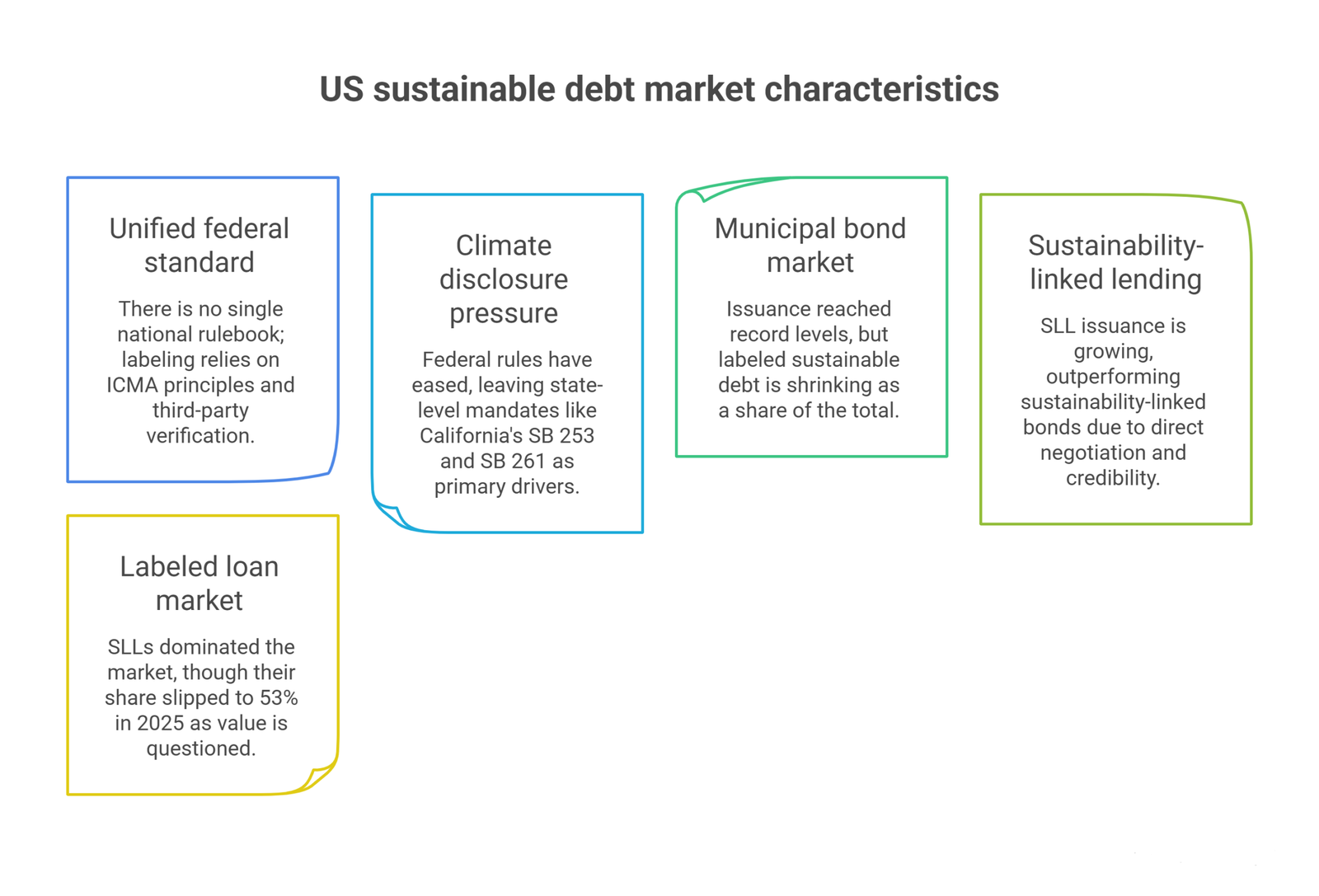
There’s no unified federal green bond standard. Green bond labeling in the US relies on the ICMA principles and third-party verification, not a government-run certification scheme. Some states, California among them, run their own climate bond programs. There’s still no single national rulebook an issuer must follow.
Federal climate disclosure pressure has actually eased, not grown. The SEC’s 2024 climate disclosure rule was stayed within weeks of adoption and never enforced. In May 2026, the SEC formally proposed rescinding it rather than replacing it with a lighter version. A final vote is expected later in 2026. That leaves state-level rules as the operative driver of climate disclosure for many US issuers. California’s SB 253 and SB 261 are the biggest of these. Large companies doing business in the state face an August 2026 deadline to report Scope 1 and Scope 2 emissions. A green label doesn’t satisfy those state disclosure laws on its own, but the underlying emissions data a company gathers for one can support the other.
The municipal market is enormous, but the green label is shrinking as a share of it. US municipal bond issuance hit a record pace in 2026. More than $290 billion sold in the first half of the year, with full-year forecasts clustering around $600 billion. Even so, labeled sustainable municipal debt has been losing ground as a share of that total, according to S&P Global Ratings’ 2026 outlook. Issuers appear to be weighing the extra reporting cost of the green label against a market that’s willing to buy their bonds either way.
Corporate sustainability-linked lending is holding up better than sustainability-linked bonds. ING’s 2026 sustainable debt outlook projects global SLL issuance reaching roughly $160 billion, up from $139 billion in 2025. SLB issuance, by contrast, stays subdued around $25 billion. The gap reflects a credibility problem specific to the linked-bond structure. SLB penalties for missing a target are often too small to matter financially, so investors have grown more skeptical of the label. SLLs face less of that skepticism. They’re negotiated directly between a borrower and its lending banks, and a bank can push back on weak targets before the deal closes.
SLLs have dominated the labeled loan market, though that lead has narrowed. Between 2020 and 2024, sustainability-linked loans made up more than 70% of dollar-denominated sustainable loan issuance. That share slipped to roughly 53% in 2025. Some lenders and large corporate borrowers have begun questioning whether an SLL adds real value once a company’s sustainability strategy is already mature.
How to decide which instrument fits your company
The decision usually comes down to three questions.
Do you have specific, fundable green projects, or a general funding need? A solar installation, a green retrofit, or a fleet electrification program points toward a green bond or green loan. A working capital gap, an acquisition, or a refinancing points toward an SLL instead.
Can you support the reporting burden a green label creates? Green bonds require ongoing proceeds tracking and a second-party opinion. That’s a real cost if your finance team is already stretched thin managing monthly close and cash flow forecasting. Oak’s 13-week cash flow model guide is a useful starting point for building the rolling forecast discipline that green bond and SLL reporting both depend on.
Are you willing to set sustainability targets a lender or investor will actually scrutinize? Weak, easily-hit SPTs are exactly what’s drawing skepticism to the sustainability-linked market right now. A target should be harder to hit than “continue doing what we’re already doing.” If your company can’t defend a KPI’s ambition to a skeptical lender, the SLL route will cost credibility rather than earn it.
Getting the financial groundwork in place before you approach lenders
Whichever instrument fits, lenders and bond investors want to see the same thing underneath it. That’s a credible, well-supported financial model showing how the sustainability commitment connects to the rest of the business. Integrated financial statements need to absorb a margin ratchet or a proceeds tracking requirement without breaking. Forecast accuracy has to hold up too, since it’s what a bank leans on when it prices a KPI-linked facility.
Oak’s guide to building an integrated three-statement financial model covers the mechanics of connecting the income statement, balance sheet, and cash flow statement. That connection is what lets a lender trace how an SPT-linked margin change flows through the business. Lenders will also ask how confident you are in your own projections. It’s worth reviewing how CFOs measure forecast accuracy before walking into that conversation.
Common pitfalls worth avoiding
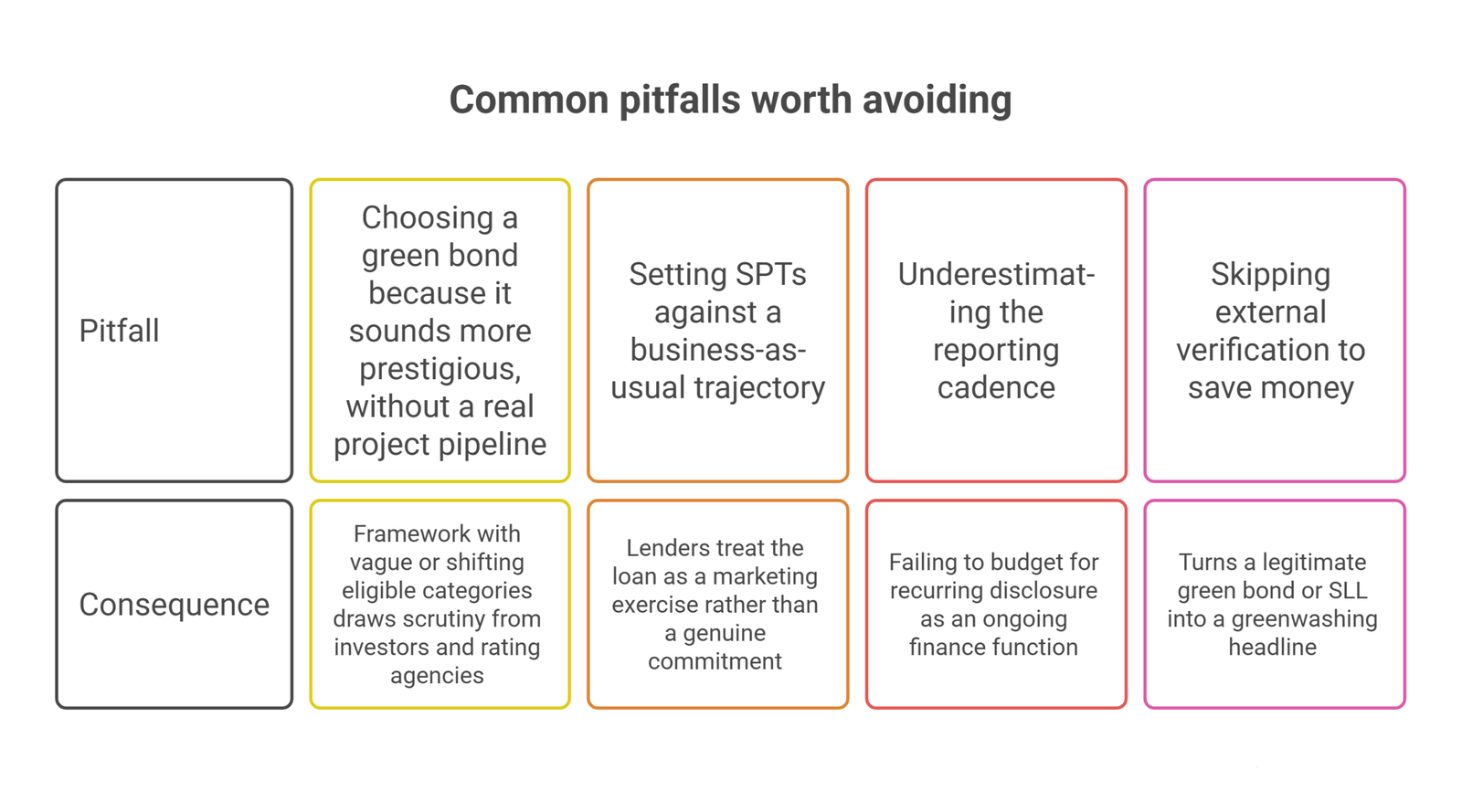
- Choosing a green bond because it sounds more prestigious, without a real project pipeline. A framework with vague or shifting eligible categories draws scrutiny. Investors and rating agencies both watch for this.
- Setting SPTs against a business-as-usual trajectory. If the target would have been hit anyway, lenders will treat the loan as a marketing exercise. That’s not a genuine commitment, and the market can tell the difference.
- Underestimating the reporting cadence. Both instruments require recurring disclosure, not a one-time framework document. Budget for it as an ongoing finance function, not a one-off legal cost.
- Skipping external verification to save money. Second-party opinions and SPT verification cost money. Skipping them is what turns a legitimate green bond or SLL into a greenwashing headline.
Frequently Asked Questions
What happens if a company misses its sustainability targets on an SLL?
The interest margin typically steps up, meaning the loan gets more expensive. It’s a financial penalty, not a default trigger. Some facilities also require enhanced reporting or increased lender engagement after a miss.
Do sustainability-linked loans require proceeds to be tracked like green bonds?
No. Because the money isn’t restricted to specific projects, SLLs don’t require proceeds tracking. What gets tracked instead is KPI performance against the agreed targets.
Is there a US equivalent to the EU Green Bond Standard?
No single federal standard exists. The federal disclosure landscape has actually loosened in 2026, with the SEC moving to rescind its climate rule rather than tighten it. US green bond issuers rely instead on the voluntary ICMA Green Bond Principles and third-party verification. State-level programs fill some of the gap, including California’s climate bond initiatives and its Scope 1 and 2 emissions reporting law.
Why has sustainability-linked bond issuance declined while sustainability-linked loans have grown?
SLBs generally use a one-way pricing structure where the coupon rises on a missed target but doesn’t fall on a hit one. That asymmetry weakens the incentive and has made bond investors more skeptical of soft or easily-achieved targets. SLLs are negotiated privately, so lenders can push back on weak KPIs before the deal is signed. That gives the structure more credibility.
Can a company combine a green label with a sustainability-linked structure?
Yes. Some issuers now attach sustainability performance targets to their green, social, or sustainability bonds. That layers a KPI-based incentive on top of proceeds that are already restricted to eligible projects. It’s a smaller, newer segment of the market, but a sign of where structuring is headed.
The instrument matters less than the groundwork behind it
Green bonds and sustainability-linked loans solve different problems. One finances specific projects, the other rewards sustained performance across the whole business. Neither works without a finance function that can produce credible numbers, defend its targets, and keep up with the reporting once the ink is dry. That’s the part most companies underestimate going in.
If your team needs help building the financial model or forecasting infrastructure a lender will actually trust, Oak’s fractional CFO services can help. It’s a way to get investor-ready before you approach the market. For a deeper look at building the model itself, see Oak’s financial modeling services.