SDG 4: Quality Education, and the 84 Million Children Still Missing It
SDG 4: Quality Education for All, Still Out of Reach
A country can build a school in every village and still fail this goal, because SDG 4 was never really about seats in classrooms. It was about whether the child sitting in one can read by the end of primary school. On that narrower, harder test, the world is losing ground in places it was supposed to be winning: reading proficiency among 15-year-olds has fallen since 2012 in wealthy and middle-income countries alike, and the number of children out of school entirely has now risen for seven straight years. This guide covers what SDG 4 actually commits the world to, where the latest 2026 reporting shows progress standing, and what specific countries, financing bodies, and businesses are doing about it, including where the private sector’s role gets misunderstood.
What is SDG 4
SDG 4, formally titled “Ensure inclusive and equitable quality education and promote lifelong learning opportunities for all,” is the fourth of the 17 Sustainable Development Goals adopted by all 193 UN member states in 2015 as part of the 2030 Agenda.
The goal covers more ground than “send kids to school.” It spans free primary and secondary completion, early childhood development, technical and vocational training, adult literacy, gender parity, school infrastructure, teacher qualifications, and even what students are taught, including education for sustainable development and global citizenship. A country can raise its enrollment rate while its reading scores fall. It can build thousands of new classrooms while a fifth of its primary schools still lack electricity or clean water. SDG 4 tracks access and quality as separate, sometimes contradictory, threads, which is why a headline enrollment number rarely tells the full story.
The official targets and indicators behind SDG 4
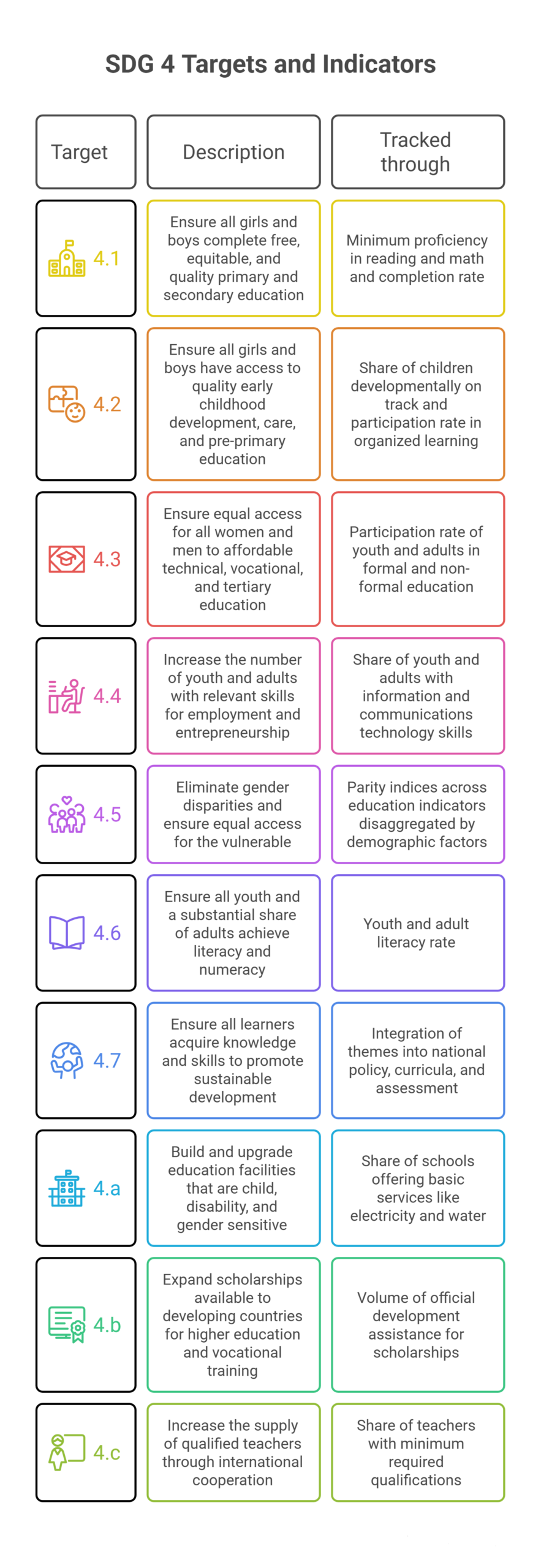
SDG 4 breaks down into 10 official targets, seven outcome targets numbered 4.1 through 4.7, and three means-of-implementation targets numbered 4.a through 4.c, tracked through 11 indicators, as set out on the UN’s SDG 4 page.
Target 4.1: By 2030, ensure all girls and boys complete free, equitable, and quality primary and secondary education leading to relevant learning outcomes. Tracked through minimum proficiency in reading and math at grades 2/3, end of primary, and end of lower secondary, and the completion rate at each of those three levels.
Target 4.2: By 2030, ensure all girls and boys have access to quality early childhood development, care, and pre-primary education. Tracked through the share of children aged 24-59 months developmentally on track, and the participation rate in organized learning one year before primary entry age.
Target 4.3: By 2030, ensure equal access for all women and men to affordable technical, vocational, and tertiary education, including university. Tracked through the participation rate of youth and adults in formal and non-formal education and training over the previous 12 months.
Target 4.4: By 2030, substantially increase the number of youth and adults with relevant skills, including technical and vocational skills, for employment and entrepreneurship. Tracked through the share of youth and adults with information and communications technology skills, by type of skill.
Target 4.5: By 2030, eliminate gender disparities in education and ensure equal access for the vulnerable, including persons with disabilities, indigenous peoples, and children in vulnerable situations. Tracked through parity indices across the other education indicators, disaggregated by sex, location, wealth, disability, and conflict exposure.
Target 4.6: By 2030, ensure all youth and a substantial share of adults achieve literacy and numeracy. Tracked through the youth and adult literacy rate.
Target 4.7: By 2030, ensure all learners acquire the knowledge and skills to promote sustainable development, including through education for sustainable development, human rights, gender equality, and global citizenship. Tracked through how far these themes are built into national policy, curricula, teacher education, and student assessment.
Target 4.a: Build and upgrade education facilities that are child, disability, and gender sensitive, and provide safe, inclusive learning environments. Tracked through the share of schools offering basic services such as electricity, drinking water, and single-sex sanitation.
Target 4.b: By 2020, substantially expand scholarships available to developing countries for enrollment in higher education, vocational training, and ICT, engineering, and scientific programs. Tracked through the volume of official development assistance for scholarships.
Target 4.c: By 2030, substantially increase the supply of qualified teachers, including through international cooperation for teacher training in developing countries. Tracked through the share of teachers with the minimum required qualifications, by education level.
Where global progress actually stands
The honest read on SDG 4, based on the UN’s 2026 reporting cycle, is that access has kept improving while learning has gone backward in several places that had the resources to prevent it.
Completion is still rising, if unevenly. Global completion rates reached 88% in primary, 78% in lower secondary, and 61% in upper secondary education in 2024. The share of young people completing upper secondary school climbed from 53% in 2015 to 60% in 2024, though that pace has slowed compared with the years right before 2015. Eastern and South-Eastern Asia posted the strongest gains; sub-Saharan Africa remains furthest behind, with only 28% completing upper secondary school.
Learning outcomes are the part actually moving in the wrong direction. Based on data from 57 countries, the share of students reaching minimum reading proficiency by the end of primary school fell from 59% to 47% between 2012 and 2022, a 12-point drop, with middle-income countries losing more ground (14 points) than high-income ones (6 points). Math proficiency fell from 41% to 36% over the same period, with declines spread fairly evenly across income groups. The table below sets out where the core indicators stood as of the most recent reporting.
| Indicator | 2015 baseline | Most recent figure |
| Upper secondary completion rate | 53% | 60% (2024) |
| Primary completion rate | 85% (2021) | 88% (2024) |
| Reading proficiency, end of primary (57-country sample) | 59% (2012) | 47% (2022) |
| Math proficiency, end of primary (57-country sample) | 41% (2012) | 36% (2022) |
| Children out of school | rising for seven straight years | 273 million (2026 GEM Report) |
| Adult literacy rate (age 15+) | 86% (2018) | 88% (2024) |
| Adults still illiterate | 773 million (2018) | 754 million (2024) |
| Teachers below national qualification standards | roughly 1 in 5 (little change since 2015) | 15-21% depending on level (2023-24) |
| Primary schools lacking electricity, water, or sanitation | about a quarter (2020) | over a fifth (2024) |
Source: UN DESA, Goal 4 progress reporting; UNESCO Global Education Monitoring Report 2026.
Early childhood education has essentially stalled. Participation in organized learning one year before primary entry age has sat close to 75% since before the pandemic and has not meaningfully moved. The regional spread is wide: many regions are above 90%, while sub-Saharan Africa and Northern Africa and Western Asia remain near 50%. Only 103 countries guarantee free pre-primary education, and just 66 mandate even one year of it.
Gender and wealth gaps widen the further a student goes. The parity index between the poorest and richest households, where 1.0 would mean no gap, stands at 0.91 in primary completion, drops to 0.68 in lower secondary, and falls to 0.34 in upper secondary. Girls have actually pulled ahead of boys in completion rates in many countries since 2015, reversing the historical pattern, but location and household wealth remain far more predictive of whether a child finishes school than gender does.
Teacher supply is the target with the least movement of any in SDG 4. About one in five teachers worldwide still does not meet national minimum qualification standards, a figure barely changed since 2015. In sub-Saharan Africa, close to two in five teachers fall short of that bar.
School infrastructure lags furthest behind on the digital side. More than one in five primary schools worldwide still lack basic electricity, drinking water, or sanitation. Roughly half lack computers or internet access for teaching, and disability-adapted infrastructure remains similarly scarce, a gap that matters more every year as digital skills move into Target 4.4.
The financing picture explains a lot of the above. Global education spending runs around $7.6 trillion a year, but that spending concentrates heavily in wealthy countries. Across 79 low- and lower-middle-income countries, the UN estimates an annual funding gap of $461 billion to reach SDG 4 by 2030, a cumulative shortfall of roughly $3.7 trillion between 2023 and 2030. Sub-Saharan Africa accounts for about half of those 79 countries and carries a large share of the gap. On the aid side, only 22% of countries with data meet the international benchmark of spending at least 4% of GDP and 15% of public expenditure on education.
Without faster action, the UN projects that only one in six countries will meet SDG 4 by 2030. An estimated 84 million children and young people will still be out of school, and roughly 300 million more will be in school but without the basic literacy and numeracy skills to use it.
What countries are doing about SDG 4
Each of these countries started from a very different baseline. The pattern that emerges: fee removal alone does not fix a system. It just reveals what else was missing.
The list below runs roughly from long-established, well-resourced systems still fine-tuning quality and equity. It ends with countries still building the basics of access and connectivity.
Finland

Finland remains the reference point for education researchers. Its 2026 policy moves show the model is still being adjusted. Other countries mostly just study it from the outside.
Finland’s own reading and math scores began sliding in recent years. The Finnish National Agency for Education responded in 2024. It added extra weekly lessons in language and math for grades 1 through 6. The decline was treated as a signal to reinforce the model, not abandon it.
Finland is also raising the bar for who can teach its youngest learners. By 2030, two-thirds of early childhood education staff must hold formal ECEC credentials. That’s up from a much looser standard today.
The government’s newest move is a 2025 Programme for Equality and Non-Discrimination in Education. It rolls out ten measures through 2026. The goal is closing gaps tied to gender, immigration background, and disability. A full evaluation is due in 2027.
Even Finland’s celebrated system still has open items on SDG 4’s harder targets. Those targets cover equity and teacher quality specifically.
Germany
Germany’s contribution to SDG 4 sits almost entirely inside Targets 4.3 and 4.4. Those targets cover vocational training and job-relevant skills. Other countries on this list focus more on primary-school targets.
Its dual vocational education system trains apprentices in two settings. Apprentices split time between company-based work and vocational school. As of 2025, the system covers more than 320 officially recognized occupations. Those range from healthcare to engineering to IT.
In autumn 2025, regulators updated seven apprenticeship occupations. The Federal Institute for Vocational Education and Training led the process. Industry groups and unions worked alongside it. The goal was keeping pace with new technology and labor-market shifts. It’s a routine but telling sign of active maintenance. The system doesn’t stay static.
Researchers flag a structural tradeoff. Germany’s model works because of deep employer buy-in. It also rests on decades of institutional infrastructure. That’s exactly what makes it hard for lower-income countries to copy directly. Lower-income countries can still borrow its underlying principles.
United Arab Emirates

The UAE’s SDG 4 story runs opposite to the UK and US. There are fewer legacy gaps and more building from scratch. Adult literacy sits near 95%, among the highest rates in the region.
A 2016 overhaul of the public school system introduced a new curriculum built around technology and critical thinking. It also added career guidance and business management content. That content targets Target 4.4’s job-relevant skills.
The government’s SDG 4 platform lists new teacher licensing and evaluation systems as ongoing reforms. Smart-learning programmes are part of that list too. Math and science are now taught in English in parts of the curriculum. That’s a deliberate bet on global competitiveness.
The UAE has ranked as the top-performing Arab country on PISA, TIMSS, and PIRLS. It has held that rank since it began participating in those tests.
Vietnam
Vietnam has been the poorest or second-poorest country in every PISA cohort since 2012. Yet its 15-year-olds have outperformed students in the UK and the US. They also outperform most wealthier ASEAN neighbors, including Malaysia, Indonesia, and Thailand. Those countries spend a similar or larger share of GDP on education.
Researchers have tried to explain the gap using the usual variables: household, school, and teacher factors. Those factors explain at most 30% of Vietnam’s outperformance.
What does show up consistently is near-universal teacher attendance. Vietnam also enforces a nationally set minimum school quality standard. Gaps in outcomes between rich and poor students stay comparatively small.
The lesson isn’t a spending formula other countries can copy directly. It’s that consistent minimum standards, enforced everywhere, matter more than budget size. Flagship schools alone don’t move the needle the same way.
United Kingdom
The UK’s most direct SDG 4 initiative targeted Target 4.6 specifically. That target covers adult literacy and numeracy. It’s an area easy to overlook once compulsory schooling ends.
Multiply was a three-year government program worth roughly £560 million. It ran from 2022 to March 2025. The target group was 17 million adults in England. Their numeracy skills sat below what’s expected of a primary school child.
It funded free courses through colleges, community groups, and local councils. Priority went to underserved learners, including non-native English speakers and people with disabilities.
The program has since ended. Evaluations found real gains in confidence and skills among participants. Its closure still leaves the adult numeracy gap only partly addressed. Target 4.6 doesn’t stop needing attention once schooling targets are met.
United States

The US illustrates SDG 4’s core problem: rising completion alongside falling learning. National reading scores for 4th and 8th graders fell again in 2024. That followed an earlier drop between 2019 and 2022.
Roughly 40% of 4th graders now score below the basic reading level. That’s the highest share since 2002. About a third of 8th graders fall below that same basic level. It’s the worst result on record.
The federal response has focused squarely on reading. In January 2026, the Department of Education awarded $256 million in literacy grants nationwide. A separate program targets high-need districts specifically. It funds literacy support from birth through grade 12.
The pattern mirrors what UNESCO’s global data shows. Money alone hasn’t reversed the decline.
Sierra Leone
In 2018, Sierra Leone launched Free Quality School Education. It removed school fees and made transition exams free. The government put 20% of its national budget behind education.
Enrollment rose from 37% to 85% under the new policy. The government built or renovated 538 primary schools and expanded 367 more. It also recruited 12,000 newly trained teachers. Teacher salaries rose 40% over the same period. Government expenditure on primary education rose from 27% to 92% of the relevant budget line.
The Center for Global Development documented a complication. A 2025 peer-reviewed review echoed the same finding. Fee removal pulled in more poor and marginalized children than expected. The exam system wasn’t built to handle that many students. More candidates have failed high-stakes exams since the policy launched than before it.
Sierra Leone’s case is a real gain in access running ahead of a still-adjusting system for measuring learning.
Kenya
Kenya launched its Digital Literacy Programme nationally in 2016. It’s popularly known as DigiSchool. The goal was to put 1.2 million tablets and laptops into every public primary school.
By 2018, the ICT Authority had reached more than 19,000 schools. It distributed devices and trained 91,000 teachers. That covered 89% of public primary schools. Teachers reported better attendance and higher school admissions where the program landed.
The limitation is connectivity, not devices. As of 2022, only 67% of Kenyan children aged 12 to 17 had any internet access. As recently as 2020, only about one in four primary schools had a working connection.
Kenya’s newer Digital Economy Acceleration Project has shifted the approach. It’s been running since mid-2025 with World Bank support. The project equips over 10,000 junior schools with a shared teacher laptop. Each classroom also gets one shared smart board instead of individual devices. The bet is that shared, connected infrastructure closes more ground than hardware alone. That matters most where bandwidth, not device count, is the real constraint.
What organizations and institutions are doing
The financing architecture behind SDG 4 has consolidated around one central actor. That’s more concentrated than the equivalent health or climate goals.
Global Partnership for Education
The Global Partnership for Education is the main multilateral fund for basic education in lower-income countries. Its current “Multiply Possibility” campaign is co-hosted by Nigeria and Italy. It covers the 2026-2030 period. The campaign targets $5 billion for the GPE fund itself. It also targets $10 billion in cofinancing. The goal is reaching 750 million children across 96 countries and territories.
GPE estimates that every dollar it invests generates more than $33 in lifetime earnings for recipients. On the domestic side, 44 GPE partner countries have made their own commitments. They’ve pledged more than $238 billion in education budgets for 2026-2030. GPE frames that as a shift away from aid dependency. The goal is self-financed systems over time.
UNESCO Global Education Monitoring Report
UNESCO’s Global Education Monitoring Report is a primary tracking source. So is its Institute for Statistics. Together they track whether countries meet the benchmarks they set for themselves. Those benchmarks fall under the 2030 framework. The 2026 edition flagged a seventh straight year of rising out-of-school numbers.
UN Global Compact
The UN Global Compact runs a Blueprint for Business Leadership on the SDGs. It treats SDG 4 as a goal with a real product and service role for companies. That’s not just a philanthropic role. Examples include mobile-based learning tools and open educational platforms. Teacher-training technology is another focus, aimed at historically poor-outcome populations.
How businesses can contribute to SDG 4
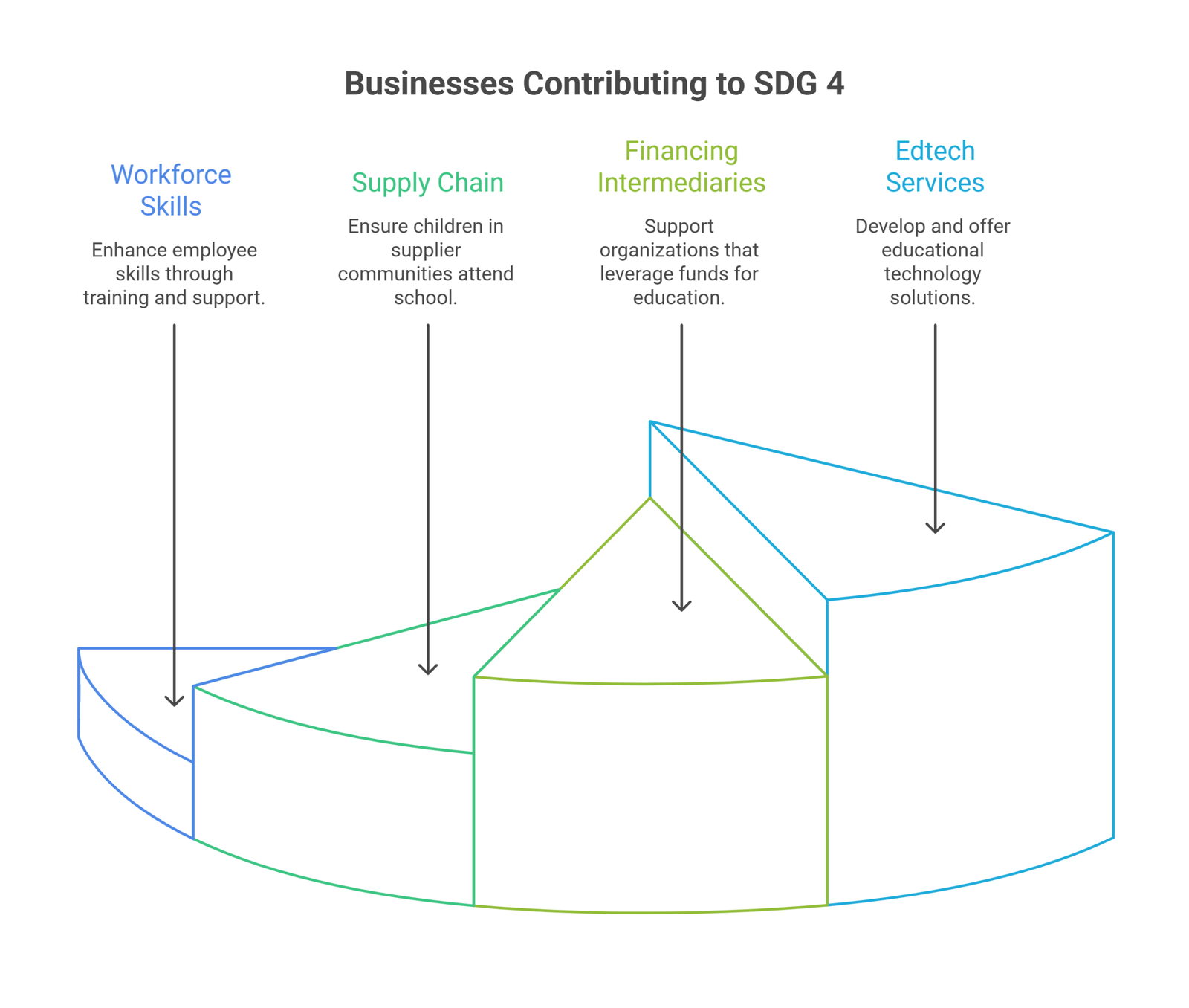
Charlotte Ersbøll’s framing of SDG 3 for the UN Global Compact, that a company should map who its operations affect the same way it already maps its emissions, applies just as directly here. Education has a few concrete entry points for a business without an education mandate.
Start with your own workforce’s skills
Target 4.4 is specifically about ICT and job-relevant skills for adults already in the workforce, an area where companies have more direct leverage than most government literacy programs do. Structured internal training, apprenticeship pipelines, and tuition support for employees all count as real, measurable contributions to this target.
Check where your supply chain touches school access
Manufacturing, agriculture, and extractive companies operating in lower-income regions affect whether children in supplier communities are in school or working, a link that ties directly to Targets 4.1 and 4.5 on completion and equity.
Support financing intermediaries rather than running programs solo
GPE’s model, where a relatively small number of donor and private-sector dollars unlock a much larger multiple in domestic government spending, is the template most companies without an education mandate should look to rather than building parallel programs from scratch.
Consider education and edtech as a service line
Companies building tutoring platforms, teacher-training tools, or school administration software are themselves closing part of the SDG 4 gap, particularly in markets where public systems are stretched thin, as Kenya’s connectivity gap and Sierra Leone’s exam-capacity strain both illustrate. Businesses in this space still need investor-ready financial models and cash flow forecasting like any other company to grow past the pilot stage, and NGOs and social enterprises working in education specifically often stall for lack of a credible financial plan rather than lack of a good program.
Case study: Nestlé needs YOUth
Nestlé needs YOUth is the clearest example of a large company treating a Target 4.4 skills gap as a decade-long program rather than a one-off donation. Launched in 2013 to help young people find jobs during Europe’s youth unemployment crisis, it set a public 2030 target of getting 10 million young people into economic opportunity through employment, agripreneurship, and entrepreneurship, and reached that target early, having also trained 4 million farmers and helped 2 million women build business skills along the way.
Nestlé then turned the model outward through the Global Alliance for YOUth, a coalition of 25 companies that pools training, mentorship, and first-job placements across member firms rather than each company running a separate program. The lesson for a smaller business isn’t the scale, it’s the structure: a public target with a deadline, tracked and reported on year over year, did more to keep the program funded internally than an open-ended CSR commitment would have.
Frequently Asked Questions
How many SDG 4 targets and indicators are there?
Ten targets, seven outcome targets and three means-of-implementation targets, tracked through 11 indicators.
Why are learning outcomes falling even as school completion rates rise?
Completion measures whether a student finishes a grade level, not whether they can read or do math at that level. Based on a 57-country sample, reading proficiency at the end of primary school fell from 59% to 47% between 2012 and 2022, even as global completion rates kept climbing, because more children are staying in school without necessarily learning the material.
Which country gets the best education results relative to its income level?
Vietnam is the most-studied case. Despite being one of the poorest countries in every PISA cohort it has joined, its 15-year-olds have outperformed students from much wealthier countries, including the UK and US, a gap researchers attribute more to consistent minimum school standards and high teacher attendance than to spending levels.
How big is the global education financing gap?
The UN estimates a $461 billion annual shortfall across 79 low- and lower-middle-income countries needed to reach SDG 4 by 2030, a cumulative gap of roughly $3.7 trillion through the decade, even though global education spending overall runs around $7.6 trillion a year.
Can a business without an education mandate realistically contribute to SDG 4?
Yes, and the most direct route is internal: employee ICT and job-skills training maps straight onto Target 4.4. Companies with supply chains in lower-income regions also have a real lever through child labor and school-access practices, and financing intermediaries like GPE offer a way to contribute capital without having to build and run a program from scratch.
Conclusion
The number worth sitting with isn’t the 273 million children out of school, though that’s rising for a seventh straight year. It’s that reading scores have fallen in the same decade completion rates rose, meaning a growing share of the world’s children are finishing school without being able to read what they’re handed. Sierra Leone shows what happens when a government removes fees faster than it builds exam capacity to match. Vietnam shows that low income doesn’t have to mean low learning, if minimum standards are actually enforced everywhere rather than only in flagship schools.
Kenya shows that hardware without connectivity closes less of a gap than it looks like on paper. None of that gets fixed by access alone, and the $461 billion annual financing gap suggests it won’t get fixed by good intentions either. Businesses have a narrower lever than governments and GPE-scale financing, but a real one, starting with workforce skills training and extending into supply chains and, for some, education itself as a service line. If your organization is building a financial model for an education-focused NGO, an edtech venture, or a nonprofit grant application,Oak’s nonprofit financial modeling services can help build the numbers behind it.