How to Start an Ecommerce Business?
How to start an ecommerce business: steps, costs, and the financial plan behind it

A dropshipping store can go live for under $1,000. A private-label brand with real inventory can burn through $30,000 before the first sale ships. Both are “starting an ecommerce business,” but the platform you pick, the legal structure you register, and the marketing budget you set all depend on which one you’re actually building.
This guide covers the steps to launch, and the specific costs and timeline behind each one, so you can plan the number before you spend it.
What an ecommerce business actually is
An ecommerce business sells products or services online instead of, or in addition to, a physical storefront. You’re not limited to local foot traffic. A customer in another country can find your store, pay in their own currency, and receive a shipment without you ever meeting them.
Global retail ecommerce sales are projected to approach $7 trillion in 2026, and the shift toward buying online instead of in-store shows no sign of slowing. That growth is also why competition has gotten sharper. Opening a store is easy. Building one that actually sells takes a plan.
Choosing a business model
Before you touch a platform or a product page, decide how you’ll get inventory into customers’ hands. The model you pick determines your upfront cost, your margin, and how much control you have over quality.
| Model | Upfront capital | Margin potential | Who it suits |
| Dropshipping | Low | Lower (10-20%) | First-time founders testing an idea with little cash |
| Wholesale | Medium | Medium (20-40%) | Founders with some capital who want steadier supply |
| Manufacturing / private label | High | Highest (40%+) | Founders with capital and a long-term brand vision |
| Digital products | Low | Highest (near 100% after creation) | Founders selling expertise, software, or content |
Dropshipping means a third-party supplier holds the inventory and ships directly to your customer. You handle marketing and the storefront; the supplier handles fulfillment. It’s the cheapest way in, but margins are thin because you’re not buying in bulk.
Wholesale means buying stock in bulk and reselling it at a markup. You need somewhere to store it and a system to track it, but the margins beat dropshipping.
Manufacturing, or private label, means you control production and branding from the start. It costs more and takes longer to launch, but it’s the only model where you fully own the product and the margin that comes with it.
Digital products, like courses, templates, or software, cost the least to reproduce once built. The catch is that the upfront work of creating something worth paying for still has to happen before you sell a single unit.
How much it actually costs to start
This is the number most guides skip. The honest answer is that it depends heavily on the model above, but three tiers cover most real launches.
| Cost category | Bootstrap (dropshipping/digital) | Standard (small inventory) | Brand-led launch |
| Domain and hosting | $20-$50/year | $20-$50/year | $20-$50/year |
| Platform subscription | $0-$30/month | $30-$80/month | $80-$300/month |
| Starting inventory | $0 (dropshipped) | $1,500-$5,000 | $10,000-$30,000 |
| Branding and product photography | $0-$200 | $300-$1,000 | $1,500-$5,000 |
| Legal and registration | $50-$300 | $50-$500 | $500-$2,000 |
| First 90 days of marketing | $200-$500 | $1,000-$3,000 | $5,000-$15,000 |
| Rough total to launch | $500-$1,500 | $5,000-$10,000 | $20,000-$50,000+ |
The bootstrap tier gets you a functioning store fast, but you’ll be competing on marketing skill alone since margins are thin. The brand-led tier buys inventory, better photography, and a real ad budget, which shortens the time it takes to look credible to a first-time visitor.
Whichever tier you’re closer to, build a financial model before you spend the first dollar, not after. Oak Business Consultant’s ecommerce financial model template lets you plug in your own cost assumptions and see the break-even point before you commit real cash to inventory or ads.
Validate demand before you spend
Every cost above assumes you already know people want what you’re selling. Skip this step and the tiers above just become how fast you lose money.
Start with a narrow niche rather than a broad category. Use Google Trends to see whether interest in your product is growing or fading. Check keyword tools like Ahrefs or SEMrush to see how many people are actively searching for it. Run a short survey through Google Forms or SurveyMonkey and ask your target customer directly what they’re struggling with.
If you’re unsure how to structure that research, a market research service can pressure-test the idea before you spend on inventory or ads.
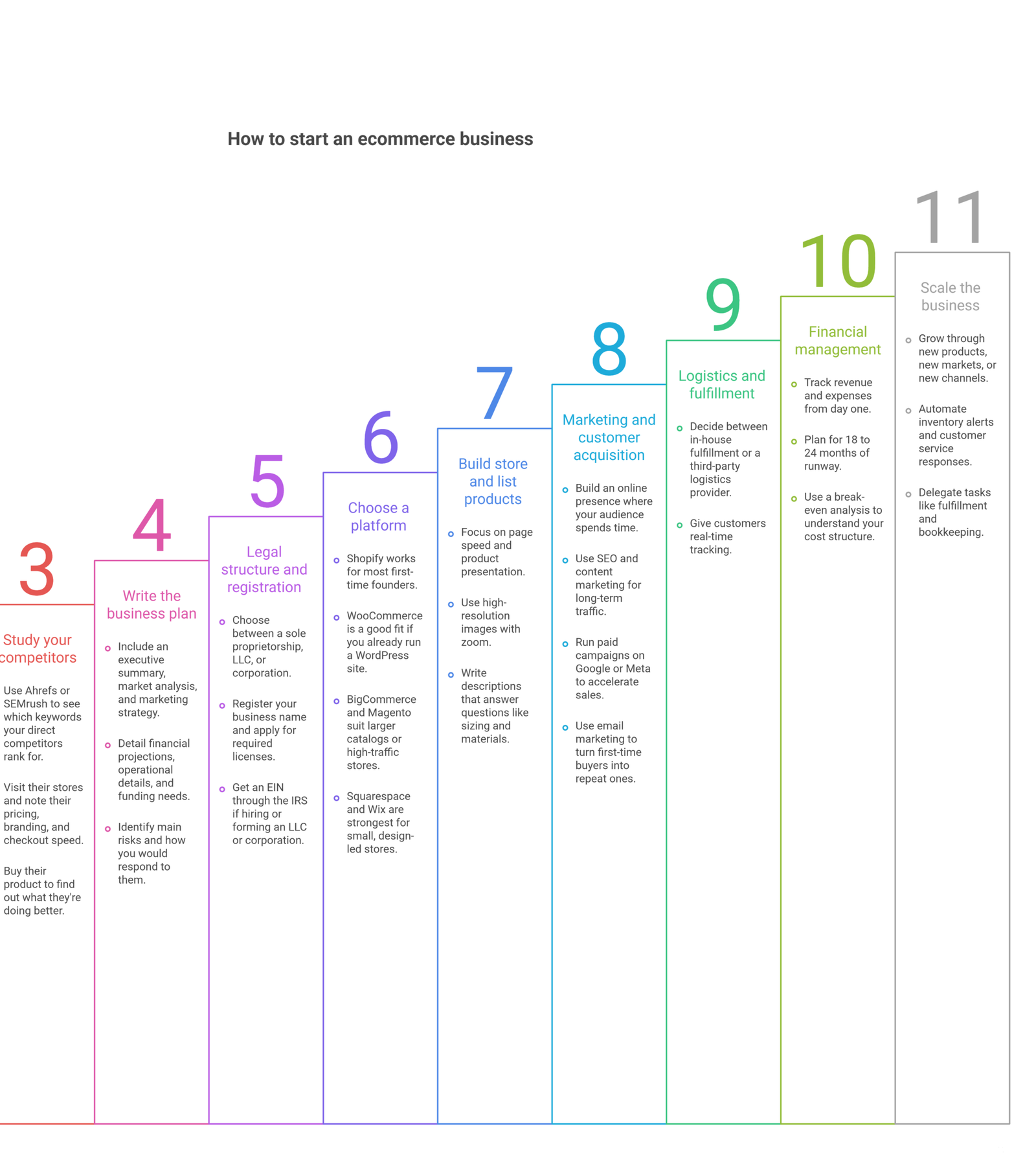
Study your competitors
Once you know there’s demand, find out who’s already meeting it. Use Ahrefs or SEMrush to see which keywords your direct competitors rank for and which ones they’re missing. Visit their stores and note their pricing, their branding, and how fast their checkout is.
Buy their product if you can. It’s the fastest way to find out what they’re doing better than you and where there’s room to do it differently.
Write the business plan
A business plan turns everything above into a document you can act on and, if needed, show to a lender or investor. At minimum, it should cover:
- An executive summary of the business in a few sentences
- Market analysis, including your competitor and demand research
- A marketing and sales strategy
- Financial projections covering startup costs, monthly burn, and break-even
- Operational details: sourcing, inventory, and fulfillment
- Funding needs, if you’re raising any
- The main risks to the plan and how you’d respond to them
If writing this from scratch feels like a separate project on top of everything else, Oak’s ecommerce business plan template gives you the structure so you can focus on the numbers and the strategy instead of the formatting.
Legal structure and registration
You need a legal structure before you can open a business bank account or sign supplier contracts.
A sole proprietorship is the simplest option. You and the business are legally the same entity, which also means you’re personally liable for its debts. An LLC separates your personal assets from the business and gives you some flexibility in how you’re taxed. A corporation is a separate legal entity that protects shareholders from personal liability, at the cost of more paperwork and, for C-corporations, double taxation.
Once you’ve picked a structure, register your business name, apply for any licenses your product category requires, and get an EIN through the IRS if you’re hiring or forming an LLC or corporation.
Choosing a platform
Shopify, WooCommerce, BigCommerce, Squarespace, and Wix all let you launch a store without writing code, but they suit different situations.
Shopify works for most first-time founders because it’s easy to set up and scales with you. WooCommerce is a good fit if you already run a WordPress site and want tighter control over customization. BigCommerce and Magento (now Adobe Commerce) suit larger catalogs or high-traffic stores that need heavier customization. Squarespace and Wix are strongest for small, design-led stores where visual polish matters more than advanced ecommerce features.
Match the platform to your model and budget, not the other way around. A dropshipping store with 20 SKUs doesn’t need Magento’s complexity, and a 5,000-SKU wholesale catalog will outgrow Wix fast.
Build the store and list your products
Once the platform is chosen, focus on two things that most directly affect conversion: page speed and product presentation.
Use high-resolution images with zoom, and write descriptions that answer the questions a buyer can’t ask you directly, like sizing, materials, and what happens if the product doesn’t work out. A blurry photo or a thin description costs you the sale before the customer ever reaches checkout.
Marketing and customer acquisition
A store with no traffic doesn’t sell, no matter how good the product is. Build an online presence on the platforms where your audience already spends time, whether that’s Instagram for visual products or LinkedIn for B2B.
Search engine optimization and content marketing bring in traffic that doesn’t disappear the day you stop paying for ads. Paid campaigns on Google or Meta can accelerate early sales, but track your cost per acquisition closely so you know whether the spend is actually working. Email marketing turns first-time buyers into repeat ones, and it’s usually the cheapest channel you’ll run once your list has any size to it.
Logistics and fulfillment
Late delivery is one of the most common reasons customers cancel orders or leave a bad review. Decide early whether you’ll handle fulfillment yourself or hand it to a third-party logistics provider. In-house gives you more control; a 3PL usually reduces your overhead as you scale.
Whichever you choose, give customers real-time tracking and don’t promise a delivery window you can’t consistently hit.
Financial management and a realistic timeline
This is where most first-time ecommerce founders underestimate the work, and where the financial planning from earlier in this guide actually pays off.
Track revenue and expenses from day one, not once the business feels “real.” Use accounting software suited to ecommerce, since sales tax across multiple states or countries gets complicated fast. If you’re not confident managing that yourself, ecommerce bookkeeping services can keep your books clean while you focus on growth.
Set your expectations correctly before you launch. Plan for 18 to 24 months of runway, not the bare minimum to open the doors. Most ecommerce businesses don’t turn a profit in year one, and judging the business by month three or four numbers alone tends to cause founders to panic and pull spending at exactly the wrong time. A break-even analysis built into your financial model tells you what’s actually normal for your specific cost structure, instead of leaving you to guess.
As the business grows past the point where a spreadsheet and good instincts are enough, ecommerce CFO services can help you track true profit by channel, manage cash flow around inventory cycles, and get the financials in order before a raise or acquisition conversation.
Scaling the business
Once the core store is running, growth usually comes from three places: new products, new markets, or new channels. Ask your existing customers what they’d buy next before you guess. List on additional marketplaces once your core channel is stable rather than spreading thin from day one.
Automate what can be automated, inventory alerts, reorder points, basic customer service responses, and delegate what can’t. You don’t need to be the person doing fulfillment, marketing, and bookkeeping all at once by month six.
Frequently Asked Questions
How much does it cost to start an ecommerce business?
A lean dropshipping or digital product launch can start around $500 to $1,500. A standard store with some inventory typically runs $5,000 to $10,000. A brand-led launch with real marketing spend and inventory usually needs $20,000 or more. The right number depends on your model, not a flat industry average.
What are the four types of ecommerce businesses?
B2C (business-to-consumer), like a retailer selling directly to shoppers. B2B (business-to-business), like a wholesaler supplying other companies. C2C (consumer-to-consumer), like items sold peer-to-peer on a marketplace. C2B (consumer-to-business), like a creator offering promotion to a brand for a fee.
Is ecommerce still a profitable business model?
Yes, but profitability depends on your model, product margins, and how well you manage cash flow, not just sales volume. A store with high revenue and no financial planning can still run out of cash.
How long before an ecommerce business becomes profitable?
Most take somewhere between 6 months and 2 years, depending on the model and how much is spent on customer acquisition early on. Plan your runway for the longer end of that range rather than the shorter one.
Can I start an ecommerce business without inventory?
Yes. Dropshipping and digital products both let you launch without holding stock, which is why they’re the lowest-cost entry points on the cost table above.
Do I need a business plan before I start selling?
You can technically launch without one, but skipping it usually means skipping the financial projections that tell you whether the business can actually sustain itself. A short plan built around real numbers beats a polished one built on guesses.
Getting the plan right before you spend
The steps to open an ecommerce store are well documented and mostly mechanical. The part that determines whether the business survives its first two years is the financial plan behind it: how much you actually need, how long you can run before turning a profit, and what happens if year one doesn’t go as expected.
Oak Business Consultant works with founders on the financial models and business plans that make those numbers concrete before the money goes out the door. Talk to our team about what a realistic ecommerce launch budget looks like for your business.