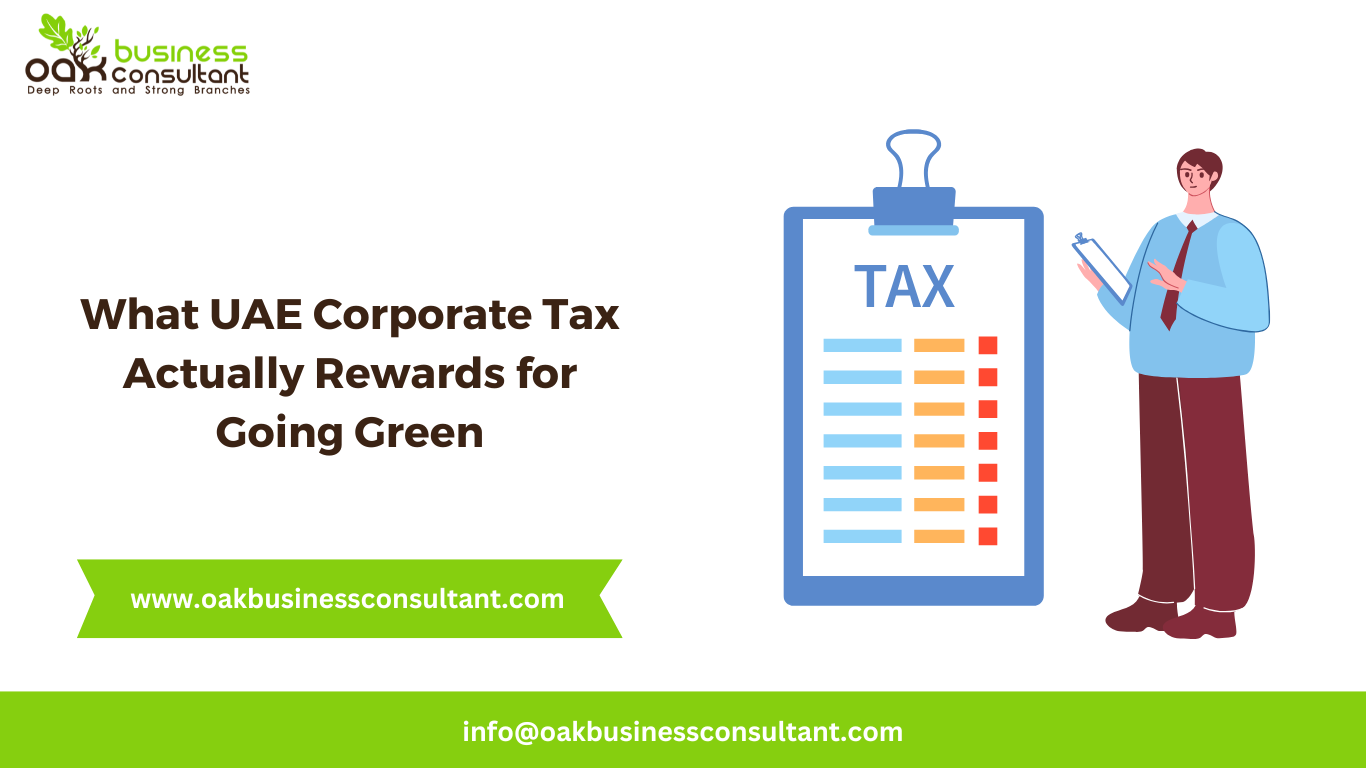
What UAE Corporate Tax Actually Rewards for Going Green
UAE Corporate Tax Incentives for Sustainability Investment: What Actually Qualifies
A business owner researching UAE green tax incentives usually runs into the same list: Investment Tax Credits, Production Tax Credits, LEED certification breaks. Real incentives, just not ones that exist under UAE law. Planning around them means planning around the wrong country’s tax code.
The UAE does tie real corporate tax treatment to sustainability activity. It just does it narrowly. A small number of specific legal instruments carry the weight here, not a broad green tax credit regime. This guide sets out exactly what those instruments are and what qualifies under each one. It also draws the line between an actual tax incentive and a customs waiver or financing program that often gets bundled into the same conversation.
Why the generic “green tax credit” answer doesn’t hold up
The UAE currently runs one of the lowest-incentive corporate tax systems in the region by design. A 2025 OECD review of UAE investment policy noted that the country offers almost no expenditure-based tax incentives at all. R&D credits are the main exception, and even those were still under active development at the time. That rules out the mechanism most “green tax incentive” content assumes exists: a direct percentage credit against the cost of installing solar panels, an EV fleet, or other environmental capital expenditure.
What the UAE has instead is a set of targeted provisions, some in force, some still proposed. They reward specific sustainability-adjacent activities: research spending, free zone commodity trading in environmental instruments, and investment structuring. None of them work like a blanket green tax credit. Each has its own scope, and getting that scope wrong is the most common mistake businesses make when planning around this topic.
The R&D tax credit: the closest thing to a green expenditure incentive
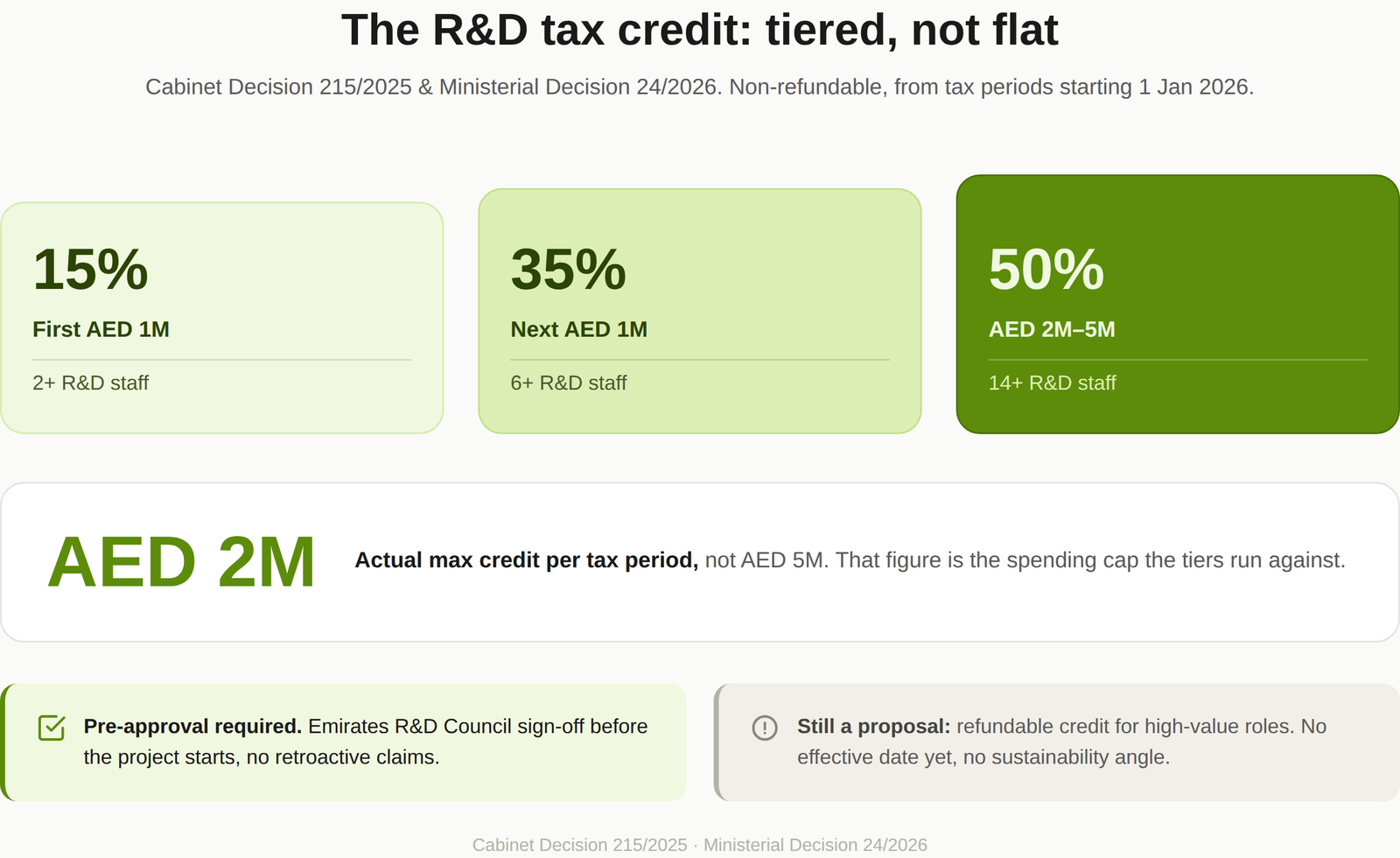
Cabinet Decision No. 215 of 2025 set the framework for a Research & Development Tax Credit, and Ministerial Decision No. 24 of 2026, issued 18 March 2026, put the operating mechanics in place. The credit is non-refundable and applies to tax periods starting on or after 1 January 2026. It is not a flat 50%. The rate is tiered against qualifying R&D expenditure, and each tier also requires a minimum number of R&D staff: 15% on the first AED 1 million of spend (at least 2 R&D staff), 35% on the next AED 1 million (at least 6 staff), and 50% on spend between AED 2 million and the AED 5 million expenditure cap (at least 14 staff).
Because of that tiering, the maximum credit a business can actually claim in a tax period is AED 2 million, not AED 5 million. Claiming the credit also requires pre-approval from the Emirates Research and Development Council before the R&D project begins, so this isn’t something a business can decide to claim retroactively at filing time.
The credit is expenditure-based and tied to activities that meet the OECD’s Frascati Manual definition of R&D. That definition covers a wide range of applied research, including clean energy technology, energy efficiency systems, water treatment innovation, and materials science aimed at reducing environmental impact.
This is the one place in UAE corporate tax law where a sustainability-focused R&D program can translate directly into a lower tax bill, though the tiering means the benefit scales with how much a business spends and how many R&D staff it employs, not a flat rate. A company developing a more efficient battery chemistry, a novel desalination process, or emissions-reduction technology for industrial equipment can qualify. The spending has to meet the qualifying expenditure definition, and the work has to happen in the UAE. Sustainability branding alone does not qualify. The activity has to meet the same technical R&D bar as any other credit claim, and the project needs Council pre-approval before it starts.
A second, related measure remains at the proposal stage. The Ministry of Finance has floated a refundable tax credit for high-value employment activities. It would cover C-suite and senior technical roles that add significant economic value, with sources pointing to sectors like technology, finance, and R&D. As of publication, this remains subject to legislative approval and has no confirmed effective date, and it’s not specifically framed around renewable energy or sustainability. It belongs in a business’s planning conversation, not in its current tax return, and isn’t something a green-focused hire should be assumed to qualify for.
The free zone incentive most businesses misread
This is where the biggest gap between assumption and reality shows up. Free zone companies that qualify as a Qualifying Free Zone Person can access a 0% corporate tax rate on qualifying income under Cabinet Decision No. 100 of 2023. In August 2025, Ministerial Decision No. 229 of 2025 expanded the list of Qualifying Activities. It now explicitly includes trading in environmental commodities, specifically carbon credits and renewable energy certificates, alongside metals, minerals, energy, and agricultural commodities.
The detail that trips people up: this incentive covers trading of these instruments, priced on a recognized exchange or through a recognized price reporting agency. On its own, it does not mean a free zone company gets 0% tax on operating income from owning and running a solar farm or an EV charging network. A free zone renewable energy generator’s income needs to be assessed against the Qualifying Activities list on its own merits. That usually means checking it against manufacturing, processing, or another listed category. It’s never assumed to qualify simply because the underlying asset is green.
This is a genuine, currently active 0% tax opportunity for a free zone business that does trade carbon credits or renewable energy certificates, whether as a primary activity or as part of a broader commodities desk. For a free zone business that generates or consumes renewable energy without trading the associated instruments, it isn’t.
The Domestic Minimum Top-up Tax and investment entities
For larger groups, the UAE’s 15% Domestic Minimum Top-up Tax, introduced alongside the OECD’s Global Minimum Tax framework, carves out an exclusion for investment entities. The stated aim is to keep the UAE competitive as an investment hub. It also has a practical sustainability angle. Funds and holding structures set up specifically to invest in renewable energy or green infrastructure projects can fall under this exclusion. It depends on how the entity is structured and where it sits in a multinational group. This isn’t a sustainability incentive by design. But it does shape how a green-focused investment vehicle gets taxed in the UAE relative to other jurisdictions. That matters for anyone structuring a fund or SPV around sustainable assets.
What gets bundled in but isn’t a corporate tax incentive
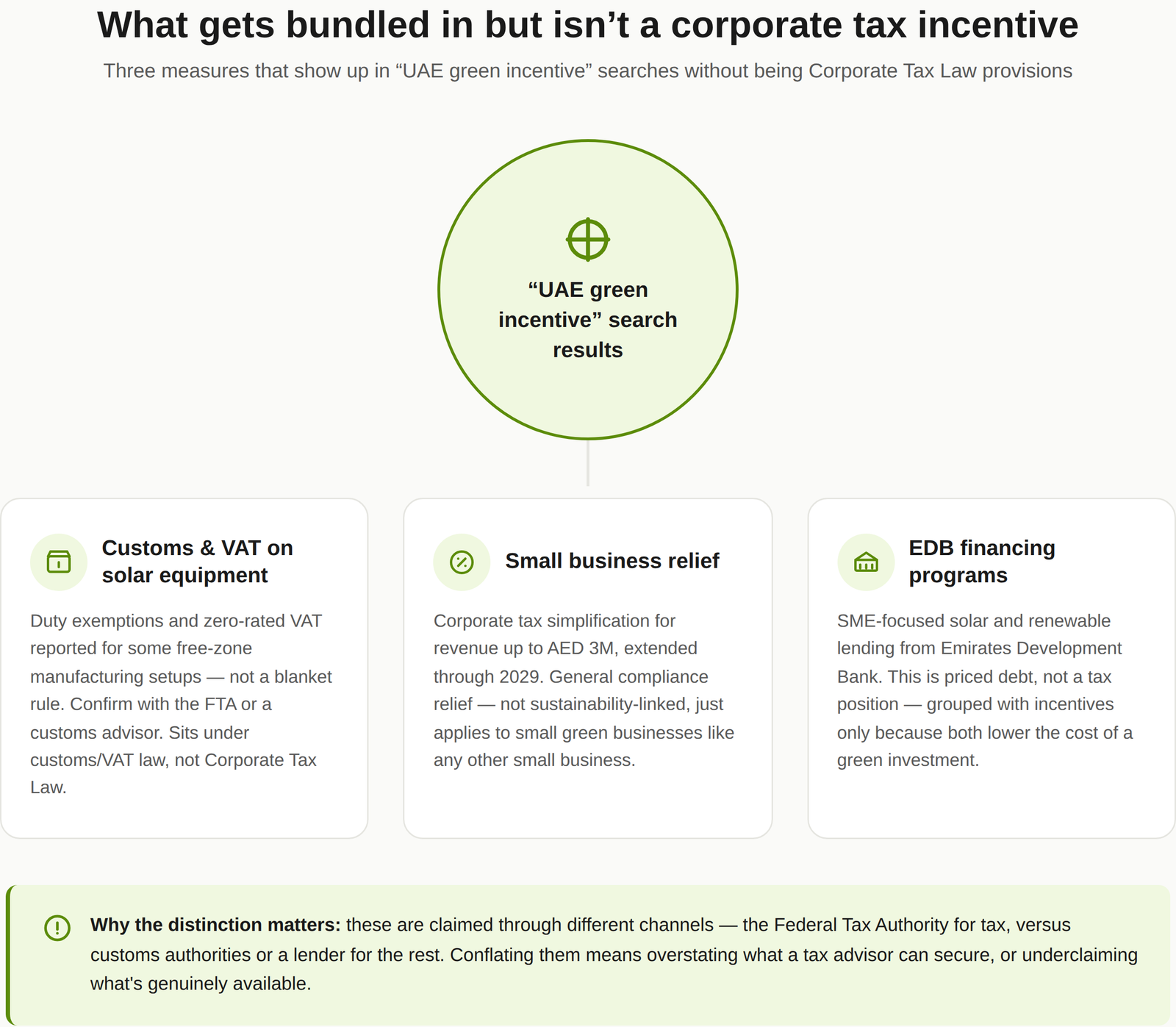
A few genuinely useful measures show up in “UAE green incentive” searches without actually being corporate tax provisions:
Customs and VAT Treatment on Solar Equipment
Some solar manufacturing setups report duty exemptions on imported equipment. This applies during an initial certification period. Solar power supply is sometimes treated as zero-rated for VAT too. But the sourcing on the general scope is thin. It appears tied to specific free zone manufacturing setups. It’s not a blanket rule for any business buying solar equipment. Confirm current treatment with the FTA or a customs advisor for your specific transaction. Don’t assume it applies. Either way, this sits under customs and VAT law. It’s not part of the Corporate Tax Law.
Small Business Relief
This is the corporate tax simplification for businesses with revenue up to AED 3 million. It was recently extended through 2029. But it isn’t sustainability-linked at all. It’s a general compliance relief. It happens to apply to small green businesses. It applies the same way to any other small business.
Emirates Development Bank Financing Programs
This includes SME-focused solar and renewable energy lending. It’s financing, priced debt. Moreover, it’s not a tax position. It’s often mentioned alongside tax incentives. That’s because both reduce the effective cost of a green investment.
Why the Distinction Matters
Keeping these separate from actual corporate tax incentives matters. They’re claimed through entirely different channels. One goes through the Federal Tax Authority. The others go through customs authorities or a lending relationship. Conflating them causes problems both ways. Businesses may overstate what a tax advisor can secure. Or they may underclaim what’s genuinely available.
Where each incentive actually sits
| Incentive | Legal basis | What qualifies | Status |
| R&D tax credit | Cabinet Decision No. 215 of 2025; Ministerial Decision No. 24 of 2026 | Tiered 15%/35%/50% on qualifying R&D expenditure up to AED 5 million spent; maximum credit AED 2 million; staffing thresholds and Council pre-approval apply | In force for tax periods from 1 January 2026 |
| High-value employment credit | Proposed by Ministry of Finance | Salary costs for senior roles in named high-value sectors (technology, finance, R&D); not renewable-energy-specific | Proposed, not yet enacted |
| Free zone 0% on environmental commodities | Ministerial Decision No. 229 of 2025 | Trading of carbon credits and renewable energy certificates by a Qualifying Free Zone Person | In force since 1 June 2023 (MD 229 effective retroactively) |
| DMTT investment entity exclusion | UAE Domestic Minimum Top-up Tax framework | Qualifying investment entities and fund structures | In force |
| Solar equipment customs/VAT treatment | Customs and VAT law, not Corporate Tax Law | Reported in some solar manufacturing/free zone contexts; general scope unconfirmed | Confirm specific scope with FTA or a customs advisor |
| Small business relief | Corporate Tax Law simplified compliance | Businesses with revenue up to AED 3 million | Extended through 2029, not sustainability-specific |
What businesses should actually do
Start by identifying which category a planned investment falls into: R&D spending, free zone commodity trading, fund structuring, or straightforward green capital expenditure. Most sustainability investment falls into that last category: buying solar panels, upgrading to efficient machinery, retrofitting a building. Whatever generic green tax content implies, that category currently has no direct UAE corporate tax incentive attached to it.
If a business does R&D work that could plausibly meet the Frascati Manual definition, document it as R&D from the outset. Don’t try to reconstruct qualifying expenditure records after the fact. If a free zone entity trades carbon credits or renewable energy certificates, confirm the pricing mechanism first. It needs to meet the recognized exchange or price reporting agency requirement under Ministerial Decision No. 230 of 2025 before Qualifying Activity status can be assumed. If the sustainability investment is being financed rather than self-funded, keep the tax conversation and the financing conversation separate. That way the business isn’t counting the same benefit twice.
Working out which of these categories actually applies, and structuring the paperwork to support a claim, is where most businesses need a second set of eyes. Oak’s Corporate Tax UAE services assess a business’s activities against the current Qualifying Activities list and R&D credit criteria before a claim is filed. That’s a very different position than sorting it out after an FTA query raises it.
A free zone business often has to weigh whether a green investment should sit inside a Qualifying Free Zone Person structure or a separate entity. That decision affects far more than one tax line. Oak’s Virtual CFO and strategic advisory services build that structuring decision into the broader financial model. The tax position and the investment case get evaluated together, not in separate conversations.
Frequently Asked Questions
Can a business claim the R&D tax credit for clean energy research?
Yes, if the work meets the Frascati Manual definition of R&D used under Cabinet Decision No. 215 of 2025 and Ministerial Decision No. 24 of 2026. Clean energy technology, energy efficiency systems, and similar applied research can qualify the same way any other R&D spending does. The rate is tiered up to 50%, and the maximum credit a business can claim in a tax period is AED 2 million, based on up to AED 5 million of qualifying expenditure and meeting staffing thresholds at each tier.
Does owning a solar farm in a UAE free zone automatically qualify for 0% corporate tax?
Not automatically. The 0% rate for Qualifying Free Zone Persons applies to specific Qualifying Activities. Trading carbon credits or renewable energy certificates qualifies under Ministerial Decision No. 229 of 2025. Simply generating or operating renewable energy assets needs to be assessed against the broader Qualifying Activities list on its own terms.
Is the high-value employment tax credit available now?
No. It remains a Ministry of Finance proposal subject to legislative approval, with no confirmed effective date as of publication. Businesses should treat it as a planning consideration, not a current benefit.
Are Emirates Development Bank green financing programs a tax incentive?
No. EDB’s SME-focused solar and renewable energy financing is debt financing, priced loans, not tax relief. It can lower the overall cost of a green investment, but it doesn’t reduce a corporate tax bill directly.
The scope is narrower than most guides suggest
The honest picture: the UAE offers real, usable corporate tax treatment tied to sustainability activity in a few defined places, R&D spending, free zone environmental commodity trading, and investment entity structuring. Beyond that, it offers nothing close to a green tax credit for general sustainability capital expenditure. Businesses planning a sustainability investment get more value from knowing that boundary upfront than from a list of incentives that don’t actually apply to their structure.
Not sure which of these, if any, applies to your business’s sustainability investment plans? Get in touch with Oak Business Consultant, and we’ll map your specific structure and activities against what’s currently available.