CPA vs CFO: Which Does Your Business Need?
CPA vs CFO: which one does your business actually need?
Most business owners think the finance function has exactly two options: hire a bookkeeper, or hire a CFO. That framing skips a role that matters more than either one at a certain stage, and it turns a genuinely simple question, who do I actually need right now, into a false choice between a tax preparer and a C-suite executive.
The real answer depends on what question you are trying to answer. If the question is “did we file correctly and are we going to owe the IRS money,” you need a CPA. If the question is “can we afford to hire a VP of Sales, and what happens to our cash position if we do,” no CPA can answer that from a tax return. That is CFO work. And if your actual problem is that your books are a mess and nobody can tell you last month’s real numbers, neither a CPA nor a CFO is the fix you need first.
What a CPA actually does
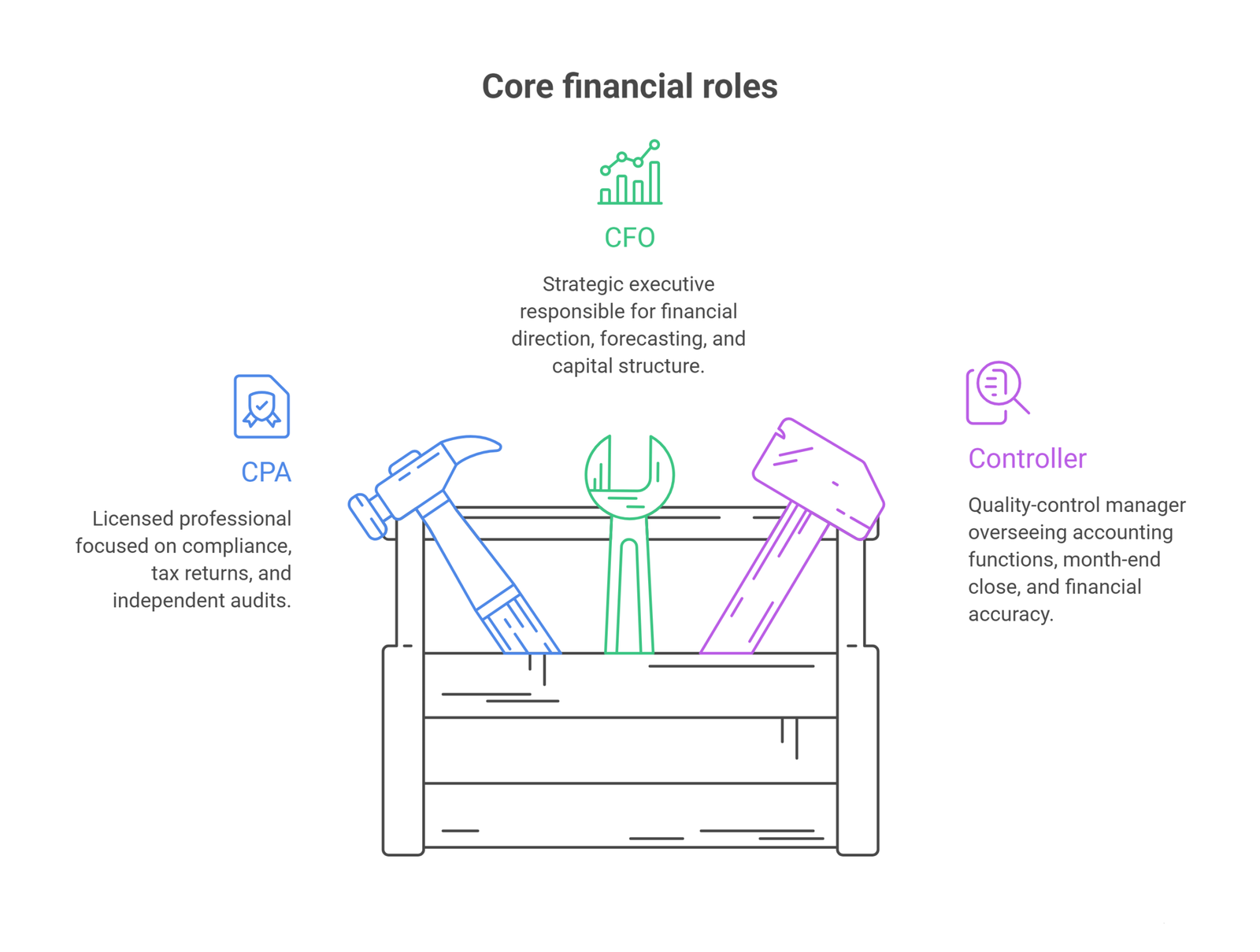
A Certified Public Accountant is a licensed professional who has passed the Uniform CPA Examination, met state-specific education and experience requirements, and maintains continuing education annually. The license itself is what allows a CPA to do a small number of things nobody else can do: sign off on audited financial statements and represent a business before the IRS.
Core CPA responsibilities:
- Preparing and filing business tax returns
- Tax planning to minimize the company’s tax burden within the law
- Independent audits, reviews, and compilations of financial statements
- IRS audit representation
- Ensuring the business stays aligned with GAAP and other regulatory standards
A CPA’s orientation is backward-looking and compliance-focused by design. They tell you what happened and whether it was handled correctly. That is not a limitation, it is the job, and it is a job every business needs done well.
What a CFO actually does
A Chief Financial Officer is a strategic executive responsible for the financial direction of the company, not its historical record. Importantly, the CFO title does not require a CPA license. Many CFOs hold one, plenty of excellent ones come from investment banking, FP&A, or operational finance backgrounds instead.
Core CFO responsibilities:
- Building financial models, including multi-year projections and scenario analysis
- Cash flow forecasting and active cash management
- Advising on pricing, margins, and unit economics
- Managing banking relationships and capital structure
- Leading fundraising preparation and investor relations
- Building KPI dashboards and board-level reporting
- Advising on mergers, acquisitions, and exit strategy
A useful way to separate the two: a CPA can tell you whether last quarter’s numbers were correct. A CFO tells you what to do about next year’s numbers before they happen.
The role most owners forget: the controller
Between the bookkeeper and the CFO sits a role that a large share of growing businesses need before they need either a full CPA relationship or a CFO: the controller.
A controller manages the accounting function itself. They oversee the month-end close, make sure financial statements are accurate and GAAP-compliant, implement accounting policies and procedures, produce management reports, and manage ongoing compliance items like payroll tax and 1099 filings. A controller is not a strategic advisor the way a CFO is, but they are not a data-entry bookkeeper either. They are the quality-control layer that makes sure the numbers feeding into every other decision are actually right.
This matters because most businesses in the roughly $2 million to $15 million revenue range need a controller before they need a CFO. Adding a CFO who builds sophisticated forecasts and scenario models on top of inaccurate or late financial statements does not produce insight, it produces confident-sounding advice based on bad data, which is worse than no advice at all.
CPA vs CFO vs controller, side by side
| Role | Time orientation | Core question answered | Requires a license |
| Bookkeeper | Present | Are transactions recorded correctly? | No |
| Controller | Present, recent past | Are the financial statements accurate and timely? | No |
| CPA | Past | Were taxes filed correctly and is the business compliant? | Yes |
| CFO | Future | What should we do next, and can we afford it? | No |
What each role costs
Cost is often the real deciding factor for a growing business, and the fractional and full-time price points differ enough that it changes the decision entirely.
| Role | Full-time annual cost | Fractional or outsourced cost |
| Bookkeeper | $45,000 to $65,000 | $500 to $2,000 per month |
| Controller | $90,000 to $140,000 | $2,000 to $5,000 per month |
| CPA (tax only) | Often bundled with controller, or $150 to $400 per hour | $3,000 to $12,000 per year |
| CFO | $200,000 to $400,000 or more | $4,000 to $12,000 per month |
For most businesses under roughly $15 million in revenue, a fractional model across these roles typically delivers better expertise per dollar than trying to build the equivalent team internally, simply because a full-time CFO or controller is expensive to keep fully utilized at that scale.
A quick test to find out which one you actually need
If you are unsure whether your current advisor is really operating at the CFO level or just doing compliance work well, there is a simple way to check. Ask them to model three different hiring scenarios against your cash position over the next eighteen months. If they come back with a clear, structured model that answers the question directly, they are functioning as a CFO in that moment, regardless of what their license says. If the answer is a rough estimate and a reassurance that things should be fine, that is a real gap, and it is exactly the gap a fractional CFO is built to close.
When you need a CPA
You need a CPA, or at minimum a licensed tax professional, whenever the situation touches compliance or the IRS directly:
- Filing a business tax return, especially as an S-Corp, partnership, or C-Corp
- Responding to an IRS audit or notice
- Evaluating a major tax decision, such as an S-Corp election or a like-kind exchange
- Having financial statements audited or reviewed, which legally requires a CPA
- Structuring the tax side of buying or selling a business
It is worth treating the CPA relationship as year-round rather than an April-only event once revenue passes roughly $1 million. A tax strategy conversation in September, well before year-end, is worth considerably more than the same conversation in March, because most of the moves that actually reduce a tax bill have to happen before the year closes, not after.
When you need a CFO
CFO-level expertise becomes necessary once the questions being asked are forward-looking rather than historical:
- Can we afford to hire this VP of Sales, and what does it do to our runway?
- What is our cash position if we lose our largest customer?
- What is this company actually worth, and what would move that number?
- How should we price a new product tier?
- How should we structure this acquisition?
None of these are questions a tax return can answer. They require someone who builds the model, runs the scenario, and advises on the decision with numbers behind it, which is precisely what CFO services exist to provide.
Understanding audits, reviews, and compilations
Since a CPA’s role in verifying financial statements comes up constantly in this comparison, it is worth being precise about what that actually means, because the three levels of CPA assurance are not interchangeable.
A compilation is the lowest level. The CPA presents management-prepared financials in a standard format without offering any assurance about their accuracy. It exists for situations where a third party needs standardized numbers but is not requiring CPA assurance.
A review provides limited assurance. The CPA performs analytical procedures and inquiries and reports that nothing came to their attention suggesting the financials need material changes. Some lenders and preferred equity investors require this level.
An audit is the highest level. The CPA tests transactions, confirms balances directly with banks and customers, evaluates internal controls, and provides positive assurance that the financials are materially accurate. Most institutional lenders above roughly $2 to $5 million in exposure require a full audit, and audits for small businesses typically run $20,000 to $80,000 depending on size and complexity.
Buying or selling a business: who do you actually need?
An acquisition is one of the few situations where a business genuinely needs both roles working simultaneously, for different reasons.
The CPA’s job in a transaction is tax structuring: deciding between an asset purchase and a stock purchase, allocating goodwill, handling depreciation step-up, and structuring any earn-out for tax efficiency, along with due diligence on the target’s tax returns and liabilities.
The CFO’s job is financial due diligence: normalizing EBITDA, validating that the target’s historical performance is real and repeatable, modeling integration scenarios, running the valuation analysis, and negotiating the financial terms of the deal. If business valuation is part of the transaction, this is squarely CFO and valuation-analyst territory, not something a CPA’s tax training covers.
These two functions do not overlap well, and trying to get both from one person on a deal of any size is usually a mistake.
Frequently Asked Questions
What is the real difference between a controller and a CFO?
A controller manages the accounting function and produces an accurate, timely financial record of what already happened. A CFO takes that record as an input and answers a different question: what should happen next. Most businesses need a controller in place before a CFO’s forecasts and models are worth trusting, since a CFO working from inaccurate numbers produces confident-sounding advice that is still wrong.
My CPA has been advising me on strategy for years. Is that a CFO function?
It can be, if they are doing it well. The honest test is the three-scenario exercise described above. Some CPAs are genuinely strong at both compliance and strategy. Many are excellent at compliance and merely comfortable, not expert, at forward-looking financial strategy. Neither is a criticism, it is simply a different skill set, and the practical test tells you which one you are actually getting.
My business is already profitable. Why would I still need a CFO?
Profitability does not remove the need for financial strategy, and it often increases it. A profitable, growing company still has to decide whether to invest in headcount, technology, or new markets, still needs to manage cash if growth is consuming working capital faster than revenue arrives, and still benefits from optimizing the metrics that determine an eventual exit valuation. Profitability is the starting line for CFO value, not the finish line.
Do I need a CPA if I already have a bookkeeper?
Yes. A bookkeeper records daily transactions accurately, but a CPA is the one with the technical tax law expertise to prepare returns correctly and represent the business if the IRS has questions. The two roles are complementary, not substitutes for each other.
Conclusion
CPA, controller, and CFO are three different answers to three different questions: was it done correctly, is the record accurate, and what should we do next. Most growing businesses eventually need all three, just not at the same time and not from the same person. The mistake to avoid is assuming the choice is binary, hiring a CFO before the underlying numbers are trustworthy, or expecting a CPA to build the strategic model that was never part of their training.
If your business has outgrown what your current CPA or bookkeeper can tell you about where things are headed, that gap is exactly what Oak Business Consultant’s CFO services are built for. Contact us to talk through which stage your business is actually at, and what kind of financial leadership it needs next.