Top Seven Priorities for Retail CFOs
Retail CFO priorities: 7 moves that protect margin and cash
A retailer buys stock months before a customer walks in. If the guess is wrong, cash sits on shelves and margin leaks out through markdowns. A retail CFO exists to make that guess smaller and cheaper to correct.
The job used to be bookkeeping, reporting and compliance. Those still matter. Today a retail CFO is also expected to turn financial data into buying, pricing and channel decisions, while tariffs, shrink and customer expectations keep pulling margin down.
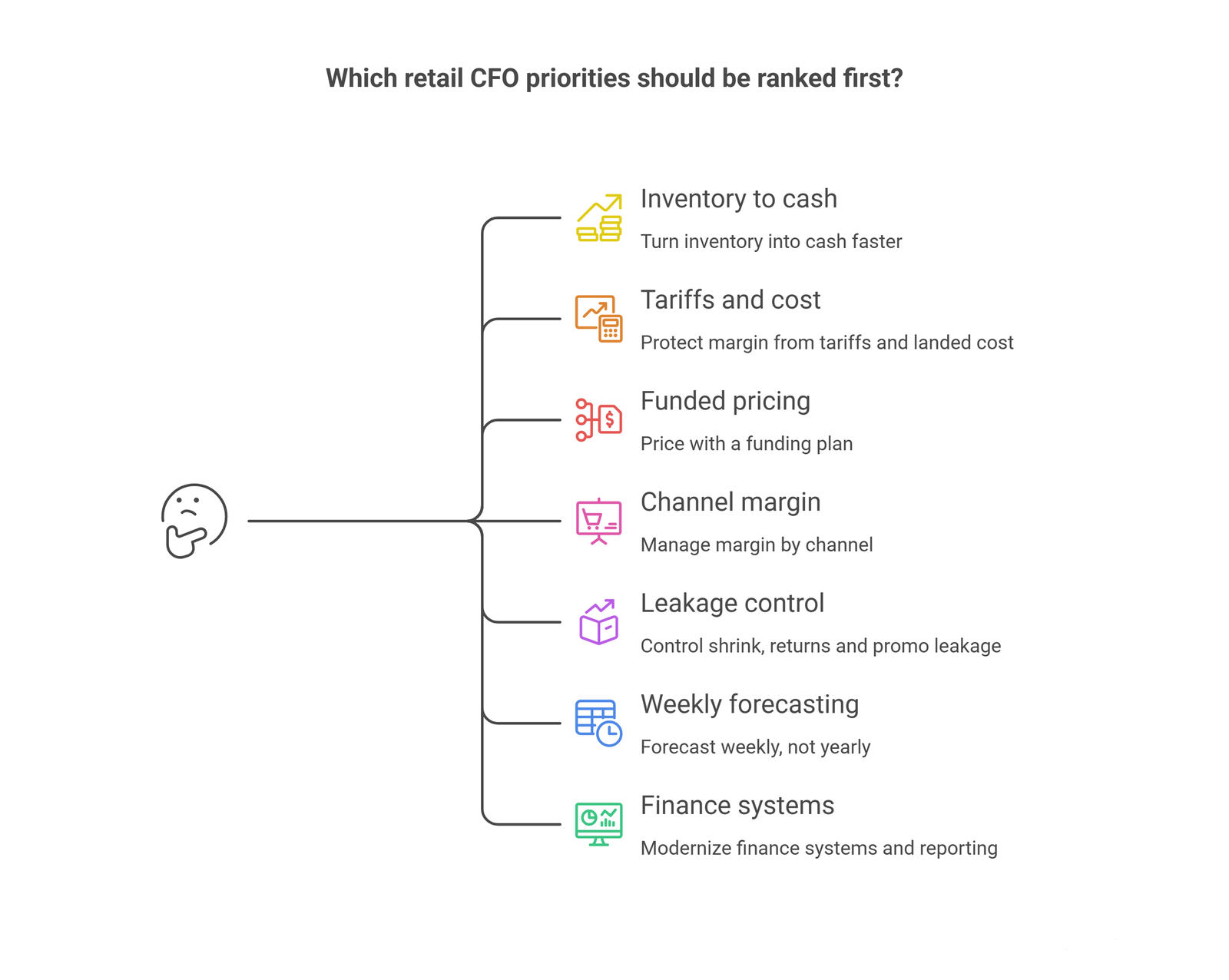
This guide covers what a retail CFO does, how priorities change with business size, seven priorities to rank first, and the metrics that show progress.
What does a retail CFO do?
A retail CFO runs the financial side of a retail business: accounting, reporting, tax, treasury, planning and controls. The strategic part of the role is deciding where cash goes, how much stock to hold, how to price and which channels earn their keep.
Retail CFO priorities by business size
The seven priorities below apply to every retailer. The order changes with scale.
| Business type | Top priority | Common trap |
| Owner-led shops (1 to 5 locations) | Cash and inventory control | Buying on instinct and discovering the cost at month end |
| Regional chain | Margin by store and by category | Averages that hide weak stores |
| Ecommerce-led retailer | Margin by channel and landed cost | Growing revenue that loses money after shipping and returns |
1. Turn inventory into cash faster
Inventory is the largest asset on most retail balance sheets. It is also the easiest place for cash to disappear.
A retail CFO tracks inventory turnover and the gross margin return on inventory investment, often shortened to GMROII. That second number shows how much margin each dollar of stock earns. A product that turns slowly and carries a thin margin is a candidate for fewer units or none.
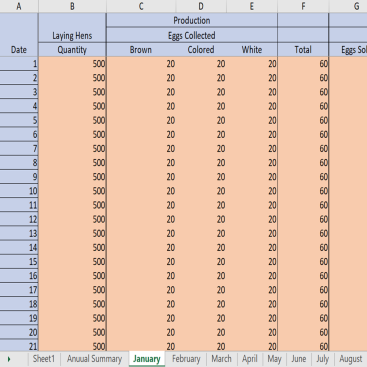
The CFO also separates aged stock from healthy stock and sets a clearance rule early. A simple inventory and COGS spreadsheet is a practical start for smaller retailers still managing this by hand.
2. Protect margin from tariffs and landed cost
Tariffs raise landed cost, which is the full cost of getting a product to your shelf: purchase price, freight, duties, insurance and currency. When duties rise, order quantities and reorder points that worked last season stop working.
A retail CFO maps which products are exposed, runs side-by-side scenarios, and resets reorder points and safety stock to match. Supplier terms matter here too. Extended payment terms or supply chain financing can ease the cash squeeze while a tariff change settles.
Companies that diversify suppliers and keep nearby sources for fast sellers recover from disruption faster. That is a finance decision as much as an operations one, because it trades cost for resilience.
3. Price with a funding plan
Pricing is a CFO decision, not just a merchandising one. Cutting prices wins traffic. It also resets margin expectations.
Walmart used one-time tariff refunds to lower prices on thousands of items, CFO Brew reported. Advisers quoted in the same story warned that permanent cuts only make sense when the retailer can fund them after the refund money runs out.
The takeaway for any retailer is to tie each price move to a source of funding. That might be supplier cost-sharing, lower shrink or mix shifts. If none exists, treat the cut as a promotion with an end date.
4. Manage margin by channel
Not every sale earns the same profit. Online orders often reach more customers but earn less per item. In-store sales usually earn more because the customer performs the last mile.
IESE research suggests inventory should lean toward stores early in a selling season to protect higher-margin sales, serve both channels mid-season, and shift online late to clear leftover stock. The research applies to products with limited stock and a finite season, such as fashion.
IESE also notes that Hudson’s Bay Company filed for bankruptcy partly because of inventory disconnects and weak online integration. Its write-up on omnichannel inventory is worth reading for any CFO managing both channels. If your online business is a growing share of sales, ecommerce CFO services can help separate channel profit from channel revenue.
5. Control shrink, returns and promo leakage
Shrink is inventory lost to theft, error or damage. Returns and promotions leak margin in the same quiet way.
A retail CFO reports all three as a percentage of sales, by store and by category. A single store with unusual shrink gets a review. A promotion that sells well and loses money gets stopped. The point is to make leakage visible, so someone owns it.
6. Forecast weekly, not yearly
A twelve-month plan locked in January will be wrong by spring. Retail CFOs increasingly use rolling forecasts that update monthly, or weekly in peak season.
Rolling forecasts let the business respond to tariff news, cost inflation, demand swings and supplier delays without starting over. They also give lenders and the board a current view of cash. Inventory and cash forecasts should be linked, because excess stock on a tariff-heavy product ties up cash needed elsewhere.
If your team is choosing planning software, our guide on what tool to use for FP&A compares the options.
7. Modernize finance systems and reporting
Boards, lenders and investors expect timely, accurate numbers. Retail CFOs get there by investing in cloud finance systems, analytics and standardized processes.
The reporting should answer practical questions. Which stores earn their rent? Which categories earn their shelf space? What is the cash position next month? Retailers that cannot answer those quickly are managing by feel.
Many CFOs also budget for digital upskilling as tools change what finance staff do. A retail model is a useful planning aid. The retail clothing store financial model shows how sales, inventory and margin connect in one file.
Metrics a retail CFO tracks
| Metric | Formula or definition | Watch for |
| Inventory turnover | Cost of goods sold divided by average inventory | Falling turns in a growing category |
| GMROII | Gross margin divided by average inventory cost | High-volume items with low margin return |
| Sell-through rate | Units sold divided by units received | Weak sell-through early in a season |
| Shrink rate | Inventory loss as a percentage of sales | One store or category out of line |
| Landed cost | Product cost plus freight, duties, insurance and FX | Duty changes not yet in the price |
| Gross margin by channel | Margin for stores, online and wholesale, reported separately | Online growth that dilutes total margin |
| Cash conversion cycle | Days inventory + days receivable – days payable | A lengthening cycle |
When to bring in a retail CFO
Many retailers hit a ceiling where growth strains cash faster than the owner can track it. Common triggers include a second or third location, a move into ecommerce, a supplier or tariff shock, a loan or investor round, and margins that fall while sales rise.
A fractional CFO brings senior judgment to those decisions for a set number of days each month. It costs less than a full-time hire and can scale with the business.
Frequently Asked Questions
What does a retail CFO do?
A retail CFO manages accounting, reporting, tax, treasury and planning for a retail business. The strategic work includes inventory investment, pricing, channel margin, cash forecasting and lender or investor reporting.
What are the top priorities for a retail CFO?
Inventory turnover, tariff and landed cost, pricing discipline, channel margin, shrink control, rolling forecasts and modern finance systems. The order depends on business size.
Does a small retailer need a CFO?
Usually not full time. A small retailer with one or two stores can often work with a bookkeeper and a part-time or fractional CFO who reviews inventory, margin and cash each month.
How does a retail CFO handle tariffs?
By mapping which products carry duty exposure, calculating landed cost, running price and order scenarios, and adjusting reorder points. Supplier terms and sourcing decisions are part of the same plan.
What is GMROII and why does it matter?
GMROII is gross margin divided by average inventory cost. It shows how much margin each dollar of stock earns. It helps a retail CFO decide which products deserve more shelf space and cash.
How is a retail CFO different from a retail controller?
A controller keeps the books accurate and the close on time. A retail CFO uses those numbers to decide how much stock to buy, how to price and where to invest. Small retailers often need both functions, sometimes from one outsourced team.
Close the gap between buying and selling
The best retail finance teams do not wait for month-end to find a problem. They see stock, margin and cash on one page every week, and they act while the fix is still cheap.
If your retail business is feeling margin or cash pressure, Oak’s team can help. Explore our CFO services or book a call.