Gender-Lens Investing in UAE: How Women-Led Businesses Get Funded
The UAE’s gender-lens investing scene: who’s funding women-led businesses now
A UAE bank turning down a woman-owned SME for a loan rarely says “because you’re a woman.” It says the business lacks two years of audited financials. Or that the collateral on offer doesn’t clear the threshold. Or that the credit file is too thin. Every one of those reasons is real, and every one of them also happens to hit women-led businesses more often than male-led ones with comparable revenue.
That’s the practical shape of gender-lens investing and gender-lens lending in the UAE right now. It isn’t a side program or a marketing angle. It’s a growing set of funds, bank products, and government schemes built around one fact: women-led businesses in the UAE are creditworthy and underfunded at the same time. This article covers what gender-lens investing actually means and what the UAE-specific funding gap looks like in numbers. It also covers who is deploying capital with a gender lens today, and what a founder should have in place before that first conversation with an investor or a bank.
What gender-lens investing actually means
Gender-lens investing, often shortened to GLI, is an investment approach that factors gender into the decision alongside the usual financial analysis. According to the Global Impact Investing Network, it’s a strategy that considers gender-based factors across the investment process to advance equality and inform better decisions. In practice, that usually means one or more of three things. It can mean capital directed at women-owned or women-led businesses, capital directed at companies with gender-diverse leadership and workforces, or capital directed at products and services that materially improve outcomes for women and girls.
It isn’t philanthropy dressed up as investing. GLI funds still underwrite for return. The Global Impact Investing Network’s 2024 survey of gender investors found that 90% met or exceeded their financial return expectations. Separate research on loan portfolios has found that businesses with higher women’s participation carry lower default rates. The gender lens changes where an investor looks for deal flow and how they weigh a founder’s profile. It doesn’t lower the bar on repayment or return.
For a UAE business owner, the more useful distinction is this: GLI is not the same as a general SME loan with a marketing campaign attached. A genuine gender-lens fund or bank programme is built around underwriting adjustments. That can mean accepting a shorter trading history, waiving certain collateral requirements, or weighting a founder’s track record differently. It isn’t just a discount code or a co-branded event.
The funding gap, in UAE-specific numbers
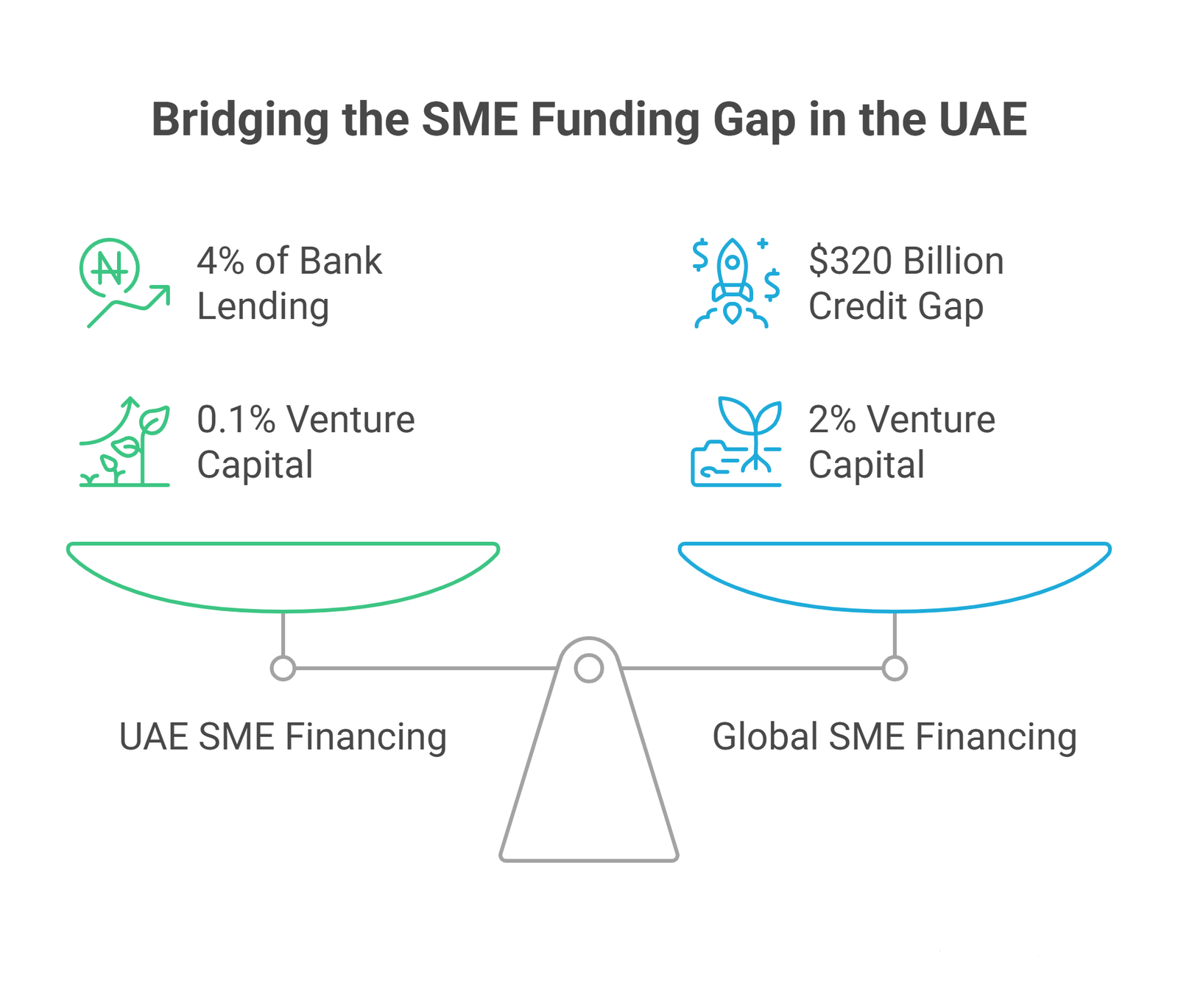
The global credit gap for women-led SMEs sits at roughly $320 billion. A 2024 World Bank-linked estimate puts the total funding gap facing women entrepreneurs worldwide closer to $1.7 trillion once informal and micro-enterprise financing is included. The UAE isn’t insulated from that pattern, even with a fast-growing SME sector.
A joint UN Women and government-backed study of UAE women business owners found that 38.8% cited lack of access to markets as their top challenge. Another 33.5% pointed specifically to lack of access to finance, capital, and bank loans. Those numbers sit inside a broader SME financing gap. Only around 4% of outstanding bank lending in the UAE goes to SMEs generally, against a sector that makes up roughly 94% of all UAE companies and more than half of non-oil GDP.
On the venture side, the gap is sharper. At a 2023 investment summit for women-led businesses in Dubai, Female Fusion cited global figures showing that women-led enterprises receive around 2% of global venture capital funding. That share drops to roughly 0.1% across the wider MENA region. Female-founded businesses also tend to use less external finance overall, not because they need less capital, but because access to it is thinner to begin with.
The UAE has responded with regulation as well as programming. In September 2019, the Central Bank of the UAE formally notified all banking and financial institutions to provide equal treatment to both genders in financial transactions, including loans. That circular didn’t eliminate the underlying barriers. Documentation gaps, thin credit files, and collateral requirements still disadvantage newer and smaller businesses, which women-led businesses disproportionately are. But it did put gender-based lending discrimination on the regulator’s radar rather than leaving it as an informal practice.
Who’s actually deploying gender-lens capital in the UAE
The most established name in UAE gender-lens venture capital is Mindshift Capital, founded in Dubai in 2018 and widely described as the UAE’s first gender-lens venture fund. It invests in women-led, early and post-seed stage technology companies across the US, MENAT, and Singapore. The fund is sized around $25 million with a target of 15 to 20 portfolio companies. Its early backers included prominent UAE-based investors such as Muna Al Gurg, Haleema Alowais, and Najla Al Midfa. Mindshift grew out of the Women’s Angel Investor Network (WAIN), the first women’s angel investing group in the Middle East. WAIN had been making its own investments in the region since 2014.
Accelerator and incubator ecosystems are showing similar patterns without necessarily branding themselves as gender-lens funds. Sheraa, the Sharjah Entrepreneurship Center, reports that close to half of the startups it supports are women-led, a figure it describes as well above global averages. It launched the Sharjah Women Impact Fellowship in 2025 with an AED 500,000 equity-free grant pool specifically for women founders scaling existing ventures. Dubai SME has run its own Future Founders and Future Funders programme with Womena, aimed at building a pipeline of Emirati women as both entrepreneurs and future venture investors.
On the banking side, 2026 has brought a wave of tailored propositions. RAKBANK launched its “She Means Business” package in May 2026 for businesses fully owned by a woman. It offers a full year of waived account fees, collateral-free access to a zero-balance business account, and a partnership with Crunchmoms, the MENA region’s largest women founder network. ADCB and Emirates Development Bank both run advisory and financing tracks aimed at women-led SMEs. EDB also continues to offer credit guarantees that reduce the collateral banks require before lending to smaller, newer businesses generally. That’s a structural fix, but it happens to help women-led businesses disproportionately given how often collateral is the sticking point.
Where the money is actually accessible right now
Direct equity from a dedicated gender-lens VC fund, or a public listing tied to gender bonds, is the most talked-about route and the least accessible one for most founders. It suits a business that’s already past seed stage with a scalable, high-growth model. That’s a small slice of the UAE’s women-led business base. The more realistic entry points sit at three different levels, depending on the stage and shape of the business.
Government-backed funds serve UAE nationals and early-stage founders first. The Khalifa Fund offers UAE nationals financing from AED 100,000 for micro-enterprises up to AED 3 million for growth-stage SMEs. Tenors run up to ten years, with subsidised profit rates. The Mohammed Bin Rashid Fund for SMEs and Dubai SME offer parallel routes in Dubai. The Emirates Development Bank layers in credit guarantees and sector-specific financing for priority industries like manufacturing, healthcare, and renewable energy.
Bank-level SME lending, increasingly with women-specific terms, is the route most established women-led businesses will use. Products range from RAKBANK’s fee-waived starter account to standard SME term loans from Emirates NBD, ADCB, Mashreq, and RAKBANK itself. Most now require one to two years of trading history and a minimum annual turnover, typically starting around AED 500,000 to AED 1 million.
Accelerator and angel networks fill the gap for founders who are pre-revenue or too early for a bank facility. Sheraa, Mindshift Capital’s own pipeline, WAIN’s ongoing portfolio management, and platforms like Female Fusion all connect founders directly with angel investors and gender-lens VCs. That matters before a business has the trading history a bank would require. For founders who’d rather have someone make those introductions on their behalf, investor matchmaking services exist specifically to shorten that search.
| Funding route | Typical stage | What it actually requires | Example in the UAE |
| Gender-lens VC / equity | Post-seed, scalable tech | A proven, high-growth model and willingness to give up equity | Mindshift Capital |
| Government-backed loan | Early to growth stage | UAE national ownership (in most schemes), a viable business plan | Khalifa Fund, EDB, Mohammed Bin Rashid Fund |
| Bank SME loan or facility | Established, trading 1-2+ years | Audited financials, minimum turnover (often AED 500K-1M), AECB credit score | RAKBANK, Emirates NBD, ADCB |
| Accelerator / angel network | Pre-revenue to early revenue | A credible pitch, traction signals, willingness to work with mentors | Sheraa, WAIN, Female Fusion |
What investors and lenders are actually screening for
Every one of these routes, gender-lens or not, comes back to the same underwriting questions. A lender or investor wants to see a clean AECB credit file and financial statements that hold up to scrutiny. They also want a realistic growth plan rather than a general statement of ambition. None of that changes because a fund has a gender mandate. What changes is how flexible the institution is willing to be on the collateral, trading history, or check size that a business can’t yet meet. It also changes what mentorship or non-financial support comes attached to the capital.
That’s also where women-led businesses in the UAE most often lose ground before an application is even filed. New businesses often lack an AECB credit history, or audited financials because they’re too new to have them. That gets them screened out at the first pass, regardless of the underlying business quality. A financial model and investor-ready business plan built before that first conversation closes most of that gap. Ongoing fractional CFO support then keeps the financials clean enough to satisfy a lender’s underwriting once the business is trading.
What to have in place before that first conversation
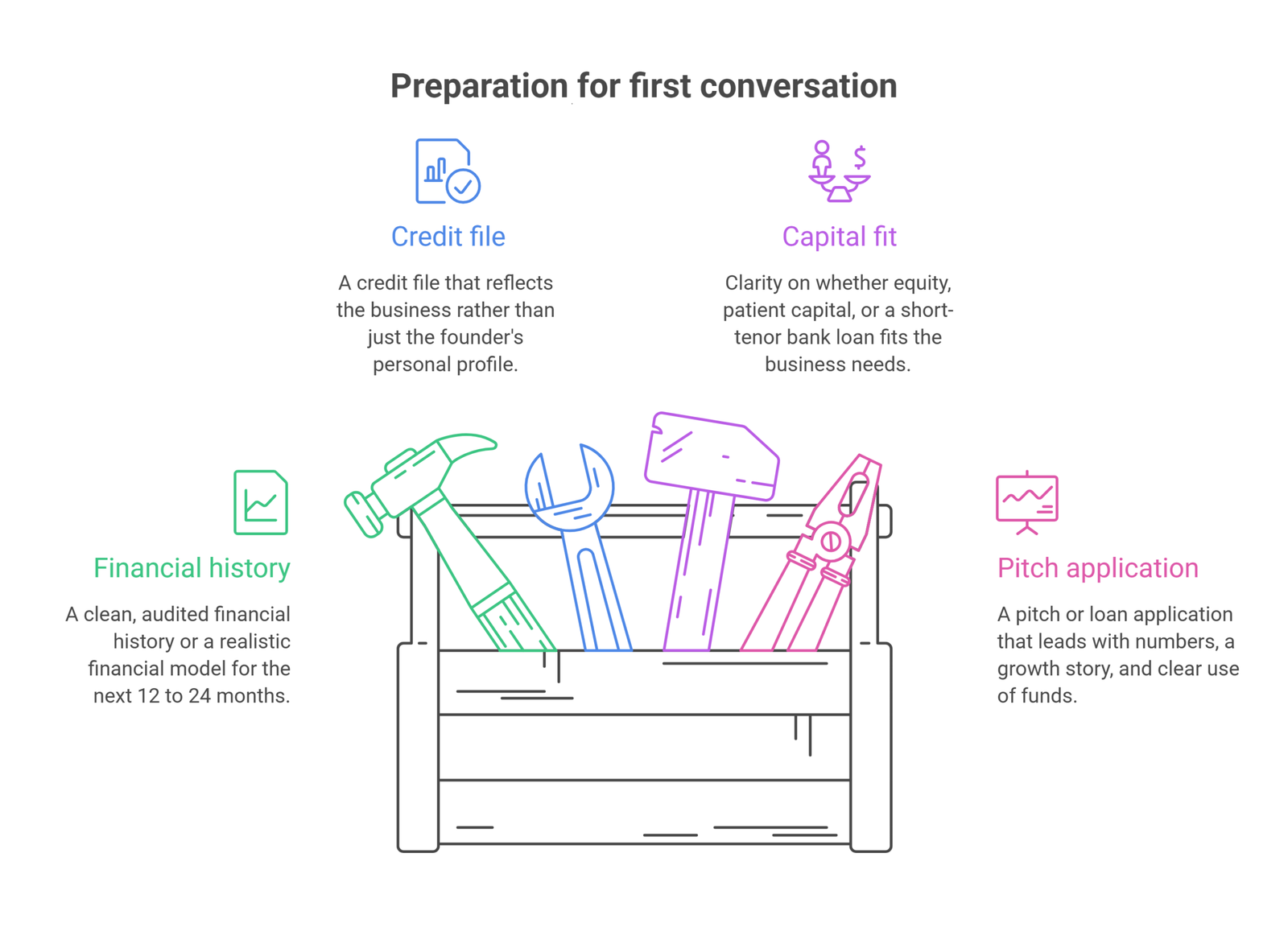
The preparation looks largely the same whether the target is a gender-lens VC, a government fund, or a bank facility, because all three are underwriting the same underlying risk.
- A clean, audited financial history, or if the business is too new for that, a realistic financial model that shows how revenue, costs, and cash flow are expected to move over the next 12 to 24 months.
- A credit file that reflects the business, not just the founder. Newer businesses often carry no separate AECB history yet, which pushes lenders back onto a founder’s personal credit profile.
- Clarity on what kind of capital actually fits. A founder who isn’t ready to give up equity shouldn’t be pitching a VC fund. A founder who needs patient, long-horizon capital shouldn’t default to a short-tenor bank loan.
- A pitch or loan application that leads with the numbers, not just the mission. Gender-lens investors are still investors first. The strongest applications pair a genuine growth story with a defensible valuation and clear use of funds.
Frequently Asked Questions
Do I need to be a UAE national to access gender-lens funding?
It depends on the route. Government-backed funds like the Khalifa Fund typically require majority UAE national ownership. Bank SME products, accelerator programmes like Sheraa, and private gender-lens VC funds like Mindshift Capital are generally open to any founder building a business in the UAE, regardless of nationality.
Does the UAE have gender bonds similar to green bonds?
Not yet at meaningful scale. The UAE’s green and sustainability-linked bond and sukuk market is well established. A dedicated gender bond market hasn’t developed locally, though, the way it has in some other emerging markets through instruments like IFC-backed gender bonds. Most UAE gender-lens capital currently flows through equity funds, accelerators, and bank lending rather than public debt instruments.
Why do collateral requirements affect women-led businesses more?
Collateral requirements typically call for assets like property or land. These are more often registered in men’s names due to broader patterns in asset ownership. A woman-led business with strong revenue can still struggle to meet a bank’s collateral threshold for reasons unrelated to the business itself. Credit guarantee schemes, like the ones run by the Emirates Development Bank, exist partly to reduce this specific barrier.
Are there specific councils or associations for UAE businesswomen?
Yes. The Dubai Business Women Council, the Abu Dhabi Businesswomen Council, and the Sharjah Business Women Council all offer networking and training. Some also provide direct routes into funding programmes or investor introductions. The Dubai Women Establishment runs broader policy and advocacy work alongside them.
How Oak Business Consultant can help
Whether the target is a gender-lens VC, a bank facility with better terms, or a government-backed loan, the underwriting always comes back to the same documentation. A lender needs a financial model it can trust, a credit history that reflects the actual business, and a growth story backed by numbers rather than intention. That’s the groundwork our capital raising and investor documentation work is built around.
Not sure which funding route actually fits your business and stage? Get in touch and we’ll walk through what’s already in place, what’s missing, and which door makes the most sense to knock on first.