


What is a Financial Planning and Analysis Manager and their Job Description?
Financial Planning and Analysis Manager Job Description
Most companies don’t need an FP&A manager until they suddenly do. There’s usually a moment: the budget spreadsheet that used to take an afternoon now takes a week, the board asks a forecasting question nobody can answer cleanly, or the owner realizes they’re the only person who understands how the numbers actually connect. That’s when “financial planning and analysis manager” turns from a job title on LinkedIn into a real hiring decision.
This guide covers what the role actually does, how it differs from a controller or a CFO, a ready-to-use job description you can adapt for a posting, typical compensation, and how to tell whether your business needs a full-time hire at all.
What does an FP&A manager do?
A financial planning and analysis (FP&A) manager owns the budgeting, forecasting, and financial analysis that leadership uses to make decisions. In practice, that means building the annual budget, running monthly or quarterly forecasts against it, explaining the variance when actuals don’t match plan, and translating what all of that means into a recommendation a non-finance executive can act on.
The role sits between raw financial data and the decisions that data is supposed to support. A controller makes sure the historical numbers are accurate. An FP&A manager takes those accurate numbers and turns them into a forward-looking view: what happens to cash flow if the company hires ten people, what a 15% price increase does to churn, whether the new product line will break even by Q3.
FP&A manager vs. controller vs. CFO
These three roles get confused constantly, especially in smaller companies where one person often does two of them at once.
The controller owns financial accounting: closing the books, keeping the company GAAP compliant, and producing accurate historical financial statements. The FP&A manager owns management accounting: budgeting, forecasting, and analysis aimed at future decisions rather than past record-keeping. The CFO sits above both, setting financial strategy, managing external relationships with investors and lenders, and using the controller’s accurate numbers and the FP&A manager’s forward-looking analysis to guide the company.
In a small business, the owner or a fractional CFO often absorbs the FP&A function directly. As the company grows, especially once monthly close, headcount planning, and board reporting become too much for one person, a dedicated FP&A manager typically reports to the CFO or a director of finance.
Core responsibilities
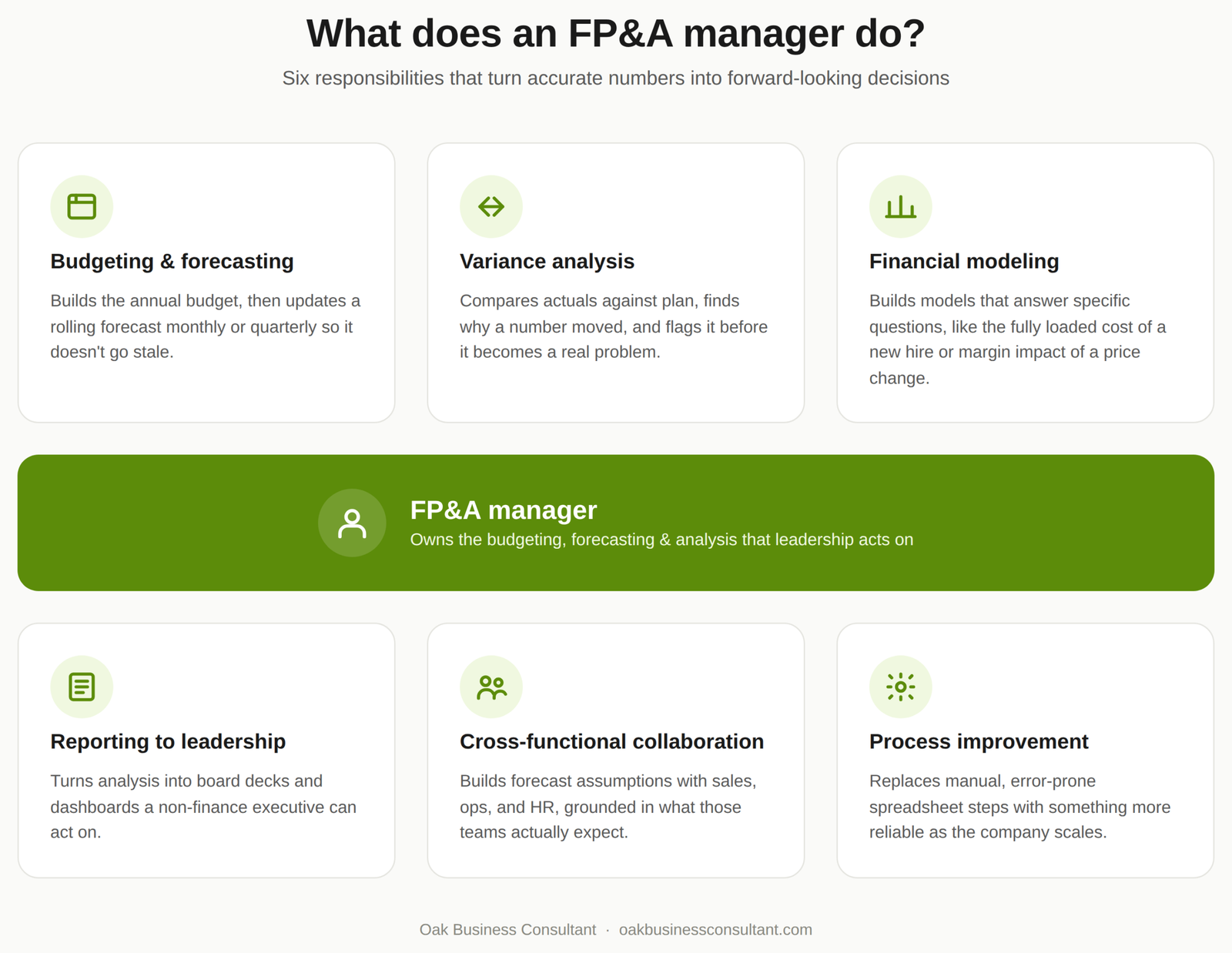
Budgeting and forecasting. Building the annual budget and updating a rolling forecast monthly or quarterly based on actual performance, rather than letting a January budget go stale by June.
Variance analysis. Comparing actuals against the plan, identifying why a number moved, and flagging it before a small gap becomes a real problem.
Financial modeling. Building models that answer specific questions: what does a new hire cost fully loaded, what happens to margin if a key vendor raises prices, what’s the payback period on a new piece of equipment.
Reporting to leadership. Turning analysis into board decks, executive dashboards, and monthly reporting packages that a non-finance audience can act on without a finance degree.
Cross-functional collaboration. Working with sales, operations, and HR to build forecast assumptions grounded in what those departments actually expect, not just historical trend lines.
Process improvement. Most FP&A managers inherit a budgeting process built in spreadsheets, and a real part of the job is gradually replacing manual, error-prone steps with something more reliable as the company scales.
Ready-to-use job description template
Here’s a template you can adapt directly for a job posting.
Job title: Financial Planning and Analysis (FP&A) Manager
Reports to: CFO or Director of Finance
Summary: We’re looking for an FP&A Manager to own our budgeting, forecasting, and financial analysis processes. You’ll build and maintain the annual budget, run monthly forecasts, and translate financial data into recommendations that shape how the company grows. The ideal candidate combines strong financial modeling skills with the communication ability to explain complex numbers to non-finance executives.
Responsibilities:
Manage the annual budgeting process and maintain a rolling forecast updated monthly or quarterly. Build and maintain financial models supporting pricing, hiring, and capital investment decisions. Lead monthly variance analysis and present findings to leadership. Partner with department heads to build forecast assumptions grounded in operational reality. Prepare board-ready reporting packages and dashboards. Identify and implement process improvements to reduce reliance on manual spreadsheet work. Support evaluation of new investments, partnerships, or acquisitions as they arise.
Requirements:
Bachelor’s degree in finance, accounting, or a related field. 5+ years of experience in FP&A, corporate finance, or a related analytical role. Advanced Excel skills; experience with an FP&A or BI platform is a plus. Strong understanding of financial statements and GAAP. Excellent communication skills, with the ability to present financial concepts to non-finance stakeholders. Experience managing or mentoring junior analysts is a plus for a senior-level hire.
Adjust the requirements up or down depending on company size. A startup hiring its first FP&A manager will weigh hands-on modeling ability more heavily than years of managing a team; a larger company backfilling the role will likely want direct team leadership experience.
Tools and software FP&A managers typically use
Most FP&A managers work across three categories of tools. Spreadsheets, primarily Excel, remain the default for ad hoc modeling even at companies with dedicated FP&A software. Dedicated FP&A platforms (tools like Adaptive Insights, Anaplan, or Vareto) connect directly to the company’s accounting and ERP systems to automate budgeting, forecasting, and reporting rather than rebuilding models from scratch every cycle. Business intelligence tools like Tableau or Power BI turn the underlying data into dashboards that leadership and department heads can check without pulling a report from finance.
The specific stack matters less than whether the company has one source of truth. A finance team split between five different spreadsheets, each maintained by a different person, is a bigger risk than which specific software sits on top of the data.
What FP&A managers earn
Compensation for this role varies widely by source, company size, and location. Robert Half’s 2026 salary guide puts the typical FP&A manager range at $105,250 to $158,000 in base salary, while Glassdoor-reported figures based on self-submitted salaries run higher, often into the $140,000 to $190,000 range at larger companies. Location moves the number substantially. States with a higher cost of living, including California, New York, and Massachusetts, consistently report averages well above the national midpoint.
Company stage matters as much as location. An FP&A manager at an early-stage startup wearing multiple hats will typically land toward the lower end of these ranges, while a senior FP&A manager at a larger, more established company sits at the higher end, especially with direct reports.
Career path
FP&A is a well-defined ladder. Most people enter as an FP&A analyst, spend three to five years building modeling and analysis skills, then move to senior analyst before reaching manager. From FP&A manager, the typical next step is director of FP&A, and from there, a finance director, VP of finance, or eventually CFO role. Many FP&A managers hold an MBA, CPA, or CFA, though none of the three is strictly required at the manager level if the candidate has strong hands-on modeling experience.
Interview questions to vet a candidate
Beyond checking a resume for the right degree and years of experience, a short set of practical questions during the interview tends to reveal more than a credential check:
Walk me through how you’d build a 12-month cash flow forecast from scratch. This shows whether the candidate actually understands the mechanics or just knows the vocabulary.
Tell me about a time a forecast was significantly wrong. What did you do? Every experienced FP&A professional has had a forecast miss. How they respond to being wrong matters more than whether they’ve ever been wrong.
How would you explain a 10% gross margin decline to a non-finance executive in two minutes? This tests the communication skill that separates a strong FP&A manager from someone who’s good with spreadsheets but can’t translate the analysis for the people making decisions.
What’s your process for reconciling a sales forecast that’s more optimistic than what the data supports? This gets at how the candidate handles cross-functional pushback, which happens constantly in this role.
Does your business actually need a full-time FP&A manager?
Not every company does, at least not yet. A full-time FP&A manager makes sense once budgeting, forecasting, and variance analysis have grown too complex or too time-consuming for the owner, controller, or existing finance team to handle well alongside their other work. Signs it’s time include monthly close consistently slipping past a week, a board or investor asking forecasting questions nobody can answer without days of prep, or a growth decision (new hires, a new location, a fundraise) getting delayed because nobody has a clear financial model to support it.
If your business isn’t quite at the point of justifying a full-time salary in the ranges above, a fractional CFO or outsourced financial planning and analysis engagement often covers the same ground at a fraction of the cost, and scales down again once the immediate need passes.
Frequently Asked Questions
Is FP&A manager the same as financial analyst?
No. A financial analyst typically supports FP&A work at a more junior level, building models and reports under direction. An FP&A manager owns the overall process, sets the forecasting cadence, and typically manages a team.
Does a small business need an FP&A manager?
Usually not as a full-time hire. Most small businesses get more value from a fractional CFO or outsourced FP&A support until the company reaches a size where the workload justifies a dedicated, full-time role.
What’s the difference between FP&A and accounting?
Accounting, including the controller function, records and reports what already happened. FP&A uses that historical data to build forecasts and models that guide future decisions. They rely on the same numbers but serve different purposes.
What certifications help for an FP&A manager role?
An MBA, CPA, or CFA are the most common, though none is strictly required. Strong Excel and financial modeling skills, along with the ability to communicate clearly with non-finance stakeholders, generally matter more than a specific certification.
How long does it take to become an FP&A manager?
Most people spend six to ten years in FP&A roles, moving from analyst to senior analyst to manager, before reaching this title. Candidates coming from investment banking, consulting, or accounting sometimes move faster given transferable analytical experience.
Conclusion
Hiring for this role wrong is expensive twice over: once in salary, and again in the months of bad forecasts or missed budget cycles before anyone notices the gap. A clear job description, a realistic sense of what the role costs, and a decision about whether you need a full-time hire or fractional support upfront will save you both.
If you’re not sure whether your business needs a full-time FP&A manager, a fractional CFO, or an outsourced financial analysis engagement, Oak’s Fractional CFO Services team can help you figure out the right fit for where your company actually is today. Book a free consultation to talk it through.


