How to Calculate Fixed and Variable Costs?
How to calculate fixed and variable costs (and actually use the numbers)
Most business owners can define fixed and variable costs without much trouble. Where it gets harder is turning that definition into a number they actually use: the exact monthly floor the business has to clear, the true cost of the next unit sold, and the sales volume where the business stops losing money and starts making it. This guide covers how to calculate both cost types, how to split the costs that fall somewhere in between, and what to do with the resulting numbers once you have them.
What are fixed costs?
Fixed costs are expenses that stay the same no matter how much you produce or sell. You pay them whether you serve ten customers or ten thousand.
Common fixed costs include rent and lease payments, insurance premiums, property tax, salaries for permanent staff, business loan repayments, equipment rental fees, and software subscriptions. They show up as a consistent line item on your income statement, and they remain even if production drops to zero.
Fixed costs matter because they set your baseline. You have to cover them before a single dollar counts as profit.
What are variable costs?
Variable costs move with your business activity. Produce more, and they rise. Slow down, and they fall.
Common variable costs include raw materials, direct labor, sales commissions, shipping supplies and packaging, and any input cost tied directly to output. If it costs $5 in materials to make one unit and you make 1,000 units, your variable material cost for that run is $5,000. Double production and you double that cost.
Why the distinction matters
Separating fixed from variable costs is not an accounting formality. It is the foundation for finding your break-even point, pricing with cost-plus methods, understanding your contribution margin, forecasting cash flow, and deciding whether scaling up actually makes financial sense. Skip this separation and pricing, budgeting, and growth decisions all become guesswork.
How to calculate fixed costs
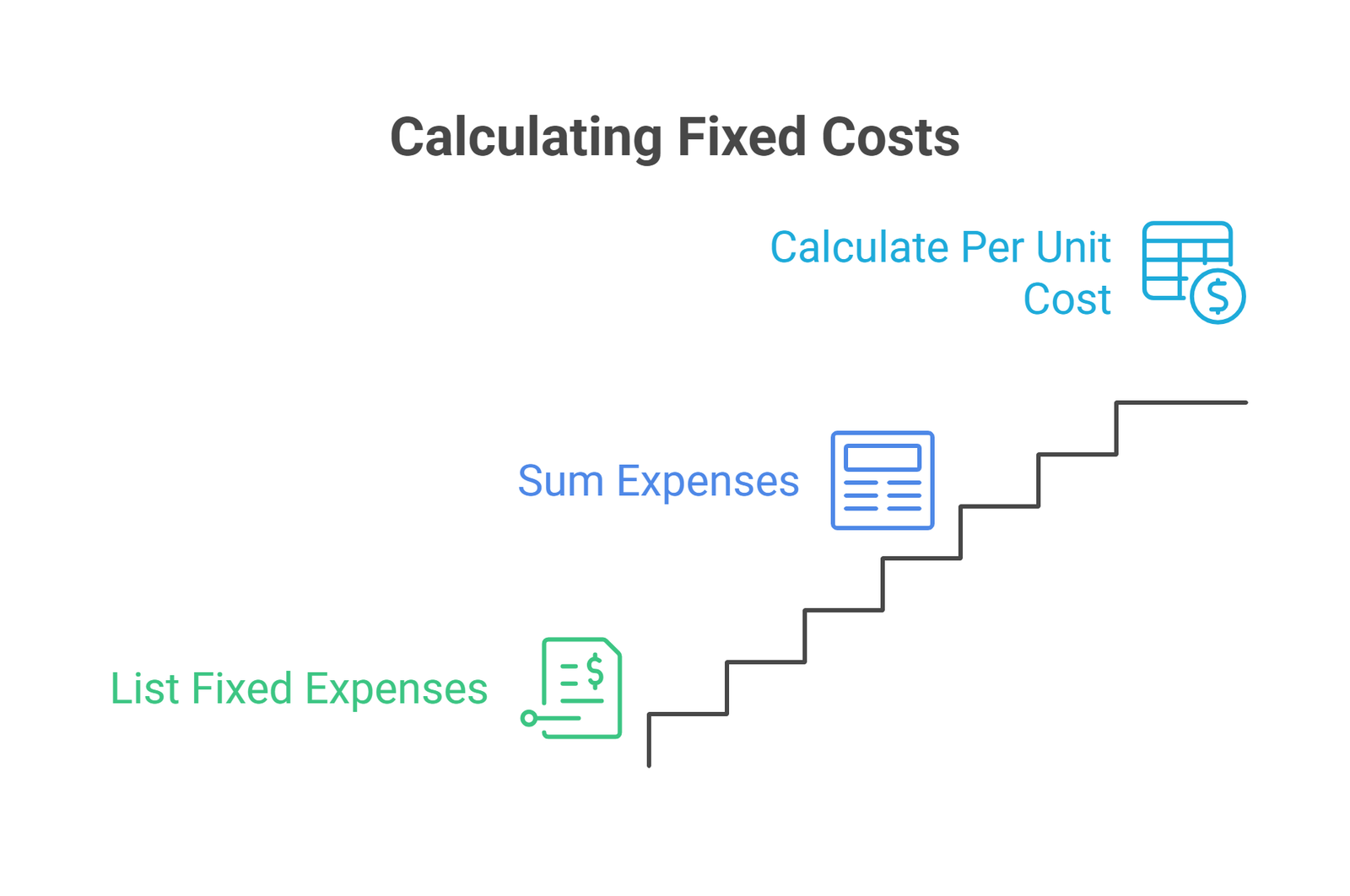
Step 1: List every fixed expense. Go through your bank statements or accounting software and write down every cost that stays constant month to month: rent, insurance, property tax (divide the annual figure by twelve), salaries not tied to output, loan payments, equipment rental, and depreciation on owned equipment.
Step 2: Add them up.
Total fixed costs = sum of all fixed expenses in the period
| Expense | Monthly amount |
| Rent | $3,000 |
| Insurance premiums | $400 |
| Property tax (monthly) | $200 |
| Salaries | $8,000 |
| Business loan | $600 |
| Equipment rental | $300 |
| Total fixed costs | $12,500 |
That $12,500 is your monthly floor. The business needs to generate at least that much in revenue just to cover fixed expenses before any profit exists.
Step 3: Find your average fixed cost per unit. Total fixed costs stay constant, but the fixed cost attached to each unit drops as you produce more, since the same $12,500 gets spread across a larger number of units.
Average fixed cost per unit = total fixed costs / units produced
At 1,200 units, that $12,500 works out to roughly $10.42 per unit. At 2,500 units, it drops to $5. This is the mechanical reason higher production volume tends to improve margins, even before variable costs enter the picture.
How to calculate variable costs
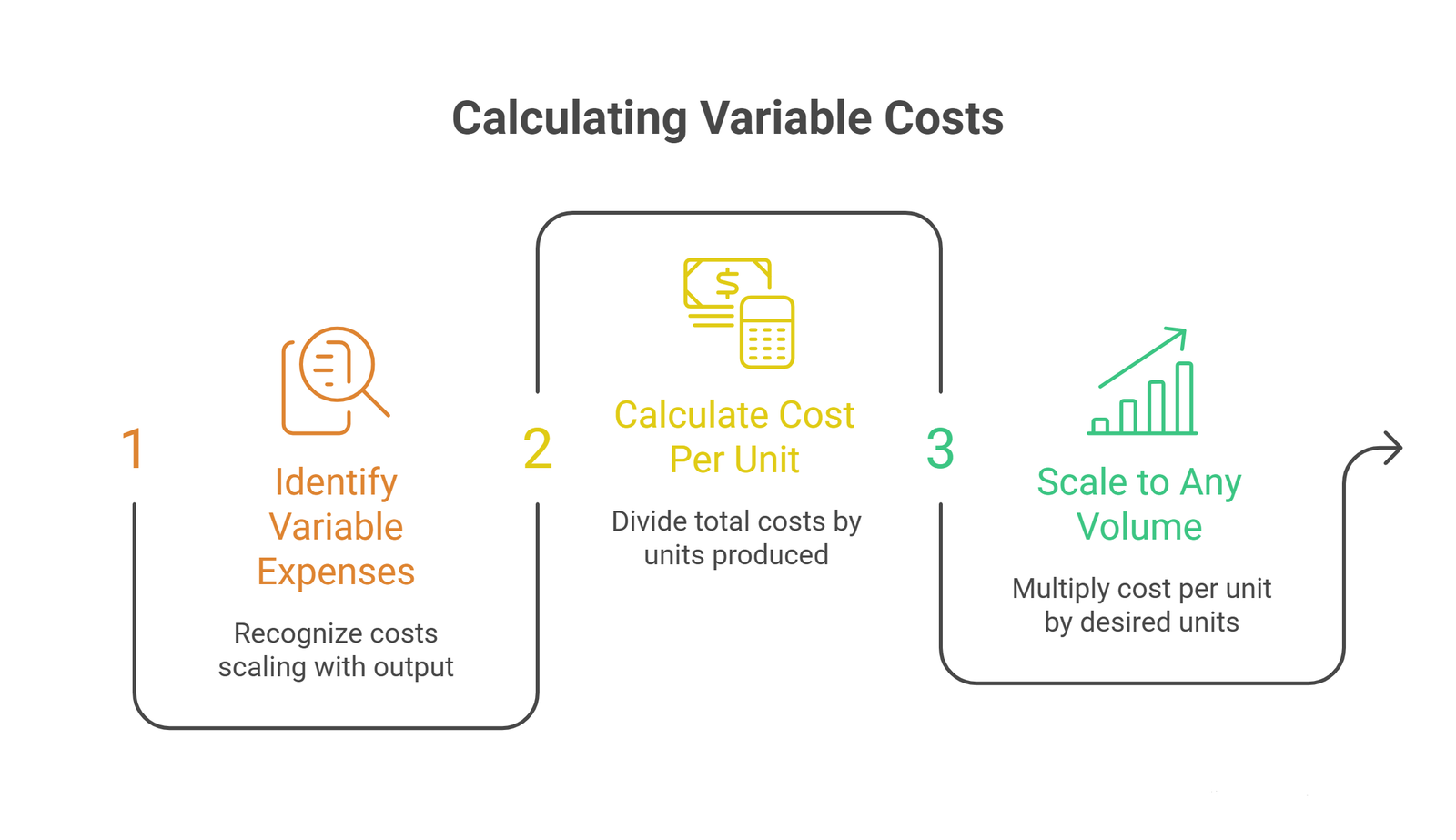
Step 1: Identify variable expenses. Look for costs that scale with output: direct materials, direct labor per unit, sales commissions, shipping supplies, and any input that rises when you produce or sell more.
Step 2: Calculate variable cost per unit.
Variable cost per unit = total variable costs / units produced
For a run of 500 units:
| Variable expense | Amount |
| Raw materials | $2,500 |
| Direct labor | $1,000 |
| Shipping supplies | $250 |
| Sales commissions | $500 |
| Total variable costs | $4,250 |
Variable cost per unit = $4,250 / 500 = $8.50
Step 3: Scale to any volume.
Total variable costs = variable cost per unit × number of units
Planning to produce 1,200 units next month: $8.50 × 1,200 = $10,200.
Total cost and the break-even point
Once you have both figures, total cost is simple addition.
Total cost = total fixed costs + total variable costs
For 1,200 units: $12,500 + $10,200 = $22,700.
The break-even point is where total revenue equals total cost. Below it, you lose money. Above it, every additional unit sold contributes to profit.
Break-even point (units) = total fixed costs / (selling price per unit − variable cost per unit)
With fixed costs of $12,500, a selling price of $20, and a variable cost of $8.50, the contribution margin is $11.50 per unit.
Break-even point = $12,500 / $11.50 = 1,087 units
Sell fewer than that and the business is still covering its fixed costs. Sell more and everything past that point is profit, minus the variable cost of producing it. This number should sit at the center of your financial analysis and pricing strategy, not buried in a spreadsheet nobody revisits.
Splitting mixed costs: the high-low and regression methods
Not every cost is purely fixed or purely variable. A utility bill with a base monthly charge plus a per-unit usage fee is a semi-variable cost, and it needs to be split before it can be used cleanly in a break-even or budgeting model.
The high-low method uses your highest and lowest activity periods to estimate the variable rate:
Variable cost rate = (cost at high activity − cost at low activity) / (high units − low units)
Fixed component = total cost at either level − (variable rate × units at that level)
It is quick to calculate but less precise than a statistical approach, since it only uses two data points and ignores everything in between.
Least-squares regression fits a line through your full set of cost data rather than just the high and low points, which makes it noticeably more accurate over a longer period with varied activity levels. Most accounting software and spreadsheet tools can run this calculation automatically once the data is entered.
Phone plans with a base fee plus usage charges, electricity with a standing charge plus per-unit rates, and sales staff paid a base salary plus commission are all common semi-variable costs worth splitting out before you run a full cost analysis.
Using the numbers to make decisions
Pricing. Cost-plus pricing starts with your total cost per unit and adds your target margin. A $22 total cost per unit with a 30% target margin points to a price around $28.60.
Scaling. A business with high fixed costs and low variable costs has high operating leverage: profit accelerates fast when sales grow, but losses accelerate just as fast when they shrink. Knowing which side of that trade-off your cost structure sits on should shape how aggressively you grow.
Expense management. Watching variable costs over time surfaces problems early. A rising cost of materials per unit can signal a supplier price increase, production waste, or an inventory management gap worth investigating before it eats further into margin.
Contribution margin. This is what each unit sold contributes toward covering fixed costs and then generating profit. Products with a higher contribution margin deserve more of your marketing budget and sales attention than products that just move volume.
How to actually lower fixed and variable costs
Knowing your numbers only helps if you act on them. Fixed costs are harder to move but worth revisiting periodically: renegotiate rent at renewal, shop insurance annually instead of auto-renewing, and consider whether a smaller or shared space covers your real needs. A loan refinance at a lower rate is a fixed cost reduction that shows up every month for the life of the loan.
Variable costs respond faster to attention. Renegotiate supplier pricing once volume grows, since most suppliers have room to move on a bigger order. Cut shipping costs by consolidating orders or switching carriers for high-volume routes. Watch for the point where economies of scale genuinely lower your cost per unit, and be equally alert to the point past that where added complexity (rush orders, smaller batches, expedited shipping) quietly pushes variable costs back up.
Common mistakes to avoid
Treating all labor as fixed. Direct labor tied to production output is variable. Only salaried staff with no direct link to output belong in the fixed column.
Ignoring semi-variable costs. Lumping a mixed cost entirely into “fixed” inflates your fixed cost total and skews your break-even number.
Using stale cost data. Material costs, energy prices, and labor rates shift. Refresh the numbers regularly rather than budgeting off a year-old cost sheet.
Skipping the reconciliation step. Always check your cost breakdown against the actual income statement to make sure nothing got missed or double-counted.
Fixed and variable costs by industry
The split looks different depending on what you sell. A manufacturing business carries high variable costs from raw materials and direct labor, with fixed costs concentrated in factory rent, insurance, and equipment depreciation. A software company runs mostly fixed: developer salaries and infrastructure dominate, since the marginal cost of one more user is close to zero. A retail business sits in between, with rent and insurance fixed and inventory, shipping, and commissions variable. A restaurant carries heavy variable costs through food and labor, with rent and management salaries as its fixed base.
Knowing where your own business sits on that spectrum should shape how you approach pricing, staffing, and how cautiously you scale.
Tools that make this easier
Accounting software can generate reports that separate fixed and variable costs automatically and feed straight into your income statement. Good bookkeeping is what makes that separation reliable in the first place. A cash flow forecast built on accurate fixed and variable figures gives a far more realistic read on the months ahead than one built on rough estimates. For businesses further along, activity-based costing software assigns costs to specific activities and products, giving more granular insight than a simple fixed-versus-variable split.
Frequently Asked Questions
What is the difference between fixed costs and variable costs?
Fixed costs stay the same regardless of production or sales volume. Variable costs change in direct proportion to output. Rent is fixed. Raw materials are variable.
How do I calculate total variable costs?
Multiply the variable cost per unit by the number of units produced. At $8.50 per unit and 1,200 units, total variable costs come to $10,200.
What is average fixed cost, and why does it matter?
It is total fixed costs divided by units produced. Because it drops as volume rises, it is the main reason unit margins tend to improve as production scales, independent of any change in variable costs.
What is a semi-variable cost?
A cost with both a fixed base and a variable component that moves with activity. Utility bills and phone plans are common examples.
How does the break-even point relate to fixed and variable costs?
It is the point where total revenue equals total cost, calculated by dividing total fixed costs by the contribution margin (selling price minus variable cost per unit).
Why separate fixed and variable costs on the income statement?
It gives a clearer read on gross margin, contribution margin, and operating leverage, which supports sharper pricing and more accurate financial analysis.
Can a variable cost become fixed?
Sometimes. A performance bonus tied to profit is variable, but a contractually guaranteed minimum bonus becomes a fixed obligation. Review cost classifications periodically rather than assuming they never change.
Conclusion
Calculating fixed and variable costs is not just bookkeeping. It is what tells you the price you need to charge, the volume you need to hit, and how much risk sits in your cost structure if sales slow down. Get the split right, run the break-even math, and revisit both numbers as your business changes rather than calculating them once and filing them away.
If you want a second set of eyes on your cost structure and pricing, Oak’s CFO services build the cost models and break-even analysis behind sharper pricing and more confident forecasting. Contact us to get started.