Differences Between a Startup Business Plan and Traditional Business Plan
Comparing Startup and Traditional Business Plans: Key Differences
Every business plan exists to answer the same basic question: what are we building, and why will it work? But a plan built for a Silicon Valley startup chasing product-market fit looks nothing like one built for a business seeking a bank loan to open a second location. Knowing which format fits your situation saves you from writing 40 pages a lender will never read, or handing an investor a one-page sketch when they expected a full financial model.
The two formats, in short
The traditional business plan is the long-form, comprehensive document most people picture when they hear “business plan.” It typically runs 30 to 40 pages (sometimes more, depending on the audience) and covers every functional area of the business in detail: market analysis, competitive landscape, organizational structure, marketing strategy, and multi-year financial projections.
The startup business plan, more precisely called the lean startup plan, comes out of Eric Ries’s 2011 book The Lean Startup and is often built around Alexander Osterwalder’s Business Model Canvas. Instead of a lengthy narrative document, it’s typically one to two pages, built to be revised quickly as a business tests assumptions and gathers real customer feedback.
Side-by-side comparison
| Traditional business plan | Startup (lean) business plan | |
| Typical length | 30–40+ pages | 1–2 pages |
| Time to prepare | Weeks to months | Hours to days |
| Best suited for | Established or mature-market businesses, bank loans, formal investors | Early-stage startups, rapid iteration, tech and high-growth ventures |
| Structure | Fixed, sequential sections | Flexible, canvas-style blocks |
| Financial detail | Full multi-year projections, income statement, balance sheet, cash flow | High-level revenue model and cost estimates only |
| How it’s used | Reference document, revisited occasionally | Working document, revised frequently as assumptions are tested |
| Core methodology | Standard business planning | Lean Startup methodology, MVP-driven |
What goes into a traditional business plan
A traditional plan follows a fairly standard sequence: an executive summary, company description, market and industry analysis, organizational structure, marketing and sales strategy, and a detailed financial plan covering income statements, balance sheets, and cash flow projections. Because it’s meant to be exhaustive, it usually also includes an appendix of supporting documents: resumes of key leadership, permits, licenses, and any contracts relevant to the business.
This format suits businesses entering established, slower-moving markets, or those seeking financing from banks and traditional lenders who expect to see detailed, multi-year projections before committing capital.
What goes into a startup (lean) business plan
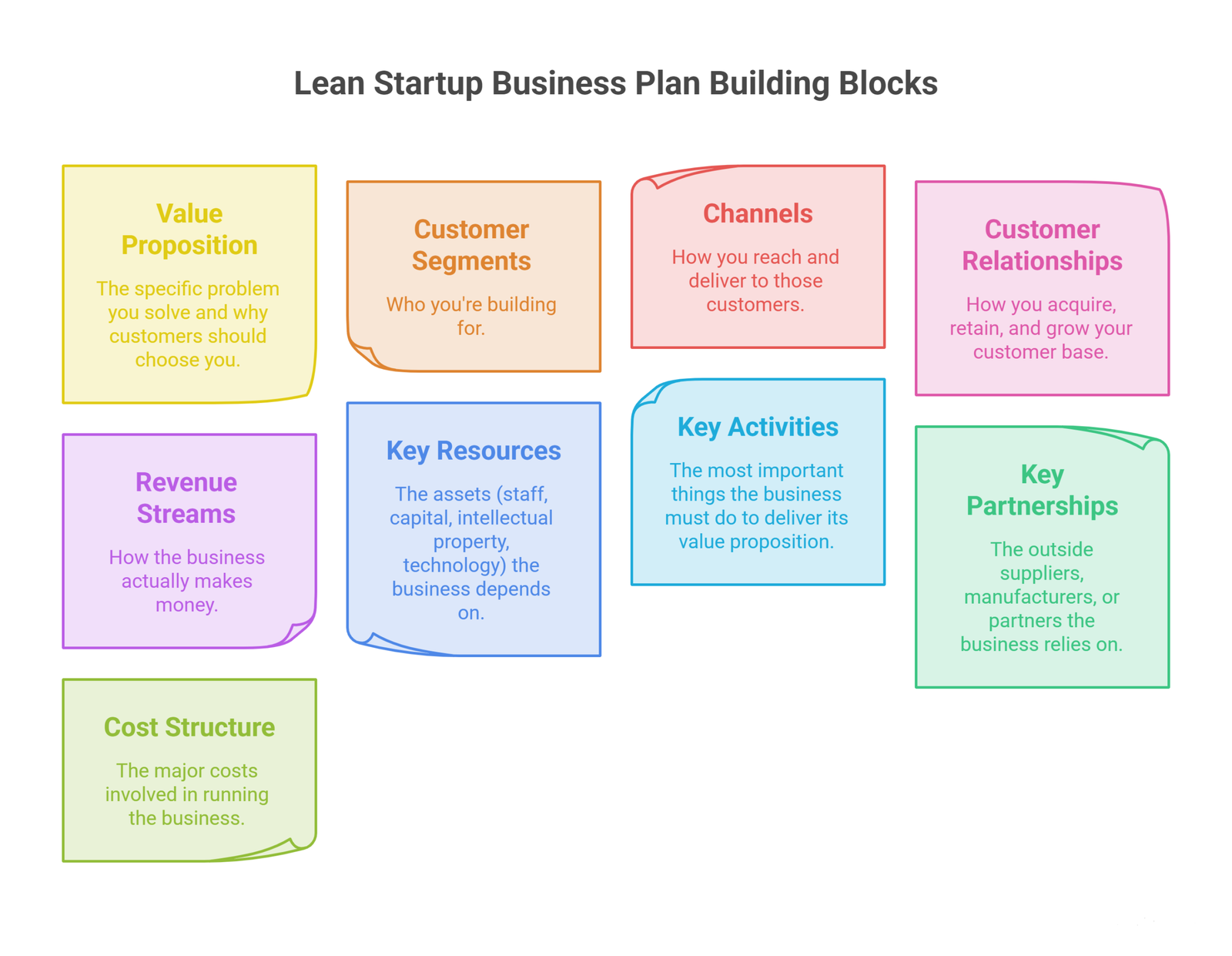
A lean startup plan is typically organized around the Business Model Canvas, which breaks the business down into nine core building blocks rather than narrative sections:
- Value proposition: the specific problem you solve and why customers should choose you
- Customer segments: who you’re building for
- Channels: how you reach and deliver to those customers
- Customer relationships: how you acquire, retain, and grow your customer base
- Revenue streams: how the business actually makes money
- Key resources: the assets (staff, capital, intellectual property, technology) the business depends on
- Key activities: the most important things the business must do to deliver its value proposition
- Key partnerships: the outside suppliers, manufacturers, or partners the business relies on
- Cost structure: the major costs involved in running the business
Because it’s meant to change as the business learns, a lean plan is usually paired with a minimum viable product, or MVP, a stripped-down version of the product used to test assumptions with real customers before investing further. This is also why lean plans favor a small team that can learn and adapt quickly over one with narrow, specialized experience.
Which one should you actually use
Neither format is inherently better; the right choice depends on what you’re trying to accomplish and who’s going to read it.
Choose a traditional business plan if:
- You’re seeking a bank loan or financing from investors who expect detailed, multi-year projections
- You’re entering a stable, well-understood market where the business model doesn’t need much validation
- You need a comprehensive internal reference document for a larger organization
Choose a startup (lean) business plan if:
- You need to move quickly and expect to revise your model as you learn from customers
- You’re pitching venture capital investors who are used to canvas-style formats and care more about market fit than a 40-page narrative
- Your business is early-stage and the core assumptions haven’t been validated yet
A hybrid approach works too. Many founders start with a lean plan to validate the idea and pressure-test assumptions cheaply, then expand it into a full traditional plan once the model is proven and the business is ready to approach banks or formal investors. There’s no rule against evolving from one format into the other as the business matures.
Frequently Asked Questions
Can a startup use a traditional business plan instead of a lean one?
Yes. Some investors, especially traditional angel investors or banks, still expect a full traditional plan regardless of company stage. The lean format is a tool suited to a specific situation, not a requirement.
Do I need both formats eventually?
Many growing businesses end up needing both: a lean plan early on for internal clarity and quick investor conversations, and a full traditional plan later when applying for larger financing or presenting to a board.
How long does each format take to prepare?
A lean plan can realistically be drafted in a few hours to a couple of days. A full traditional plan, especially one with detailed financial projections and market research, typically takes weeks and can run into the hundreds of hours for a truly comprehensive version.
Does a lean startup plan need financial projections at all?
Yes, but at a much higher level than a traditional plan. A lean plan usually includes a basic revenue model and cost structure rather than full income statements, balance sheets, and multi-year cash flow forecasts.
Is the Business Model Canvas the only way to build a lean plan?
It’s the most common framework, but not the only one. Some founders use simpler one-page formats that hit similar points (problem, solution, market, revenue model) without following the canvas structure exactly. What matters more than the specific template is keeping the document short enough to revise quickly.
Conclusion
Picking the wrong format wastes real time, either over-building a detailed plan before you’ve validated your idea, or under-preparing when a lender or formal investor expects real financial depth. If you want something in between, our one-page business plan guide walks through a format that borrows the brevity of a lean plan while still hitting the points investors look for, and our free business plan template covers the full traditional structure section by section if you’re heading in that direction.
If you’re not sure which format your funding conversation actually calls for, or you want a professionally built plan either way, our investor-ready business plan services can help you figure out the right scope and build the plan to match it.