How to Choose a Virtual CFO: EVERYTHING You Need to Know
How to choose a virtual CFO
Choosing a virtual CFO tends to go wrong in a predictable way. An owner meets three candidates, likes the most confident one, and signs a retainer. Three months later, it turns out the real need was a clean month-end close or an investor-ready model, and the CFO was hired for neither.
The fix is to choose the job before choosing the person. A virtual CFO is a senior finance professional who provides CFO-level planning, forecasting, and cash management remotely, usually part time. The eight steps below take you from a written brief to a 90-day review.
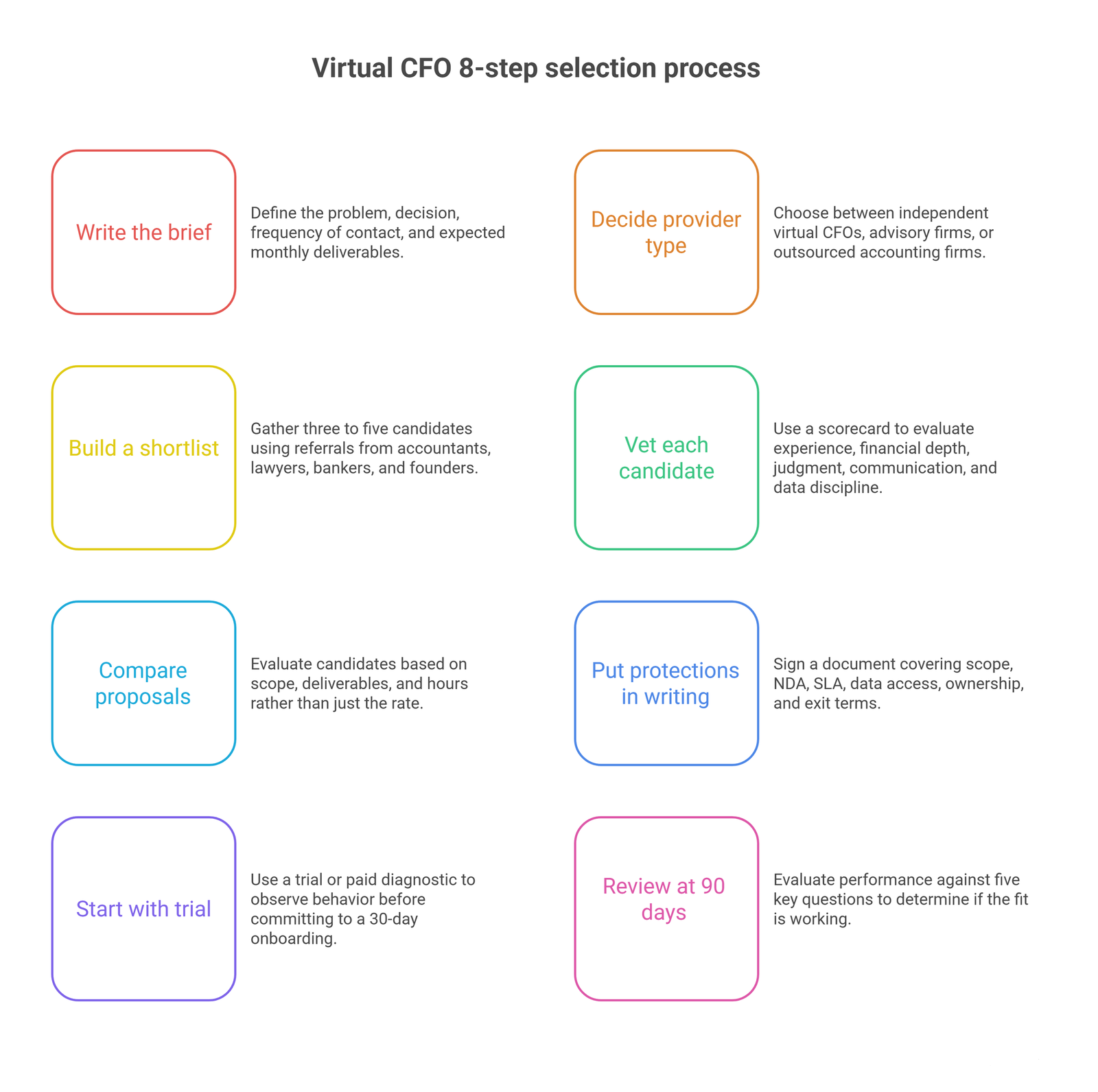
Step 1: Write the brief before you meet anyone
Start with one page. What decision or problem is costing you the most right now? Is it cash visibility, investor documents, a market launch, or reporting that arrives too late to use? Then note how often you want to hear from the CFO and what you expect them to deliver each month.
The brief also tells you which engagement model fits. The table below maps common situations to the three models Oak Business Consultant offers.
| Situation | Best-fit model | Typical length |
| Preparing to raise capital or sell the business | Special purpose CFO | Length of the project |
| Rapid growth, systems struggling to keep up | Interim CFO | Often 3 to 6 months |
| Merger, acquisition, or leadership change | Interim CFO | Often 3 to 6 months |
| Launching a product or entering a new market | Special purpose CFO | Length of the project |
| Ongoing planning, forecasting, and cash oversight | Full-time virtual CFO | Ongoing |
If your situation does not fit a row, that is useful information too. It means the brief needs more work before you start calling providers.
One more check before you go further. If your main problem is late or inaccurate books, a bookkeeper or controller may be the better first hire. A CFO builds strategy on top of clean data, and the article on what a virtual CFO does explains where that line sits.
Step 2: Decide what type of provider you need
Virtual CFOs come in different forms, including independent contractors and outsourced accounting firms that offer CFO services. Each has trade-offs.
| Provider type | Strengths | Trade-offs |
| Independent virtual CFO | Direct access to one senior person, often flexible on scope | Single point of failure if they are unavailable |
| Advisory or CFO firm | Backup coverage, a bench of specialists such as tax and deal advisers | You may meet a senior partner in sales and a junior analyst in delivery |
| Outsourced accounting firm with a CFO arm | Bookkeeping, close, and CFO work under one roof | CFO work can be thinner than the accounting side |
Whichever you pick, ask who will actually do the work and who covers when they are away.
You may also see “fractional” and “interim” used alongside “virtual.” In practice, virtual describes remote delivery and fractional describes part-time hours, and most providers offer both at once. The guide to hiring a virtual CFO covers the differences and the cost comparison with a full-time hire.
Step 3: Build a shortlist from referrals
Three to five candidates is enough. The best source is people who have worked with finance professionals before: your accountant, your lawyer, your banker, and other founders in your network. Ask most virtual CFOs where their new clients come from, and the usual answer is referrals. That tells you where the good ones are found.
A referral carries weight because someone you trust has already lived with the result. Online searches still help, but treat them as a way to add names, not to rank them.
Step 4: Vet each candidate with the same scorecard
Use one scorecard for every candidate so the comparison is fair. The full version, with a test question, a strong-versus-weak answer, and a red flag for each quality, is in the guide on what to look for in a virtual CFO. In short, score industry experience, financial depth, strategic judgment, communication, data discipline, and a verifiable track record from 1 to 5.
Three checks are worth doing for every name on the list:
- Credentials. A degree in finance or accounting is the baseline. A CPA, CMA, or similar designation is a useful signal.
- References. Speak to at least two current or recent clients, and ask what changed after the CFO started.
- Reviews. Read them across several platforms and pay attention to dates. Be wary of glowing reviews from anonymous accounts.
Drop any candidate who scores 3 or below on financial depth or data discipline. Those two are hard to fix after you sign.
Step 5: Compare proposals by scope, not by rate
Ask every provider to put the same eight things in writing:
- Named deliverables and their due dates.
- Hours included per month.
- Meeting and reporting rhythm.
- Promised response time for urgent questions.
- Who does the work, and who covers absences.
- Software, storage, or travel costs billed on top.
- Who can access your systems, and how access ends.
- Notice period and exit terms.
Then look at how they charge. Virtual CFOs usually price in one of three ways.
| Pricing model | Best for | Watch for |
| Hourly | One-off reviews and short questions | Costs that drift upward with no cap |
| Monthly retainer | Ongoing reporting, forecasting, and oversight | Vague hours and deliverables |
| Project fee | A defined job such as a fundraising model | Scope creep and change-order charges |
Published ranges vary widely. Some US providers describe a solid virtual CFO service as starting around $5,000 per month. Others list outsourced CFO services at about $1,000 to $2,500 per day, or $5,000 to $12,000 per month, depending on scope. The hiring guide linked in Step 2 breaks down typical costs by business stage.
The cheapest quote is rarely the best one, and the math shows why. Take two illustrative proposals. One charges $4,000 for 10 hours, which is $400 per hour. The other charges $6,000 for 25 hours, which is $240 per hour, and names the deliverables. The second costs more per month and less per hour of work. Divide each quote by its included hours and its named deliverables before you compare.
Step 6: Put the protections in writing
Before work starts, agree on these points in a document both sides sign:
- Scope and deliverables, with due dates. Weekly check-ins suit most growing businesses, though busy periods may need more.
- A confidentiality agreement (NDA) and a service-level agreement (SLA) that define scope, timelines, and liabilities.
- Data access. Individual logins, limited permissions, and a written step for removing access at the end. The FTC’s cybersecurity guidance for small businesses lists questions worth asking any vendor about its security practices.
- Ownership. Your financial model, reports, and working files should belong to you when the engagement ends. Ask directly, because some providers keep models in their own templates.
- Exit terms. A short notice period is easier to live with than a long lock-in.
Set deadlines with some slack. If every date is tight, one unexpected invoice or audit request will push the whole schedule back, and both sides will feel it.
Step 7: Start with a trial, then run a 30-day onboarding
A trial tells you more than any interview. Many virtual CFOs offer a free consultation or a discounted first engagement, so ask. If they do not, propose a paid diagnostic: a short project such as a cash flow forecast or a financial review.
During the trial, watch how the candidate behaves. Do they study your business before offering advice? Additionally, do they deliver on the date they promised? Do your questions get plain answers? Those habits will not change after you sign a longer contract.
Once you commit, use the first 30 days to set the foundation:
- Grant access through individual accounts, not shared logins.
- Hand over the last 12 months of statements and your current chart of accounts.
- Agree on the five or six numbers you want to see every month.
- Build a baseline cash forecast, ideally covering the next 13 weeks.
- Fix the reporting calendar and the standing meeting time.
Step 8: Review at 90 days
Put the review date in the calendar on day one. At 90 days, ask five questions:
- Is there a cash forecast, and is it updated on schedule?
- Do reports arrive on the dates agreed?
- Has month-end close become faster or cleaner?
- Have you made at least one decision differently because of the CFO’s advice?
- Are you spending less of your own time on finance?
Three or more yes answers mean the fit is working. Fewer than that is a conversation to have now, not at renewal. Your options are to keep going, adjust the scope, or end the engagement under the notice terms you agreed in Step 6.
Getting more from the relationship after you hire
A good virtual CFO can only work with what they receive. Send monthly figures on time, tell them about changes in the business early, and give feedback when something misses the mark. Be specific: say what went wrong and what you would prefer next time.
Their network is also part of what you are paying for. Many virtual CFOs can introduce a tax adviser, a lawyer, or a lender when you need one. Be open to their suggestions on pricing, processes, and tools, but weigh each one before acting. Good advice still deserves a question or two.
Three mistakes that cost the most
The first is hiring on personality. Charm is not a forecast. The second is skipping the written scope, which turns every disagreement into a memory contest. The third is using a CFO as a bookkeeper, which wastes senior time on work a bookkeeper handles at a lower rate.
Frequently Asked Questions
How long does it take to choose a virtual CFO?
Plan for a few weeks. Spend the first week on the brief and shortlist, then one to two weeks on calls and references. Add the trial period after that. Skipping the brief to save time usually costs more later.
How much does a virtual CFO cost?
It depends on scope, hours, and the provider. Published US ranges run from about $5,000 per month for a solid service to $12,000 or more for broader support. Ad hoc work is usually billed by the hour or by the project. Always compare what each quote includes.
What is the difference between an interim, special purpose, and full-time virtual CFO?
An interim CFO covers a defined period of change, often three to six months. A special purpose CFO handles one project, such as a fundraise. A full-time virtual CFO provides ongoing support across planning, reporting, and cash management.
Can a virtual CFO replace my accountant?
No. Accountants handle compliance, tax filing, and record keeping. A virtual CFO uses that data to forecast, plan, and advise. Most businesses need both, working from the same set of numbers.
Should I ask for a trial before committing?
Yes, whenever it is possible. A short paid project or a discounted first month shows you how the CFO communicates, whether deadlines hold, and how well they understand your business.
Is my business too small for a virtual CFO?
Not necessarily. Complexity matters more than size. If cash surprises you, investors are asking for numbers you do not have, or decisions rely on guesswork, the need already exists. The guide on which businesses need a virtual CFO covers the common cases.
Choose the job first, then the person
Most bad hires trace back to a vague brief. Owners who write down the problem, the deliverables, and the review date in advance tend to find the right CFO faster. They also see sooner when a fit is not working.
Oak Business Consultant offers interim, special purpose, and full-time virtual CFO services for startups and growing businesses. Book a call with the team to turn your brief into an engagement that fits your stage and budget.