Who Needs a Virtual CFO: 12 Businesses That Must Have One
Which businesses need a virtual CFO? 12 types and the trigger for each
Many owners assume a CFO is something you hire after reaching a revenue milestone or filing for an IPO. That assumption is expensive. Companies without senior financial leadership tend to decide on incomplete information. The cost shows up as missed cash flow problems, stalled funding, and strategies that never get started.
A virtual CFO gives you that leadership part time, at a fraction of a full-time salary. This guide covers 12 types of business that benefit most, the trigger that signals the need, and what the CFO actually does for each.
A quick test before the list
You probably need a virtual CFO when several of these are true:
- Cash flow surprises you.
- Big decisions rest on gut feel because reports arrive late.
- An investor, lender, or buyer wants numbers you cannot produce.
- Growth is outrunning your systems.
- Your accountant is great at compliance but cannot weigh in on strategy.
The 12 types at a glance
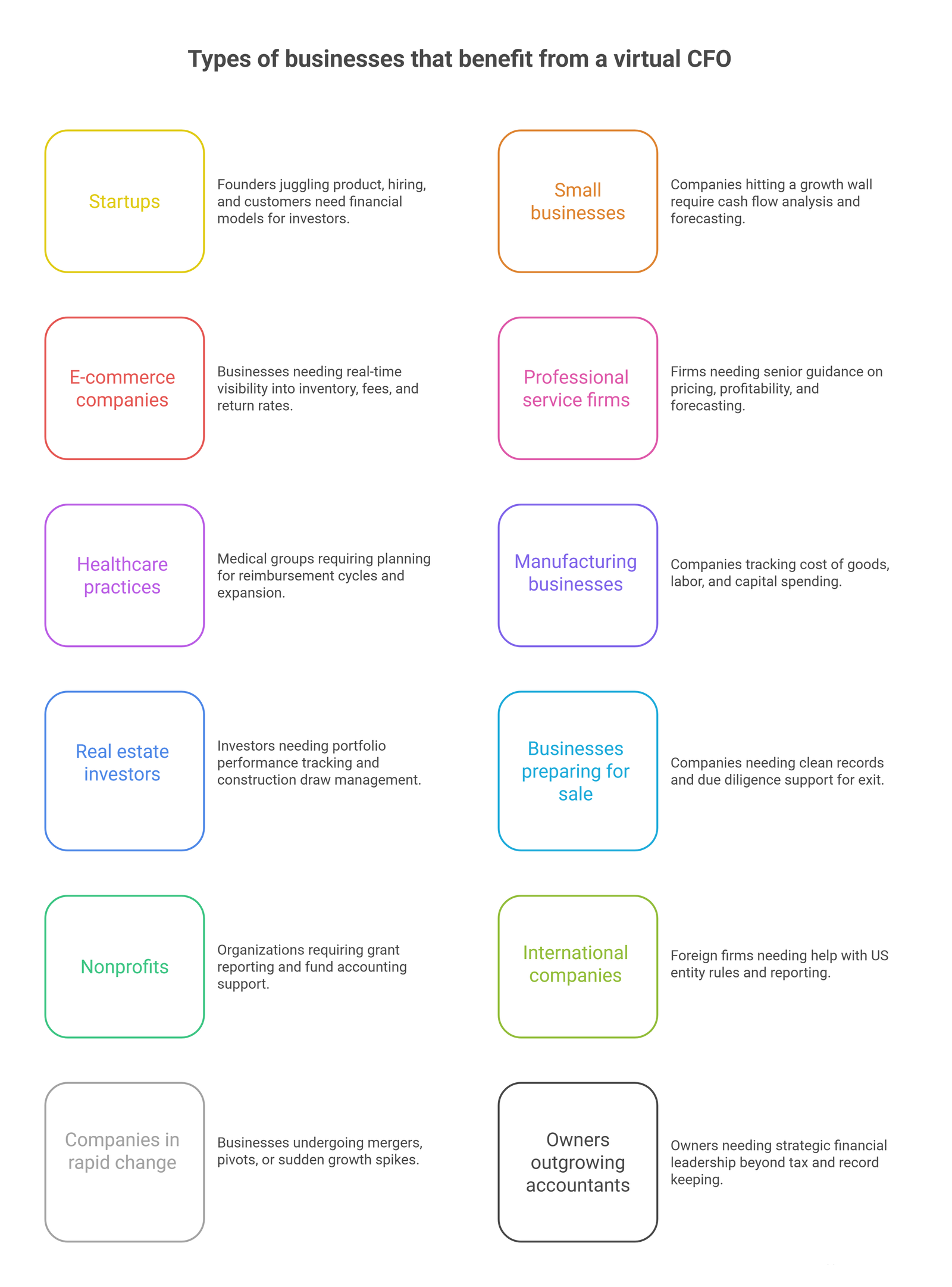
| Business type | Typical trigger | First project |
| Startups past the idea stage | Preparing a seed or Series A raise | Financial model and burn rate tracking |
| Small businesses hitting a growth wall | Profit on paper, no cash in the bank | Cash flow forecast |
| E-commerce companies | Inventory and platform fees straining cash | Real-time dashboard and inventory financing plan |
| Professional service firms | Owner doing everything | Profitability by client or service |
| Healthcare practices | Slow reimbursement, expansion plans | Cash plan around payer timing |
| Manufacturers and product businesses | Margin leakage, rising material costs | Cost of goods and variance analysis |
| Real estate investors | Growing portfolio, lender requests | Property-level performance reporting |
| Businesses preparing to sell | Exit planned in one to three years | Clean financials and buyer-ready reporting |
| Nonprofits and social enterprises | Grant reporting, board budgets | Fund-level budget and reporting |
| International companies entering the US | New US entity and no local finance team | Reporting and tax setup |
| Companies in rapid change | Merger, leadership change, or pivot | Controls and reporting rhythm |
| Owners who outgrew their accountant | Strategic decisions with no model behind them | Financial model for the next decision |
1. Startups past the idea stage
Founders juggle product, hiring, and customers, and financial planning slips to the bottom of the list. It stays there until a raise or a cash crunch forces the issue.
A virtual CFO builds the financial model early, tracks burn rate precisely, and creates projections that hold up in front of investors. Investors back organized, credible businesses. A good idea alone is rarely enough. If you are preparing a seed round or Series A, a model and clean reporting are usually a prerequisite. The guides to virtual CFOs for startups and to when a startup should hire a CFO go deeper, and this SaaS CFO case study shows the work in practice.
2. Small businesses hitting a growth wall
Growth can look like success from the outside while the bank balance says otherwise. More orders mean more staff, more overhead, and more cash tied up before customers pay.
A virtual CFO runs cash flow analysis, sets up cash management routines, and builds a forecast that supports sustainable growth instead of chasing revenue. Forecasting turns a surprise into a scheduled decision.
3. E-commerce companies
E-commerce looks lean on paper: no storefront, direct to consumer, global reach. The finances are not lean. Inventory financing, seasonal cash needs, platform fees, return rates, and several revenue channels all need tracking.
A virtual CFO builds real-time visibility into the numbers and sets KPIs that track what matters. Controls then stop cash leaking through poorly managed costs. Without that, many e-commerce owners find problems through the bank balance, when they are costly to fix.
4. Professional service firms
Law firms, consultancies, and agencies often reach a stage where the owner does client work, sales, hiring, and reads the financials on the side. That is neither sustainable nor strategic.
A virtual CFO gives the firm senior guidance without a full-time executive hire. The work typically covers forecasting, pricing, and profitability by client or service line. It also builds the finance foundation needed to bring in a partner or outside investor later.
5. Healthcare practices and medical groups
Healthcare finance has its own pressures: reimbursement cycles, payer mix, credentialing costs, and revenue that can lag service by months. Cash flow is hard to predict without a model.
A virtual CFO with healthcare experience plans cash around slow reimbursement periods. They also model expansion decisions, such as a second location or a new specialist, and keep records audit-ready. The article on virtual CFOs in healthcare covers the sector in more depth.
6. Manufacturing and product businesses
Manufacturers carry raw material costs, labor, equipment depreciation, and supply chain variability, all while balancing capacity against demand.
A virtual CFO tracks cost of goods closely, finds where margin leaks across production, and plans capital spending and debt. For product businesses entering retail or widening distribution, the CFO also prepares the projections that buyers and supply chain lenders expect.
7. Real estate investors and property managers
Real estate is a financial business that happens to hold property. Every acquisition, refinance, and portfolio decision has long-term consequences.
Growing investors need more than a bookkeeper and a tax accountant. A virtual CFO manages cash across properties, tracks performance by asset, and produces financial statements for lender presentations. For development and value-add projects, the CFO models returns, tracks construction draws, and prepares exit scenarios. Entity structuring itself is done with your legal and tax advisers. See how a virtual CFO can grow a real estate firm and this multi-entity real estate case study.
8. Businesses preparing for a sale or acquisition
If you plan to sell in the next one to three years, a virtual CFO is one of the better investments you can make now. Buyers pay for certainty. Clean records, solid controls, and well-documented numbers support a stronger price.
The work usually includes cleaning up financials, preparing a quality of earnings review, building management presentation materials, and handling due diligence questions. The cost is often small next to the effect on the exit.
9. Nonprofits and social enterprises
Nonprofits have payroll, cash flow, grant compliance, and audit needs, and they are often short of financial leadership.
A virtual CFO who knows the sector helps with grant reporting, fund accounting, board-ready budgets, and models that support program growth. For social enterprises that mix earned revenue with donations, the CFO helps keep financial health and mission pointed the same way.
10. International companies entering the US market
Foreign companies setting up US operations face unfamiliar entity rules, reporting requirements, and tax filings. They also manage finances across time zones and currencies without a local team.
A virtual CFO helps set up the accounting systems and reporting rhythm that US operations need. They also coordinate with US-licensed legal and tax advisers on entity and filing questions. That gives the business a credible financial base from the first quarter.
11. Companies going through rapid change
A merger, an acquisition, a leadership change, a pivot, or a sudden growth spike all create financial complexity. Most teams are not equipped to handle it alone.
In those periods a virtual CFO acts as a steady hand. They assess which tools and processes are needed, set a reporting rhythm that keeps leaders informed, and keep controls from breaking during the disruption. The value is partly in the numbers and partly in the confidence to decide quickly.
12. Owners who have outgrown their accountant
Your accountant may be excellent at tax and record keeping yet unable to help you weigh an acquisition or model a pricing change. That is not a criticism. Accounting and financial leadership are different skills.
A virtual CFO fills the gap and works alongside your accountant or bookkeeper. If you find yourself making large financial decisions on instinct instead of models, that is the moment to bring one in.
Who does not need one yet
A virtual CFO is not for everyone at every stage. You may not be ready if your books are months behind, you have no budget to act on a forecast, or your only need is tax filing. In those cases, start with a bookkeeper or an accountant and revisit the question later. The guide to hiring a virtual CFO covers the cost and timing in more detail.
What a virtual CFO does across all 12
The core work is similar for every business above, even if the emphasis shifts. It includes reporting, cash flow management, budgeting and variance review, compliance coordination, and support for the finance team. The article on what a virtual CFO does walks through each responsibility with examples.
Frequently Asked Questions
At what revenue level does a business need a virtual CFO?
There is no magic number. Complexity matters more than revenue. If finances keep you up at night, or decisions are made without reliable numbers, the need probably exists already.
What is the difference between a virtual CFO and a bookkeeper or accountant?
A bookkeeper records what happened. An accountant handles taxes and compliance. A virtual CFO uses that information to plan what to do next.
How much does a virtual CFO cost compared with a full-time CFO?
Retainers typically run from about $3,000 to $15,000 per month, and most small and mid-sized businesses pay $3,000 to $10,000. A full-time CFO means a salary, benefits, and recruiting costs on top. Scope drives the price either way.
Can a virtual CFO help with fundraising?
Yes. They build the financial model, shape the numbers behind your story, and prepare your records for due diligence.
How do I know my business is ready?
If you are growing but feel reactive instead of in control of your finances, that gap is the job a virtual CFO closes. The guide to choosing a virtual CFO explains how to start.
The question is how long you can wait
If your business is growing, facing complexity, or making decisions with real financial risk, the question is not whether a virtual CFO could help. It is how much longer you can go without one.
Oak Business Consultant provides virtual CFO services for businesses at every stage of growth, from strategic planning and cash flow management to fundraising support. Book a call with the team to find out what senior financial leadership can do for yours.