How a Virtual CFO Can Grow Your Real Estate Firm
Real estate CFO: 6 jobs that grow a firm, and when to hire one
A real estate firm can look healthy and still run short of cash. Rent arrives on the first. Loan payments, construction draws and capital calls follow their own calendars. Debt matures whether the market is ready or not.
An accountant records what happened. A real estate CFO plans what the capital stack can carry next. That gap is where many growing developers, investors and property managers get hurt.
This guide explains what a real estate CFO does, how the role differs from an accountant or controller, six jobs that drive growth, and the signs that it is time to hire one.
What does a real estate CFO do?
A real estate CFO leads financial strategy for a firm that develops, owns, manages or invests in property. The work covers capital structure, fundraising, forecasting, debt and covenant management, risk, investor reporting and deal analysis.
The role is built around property-level and portfolio-level thinking. A good real estate CFO can tell you how each asset performs and how the whole portfolio holds up if rates move, a loan matures or a tenant leaves.
Real estate CFO vs accountant vs controller
Owners often expect one person to do all three jobs. They are different jobs.
| Role | Main question answered | Time focus | Typical output |
| Accountant or bookkeeper | What happened this month? | Past | Books, tax filings, bank reconciliations |
| Controller | Are the numbers accurate and controlled? | Present | Monthly close, property and entity reports, audit support |
| Real estate CFO | What should we do next, and how do we fund it? | Future | Capital plan, forecasts, lender and investor strategy, deal analysis |
A firm that has an accountant but no CFO usually has clean books and no plan. That works until the first refinance or the first large acquisition.
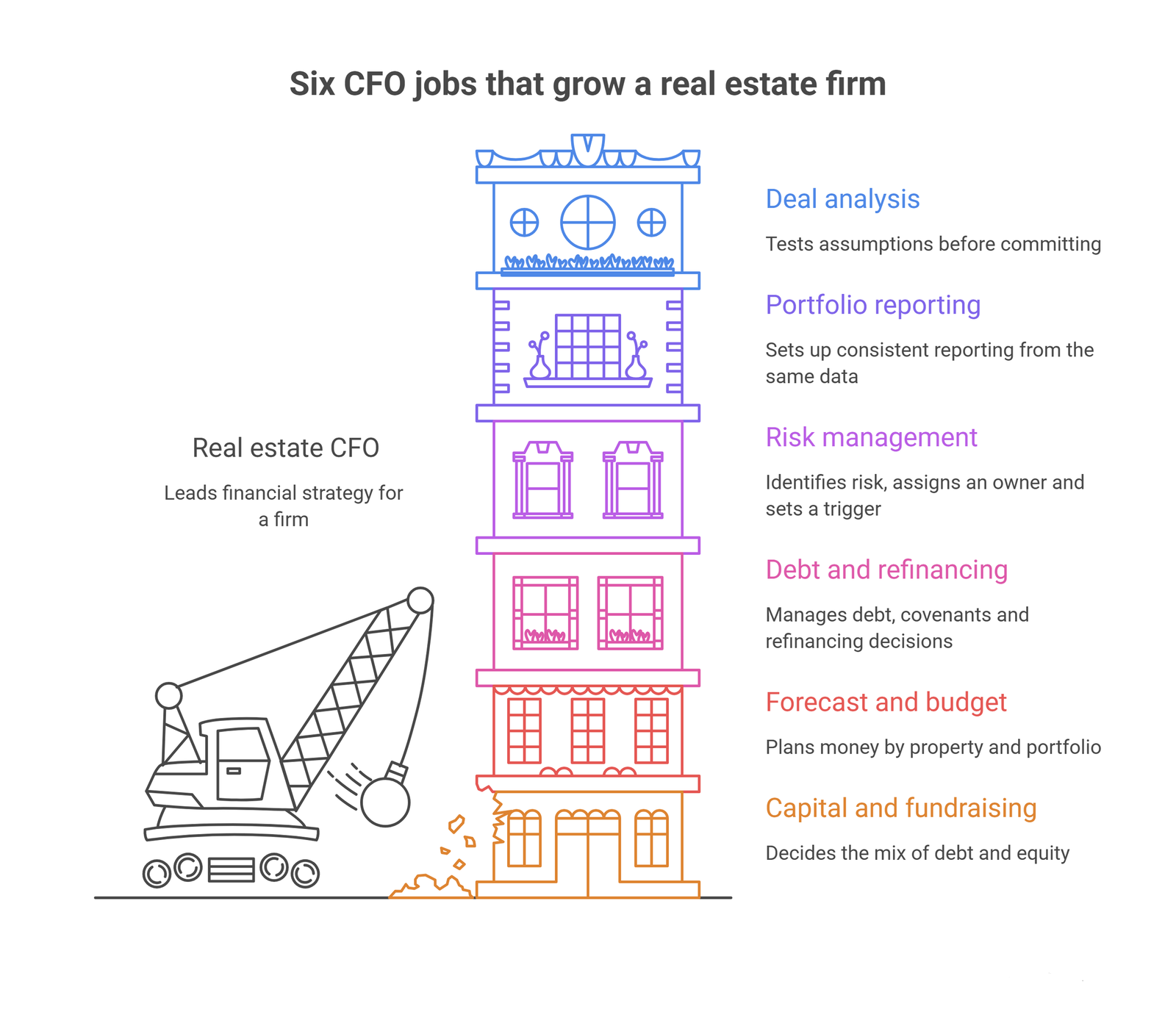
1. Design the capital stack and raise capital
Every deal needs money from somewhere. A real estate CFO decides the mix of senior debt, mezzanine debt, preferred equity and common equity, and what each layer costs.
The CFO also prepares the business plan and financial model that investors read. Equity partners want to see how returns are split, which usually means a clear distribution waterfall. Lenders want debt service coverage and a credible exit.
Real estate CFOs often have working relationships with banks, private lenders and investors because they see many deals. Those introductions can shorten a raise. A CFO also helps pick the right valuation method for the asset type, whether that is income, comparable sales or replacement cost.
2. Forecast and budget by property and by portfolio
Forecasting predicts revenue, expenses and profit. Budgeting decides how money will be used. In real estate, both need to work at two levels.
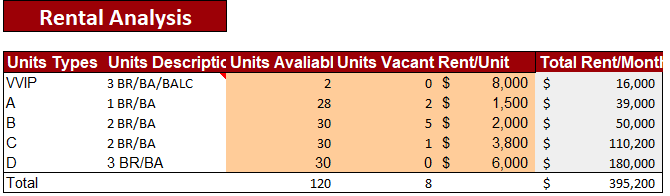
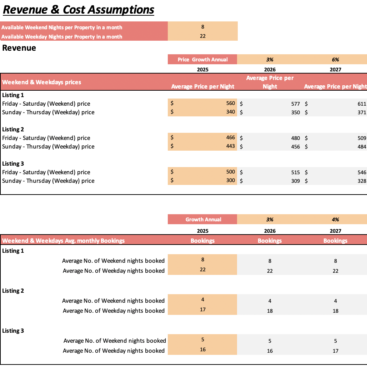
At the property level, the forecast covers rent roll, vacancy, operating costs, capital reserves and construction draws. At the portfolio level, it adds debt service, distributions, taxes and cash held for the next acquisition.
Few firms can build that alone. A real estate financial modeling service can set up a model once, and the CFO keeps it current. Our guide to the financial budgeting process shows how the budget cycle fits around it.
3. Manage debt, covenants and refinancing
Debt is where real estate firms break. A loan can be affordable at signing and painful at maturity if rates or values have moved.
A real estate CFO keeps a debt calendar with every maturity, rate reset and covenant test. The usual covenants are debt service coverage ratio (DSCR) and loan to value (LTV). The CFO forecasts both before the lender tests them, so a problem is a conversation and not a default.
The same calendar drives refinancing and restructuring decisions. If a property will not meet the covenant at maturity, the CFO needs months of lead time, not weeks.
4. Manage risk before it becomes a loss
A strong market does not remove financial risk. Real estate firms face compliance risk, debt risk, liquidity risk, rate risk and, for those that grow by acquisition, integration risk.
A CFO identifies each one, assigns an owner and sets a trigger. For example: if liquidity falls below a set number of months of obligations, new acquisitions pause. Triggers written down in advance are easier to follow when the market turns.
5. Report by property and for the whole portfolio
Investors and lenders want two views: each asset on its own, and everything consolidated. That is hard to produce from a single general ledger.
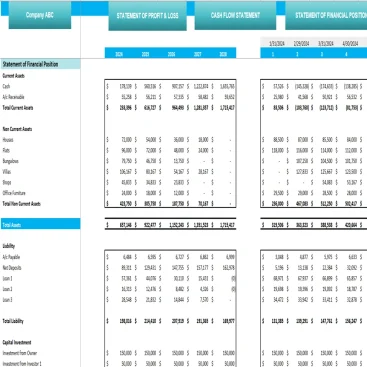
A real estate CFO sets up the chart of accounts, entity structure and property management system so both views come from the same data. Platforms such as Yardi and MRI are common in the industry. The CFO also sets the reporting calendar so lenders and investors get consistent numbers every period.
Clean property-level books are the base of all of this. If your records are behind, start with bookkeeping for real estate investors.
6. Analyze deals before committing
A deal is a set of assumptions. A real estate CFO tests them. That includes return analysis, the capital stack, downside cases and sensitivity to rent growth, exit cap rate and interest rate.
For a larger holding, a real estate portfolio financial model template is a practical starting point. The CFO then adapts it to the firm’s structure and reporting needs.
Metrics a real estate CFO tracks
| Metric | Formula | What it tells you |
| Net operating income (NOI) | Rental income minus operating expenses, before debt service | Income the property produces on its own |
| Cap rate | NOI divided by property value | Yield and relative pricing |
| DSCR | NOI divided by annual debt service | Ability to cover the loan |
| LTV | Loan balance divided by property value | Debt load and refinance room |
| Occupancy and vacancy | Occupied units divided by total units | Revenue stability |
| Cash-on-cash return | Annual pre-tax cash flow divided by cash invested | Return on equity actually put in |
When to hire a real estate CFO
A growing firm usually needs a CFO before it can afford one full time. Watch for these signs:
- You are raising capital or restructuring investors.
- A loan matures within the next year.
- You own more than a few properties across several entities.
- Your accountant can report the past but cannot forecast the next twelve months.
- Lenders or investors ask for reports you cannot produce.
A full-time CFO or controller brings salary, bonus and benefits. An outsourced or fractional CFO delivers much of the same strategic work only when you need it. You also avoid adding headcount and office space.
Other work an outsourced real estate CFO can take on
Beyond the six jobs above, an outsourced real estate CFO often handles complex transaction structuring for debt and equity, loan draw reviews and debt covenant compliance. The same person can run operating cost analysis, review contracts, advise on choice of entity and prepare for audits. Tax filing coordination and staff management are common add-ons for smaller firms.
Frequently Asked Questions
What is a real estate CFO?
A real estate CFO is a senior finance leader who plans and funds a property business. The role covers capital structure, forecasting, debt management, risk and investor reporting. Many small and mid-sized firms use an outsourced or fractional CFO for this.
How is a real estate CFO different from a controller?
A controller makes sure the books are accurate and the monthly close is on time. A real estate CFO looks forward: how to fund the next deal, when to refinance and how to protect the portfolio if conditions change.
When should a real estate firm hire a CFO?
Typically when it raises capital, faces a loan maturity, adds properties or entities, or needs lender and investor reporting it cannot produce. Many firms start with a fractional CFO and move to full time later.
Can a small real estate company afford a CFO?
Often yes, through an outsourced or fractional arrangement. It brings senior expertise for a fraction of full-time cost and can be scaled as the portfolio grows.
What does a real estate CFO do for commercial investors?
The CFO tracks return on investment per property and across the portfolio. They review investment activity, manage expected cash flow and use that data to build portfolio value. They also keep lender and investor reports on schedule.
What metrics should a real estate CFO watch?
NOI, cap rate, DSCR, LTV, occupancy and cash-on-cash return. Each one comes with a formula and a threshold agreed with lenders and investors in advance.
Plan the next deal before you sign it
Growth in real estate rewards firms that know their numbers at the asset level and plan funding a year ahead. A real estate CFO makes that routine, not heroic.
Oak’s team supports developers, investors and property managers on capital planning, forecasting and reporting. Explore our construction and real estate CFO services to see what a first engagement looks like.