


How COVID Changed the Role of the Restaurant CFO
The restaurant CFO after COVID: prime cost, cash and risk
In 2020, restaurant CFOs spent their days on survival math. Which locations stay open, which vendors get paid first, and how many weeks of cash remain. The emergency has passed, but the job did not shrink back to bookkeeping.
Industry surveys now put food costs 35 to 38 percent above 2019 levels, with labor up by a similar margin. Menu price increases have not fully closed that gap. Margins that were thin before the pandemic are thinner today.
A restaurant CFO is now part cash manager, part cost analyst and part operating partner. This guide covers what changed, the numbers to review every week, and where outside CFO help pays for itself.
What COVID changed about the restaurant CFO role
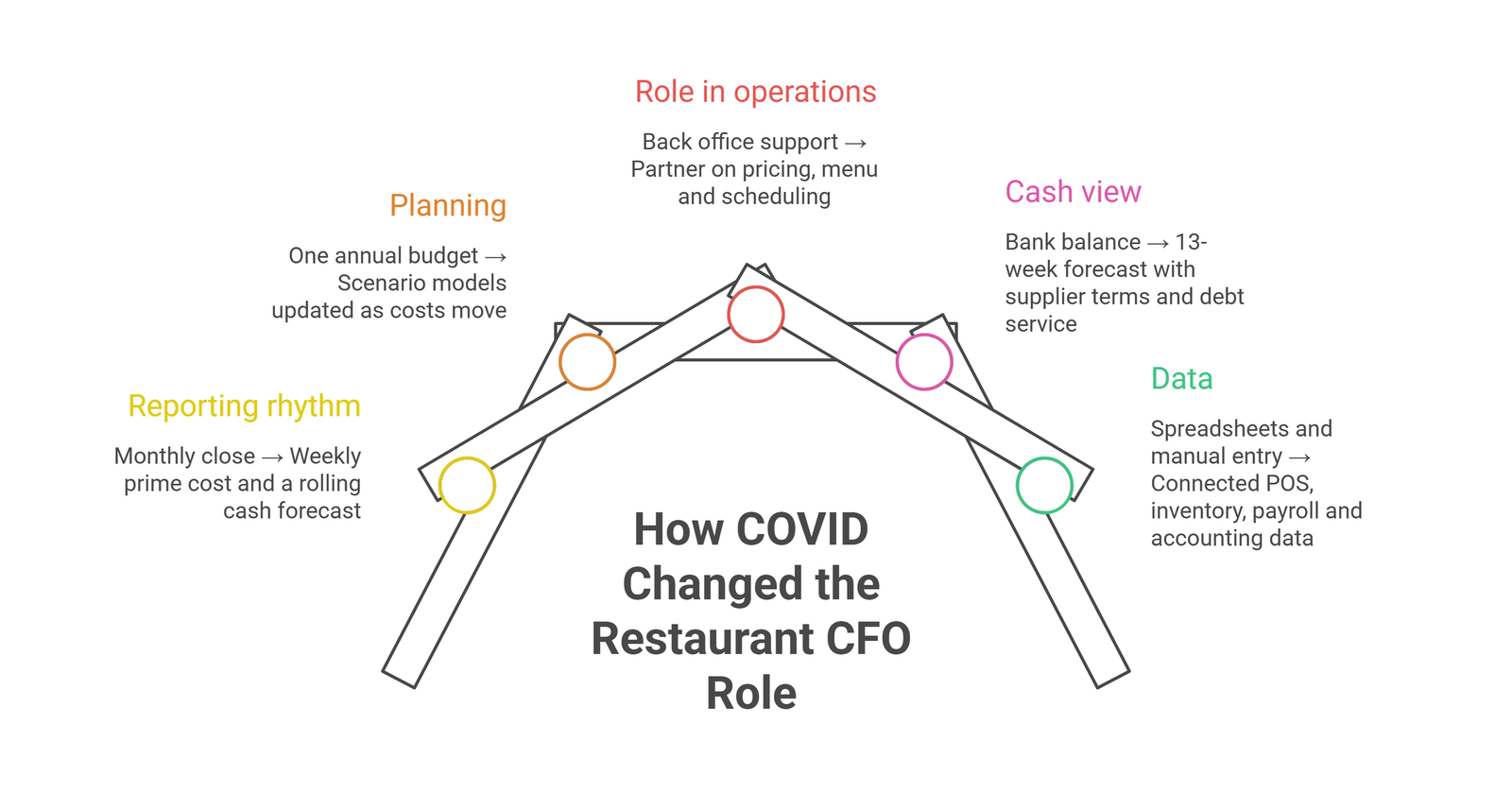
Before 2020, many restaurant finance leads closed the month, filed taxes and reported results to owners. The pandemic pulled them into relief programs, tax relief paperwork, landlord talks and daily cash protection. Finance moved from the back office to the center of operating decisions.
That shift stuck. Owners and lenders now expect finance to explain why costs moved, not just report that they did.
| Area | Before 2020 | Today |
| Reporting rhythm | Monthly close | Weekly prime cost and a rolling cash forecast |
| Planning | One annual budget | Scenario models updated as costs move |
| Role in operations | Back office support | Partner on pricing, menu and scheduling |
| Cash view | Bank balance | 13-week forecast with supplier terms and debt service |
| Data | Spreadsheets and manual entry | Connected POS, inventory, payroll and accounting data |
Prime cost: the number to review every week
Prime cost is the sum of food and beverage cost plus total labor cost, shown as a percentage of sales. Total labor includes wages, payroll taxes, benefits and management salaries. It is the single most useful number on a restaurant P&L because food and labor are the two biggest costs an operator can control.
Prime cost % = (food and beverage cost + total labor cost) ÷ net sales × 100
Here is an illustrative example. A restaurant sells $100,000 in a week. Food and beverage cost is $30,000 and labor is $32,000. Prime cost is $62,000, or 62 percent. That leaves 38 percent for rent, marketing, utilities, debt service and profit.
Many guides still cite 55 to 65 percent as the healthy band. Reported 2026 medians for full-service concepts now sit at or above the top of that range. The older 60 percent target describes the best operators, not the average.
| Concept type | Typical food cost | Typical labor cost | Reported median prime cost |
| Quick service | 28 to 32% | 25 to 30% | 60 to 63% |
| Fast casual | 28 to 33% | 27 to 32% | 62 to 65% |
| Full-service casual | 28 to 32% | 33 to 38% | 65 to 68% |
| Fine dining | 30 to 35% | 35 to 40% | 67 to 70% |
Ranges drawn from 2026 industry reports citing National Restaurant Association and Restaurant365 data. Use them as a peer reference, not a target for your own concept.
Track sales per labor hour too
Labor percentage moves with menu prices, so it can mislead. If prices rise 6 percent, labor percentage falls even when staff productivity stays flat. Sales per labor hour removes that distortion. It shows whether the schedule matches actual demand by daypart.
Build a weekly review habit
Monthly P&L reviews find a cost spike weeks after it happened. A simple weekly routine works better:
- Every general manager sees food, labor and prime cost for the week ending Sunday.
- Any variance above 1.5 points against budget needs a written explanation.
- The finance lead reviews trends across locations, not single weeks.
- Owners track the same short list of CFO KPIs every week.
Cash flow and liquidity: the 13-week forecast
Restaurants collect cash at the point of sale, so receivables rarely cause the squeeze. They matter only for catering, corporate accounts and gift card programs. For those lines, reminders on unpaid invoices and a weekly collection target still apply.
For most restaurants, the pressure comes from elsewhere:
- Inventory that costs more to hold
- Card processing fees that take a bigger share of sales
- Suppliers moving from Net 30 to Net 15 or cash on delivery
- Payroll timing, rent and debt service due on fixed dates
A rolling 13-week cash forecast shows these pressures weeks before they become emergencies. Clean books make the forecast reliable, which is why restaurant bookkeeping is the foundation of good cash management.
Supplier terms and debt
Negotiate payment terms before price. A Net 21 term with a small discount for early payment can beat Net 30 at list price. Do not pay early unless the discount justifies it. If cash is tight, protect payments to key suppliers first.
Debt deserves the same attention. Moving short-term debt to a longer term can lower monthly payments and give more room to meet obligations. Lenders commonly look for fixed-charge coverage of at least 1.25 and debt service coverage of at least 1.20.
Delivery and channel economics
Third-party delivery now makes up a meaningful share of revenue for many concepts. Headline commissions of 15 to 30 percent understate the real cost. Once sponsored placement, promotions and refunds are counted, industry analyses often put the all-in cost at 30 to 40 percent.
A CFO can treat each channel as its own business:
- Price the delivery menu above the dine-in menu.
- Calculate contribution margin after commission and promotions.
- Remove items that do not clear your margin target on delivery.
- Push repeat customers toward your own ordering channel, where fees are much lower.
An order that loses money is not worth winning. Zero orders on a losing channel beat a thousand orders on it.
Debt, leases and the cost of capital
Capital is available in 2026, but it is expensive. One mid-2026 industry report puts SBA 7(a) loans at roughly 10 to 12 percent, online lenders at 18 to 30 percent APR, and merchant cash advances at 40 to 80 percent effective APR. At those rates, new debt only helps if unit economics can carry it.
The same report links several 2026 multi-unit Chapter 11 filings to a common pattern: shared debt, flat traffic and fixed costs that outran sales. A CFO who runs three or more units should read each unit’s P&L against its share of debt service. Decide on weak units before a lender does.
Cost control without cutting quality
Cost cuts that hurt the guest experience usually backfire. Better options protect quality and reduce waste:
- Menu engineering. Rank items by contribution margin dollars and volume. Cut the low-margin, low-volume group and feature the winners.
- Vendor consolidation. Fewer suppliers give you more bargaining power on terms.
- Scheduling to demand. Match labor to actual covers by daypart, not to last year’s pattern.
- Digitized admin work. Automate invoice entry, payroll and reconciliations so managers spend time on the floor.
Each of these ties back to a tight financial budgeting process that is reviewed as costs move.
Data and reporting for owners, lenders and investors
When uncertainty rises, stakeholders ask more questions. A restaurant CFO needs one source of truth that pulls together sales, labor, inventory and accounting data. Without it, every answer takes a day of spreadsheet work.
Good reporting also manages expectations. Lenders and investors respond better to a forecast with clear assumptions than to a surprise. Strong financial planning lets a CFO show the range of outcomes before the numbers arrive.
When a fractional or virtual CFO makes sense
Most independent restaurants and small groups cannot justify a full-time CFO. They still need CFO-level work. A fractional CFO covers it at a fraction of the cost. Signs it is time to bring one in:
- Prime cost has drifted up for two quarters and nobody can say why.
- Cash feels tight even in busy months.
- You are planning a new location, a refinance or an investor raise.
- Month-end numbers arrive late or cannot be trusted.
A 90-day restaurant CFO checklist
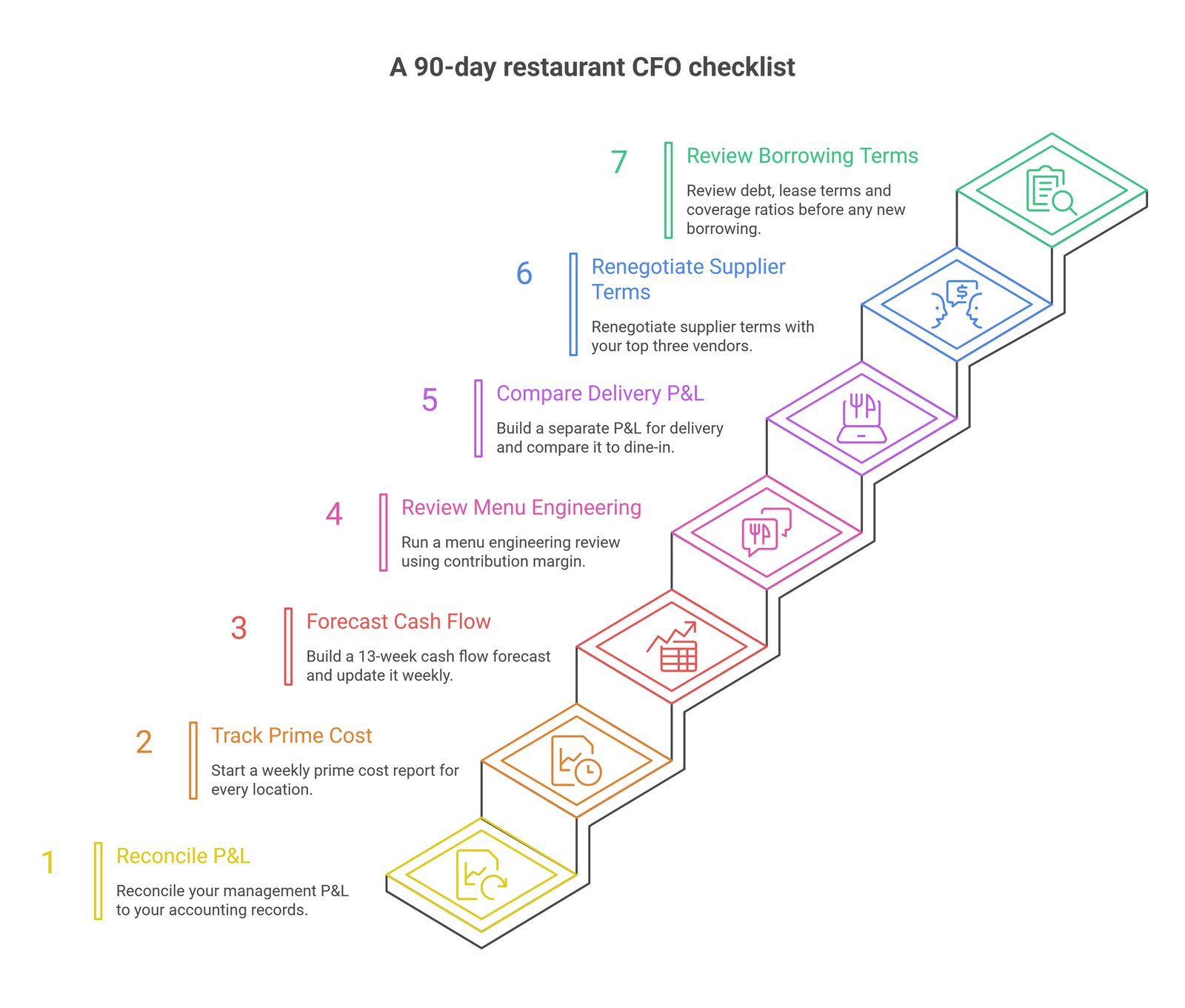
- Reconcile your management P&L to your accounting records.
- Start a weekly prime cost report for every location.
- Build a 13-week cash flow forecast and update it weekly.
- Run a menu engineering review using contribution margin.
- Build a separate P&L for delivery and compare it to dine-in.
- Renegotiate supplier terms with your top three vendors.
- Review debt, lease terms and coverage ratios before any new borrowing.
Frequently Asked Questions
What does a restaurant CFO do?
A restaurant CFO manages cash flow, budgets, forecasting, cost control and financial reporting. After COVID, the role also covers pricing input, labor scheduling analysis, delivery economics, debt decisions and reporting to owners, lenders and investors. The focus is protecting margin, not just recording results.
What is a healthy prime cost for a restaurant?
Many guides use 55 to 65 percent of sales as the healthy band. Reported 2026 medians run higher for full-service concepts, around 65 to 68 percent for casual dining. Compare your result with peers in your own concept, and watch the trend week to week.
How did COVID change restaurant finance?
COVID moved finance from monthly reporting to daily cash protection. CFOs handled relief programs, scenario planning and supplier negotiations. Lasting changes include weekly cost reviews, rolling cash forecasts, closer work with operations, and more attention to delivery and debt.
How often should a restaurant review its financials?
Review prime cost weekly and revenue and covers daily. Review the full P&L and cash forecast monthly. Monthly-only reviews can hide a food cost spike for weeks.
Do small restaurants need a CFO?
Most do not need a full-time CFO, but they benefit from CFO-level support. A fractional or virtual CFO can build the forecast, set up weekly reporting and advise on debt for a part-time fee. That support matters most before expansion or refinancing.
Is third-party delivery profitable?
It can be, if you price for it. All-in costs often reach 30 to 40 percent once promotions and sponsored placement are included. Price the delivery menu higher, track contribution margin per order, and drop items that do not earn their place.
Conclusion
The restaurant CFO job after COVID is less about one big crisis and more about weekly discipline. The operators who stay profitable watch prime cost, forecast cash 13 weeks ahead and treat every sales channel as its own business.
Oak Business Consultant helps restaurant owners put that discipline in place. Our virtual CFO services include financial reporting, cash forecasting and cost analysis built around your concept. Book a call and we will review your numbers, show you where to focus, and flag financial risks before they grow.


