Importance of Financial Forecasting for Mid-Market Companies
Why mid-market companies can’t afford to guess about cash
Mid-market companies live in an uncomfortable middle ground. They carry the overhead and complexity of a much larger business, but rarely have the capital cushion that lets a large enterprise absorb a bad quarter. A startup can pivot in a week. A Fortune 500 company can weather a downturn out of reserves. A $10 million to $200 million revenue business usually has neither option. That is what makes financial forecasting for mid-market companies less of a nice-to-have and more of a survival skill.
The good news is that forecasting has become far more accessible than it used to be. The bad news is that most mid-market finance teams still treat it as an annual chore instead of a living management tool, which is exactly where the value gets lost.
What financial forecasting actually involves
Financial forecasting is the practice of estimating a company’s future income, expenses, and cash position using historical performance, current trends, and known upcoming changes. It is not the same as budgeting. A budget sets a spending plan and a target. A forecast is a running estimate of where the business is actually headed, updated as new information arrives.
For a mid-market company, a usable forecast pulls together three things at once: the income statement, the balance sheet, and the cash flow statement. Looking at only one in isolation is how businesses end up profitable on paper while quietly running out of cash.
Quantitative and qualitative methods, used together
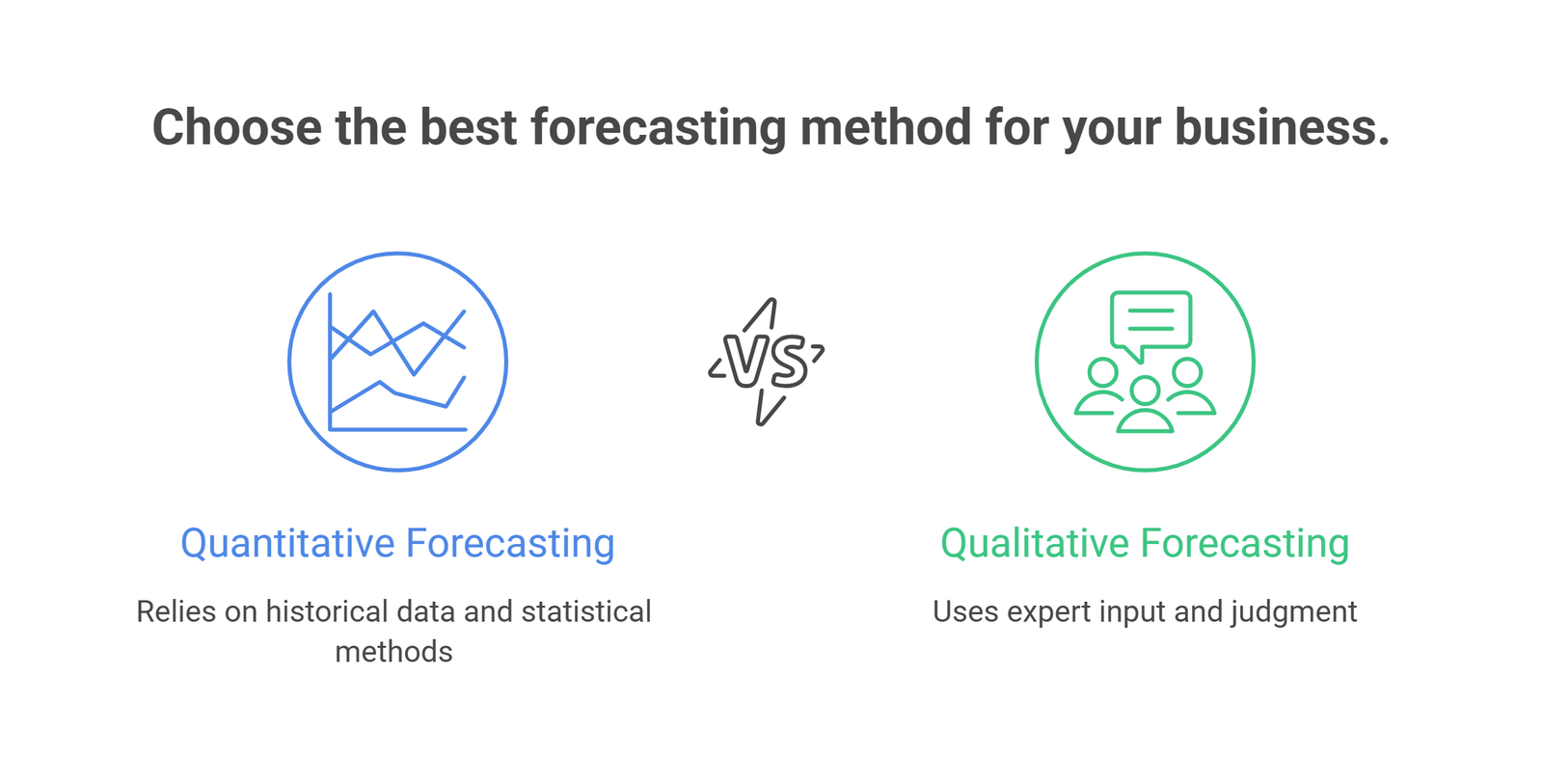
Numbers alone rarely tell the whole story, and neither does intuition alone.
- Quantitative forecasting relies on historical data and statistical methods, from a simple moving average to regression analysis. For businesses with more variables in play, a Monte Carlo simulation can model a wider range of outcomes.
- Qualitative forecasting fills the gaps quantitative data can’t reach, particularly when a market shift has no clean historical precedent. Expert input, the Delphi method, and structured customer surveys all add a layer of judgment that raw numbers miss.
The strongest mid-market forecasts blend both. Numbers ground the model in reality, and judgment adjusts it for what hasn’t happened yet.
A concrete example: why granularity matters
Abstract forecasting advice is easy to nod along to and hard to apply. Here’s a simplified version of how it plays out in practice.
A mid-market manufacturer projects $40 million in revenue for the coming year, based on a 12% increase in average selling price and flat unit volume. On its own, that number looks solid. But if raw material costs are expected to climb 10% in the same period, Cost of Goods Sold could rise from $22 million to roughly $24.2 million, quietly eating most of the margin gain the pricing increase was supposed to deliver.
This is why a forecast has to move past the top-line revenue figure. Revenue forecasting shows potential. Expense projection shows whether that potential survives contact with reality. Only cash flow analysis shows whether the business can actually fund the gap in between.
Why so many forecasts fail before they’re used
Plenty of mid-market companies have tried forecasting, gotten burned by wildly inaccurate projections, and quietly gone back to spreadsheets and gut feel. The failure is rarely the concept. It’s usually one of a few repeatable mistakes:
- Built in a silo. A forecast assembled by finance alone, without input from sales and operations, tends to miss real-world constraints like hiring lead time or production capacity.
- Overly optimistic assumptions. Growth rates and margin targets that reflect where leadership wants to be, not where the trendline actually points.
- Set once and forgotten. An annual forecast that never gets revisited stops being useful the moment market conditions shift, which for most mid-market companies happens well before the year is out.
- Disconnected from real decisions. A forecast nobody actually consults before hiring, pricing, or investing is a document, not a management tool.
Fixing these is less about better software and more about discipline: pulling in department heads, stress-testing assumptions, and revisiting the numbers on a set schedule rather than waiting for a crisis to force it.
Market volatility rewards agility, not certainty
Mid-market firms tend to feel supply chain disruptions, cost swings, and demand shifts faster and harder than larger competitors with more buffer. A budget fixed in January is often obsolete by March.
This is where rolling forecasts earn their keep. Instead of a single static plan, a rolling forecast gets updated monthly or quarterly, so the business is always measuring itself against current conditions rather than last year’s assumptions. Many finance teams pair this with causal analysis, using a P&L Statement to ask why a number moved. A margin dip driven by rising input costs calls for a different response than one driven by softer demand, and a forecast that only tracks the “what” without the “why” leaves leadership guessing at the fix.
Cash flow: the number that actually determines survival
Profit and solvency are not the same thing, and mid-market companies learn this the hard way more often than they’d like to admit. A business can show a profit on its Cash Flow Statement and still miss payroll if cash is tied up in unpaid invoices or slow-moving inventory.
A useful cash forecast tracks three things closely:
- Accounts receivable: when payments actually land in the bank, not when they’re invoiced.
- Accounts payable: when obligations to vendors and lenders come due.
- Capital expenditures: upcoming investments that will draw down cash before they generate returns.
A growing number of finance teams have adopted the rolling 13-week cash flow forecast as a standing tool rather than a crisis measure. Updated weekly, it tracks every expected inflow and outflow closely enough to flag a shortfall months before it becomes an emergency, giving the business time to line up a credit facility or adjust spending on its own terms instead of a lender’s.
Scenario planning turns big decisions into informed ones
Mid-market leaders regularly face decisions with real financial weight: expanding into a new territory, acquiring a smaller competitor, or committing to a major software platform. Scenario planning models the likely financial outcome of each path before a dollar moves.
Building out a “best case,” “worst case,” and “most likely” scenario for a major decision shows how it would affect Key Performance Indicators like margin, cash runway, and customer acquisition cost. When conditions shift mid-quarter, a business with this framework already in place can re-run the analysis in hours instead of starting from scratch.
Spreadsheets get you started, not far enough
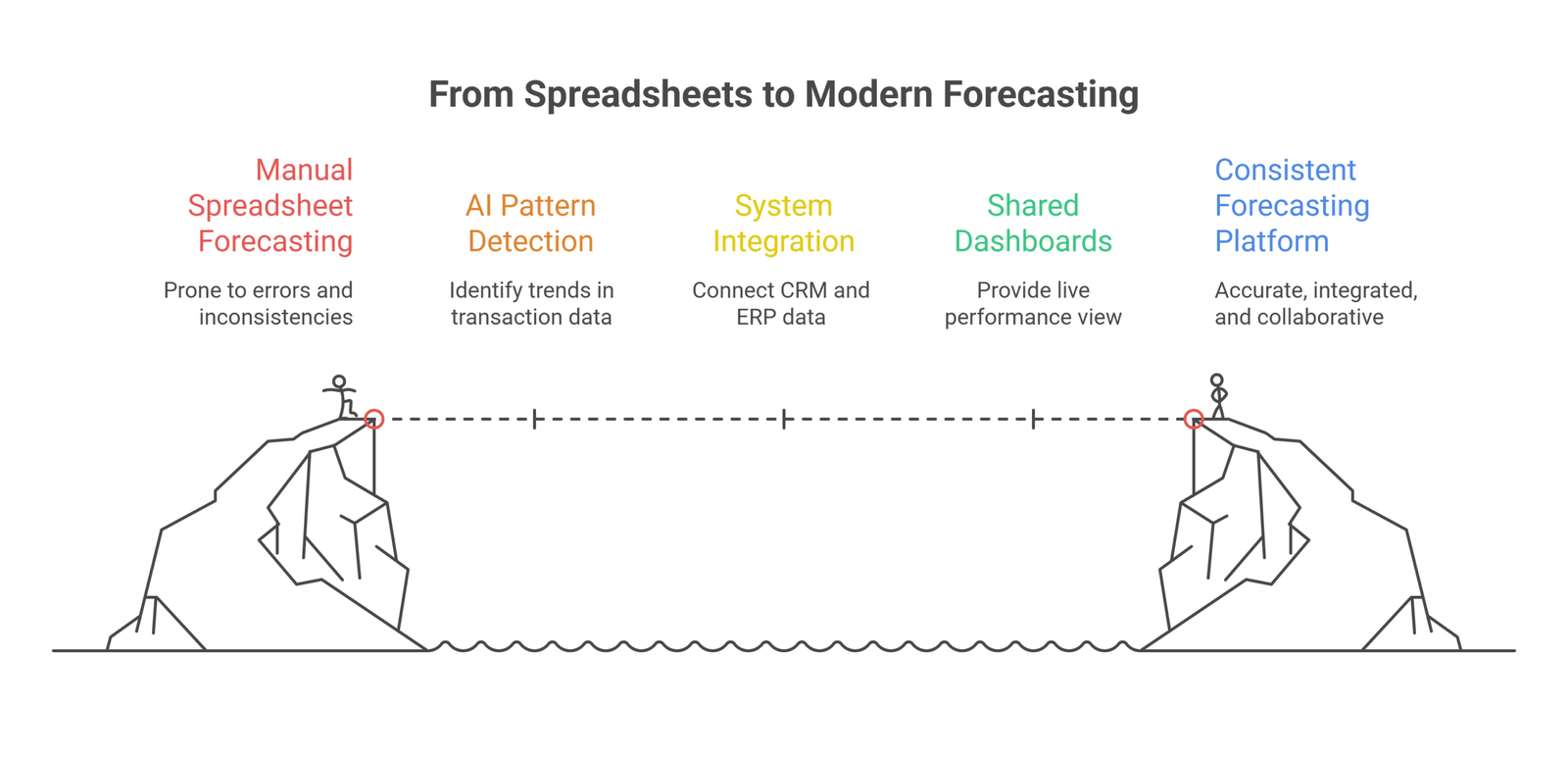
Most mid-market forecasting still lives in spreadsheets, and for a while that’s fine. The trouble starts as the business grows: manual formulas break, version control becomes a mess, and a single mistyped cell can throw off an entire quarter’s projection without anyone noticing until the numbers stop making sense.
Modern forecasting platforms address this in three ways:
- AI-assisted pattern detection that flags trends in transaction data a manual review would likely miss.
- System integration, connecting the CRM for sales data and the ERP for real-time inventory and supply chain figures.
- Shared dashboards that give department heads and the CEO the same live view of performance, instead of five different spreadsheet versions floating around.
The goal isn’t complexity for its own sake. It’s giving everyone in the business one consistent set of numbers to work from.
Forecasting builds the credibility investors and lenders expect
Financial forecasting doesn’t just guide internal decisions. It shapes how outsiders see the business. Banks evaluating a credit line, investors weighing a growth round, and acquirers running due diligence before a sale all want to see more than a plausible story. They want to see a forecasting process with a track record, one where past projections held up reasonably well against actual results.
A company preparing for a capital raise or eventual exit benefits from building this discipline well before it’s needed. A forecast used consistently to run the business, rather than one assembled just for a pitch deck, signals a level of financial maturity that tends to translate directly into stronger terms and higher valuations.
Making the forecast something people actually use
A forecast that sits in a shared drive untouched between board meetings isn’t doing its job. The insights from financial planning and analysis need to reach the people running day-to-day operations. If the sales forecast points to 20% growth next year, HR needs that number early enough to plan hiring and training, not after the growth has already outpaced the team.
The mid-market companies that get the most out of forecasting treat it as a living document: reviewed in weekly or monthly management meetings, adjusted as conditions change, and used as the actual basis for hiring, pricing, and investment decisions rather than a report that gets filed away.
| Approach | Update frequency | Best suited for |
| Annual budget | Once a year | Baseline planning, board reporting |
| Rolling forecast | Monthly or quarterly | Adapting to market shifts in real time |
| 13-week cash flow forecast | Weekly | Managing liquidity and avoiding cash crunches |
| Scenario planning | As-needed, per decision | Evaluating major strategic moves |
Frequently Asked Questions
Why does financial forecasting matter more for mid-market companies than small businesses?
Mid-market companies carry more complex overhead, debt structures, and workforce planning needs than small businesses, with less room for error than large enterprises. A missed forecast has more consequences and fewer easy fixes.
How often should a mid-market company update its forecast?
An annual budget still has a place, but the more useful practice is a rolling forecast updated monthly or quarterly, alongside a weekly 13-week cash flow forecast for liquidity management.
What’s the real difference between budgeting and forecasting?
A budget sets a spending plan and a target for where the company wants to go. A forecast estimates where the company is actually headed based on current data. Mid-market companies need both, but they serve different questions.
Can AI replace human judgment in forecasting?
AI tools are strong at spotting patterns in large volumes of transaction data, but they can’t replace the judgment involved in qualitative forecasting, like interpreting a shift in customer sentiment or a new competitive threat.
What happens when forecasting is done poorly?
Weak forecasting leads to cash flow crises, missed hiring windows, and capital misallocated toward declining product lines while real growth opportunities go unfunded. It also weakens credibility with lenders and investors when the numbers don’t hold up under scrutiny.
Conclusion
The importance of financial forecasting for mid-market companies comes down to a simple trade-off: the cost of building a forecasting discipline now, against the cost of finding out too late that the business ran out of cash, missed a growth window, or walked into a capital raise unprepared.
Combining quantitative rigor with qualitative judgment, treating cash flow as the primary constraint it actually is, and updating the forecast on a real cadence rather than once a year turns forecasting from a compliance exercise into a genuine planning advantage.
Building and maintaining that discipline in-house is exactly what CFO services are built for. Oak Business Consultant works with mid-market companies to build forecasting models that hold up under real conditions, from Full-Time CFO support to Fractional CFO Services for teams that need senior-level oversight without a full-time hire. For a closer look at how forecasting fits alongside budgeting and cash flow work, see our guides on budgeting, planning, and forecasting and cash flow modeling.
Ready to build a forecast you can actually run the business on? Book a free consultation with Oak’s CFO team.