Cosmetics Financial Model: Calculate Product Margins & CAC
Cosmetic financial model: a 70% margin can lose $25.80 a sale
A serum costs $12 to make and sells for $40. That is a 70% gross margin. Founders see it and relax.
Then the customer arrives through a paid ad that cost $45. After payment fees, shipping, and returns, the first sale loses $25.80. The brand needs more orders from the same customer just to break even.
A cosmetic industry financial model shows that walk, from gross margin down to cash in the bank. This guide builds it step by step. It covers channel margins, a worked unit example, the cash a production run locks up, and the compliance costs most templates skip.
Start with the business type
Cosmetics covers very different businesses. Each earns its margin in a different place and runs out of cash in a different way.
| Business type | Where margin comes from | Biggest cash risk | Oak model |
| Own brand | Gap between landed cost and price | Minimum orders and unsold stock | Beauty and cosmetics models |
| Importer or distributor | Spread between landed cost and resale | Customs, currency, slow stock turns | Imported cosmetic products model |
| Marketplace | Commissions and product margin | Customer acquisition, seller payouts | Beauty and health marketplace model |
| Subscription box | Recurring monthly revenue | Churn and sourcing cost | Beauty subscription box model |
| Salon, nail studio, mobile spa | Booked hours and retail sales | Staff cost and empty chairs | Makeup salon model |
The rest of this guide focuses on brands that sell products. Salon-style models run on different logic, covered near the end.
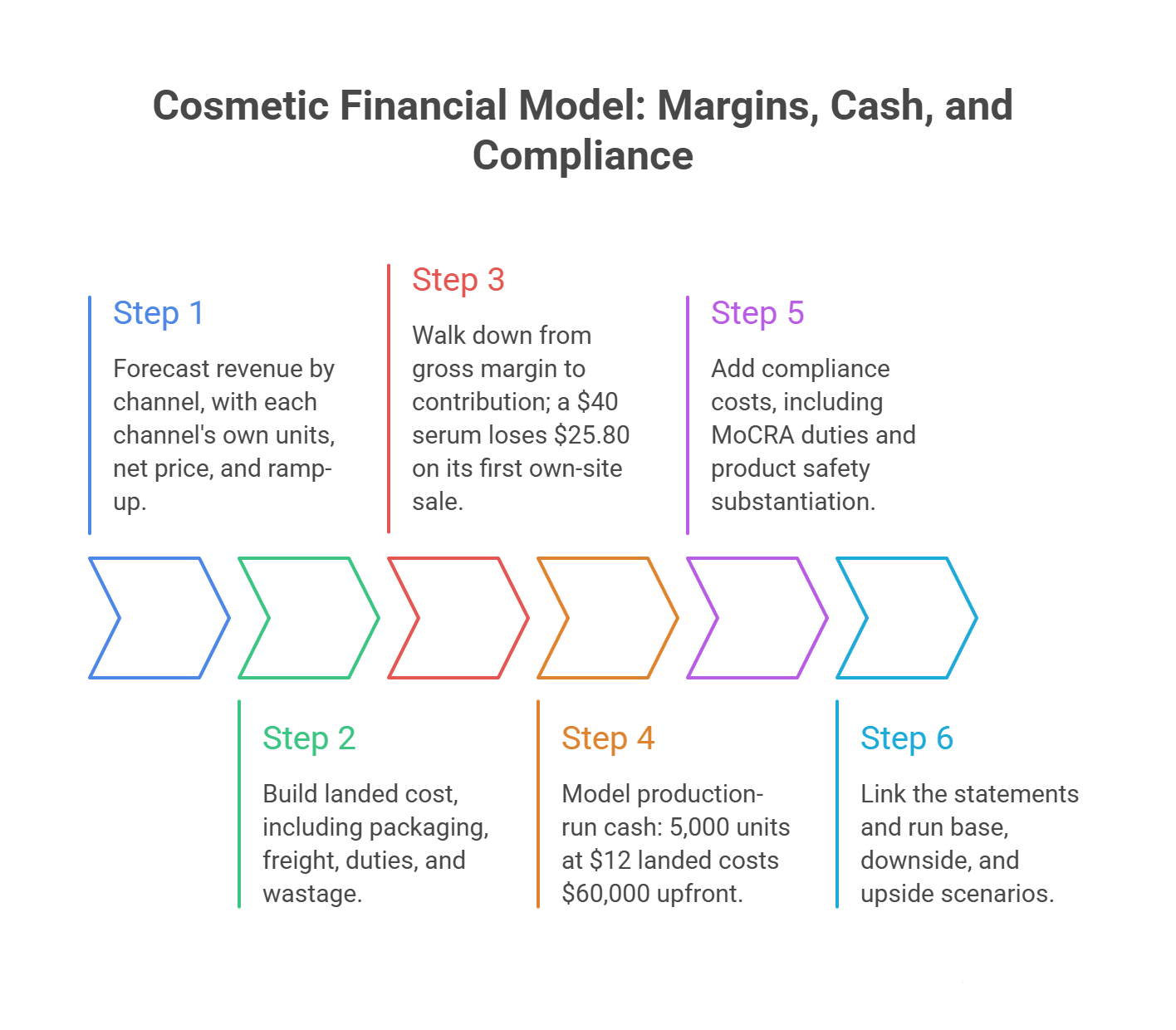
Step 1: forecast revenue by channel
Never forecast one price. Each channel pays a different amount for the same product.
On your own site, you keep the full retail price. Through a retailer, you sell at roughly half the shelf price. This is the keystone rule, so a $40 serum sells to the retailer for about $20.
Build one revenue line per channel. Give each its own units, net price, and ramp-up. Add seasonality for gifting periods and launches.
Step 2: build landed cost, not factory cost
Landed cost of goods sold covers everything needed to put a finished unit on the shelf:
- Formula and raw materials
- Primary and secondary packaging
- Filling, labeling, and quality testing
- Inbound freight, duties, and customs
- Wastage and failed batches
Freight belongs here, not in overhead. Moving it out inflates gross margin.
Unit cost also falls with volume. Model the price breaks you expect to reach, not just today’s quote.
Step 3: walk down from gross margin to contribution
Gross margin is only the first layer. Contribution margin removes the variable costs of selling:
- CM1 = revenue – landed COGS
- CM2 = CM1 – payment fees, fulfillment, shipping, returns
- CM3 = CM2 – customer acquisition cost (CAC)
CM3 pays for overhead, salaries, and profit. Eightx is a fractional CFO firm that advises beauty brands. It reports that direct-to-consumer brands start near a 65% to 72% gross margin. They land at a 25% to 35% contribution margin once these costs and CAC come out.
The same serum in two channels
The numbers below are hypothetical.
| Line | Own site | Retailer (keystone) |
| Price received | $40.00 | $20.00 |
| Landed COGS | $12.00 | $12.00 |
| Gross profit | $28.00 (70%) | $8.00 (40%) |
| Payment fees (3%) | $1.20 | none |
| Fulfillment and shipping | $6.00 | none |
| Returns reserve (4%) | $1.60 | none |
| Freight, allowances, testers (10%) | none | $2.00 |
| Contribution before CAC | $19.20 (48%) | $6.00 (30%) |
| CAC for a new customer | $45.00 | none |
| First-unit result | -$25.80 | $6.00 |
The own-site sale loses money on day one. That is normal for paid acquisition. What matters is how fast the customer comes back.
How many orders to break even
Contribution before CAC is $19.20 per unit on the own site. Divide CAC by that figure to see total orders needed.
| CAC | Total orders to break even | Repeat orders needed |
| $30 | 1.6 | 0.6 |
| $45 | 2.3 | 1.3 |
| $61 | 3.2 | 2.2 |
| $80 | 4.2 | 3.2 |
| $100 | 5.2 | 4.2 |
Eightx puts typical beauty CAC between $40 and $100, with a median near $61, against an average order value near $66. At those levels, a customer who buys once never pays back. The brand lives on the second and third order.
A retailer sale earns $6.00 with no acquisition cost. Once CAC is counted, the gap between channels narrows. In high-CAC conditions, wholesale can come out ahead. The right mix depends on your own CAC and repeat rate.
Why lifetime value needs margin, not revenue
A frequent mistake is dividing revenue lifetime value by CAC. Eightx gives an example: $185 of revenue per customer looks like 3:1 against a $61 CAC. At a 30% contribution margin, that $185 is about $55 of contribution. Against $61 of CAC, the real ratio is below 1:1.
Use margin dollars in the ratio. Eightx suggests targeting 3:1 or better on that basis.
Step 4: model the cash a production run locks up
Cash leaves before sales begin. Contract manufacturers set minimum order quantities, so you buy in blocks.
Take a first run of 5,000 units at $12 landed. That is $60,000 paid out before the first sale.
Now run the cash. Assume 400 units a month, all on the own site. That is 250 new customers at $45 CAC plus 150 repeat units.
| Monthly line | Amount |
| Revenue (400 x $40) | $16,000 |
| Payment fees, fulfillment, returns | -$3,520 |
| CAC (250 x $45) | -$11,250 |
| Cash in after selling costs | $1,230 |
The run lasts 12.5 months. Cash in over that time is about $15,400. Against the $60,000 paid up front, the brand is roughly $44,600 short when the stock sells out. That is before salaries, software, rent, or insurance.
The same loss appears on the P&L as $3,570 a month. The difference is timing. Cash left on day one, and profit shows up later.
The cash conversion cycle
Add one more formula to the model:
Cash conversion cycle = inventory days + receivable days – payable days
Eightx reports that e.l.f. Beauty runs about 168 inventory days, 39 receivable days, and 74 payable days. That is a cycle of roughly 130 days for a large public brand. It also notes public comparables carrying 126 to 213 inventory days.
Small brands rarely get 74 days of supplier credit. Deposits are often paid weeks before delivery. Model the real terms.
Include these items explicitly:
- Production and packaging deposits
- Supplier payment terms
- Months of stock on hand by product
- Samples, testers, and influencer product
- Write-offs for expired or discontinued stock
An over-ordered hero product is a common trap. The brand buys extra to reach the minimum, then carries the surplus for a year. Fewer, faster-selling products usually protect cash better than a wide range.
Step 5: add compliance costs
Most templates leave regulation out. In the United States, cosmetics need no FDA approval before sale, but the FDA still regulates them. The Modernization of Cosmetics Regulation Act (MoCRA) added duties that cost money.
Core requirements include:
- Facility registration, renewed every two years
- Product listing for each cosmetic
- Safety substantiation for each product
- Labeling rules, including contact details
- Reporting of serious adverse events within 15 business days
A small-business exemption exists. Companies with average annual US cosmetic sales under $1 million over the previous three years can skip facility registration and product listing. Three limits matter:
- Safety substantiation, labeling, and adverse event reporting still apply.
- Certain higher-risk products never qualify. These include eye-area products, injectables, internal-use products, and long-lasting alterations to appearance.
- The test uses a rolling three-year average. Growth can end the exemption.
Eightx estimates a small direct-to-consumer brand should budget roughly $1,500 to $7,000 in year one. That covers registration, listing, safety records, label updates, and an adverse event process. Treat it as a planning figure, not a quote.
Rules change. Confirm current requirements with the FDA or a regulatory adviser. Brands selling abroad must model each market’s rules.
For modeling, treat testing, claims studies, and registration as fixed costs per product. A $50,000 claims study adds $1.00 per unit across 50,000 units. It adds $0.10 across 500,000. That is a financial reason to keep the range tight.
Step 6: link the statements and run scenarios
Add operating costs such as salaries, software, rent, insurance, and professional fees. Then link the profit and loss, cash flow, and balance sheet. The lowest point of cumulative cash is the funding the business needs.
Run a base, downside, and upside case. Four drivers move a cosmetics model most:
- CAC
- Repeat rate
- Channel mix
- Inventory turns
Cutting the repeat rate by ten points often matters more than a small saving on COGS.
Benchmarks to sanity-check your model
Use these to catch numbers that look too good. They come from Eightx’s beauty benchmark work, which draws on public filings and industry data.
| Metric | Planning figure |
| Own-site gross margin | 65% to 72% |
| Contribution margin after CAC (CM3) | 25% to 35% |
| Blended CAC | $40 to $100 (median about $61) |
| Average order value | About $66 |
| Return rate | 4% to 10% of orders |
| LTV to CAC, in margin dollars | 3:1 or better |
| Inventory days at public brands | 126 to 213 |
Two cautions apply. These figures come from a consulting firm’s synthesis, not audited industry statistics. Public companies also skew larger than most startups. Compare them against your own category and stage.
Salons, nail studios, and mobile spas
Service businesses sell time, not units. The core formula is:
Revenue = chairs or rooms x available hours x utilization x average ticket
Utilization is the share of hours actually booked. Rent and base staff pay are fixed, so empty hours hurt most. Booth rental changes the picture, because the salon earns rent instead of service revenue.
Retail product sales add margin but need inventory, so model them like a small shop. A mobile spa replaces rent with vehicle cost, fuel, and travel time between bookings.
Common mistakes in cosmetic financial models
- Stopping at gross margin. It hides fees, shipping, returns, and CAC.
- Assuming every sale earns money. First orders often lose money.
- Using one repeat rate. It differs by product, channel, and cohort.
- Ignoring minimum orders. Cash for a full run leaves before sales arrive.
- Leaving out compliance. Testing and registration are fixed costs per product.
- Skipping channel scenarios. Adding a retailer changes margin, timing, and volume at once.
Frequently Asked Questions
What should a cosmetic industry financial model include?
Revenue by channel, landed COGS, a contribution margin walk-down, CAC and repeat assumptions, an inventory and minimum order plan, compliance costs, three linked statements, and scenarios.
What is a good gross margin for a cosmetics brand?
Eightx puts own-site beauty brands near 65% to 72%. Gross margin alone does not show profit. Check contribution after CAC.
How much does it cost to start a cosmetics brand?
It depends on the product, order size, and channel. The model answers it by adding the first production run, packaging, testing, launch marketing, and operating costs until the brand breaks even. The lowest point of cumulative cash is the funding need.
How do I price a cosmetic product for retailers?
Set the retail price first. Retailers commonly buy at about half the shelf price. Then check that the wholesale price still covers landed COGS, freight, and allowances.
Do small cosmetics businesses need to register with the FDA?
Companies under $1 million in average annual US cosmetic sales may be exempt from facility registration and product listing. Product-type exclusions apply. Safety, labeling, and adverse event rules still apply. Confirm current rules with the FDA or an adviser.
What repeat rate should I plan for?
Use your own cohort data as soon as you have it. Before launch, run the model at a lower rate than you hope for, then see how much extra cash the brand needs.
Model contribution before you buy stock
Beauty founders often fall for the product and the margin. The better habit is to model contribution, repeat rate, and cash before signing a retailer or funding a production run.
A brand that knows its CM3 and its break-even repeat rate can pick channels with confidence. If you need a model for an investor, a lender, or a launch decision, Oak Business Consultant builds them from product level to group level. Talk to Oak about financial modeling services for your cosmetics business.