Top Financial Modeling Examples Every Analyst Should Know
Top Financial Modeling Examples
Financial models are one of those tools every business ends up needing, whether you’re a startup building your first projection or an established company preparing for a sale. Each type of model matches a different job: some are for day-to-day budgeting, others exist purely to help a business figure out what it’s worth. Picking the wrong one wastes time; picking the right one gives you a number you can actually act on.
This guide walks through the financial modeling examples you’re most likely to need, what each one is actually for, and how to build a basic model in Excel from scratch.
Financial modeling examples
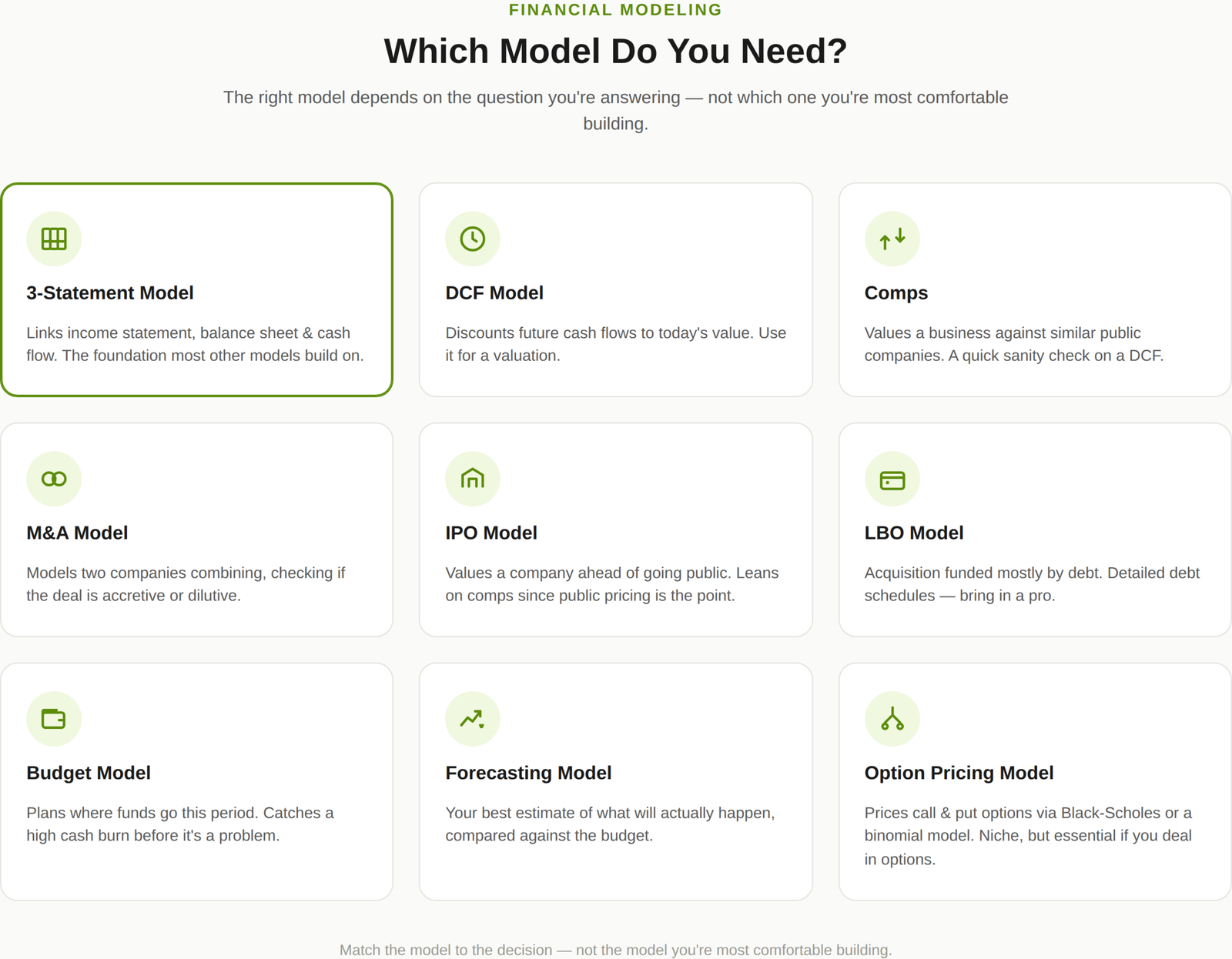
Which model you need depends entirely on the question you’re trying to answer. Want a baseline for budgeting and forecasting? Start with the 3-statement model. Preparing for a merger or acquisition? You’ll want something built specifically for that. Here’s a rundown of the models that come up most often.
3-statement financial model
The 3-statement model is the most commonly used financial model in Excel, and almost every business builds some version of it for budgeting and forecasting. It links the three core financial statements, income statement, balance sheet, and cash flow statement, so that a change in one flows through to the others automatically. Adjust a revenue growth assumption and you’ll see it ripple into cash flow and equity without touching another cell.
It’s the foundation most other models are built on top of, which is why it’s usually the first one an analyst learns.
Discounted cash flow (DCF) model
The discounted cash flow model takes the cash flows from a 3-statement model and discounts them back to today’s value using the company’s cost of capital. The output is an estimate of what the business is actually worth right now, based on what it’s expected to generate in the future.
This is the model to use when you need a valuation, whether that’s for raising capital, planning an exit, or just understanding whether the business is on track to generate a positive return over time. Getting it right depends heavily on your assumptions, so it’s worth stress-testing the growth rate and discount rate before you trust the output.
Comparable company analysis (comps)
Comparable company analysis, usually just called “comps,” values a business by looking at how similar, publicly traded companies are priced in the market. You pull metrics like revenue multiples or EBITDA multiples from a set of comparable businesses and apply them to your own numbers.
Comps are quicker to build than a DCF and act as a useful sanity check on it: if your discounted cash flow valuation comes in wildly higher or lower than what similar companies are trading at, that’s worth investigating before you present either number to an investor.
M&A model
An M&A model, sometimes called a merger model, evaluates what happens financially when two companies combine. It typically works by modeling each company on its own tab, then consolidating them to see the combined entity’s numbers, checking whether the deal is accretive (it increases earnings per share) or dilutive (it decreases them).
This model matters most on the buy side or sell side of an actual transaction, and it can get complicated fast depending on how the deal is financed, with cash, debt, stock, or some mix of the three. If your business is heading toward an acquisition or being acquired, this is the model your advisors will build before anyone signs anything.
Initial public offering (IPO) model
An IPO model values a company ahead of it going public, and it leans more on comparable company analysis than the other models on this list since public market pricing is the whole point. It’s only relevant to businesses actually planning to list, so you won’t see this one used nearly as often as the 3-statement or DCF model.
Leveraged buyout (LBO) model
The leveraged buyout model is significantly more detailed than most of the others here, and it’s mostly used in investment banking and private equity. It models a scenario where a company is acquired primarily using borrowed money, and it requires building out detailed debt schedules to track how that debt gets paid down over time and what return the equity investors end up with.
Building an accurate LBO model takes real technical depth. If your business is on the receiving end of a leveraged buyout, this is a case where bringing in a professional CFO service is worth it rather than attempting it in-house.
Budget model
A budget model is one of the more approachable financial modeling examples on this list, and most businesses build one every year. It lays out where you plan to allocate funds over the coming period, factoring in capital expenditures alongside operating costs, so you can catch a high cash burn rate before it becomes a real problem rather than after.
Forecasting model
Budgeting and forecasting get talked about almost interchangeably, but they do different jobs. A budget is the plan; a forecast is your best estimate of what will actually happen, and the two get compared against each other to see how far reality has drifted from the plan.
A forecasting model incorporates your business’s revenue assumptions and expected market conditions to project performance over the next several periods. Analysts often build sensitivity tables alongside it to see how the forecast holds up under different real-world scenarios, like a slower sales quarter or a supplier price increase.
Option pricing model
The option pricing model is the outlier on this list: it’s not really about valuing a business at all, but about pricing call and put options using either the Black-Scholes formula or a binomial model. Excel has built-in functions that handle the math, so you’re mostly plugging in inputs like volatility and time to expiration rather than building the logic from scratch. It’s a narrow, specialized use case compared to the others here, but if your business deals in options at all, it’s the model you need.
Each of these financial modeling examples exists to answer a different question. The trick is matching the model to the decision you’re actually trying to make, not defaulting to whichever one you’re most comfortable building.
How to build a basic financial model in Excel
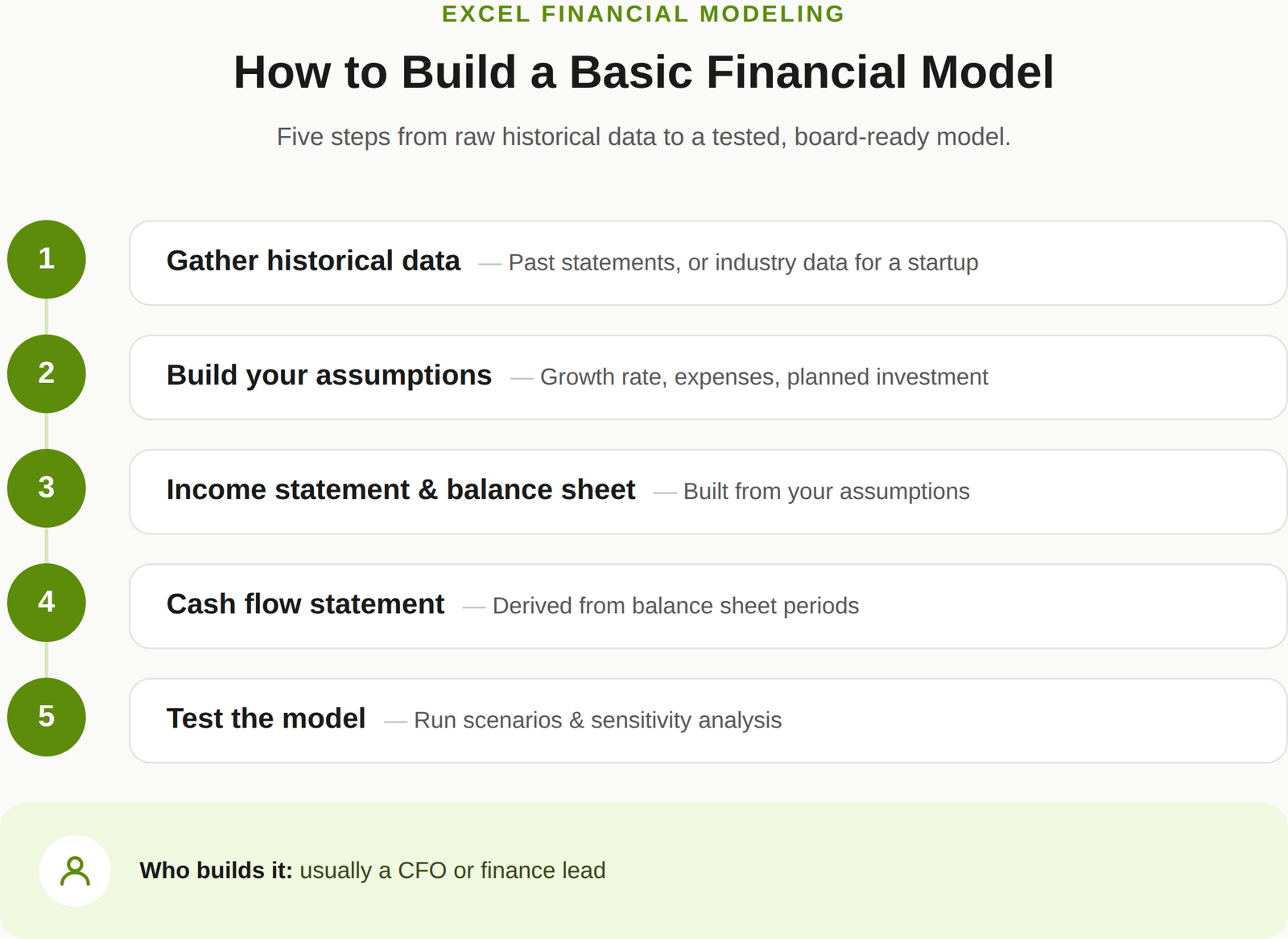
There’s a wide range of financial models beyond the ones above, and most of them depend on what your business actually needs. Here’s how to build a basic one from the ground up.
Get access to all of the historical data
Start by pulling your business’s historical financial data. If you’re a startup without a track record yet, look at industry data instead to build plausible assumptions. Established businesses can use their own past financial statements and available market data as a base. Whichever you’re working from, this historical performance is what your projections will be built on top of, so it’s worth spending real time getting it right before moving on.
Build your assumptions
Once you have your data, build out your assumptions sheet: the inputs that drive the rest of the model. This typically includes your revenue growth rate, forecast expenses, and any planned changes to the business, like new investment or an expansion you’re planning.
Build the income statement and balance sheet
With your assumptions in place, move into the financial statements themselves, starting with the income statement. Work through every assumption tied to revenue, expenses, financing costs, and profit. From there, build the balance sheet, incorporating its own assumptions and pulling in retained earnings from the income statement.
Build the cash flow statement
The cash flow statement comes after the first two are finished, and unlike them, it doesn’t need its own separate assumptions. Instead, it’s built from the differences between balance sheet periods. That’s also why getting your balance sheet assumptions right matters so much: any error there flows straight into your cash flow projections.
Test the model
Once everything is built, test it. Run a sensitivity analysis or a few different scenarios to see how the model holds up when you change a key assumption. This is the step that tells you whether your model is actually reliable or whether it just looks finished. Skipping it is how errors make it into a board deck.
Who actually builds this
In most businesses, this falls to whoever’s running the finance function, usually a CFO or someone in that role. Since the model underpins so much of your business plan and any fundraising conversation, it’s worth making sure whoever builds it actually has the technical background to do it well.
Frequently Asked Questions
What is financial modeling used for?
Financial modeling is used for forecasting performance, evaluating investments, budgeting, strategic planning, and decision-making, all by projecting future revenues, expenses, and profitability.
What information should be included in a financial model?
A solid financial model includes historical data, clearly stated assumptions, an income statement, a balance sheet, a cash flow statement, key financial metrics, and some form of scenario or sensitivity analysis.
What’s the difference between a forecast and a budget?
A budget is the plan you set for a future period. A forecast is your updated, ongoing estimate of what will actually happen, based on the most current data available. Businesses build both and compare them regularly to see where reality is diverging from the plan.
What types of businesses use financial modeling?
Startups, established corporations, investment banks, private equity firms, and consulting firms across industries from real estate to healthcare all rely on financial modeling, though which type of model they build depends on what decision they’re making.
Conclusion
Financial modeling is a tool for businesses of every size to forecast performance, evaluate investments, and plan strategically. Picking the right model, whether that’s a 3-statement model for baseline planning, a DCF or comps analysis for valuation, or an LBO model for a leveraged transaction, comes down to matching it to the specific decision in front of you. All of them depend on solid historical data, honest assumptions, and real testing to produce a number worth trusting.
We work with businesses on exactly this at Oak Business Consultant. If you’d rather have an experienced CFO service build or review your model than tackle it alone, contact us for a free consultation.