SDG 5: Gender Equality, and the 100 Years It Will Take at This Pace
SDG 5: Gender Equality and the Long Road Still Ahead
No indicator under SDG 5 has been met. Not one. That’s the finding from the UN’s own 2026 tracking, thirty years after the Beijing Declaration first put gender equality on the global agenda. Some things have genuinely improved. Child marriage has declined at twice the pace of the previous decade. Women now hold more parliamentary seats than a decade ago. But on the indicator that measures whether women actually run anything, women in management, the current pace of progress means gender parity won’t arrive for another century. This guide covers what SDG 5 actually commits the world to. It covers where the latest 2026 reporting shows progress standing. And it covers what specific countries, financing bodies, and businesses are doing about it, including where a law alone turns out not to be enough.
What is SDG 5
SDG 5 is formally titled “Achieve gender equality and empower all women and girls.” It’s the fifth of the 17 Sustainable Development Goals. All 193 UN member states adopted it in 2015 as part of the 2030 Agenda.
The goal spans legal discrimination and violence against women. It covers child marriage and female genital mutilation, unpaid care work, and political and managerial representation. It also covers reproductive rights and access to land, finance, and technology. A country can pass a strong equal-pay law and still watch its pay gap widen, if women are simply concentrated in lower-paying sectors. It can hit record numbers of women in parliament and still see almost no movement in corporate boardrooms. SDG 5 treats legal rights, economic participation, and physical safety as separate fronts that all have to move together. That’s part of why, of all 17 SDGs, gender equality is the one where no single reform fixes the whole picture.
The official targets and indicators behind SDG 5
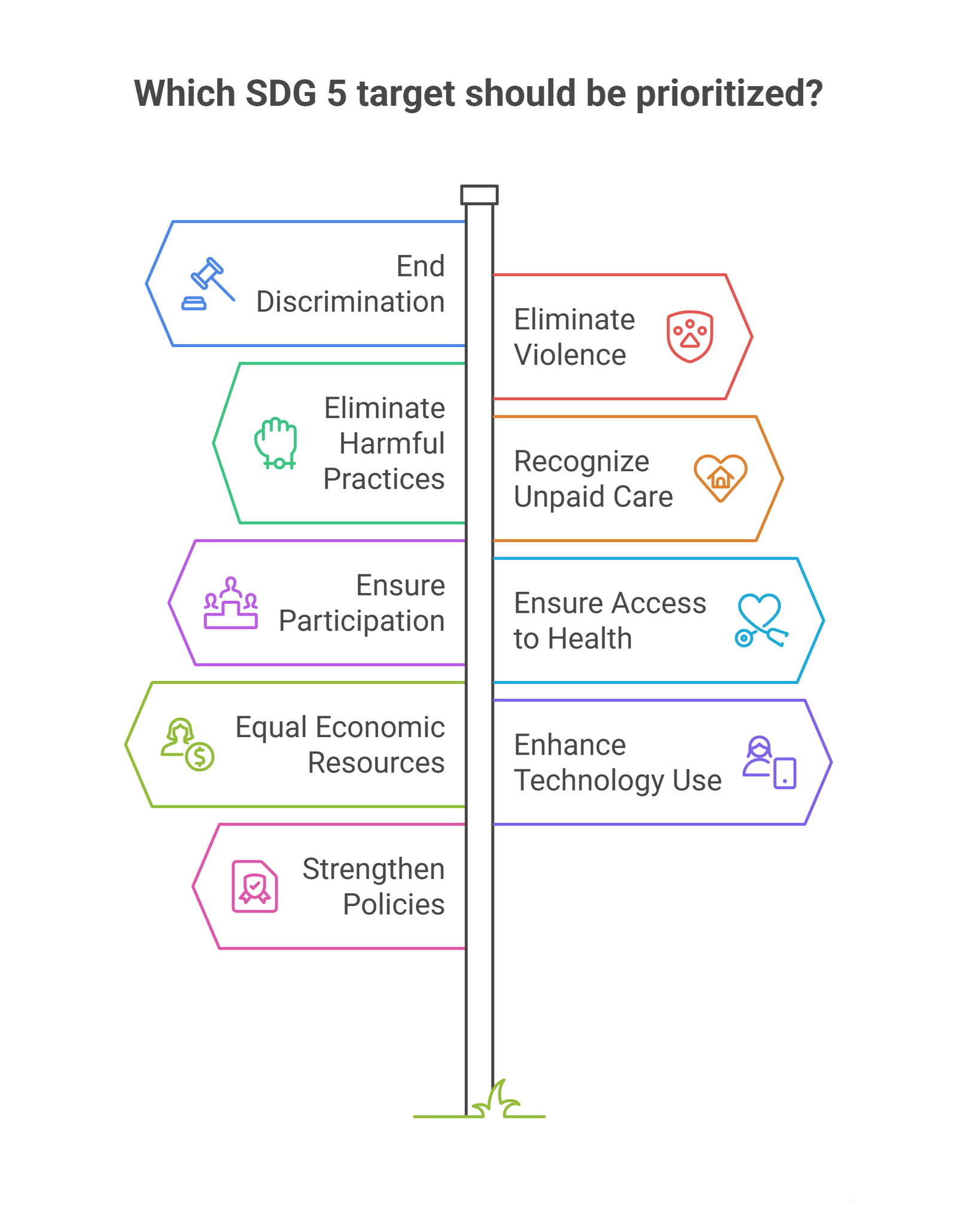
SDG 5 breaks down into nine official targets. Six are outcome targets, numbered 5.1 through 5.6. Three are means-of-implementation targets, numbered 5.a through 5.c. Together they’re tracked through 14 indicators, as set out on the UN’s SDG 5 page.
Target 5.1: End all forms of discrimination against all women and girls everywhere. Tracked through whether legal frameworks exist to promote, enforce, and monitor equality and non-discrimination on the basis of sex.
Target 5.2: Eliminate all forms of violence against all women and girls in public and private spheres, including trafficking and sexual exploitation. Tracked through the share of women subjected to physical, sexual, or psychological violence by an intimate partner, and the share subjected to sexual violence by someone else.
Target 5.3: Eliminate all harmful practices, such as child, early, and forced marriage and female genital mutilation. Tracked through the share of women married before age 15 or 18, and the share of women and girls who have undergone female genital mutilation.
Target 5.4: Recognize and value unpaid care and domestic work through public services, infrastructure, and social protection policies, and promote shared responsibility within the household. Tracked through the share of time spent on unpaid domestic and care work, by sex.
Target 5.5: Ensure women’s full and effective participation and equal opportunities for leadership at all levels of decision-making in political, economic, and public life. Tracked through the share of seats held by women in national parliaments and local governments, and the share of women in managerial positions.
Target 5.6: Ensure universal access to sexual and reproductive health and reproductive rights. Tracked through the share of women who make their own informed decisions on sexual relations, contraception, and reproductive health care. Also tracked through the number of countries with laws guaranteeing that access.
Target 5.a: Undertake reforms to give women equal rights to economic resources, land ownership, financial services, and inheritance. Tracked through women’s ownership or secure rights over agricultural land, and whether national legal frameworks guarantee those rights.
Target 5.b: Enhance the use of enabling technology, particularly ICT, to promote the empowerment of women. Tracked through the share of individuals who own a mobile telephone, by sex.
Target 5.c: Adopt and strengthen sound policies and enforceable legislation for gender equality and the empowerment of women and girls. Tracked through the share of countries with systems to track and publicly report gender-equality spending.
Where global progress actually stands
The honest read on SDG 5, based on the UN’s 2026 reporting cycle, is stark. Progress has advanced since 2015. No indicator has reached the target level.
Political representation is the clearest gain, and also the clearest example of how slow “progress” can still mean. Women held 27.4% of seats in national parliaments as of January 2026, up from 22.3% in 2015. That’s real movement. It’s also a gain of roughly 5 percentage points in a decade. Seven countries now have 50% or more women in their lower house, up from three in 2015. Three chambers still have zero women members.
Managerial representation has moved even slower. Women held 30.5% of managerial positions globally in 2025, up from 26.9% in 2015, even though women make up about 40% of total employment. At the current rate, gender parity in management is roughly a century away.
Violence against women has barely moved at all. Nearly one in three women, an estimated 840 million globally, have experienced physical or sexual violence from a partner or non-partner in their lifetime. That figure has stayed roughly flat since 2000. In just the past 12 months, 316 million women, 11% of women 15 and older, were subjected to physical or sexual violence by an intimate partner.
The table below sets out where the core indicators stood as of the most recent reporting.
| Indicator | 2015 baseline | Most recent figure |
| Women’s share of seats in national parliaments | 22.3% | 27.4% (Jan 2026) |
| Women’s share of managerial positions | 26.9% | 30.5% (2025) |
| Women and girls married before 18 | roughly 1 in 4 (2010) | 18% (2026) |
| Women and girls who have undergone FGM | 200 million (2016 estimate) | 230 million (2025 estimate, wider data coverage) |
| Women subjected to intimate partner violence in past 12 months | not comparably tracked pre-2018 | 11%, or 316 million women (2026) |
| Women aged 15-49 with full reproductive decision-making autonomy | 55% (2018) | 56.3% (2025) |
| Women’s mobile phone ownership relative to men | 12% less likely (2022) | 10% less likely (2025) |
| Countries with a system to track gender-equality spending | 69 countries (2018) | 123 countries (2025) |
Source: UN DESA, Goal 5 progress reporting; UN Women and UN DESA, Progress on the SDGs: The Gender Snapshot 2025.
Child marriage is the target moving fastest in the right direction, though it’s starting from a high base. About one in five young women are married before 18, down from roughly one in four in 2010. The last decade cut the practice at twice the rate of the decade before it, mostly on the strength of progress in Southern Asia. Sub-Saharan Africa remains the region furthest behind, at 31%.
Legal protection is the target with the least room for comfort. In 61 of the 131 countries with data, at least one law still restricts women from doing the same jobs as men. Only 38 countries set 18 as the minimum marriage age with no exceptions. Only 63 have rape laws based on the principle of consent, not force.
Land and asset ownership tell a similar story. In roughly 80% of reporting countries, fewer than half of women in agricultural households hold ownership or secure rights over the land they work. Legal protection is often the missing piece: 58% of assessed countries have inadequate legal protections for women’s land rights, including gaps in spousal consent requirements and equal inheritance.
The financing picture explains part of why progress has stalled. UN Women’s 2025 Gender Snapshot projects that if current trends continue, 351 million women and girls will still be living in extreme poverty by 2030. The report frames that outcome as a political choice, not an inevitability. It points to one concrete lever: closing the gender digital divide. That alone could reach 343.5 million women and girls and generate a $1.5 trillion boost to global GDP by 2030.
Without faster action, the UN projects it will take until 2063 to reach gender parity in parliaments, and far longer for parity in management. None of SDG 5’s 14 indicators is on track to be met by 2030.
What countries are doing about SDG 5
Each of these countries shows a different lever working, or a lever that worked less than expected. The list below runs roughly from the clearest wins to levers still being tested, or rolled back entirely.
Rwanda

Rwanda’s 2003 constitution set a 30% quota for women in all elected decision-making bodies. It was a direct response to a post-genocide population that was 60 to 70% female. The government was being rebuilt from close to zero at the time.
Women didn’t stop at the quota. As of late 2025, they hold 63.8% of seats in Rwanda’s lower house. That’s the highest share of any country in the world, well above Cuba’s 55.7%.
Women parliamentarians used that majority to pass reforms most quota systems never get around to. These include equal land inheritance rights and equal-pay labor law. A binding quota, not just an aspirational target, made the difference. It took Rwanda from 19% female representation before the genocide to a global high within two decades.
Germany

Germany introduced a compulsory 30% gender quota for supervisory boards in 2015. It applies to large listed companies with parity co-determination. A 2021 follow-up law, FüPoG II, extended the requirement to executive boards with more than three members.
The supervisory board quota worked as intended. Women’s share of those seats crossed 30% by 2017 and reached 35.2% by late 2020. Executive boards moved much slower, since no fixed lower limit applied there until the 2021 update.
A second 2021 law set a separate goal for public-sector leadership. It aims for equal participation of men and women in public companies by the end of 2025. Germany’s case shows that a binding quota works fastest where it’s actually mandatory, not just recommended.
United Arab Emirates

The UAE has pursued gender parity through a dedicated federal body rather than a single law. The Gender Balance Council, established in 2015, set a target of 30% female representation in leadership by 2025.
A 2021 mandate required public joint-stock companies to include women on their boards. That requirement was strengthened further in 2024 for private joint-stock companies, taking effect in January 2025. As of 2022, women still held only 8.9% of board seats across UAE-listed companies. That showed how much work remained even after the mandate began.
By 2025, 71 organizations had signed the Council’s SDG 5 pledge. The UAE ranked seventh globally on the UN’s Gender Inequality Index that year. It ranked first regionally, across the Middle East and North Africa.
The Council’s newest strategy launched in 2025. It aims to mainstream gender considerations across every federal sector. That’s a shift from treating gender as one policy among many.
Iceland

Iceland has topped the World Economic Forum’s Global Gender Gap Report for 15 straight years. In 2018, it became the first country to make equal pay legally mandatory rather than aspirational.
Companies with 25 or more employees must obtain Equal Pay Certification. An accredited auditor verifies that pay decisions aren’t based on gender. The policy has been copied since by parts of the EU.
It hasn’t been enough on its own. Iceland’s gender pay gap actually grew again in 2025.
The driver isn’t unequal pay for the same job. It’s occupational segregation instead. About 43% of working women sit in the public sector. Only 15% of men work there. Different sectors simply pay differently.
Iceland’s case is a caution against treating a certification law as the finish line.
France

In March 2024, France became the first country since the former Yugoslavia to enshrine abortion access in its constitution. Parliament approved the amendment by a vote of 780 to 72. President Emmanuel Macron signed it into law on International Women’s Day, calling the freedom “irreversible.”
The move was explicitly framed as a response to the US Supreme Court’s 2022 reversal of Roe v. Wade. French lawmakers cited it directly in the bill’s introduction.
Rights groups have been careful not to let the win overshadow other gaps. Human Rights Watch flagged 31 reported femicides in France in 2024 alone. France also helped block rape-by-lack-of-consent language from the EU’s first directive on violence against women. That’s a reminder that one entrenched right doesn’t close every front under SDG 5.
United States

The US shows what happens to Target 5.6 when a constitutional right is removed rather than added. The 2022 Dobbs decision overturned Roe v. Wade, ending 50 years of federal abortion protection. As of January 2026, 13 states enforce complete bans and 28 more impose gestational-age restrictions.
The public-health data since then has been consistent, if not always statistically definitive on every measure. One 2026 Johns Hopkins study found a 9.2% rise in pregnancy-associated deaths across ban states between 2016 and 2023. A separate 2025 analysis found Black maternal mortality disparities between ban and non-ban states nearly tripled between 2019 and 2023.
Roughly 62.7 million women and girls lived under a state abortion ban as of January 2025. The US case is the clearest reminder in this list that SDG 5 gains aren’t automatically permanent once won.
Colombia

In November 2024, Colombia’s Congress passed a law raising the minimum marriage age to 18 with no exceptions. It closed a 137-year-old loophole that let 14-year-olds marry with parental consent. President Gustavo Petro signed it into law in early 2025, after eight previous attempts had failed since 2007.
The law matters at scale. About one in five girls under 18 in Colombia was married or in a marriage-like union before the ban. Rates ran between 40% and 65% in rural, Indigenous, and Afro-Colombian communities.
The law didn’t stop at the ban. It also created a National Comprehensive Program for Life Projects for Children and Adolescents. That program targets the poverty and lack of education driving the practice. Advocacy groups involved in the campaign have been explicit about one thing. The ban is the beginning of implementation, not the end of it.
What organizations and institutions are doing
The financing and coordination architecture behind SDG 5 works like a standing pledge system. It gets re-measured every year, more than it looks like a single central fund.
Generation Equality Forum
The Generation Equality Forum, convened by UN Women in 2021, secured close to $40 billion in five-year commitments. Governments, the private sector, and philanthropy all contributed pledges. By 2026, the tracked total across all partners had grown to $50.3 billion.
Only about $21 billion of that had actually been spent as of the most recent financial survey. Additionally, UN Women attributes part of that gap to shrinking official development assistance elsewhere, pulling against gender-focused commitments.
UN Women and UN DESA Gender Snapshot
UN Women and UN DESA jointly publish the annual Gender Snapshot report. It’s the primary source tracking whether the world is on pace against each of SDG 5’s 14 indicators. It also tracks gender-related indicators across all 17 SDGs.
UN Global Compact
The UN Global Compact’s Blueprint for Business Leadership on SDG 5 frames gender equality differently than most CSR guidance does. It treats gender equality as a human-rights responsibility every company holds by default. That’s under the UN Guiding Principles on Business and Human Rights, not as an optional initiative.
How businesses can contribute to SDG 5
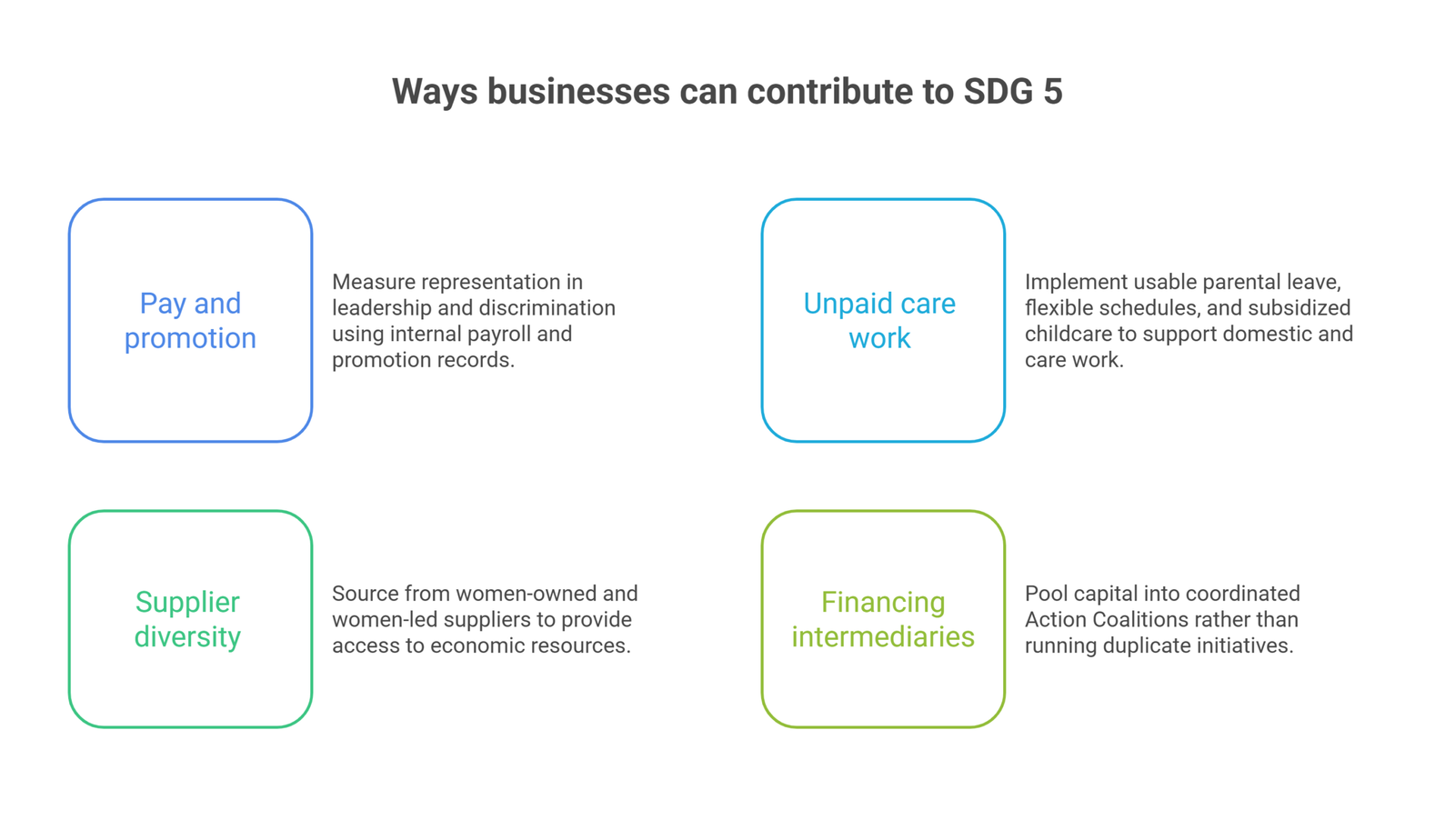
The same mapping exercise applies here as it does for any SDG a business doesn’t have an explicit mandate on. Start with who your operations affect, then look outward.
Start with pay and promotion data inside your own company
Target 5.5 is about representation in leadership, and Target 5.1 is about discrimination more broadly. Both are things a company can measure directly, using its own payroll and promotion records, well before waiting on a supply chain audit or a government policy. Iceland’s experience is the caution here: a pay audit alone catches unequal pay for the same role. It won’t catch women being systematically excluded from the higher-paying roles in the first place.
Address unpaid care work through policy, not slogans
Target 5.4 is specifically about unpaid domestic and care work, which women still do at 2.5 times the rate of men worldwide. Parental leave that’s actually usable by any parent, flexible schedules, and on-site or subsidized childcare are the concrete levers here, not a statement of support for working parents.
Look at supplier diversity as an economic-empowerment lever
Target 5.a is about women’s access to economic resources and land. For companies with meaningful procurement budgets, sourcing from women-owned and women-led suppliers is a direct, measurable version of that target, not just a values statement.
Support financing intermediaries rather than running parallel programs
Generation Equality’s model, pooling capital across governments, philanthropy, and companies into coordinated Action Coalitions, is the template for a business without a dedicated gender program. It’s a way to add capital to something already built rather than standing up a duplicate initiative from scratch.
Case study: P&G’s supplier diversity commitment
At the 2021 Generation Equality Forum, P&G committed to spending $10 billion with women-owned and women-led businesses by 2025. The eventual goal: directing 10% of its total purchasing dollars there, roughly ten times the industry average at the time. The company built the commitment on a supplier-diversity program already running since 2007, rather than starting fresh. It partnered with WEConnect International to identify and vet women-owned suppliers globally, rather than building that vetting capacity in-house. By 2022, P&G had folded the original target into a broader, ongoing goal of $5 billion annually in diverse and women-led supplier spend by 2030. The structural lesson holds regardless of whether the original number was hit exactly. A purchasing commitment tied to an existing, decades-old program scales more reliably than a one-time pledge with no operational base underneath it.
Frequently Asked Questions
How many SDG 5 targets and indicators are there?
Nine targets: six outcome targets and three means-of-implementation targets. They’re tracked through 14 indicators.
Is any country actually on track to meet SDG 5 by 2030?
No. The UN’s own 2026 reporting states plainly that no indicator or sub-indicator under SDG 5 has reached “target met or almost met” status globally. That’s true even in countries making the fastest individual progress, like Rwanda on political representation.
Which country has the most women in parliament?
Rwanda, at 63.8% as of late 2025, the highest share in the world. It’s the result of a binding 30% constitutional quota adopted in 2003, which women then exceeded on their own.
Does an equal-pay law actually close the gender pay gap?
Not on its own. Iceland made equal pay certification mandatory in 2018 and has topped global gender-equality rankings for 15 years. Yet its pay gap widened again in 2025. The main reason: women and men are concentrated in different, differently-paid sectors, not paid unequally for the same job.
Can a business without a gender-equality mandate realistically contribute to SDG 5?
Yes. The most direct levers are internal: pay and promotion data, usable parental leave, and childcare support. Companies with meaningful procurement budgets also have a real lever through supplier diversity. Financing coalitions like Generation Equality offer a way to contribute capital without building a parallel program.
Conclusion
The number worth sitting with isn’t the 27.4% of parliamentary seats now held by women, real as that gain is. It’s that women in management have gained only about 4 percentage points since 2015, putting full parity roughly a century away at the current pace. Rwanda shows what a binding quota can do when it’s actually enforced. Iceland shows that a strong law can still leave the bigger structural gap, occupational segregation, completely untouched. Colombia shows that a landmark legal ban is the start of the work, not the end of it. It only holds if the program behind it reaches the poverty and lack of education driving the practice in the first place.
None of that gets fixed by legislation alone. The gap between $50.3 billion pledged and $21 billion actually spent through Generation Equality suggests it won’t get fixed by commitments alone either. Businesses have a narrower lever than governments and global financing coalitions, but a real one: pay and promotion data, usable parental leave, and supplier diversity. All of that works better backed by financial models that hold up past the announcement. If your organization is building a financial model for a women’s economic empowerment program, a supplier-diversity initiative, or a gender-focused NGO,Oak’s nonprofit financial modeling services can help. It builds the numbers behind it.