Controller vs CFO: Understanding the Difference
Controller vs CFO: Which does your business need first?
Two business owners both say they need more finance help. One gets last month’s numbers three weeks late and finds errors in them. The other has clean books but cannot say whether the company can afford a second location. The first owner needs a controller. The second needs a CFO.
The titles sound close, and in small companies one person often carries both jobs. That is why the choice is easy to get wrong. This guide explains what each role does, how they differ, what they cost, and how to tell which one your business needs first.
The short answer
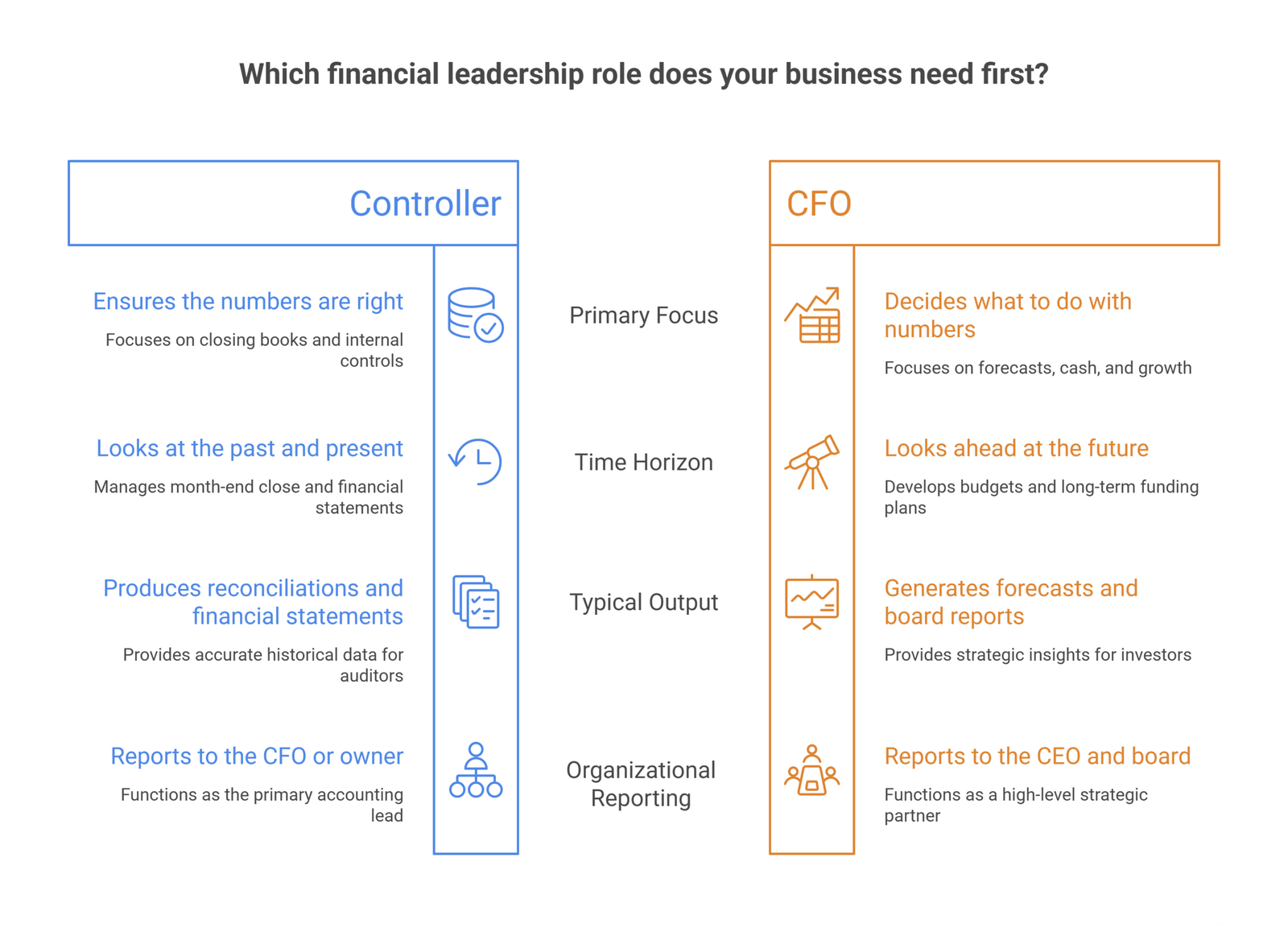
A controller makes sure the numbers are right. A CFO decides what to do with them. The controller looks at the past and present: closing the books, preparing financial statements and running internal controls. The CFO looks ahead at forecasts, cash, funding and growth plans. When a company has both, the controller usually reports to the CFO.
| Controller | CFO | |
| Main job | Accurate books, reports and internal controls | Financial strategy, cash, capital and growth |
| Time focus | Past and present | Present and future |
| Usually reports to | The CFO, or the CEO or owner in smaller firms | The CEO and the board |
| Main audience | Management, auditors and lenders | The CEO, board, investors and lenders |
| Typical output | Month-end close, financial statements, reconciliations | Forecasts, budgets, funding plans, board reports |
| Common background | Accounting, often with a CPA or CMA | Finance or accounting, often with an MBA, CPA or CFA |
What a controller does
A controller is the head of accounting. The job starts with the month-end close: recording transactions, reconciling accounts and producing the balance sheet, income statement and cash flow statement. Those statements follow GAAP or IFRS, depending on where the company reports.
Beyond the close, a controller typically handles:
- the general ledger and chart of accounts
- oversight of accounts payable and receivable
- budget tracking and variance reports
- internal controls that catch errors and fraud
- audit preparation and tax coordination
- management of bookkeepers and accountants
Most controllers have an accounting degree, and many hold a CPA or CMA. In a small company the controller often does more than this. With no CFO in place, the controller may run cash management, build the budget and deal with the bank. That works for a while, but it leaves little time for planning.
What a CFO does
A chief financial officer (CFO) is the most senior finance executive and a member of the leadership team. The role covers strategy more than bookkeeping. A CFO builds the forecast, manages cash and runway, and decides how the company funds growth. The CFO also advises the CEO on big calls such as hiring plans, pricing, expansion or an acquisition.
Typical CFO responsibilities include:
- financial planning, forecasting and scenario modeling
- cash flow management and treasury decisions
- raising debt or equity and managing investor and lender relationships
- mergers, acquisitions and valuations
- risk management
- board reporting
- leading the finance team, including the controller
CFOs usually come from accounting, corporate finance or banking. Many hold an MBA, a CPA or a CFA charter. At public companies, the CEO and CFO personally certify the accuracy of the financial statements under the Sarbanes-Oxley Act.
The same month-end, two different jobs
The easiest way to see the difference is to follow one month-end report. Suppose March payroll comes in well over budget.
The controller’s question is whether the number is right. They check that overtime and contractor payments were coded to the correct accounts, confirm the books reconcile, and issue a corrected variance report.
The CFO’s question is what the number means. Is the overspend a one-time spike or a new run rate? How does it change cash over the next six months? Does the hiring plan still fit, and does the bank’s loan covenant still hold?
Both questions matter. But the CFO can only answer theirs if the controller has answered the first one correctly. That dependency is why most companies add a controller before a CFO.
Where the roles overlap, and where titles get confusing
Overlap is common in companies under about $10 million in revenue. The controller handles cash and budgets, and the owner acts as the CFO. Other finance titles add to the confusion, so here is how they fit:
| Role | What the person does |
| Bookkeeper | Records transactions, pays bills and sends invoices |
| Accountant | Prepares statements, reconciles accounts and handles the close |
| Controller | Runs the accounting function and owns reporting accuracy and controls |
| VP of finance | Sits between the controller and CFO, with more strategy than a controller but less authority than a CFO |
| Treasurer | Manages cash, debt and banking relationships |
| Outside CPA | Handles tax filing, tax planning, and audits or reviews |
The comptroller title causes its own confusion. It usually means the top accountant in a government agency or nonprofit, although some private companies use it as a synonym for controller. This guide to comptroller vs controller covers the public and private versions in detail.
Signs you need a controller
A controller solves problems with the accuracy, speed and reliability of the books. Hire one, or outsource the work, when:
- monthly reports arrive late or contain errors
- lenders, investors or auditors ask for GAAP statements and the books are not ready
- nobody owns the month-end close, so the process changes every month
- receivables go uncollected, or bills are paid late or twice
- the owner still reconciles bank accounts or approves every journal entry
- the bookkeeping team is growing and nobody reviews its work
As a rough rule, a business starts to need a part-time controller around $1 million in annual revenue. Many companies have one on staff by about $10 million.
Signs you need a CFO
A CFO solves problems of direction. The books may be accurate, but the company still faces decisions it cannot model. Look for a CFO when:
- the company plans to raise capital, make an acquisition or sell within the next five years
- cash is tight even though sales are growing
- margins are shrinking and nobody can say why
- lenders or investors want forecasts, not just historical statements
- the business is opening new locations, markets or product lines
- the controller keeps getting pulled into strategy work that was never part of the job
A full-time CFO usually makes sense somewhere between $30 million and $50 million in revenue, and sooner for venture-backed companies. Many smaller businesses need CFO-level thinking years before that. That gap is where fractional CFOs come in.
What the hiring path looks like by company size
| Revenue stage | Common finance setup |
| Under $1 million | Bookkeeper and outside accountant. The owner acts as CFO. |
| $1 million to $10 million | Part-time or outsourced controller. Fractional CFO for fundraising or planning. |
| $10 million to $30 million | In-house controller. Fractional CFO for strategy and funding. |
| $30 million to $50 million and up | Full-time CFO, with the controller reporting to them. |
These bands are rules of thumb, not rules. A software startup raising venture capital may need CFO-level modeling in its first year. A profitable family business with steady sales may not need one until much later.
The classic ladder runs from bookkeeper to accountant to controller to CFO. It describes how many companies grew, but it is not the only order.
The middle path: outsourced controller and fractional CFO
Most small and mid-sized businesses cannot justify two full-time finance executives, and pay explains why. Salary.com data, as cited by Ramp in September 2026, puts US median base salaries at about $254,000 for controllers and $438,500 for CFOs. Bonuses, benefits and equity come on top, and pay varies with company size and country.
Outsourcing splits the work and the cost. An outsourced controller runs the close, reviews the books and keeps reporting on schedule. This is often part of accounting and bookkeeping services for growing companies. A fractional CFO works part-time, builds the forecast, plans cash and supports fundraising or lender conversations. Many companies use both, each for a set number of hours per month.
The cost of a fractional CFO typically runs from $3,000 to $15,000 a month, depending on scope. A fractional CFO can also mentor an existing controller who is growing toward the top finance job.
The trade-off is attention. A fractional CFO splits time across clients, so the scope, hours and reporting rhythm need to be clear from the start. For most companies under $30 million, that arrangement still costs far less than a full-time hire.
Common mistakes when hiring
Four mistakes show up often.
The first is hiring a controller and expecting strategy. A controller can flag a cash shortfall, but building a funding plan is a different skill set.
The second is hiring a CFO to fix messy books. A CFO can build a forecast, but a forecast built on unreconciled data is a guess. Clean the books first.
The third is promoting a controller to CFO without checking the gap. Controllers know accuracy and control. A CFO also needs experience with capital markets, investor communication and board reporting, and many controllers have never done those.
The fourth is waiting for a crisis. Companies often look for finance leadership only when a lender, investor or tax authority asks for something they cannot produce. Hiring or outsourcing earlier usually costs less than a rushed fix.
Frequently Asked Questions
Is a controller higher than a CFO?
No. The CFO outranks the controller. In a company with both, the controller reports to the CFO. In a company without a CFO, the controller may report to the CEO and carry broader duties.
Can one person be both controller and CFO?
In a very small company, yes, and the owner often does both. The risk is workload and oversight. When one person records transactions, approves them and reports on them, nobody checks the work. Most companies split the roles once volume or outside scrutiny increases.
Does a company with a controller still need a CFO?
Eventually, yes. A controller keeps the books accurate, but planning for funding, acquisitions or expansion needs a different skill set. Before a full-time CFO makes sense, a fractional CFO can cover that gap.
What is the difference between a controller and an accountant?
An accountant records transactions, prepares statements and handles reconciliations. A controller manages that work, owns the accuracy of the reports and sets the internal controls. In a small firm one person may do both, but the responsibilities differ.
How much more does a CFO cost than a controller?
In the US, median base pay is about $438,500 for CFOs and $254,000 for controllers (Salary.com data cited by Ramp), before bonuses and equity. Fractional CFO work usually costs far less per year because the company pays only for the hours it uses.
What is the difference between a controller and a comptroller?
Both manage accounting and financial reporting. Comptroller usually refers to the top finance officer in a government agency or nonprofit, while controller is the private-sector title. Some organizations use the two words interchangeably.
Choosing your first hire
A simple test settles most cases. If the numbers you have are late or wrong, start with a controller. If the numbers are right but nobody can say what they mean for next year, start with a CFO. Plenty of businesses need a bit of both before they can afford either one full-time, and that is a normal place to be.
Oak Business Consultant provides CFO services that include fractional and virtual CFOs and outsourced controller support. A company can match its finance team to its current stage and add to it as it grows. To talk through which role fits your business, book a call with the Oak team.