Cost of Fractional CFO: What to Expect
Cost of a fractional CFO: what $3,000 to $15,000 a month buy
A fractional CFO costs $3,000 to $15,000 a month on retainer, or $175 to $450 an hour. Most small and mid-size businesses pay between $5,000 and $10,000 a month. That is $60,000 to $120,000 a year, a fraction of what a full-time hire costs.
The range is wide because the price follows hours, seniority and complexity. A seed-stage company that needs a cash forecast is buying a different job from a multi-entity group preparing an acquisition. Both hire a “fractional CFO”.
This guide shows how each pricing model works, what moves a quote up or down and what a retainer usually covers. It also covers the cases where the cost is not worth paying. For a plain definition of the role, read our guide on what a fractional CFO is.
The four pricing models
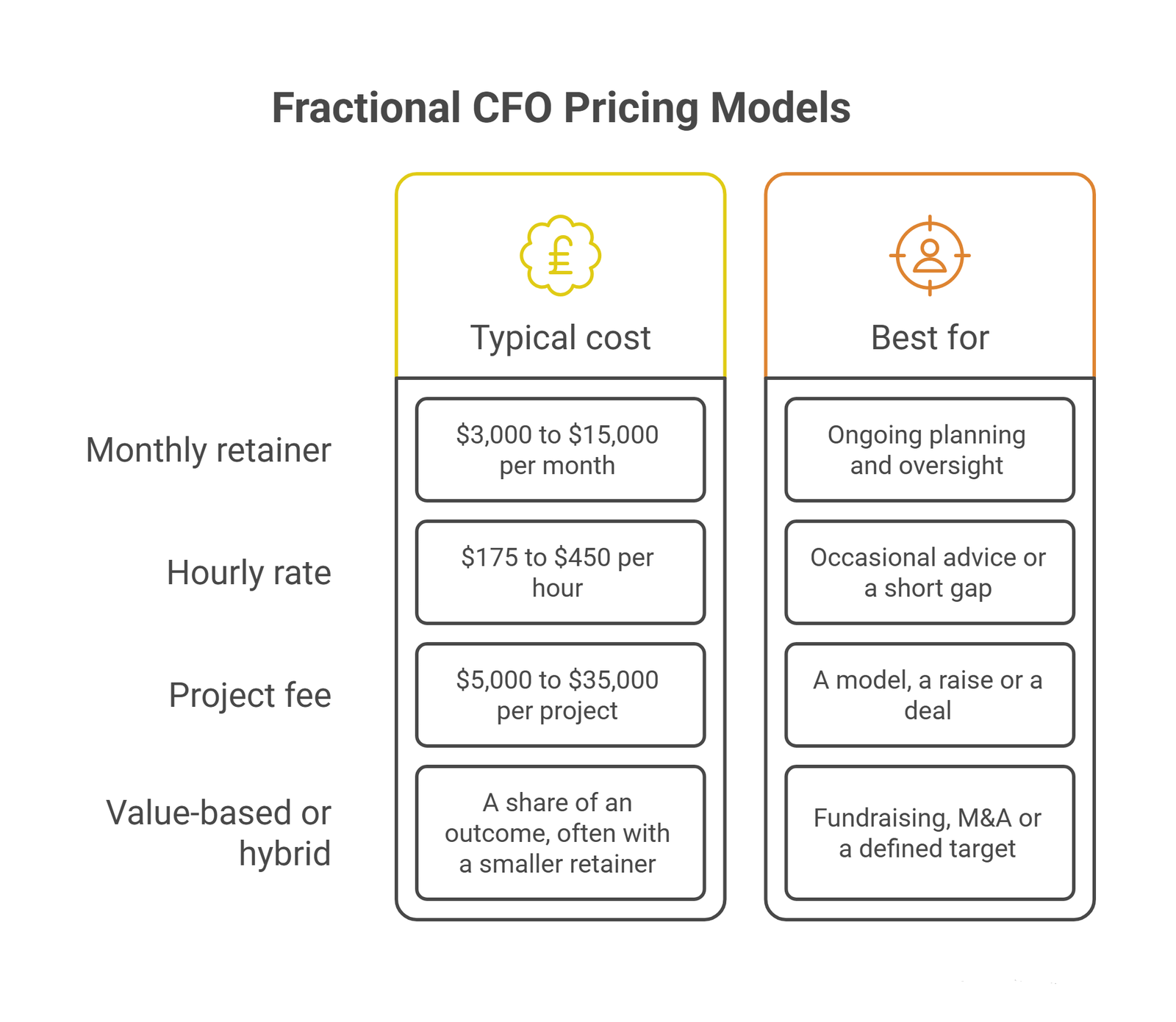
Fractional CFOs charge in four ways. Most use a retainer and add a project fee when a big task comes up.
| Pricing model | Typical cost | Best for |
| Monthly retainer | $3,000 to $15,000 per month | Ongoing planning and oversight |
| Hourly rate | $175 to $450 per hour | Occasional advice or a short gap |
| Project fee | $5,000 to $35,000 per project | A model, a raise or a deal |
| Value-based or hybrid | A share of an outcome, often with a smaller retainer | Fundraising, M&A or a defined target |
Monthly retainer
A retainer gives you an agreed number of hours, regular meetings and access between them. It is the most common setup. The cost stays predictable, and nobody watches the clock when a quick question comes up.
The arithmetic is simple. Twenty hours a month at $250 an hour is $5,000. Most retainers are a flat fee that works out to a similar figure, so ask which hours the fee assumes.
Longer commitments sometimes earn a lower monthly rate, because the CFO gets steady income. Short trials usually cost more per month.
Hourly rate
Hourly billing suits light or one-off needs. Examples are reviewing a single decision, covering a gap before a hire or topping up a retainer. Rates depend on experience.
| Experience | Typical hourly rate |
| 5 to 10 years | $175 to $250 |
| 10 to 15 years | $250 to $350 |
| 15+ years, with fundraising or M&A depth | $350 to $450 |
Hourly costs get hard to predict once your needs pass about 15 hours a month. At that point a retainer is usually cheaper and gives you better access.
Project fees
Fixed-price work suits a defined deliverable. Typical ranges are:
- Financial model: $10,000 to $25,000
- Fundraising preparation: $5,000 to $20,000
- Financial systems setup: $8,000 to $20,000
- M&A due diligence: $15,000 to $35,000
Many relationships begin with a project and turn into a retainer when the work goes well. If the first need is a forecast for a raise, Oak’s financial modeling service covers that as a standalone piece.
Value-based and hybrid pricing
Some CFOs tie part of the fee to an outcome. Examples are a percentage of capital raised or a bonus for hitting a cost target. It fits clear, measurable goals. It fits poorly when the result depends on things the CFO does not control. Agree in writing how the outcome will be measured.
What a retainer buys at each company size
Revenue is a rough guide. Complexity matters more, but size predicts hours. Bands differ by provider and industry.
| Company stage | Annual revenue | Typical monthly cost | Hours per month |
| Early stage | Under $1M | $1,000 to $3,000 (hourly or a light retainer) | 5 to 10 |
| Small business | $1M to $5M | $3,000 to $5,000 | 10 to 20 |
| Growth | $5M to $20M | $5,000 to $10,000 | 20 to 40 |
| Scaling | $20M and above | $10,000 to $15,000 or more | 40 or more |
A startup preparing to raise often sits one tier above its revenue. Investor work adds hours that a revenue number does not show.
What pushes the price up or down
Two companies with the same revenue can get very different quotes. These six factors explain most of the gap.
| Factor | Pushes cost up | Pushes cost down |
| Experience | Past CFO or VP of finance roles, a record in raises or M&A | Newer to fractional work, narrower scope |
| Entity structure | Several entities, intercompany transactions, multiple states | One entity, one set of books |
| Scope | Modeling, board reporting, investor relations, fundraising | Monthly reporting, cash forecast, KPI review |
| Industry | Regulated sectors, subscription revenue, complex accounting | Simple revenue model, a sector the CFO knows well |
| State of the books | Months behind, errors, broken systems | Clean, current books on a stable system |
| Commitment | Short trial, weekly meetings | Twelve-month term, monthly meetings |
Location matters less than it used to, since most fractional CFOs work remotely. A CFO who has to be on site in a major city usually charges more.
The state of the books deserves extra attention. A CFO cannot forecast from data that is three months late. Cleanup either eats the strategic hours in your retainer or arrives as a separate fee. Fixing the books first with an accounting and bookkeeping provider usually costs less than paying CFO rates for catch-up work.
What is usually included and what costs extra
Scope is where quotes differ most. Two $6,000 retainers can cover very different work.
Most retainers include:
- Monthly budget and forecast reviews
- A cash forecast on a fixed schedule
- KPI reporting
- Regular calls with the owner or board
- Email or chat access between calls
These usually cost extra:
- Bookkeeping and the monthly close
- Tax preparation and filings, including VAT returns and corporate tax
- Fundraising, M&A or modeling projects
- Formal board reporting packs
- Selecting and setting up financial systems
Compare hours, deliverables and response times, not only the fee.
Fractional CFO vs full-time CFO: the cost gap
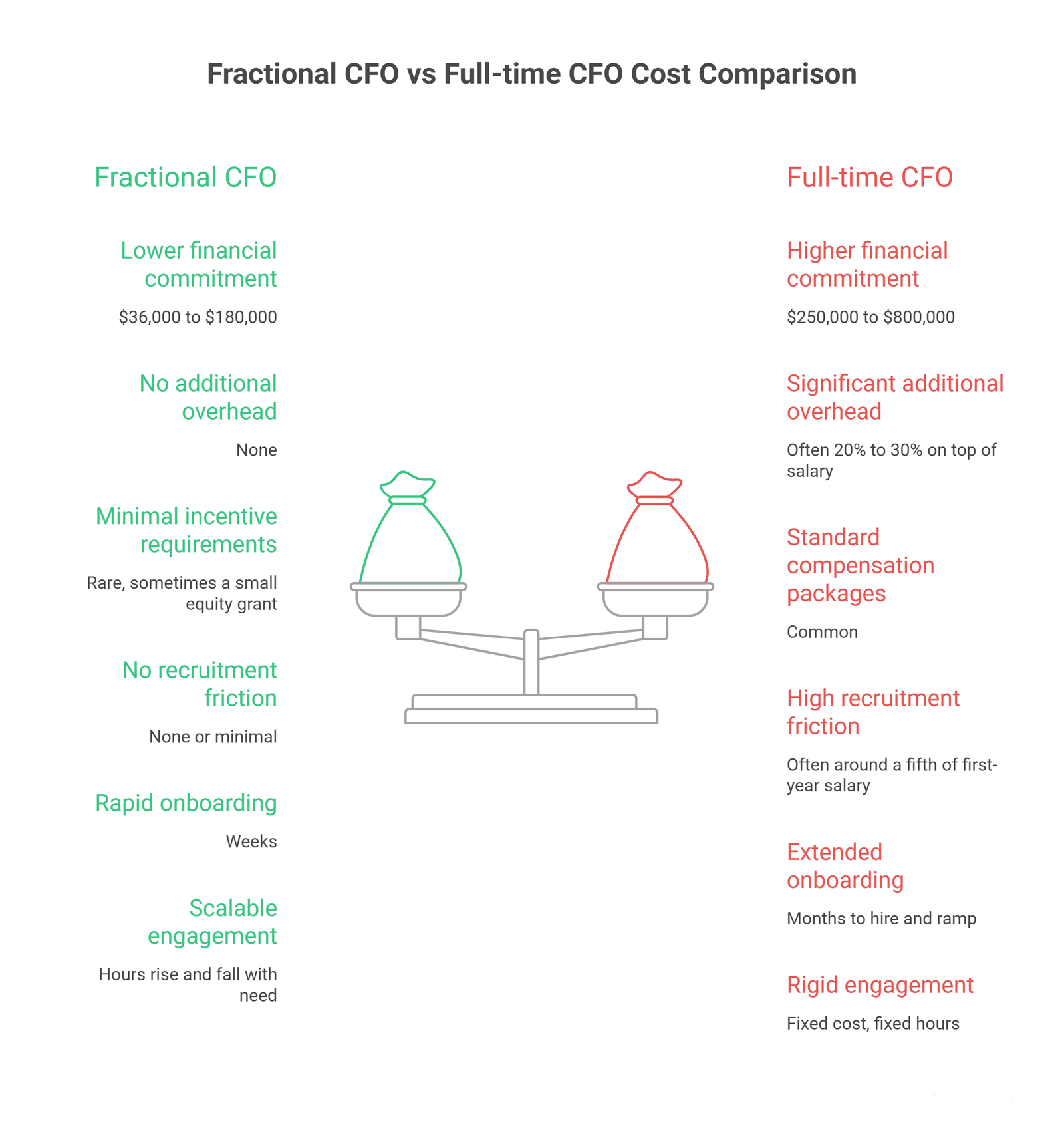
Published estimates for a full-time CFO’s first-year cost run from about $250,000 to $800,000. The spread comes from salary, benefits, bonus, equity and recruiting fees.
| Cost item | Full-time CFO | Fractional CFO |
| Annual cost, all in | $250,000 to $800,000 | $36,000 to $180,000 |
| Benefits and payroll costs | Often 20% to 30% on top of salary | None |
| Bonus and equity | Common | Rare, sometimes a small equity grant |
| Recruiting | Often around a fifth of first-year salary | None or minimal |
| Time to start | Months to hire and ramp | Weeks |
| Flexibility | Fixed cost, fixed hours | Hours rise and fall with need |
Even at the top of the fractional range, the annual cost sits below the low end of the full-time estimates.
The crossover point
Estimates for when a full-time CFO wins range from $20 million to $50 million in revenue. Complexity moves the line more than size does.
Look for these signs. Daily decisions need a CFO in the room. The finance team has five or more people. An investor or regulator expects a full-time executive. A controller plus a fractional CFO is a common step before a full-time hire.
When a fractional CFO is not worth the cost
Not every business gets a return. Four situations tend to disappoint.
- The business is very small and simple. Many providers see little return below roughly $500,000 to $1 million in revenue. A good bookkeeper and an annual tax review cost less and cover more.
- The books are behind. Strategy needs reliable numbers, so fix the records first.
- Nobody will act on the advice. A forecast changes nothing if there is no cash or appetite to follow it.
- The need is execution, not strategy. A controller or analyst fits that job better and costs less.
Questions to ask about price before you sign
A quote is only as clear as the answers behind it. Ask each provider:
- Which hours does the fee assume, and what happens past them?
- Who does the work: the person I meet, or a junior?
- Does the retainer cover cleanup, board packs and ad hoc questions?
- Is there a minimum term, and how do I leave?
- How does a change in scope change the fee?
- How will we measure whether the engagement is working?
Red flags that you are overpaying
Watch for these during the engagement:
- You pay CFO rates for controller work. If most hours go to month-end close and reconciliations, read our guide on comptroller vs. controller roles and rescope the work.
- The scope keeps growing and results do not.
- Hours are vague, or the CFO is hard to reach for days at a time.
- The rate sits far below market. Ongoing CFO work for under $3,000 a month often means limited experience or very few hours.
- A year in, you cannot name a decision the CFO changed.
- A long lock-in has no exit clause.
How to judge whether it paid off
Price alone says little. Compare the total cost with the hard value delivered. Total cost means the retainer, internal staff time, tools and any projects billed separately. Hard value means costs cut, margin gained and cheaper financing that you can trace to documents.
Keep time saved and peace of mind in a separate column. Cash released by faster collections is a liquidity gain, not profit, so do not count it as return.
Set a check at 90 days. By then you should see a clearer cash position, a working forecast and reporting that arrives on a fixed date. If none of those exist, raise it directly.
Frequently Asked Questions
How much does a fractional CFO cost per month?
Most fractional CFOs charge $3,000 to $15,000 a month. Small and mid-size businesses usually land between $5,000 and $10,000. The exact figure depends on hours, scope, complexity and the CFO’s experience.
What is the hourly rate for a fractional CFO?
Hourly rates run from $175 to $450. CFOs with 5 to 10 years of experience charge about $175 to $250. Those with 15 or more years and fundraising or M&A depth charge $350 to $450.
Is a fractional CFO cheaper than a full-time CFO?
Almost always, at least until the business reaches roughly $20 million to $50 million in revenue. A fractional CFO at the top of the range costs about $180,000 a year. Published estimates for a full-time CFO start near $250,000.
How many hours does a fractional CFO retainer include?
It ranges from 5 to 10 hours a month for the smallest engagements to 40 or more for large, complex ones. Ask for the number of hours in writing, along with the rate for extra hours.
Can you negotiate fractional CFO fees?
Yes. Longer terms and a narrower scope often lower the monthly fee. Negotiate scope and value rather than only the rate, because a cheaper CFO who cannot deliver costs more in the end.
What should a fractional CFO agreement include?
It should state the scope, the hours included and the deliverables. It should also give the reporting schedule, the rate for extra hours, the notice period and confidentiality terms. Vague scope is the most common cause of billing disputes.
Does an outsourced or virtual CFO cost the same?
Mostly, yes. The labels overlap, and price follows scope, hours and seniority rather than the name. Oak’s outsourced CFO guide explains how the terms differ.
Conclusion
A quote tells you what a CFO charges. It does not tell you what you need. Before you compare providers, write down the one decision you want help with this year. It might be a raise, a cash squeeze or a pricing change. Then ask each provider how many hours that decision takes and what they would deliver.
Oak Business Consultant provides fractional CFO services for startups and growing businesses. Share your decision with the team and ask for a scoped quote. Schedule a free consultation.