Corporate Tax in UAE: What You Need to Know
UAE corporate tax: who pays 9%, who pays 0%, and what to file
The UAE’s headline corporate tax rate is 9%. Most owners pay less. Some pay nothing. Which outcome applies depends on profit, business structure and location.
Get it wrong and the fines start, even when no tax is owed. This guide explains the rates, who is in scope, how free zone and small business rules work, and what the deadlines are.
Rule to watch: Small Business Relief is a temporary measure with a set end date. Check its current status on tax.gov.ae before relying on it. The details are in the section below.
What is UAE corporate tax?
UAE corporate tax is a federal tax on business profit. It was introduced by Federal Decree-Law No. 47 of 2022. It applies to financial years starting on or after 1 June 2023.
For a company with a 1 January year start, the first taxed period was calendar year 2024. The Federal Tax Authority (FTA) runs the system through its EmaraTax portal.
The tax applies to taxable income, not revenue. Salary, dividends and personal investment income sit outside the tax.
UAE corporate tax rates at a glance
| Situation | Rate | What to know |
| Taxable income up to AED 375,000 | 0% | Applies to each taxable person in every tax period |
| Taxable income above AED 375,000 | 9% | Charged only on the amount above the line |
| Qualifying free zone person, qualifying income | 0% | Strict conditions apply |
| Qualifying free zone person, other income | 9% | Applies to non-qualifying income |
| Large multinational groups | 15% minimum effective rate | Domestic Minimum Top-up Tax, for groups with revenue of EUR 750 million or more, from 2025 |
| Small Business Relief | Zero taxable income | Revenue of AED 3 million or less, by election. Temporary relief |
Worked example. A mainland company has taxable income of AED 800,000. The first AED 375,000 is taxed at 0%. The remaining AED 425,000 is taxed at 9%. Tax due: AED 38,250.
The AED 375,000 line is a profit threshold. A company with AED 600,000 in revenue and AED 300,000 in allowable costs has taxable income of AED 300,000. It pays no corporate tax.
Who must pay corporate tax?
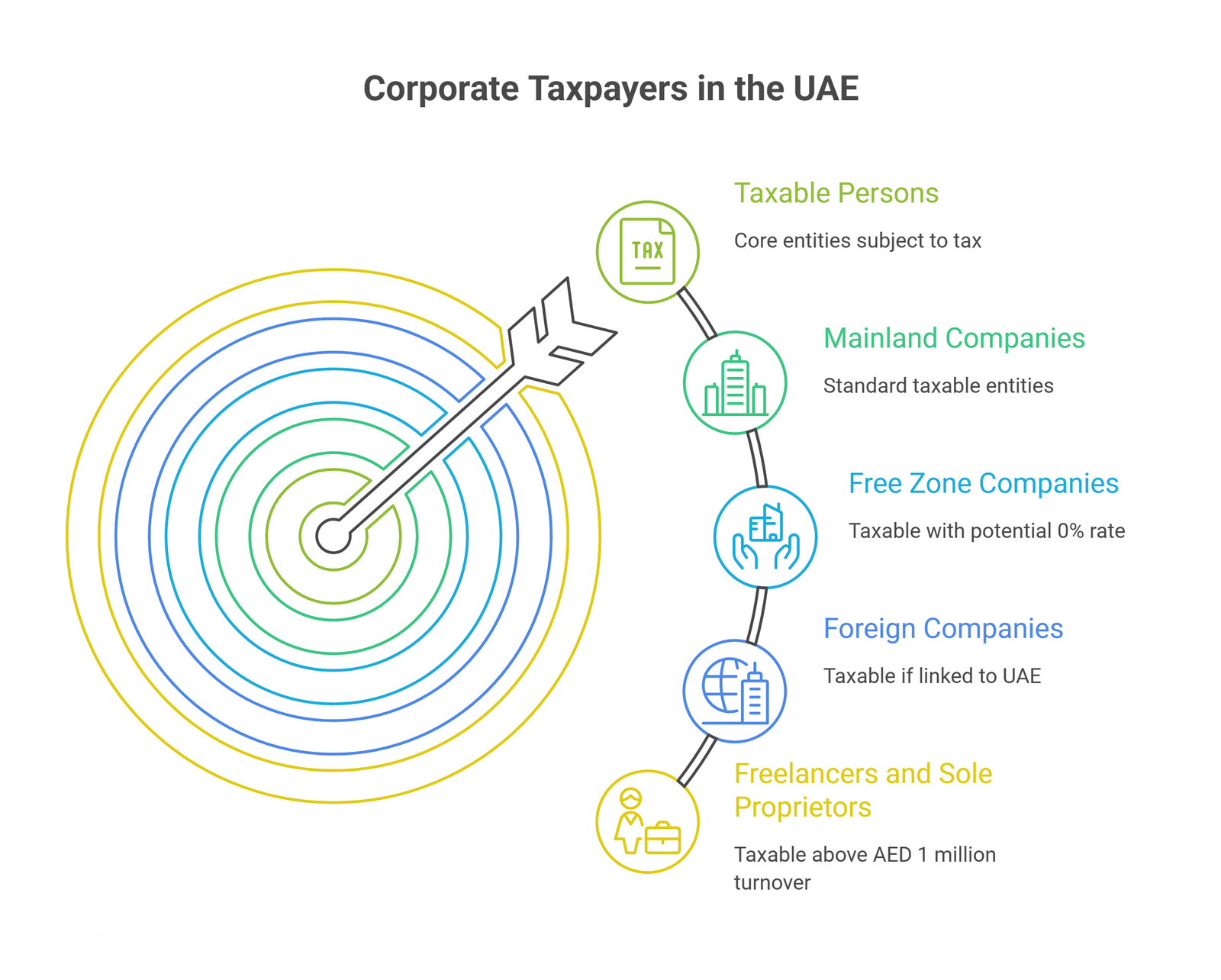
These groups fall inside the tax:
- Mainland companies and branches. All are taxable persons.
- Free zone companies. They stay in scope. A 0% rate is possible, but only if the company meets the qualifying free zone rules.
- Foreign companies with a UAE link. This includes a permanent establishment in the UAE or effective management and control from the UAE.
- Freelancers and sole proprietors. They enter the tax once business turnover passes AED 1 million in a calendar year. The test uses turnover, not profit.
- Extractive and natural resource businesses. Oil, gas and mining companies follow special rules and emirate-level arrangements.
Some persons are exempt. Examples include government entities, qualifying public benefit entities, qualifying investment funds and pension schemes. Extractive businesses follow emirate-level rules.
Exempt does not always mean unregistered. Most exempt persons still register with the FTA to confirm their status.
Free zone companies: 0% is earned, not automatic
Free zone companies are a common source of confusion. A free zone licence does not remove a business from corporate tax. It only opens the door to a 0% rate on qualifying income.
To be a qualifying free zone person, a company must meet all seven conditions:
- It is registered in a free zone.
- It keeps adequate substance in the free zone, meaning staff, assets and spending that match its activity.
- It earns qualifying income.
- It has not elected to be taxed under the standard regime.
- It follows transfer pricing rules and keeps the documents.
- Its non-qualifying revenue stays within the de minimis limit.
- It prepares audited financial statements under IFRS.
The de minimis limit is the lower of 5% of total revenue or AED 5 million.
Qualifying activities include manufacturing, processing, trading of qualifying commodities, holding shares for investment, fund and wealth management, headquarters and treasury services to related parties, and logistics. Distribution of goods qualifies only from a designated zone.
Excluded activities include regulated banking, finance, leasing and insurance. They also include most dealings with individuals and ownership of property outside narrow exceptions.
Income from mainland customers generally does not qualify unless the activity itself is a qualifying one.
The penalty for failing any condition is heavy. The company is taxed at 9% on its full income for the current year and the next four. It can retest its status in the sixth year.
A mainland branch of a free zone company counts as a domestic permanent establishment. Its income is taxed at 9%. Choosing between mainland and free zone is now a tax decision as much as a licensing one. Oak’s guide to company registration in the UAE explains the setup options.
Small Business Relief: a temporary relief for small businesses
Small Business Relief lets an eligible business elect to be treated as having no taxable income for a period. It is an election. It does not apply automatically.
Who qualifies
- A UAE resident person, including a natural person or a company.
- Revenue of AED 3 million or less in the current period and in every previous period.
Who cannot use it
- Qualifying free zone persons.
- Members of multinational groups with consolidated revenue above AED 3.15 billion.
The catch on past revenue. Every earlier period counts. The FTA gives an example of a Sharjah business with AED 1.9 million in revenue in its latest period. It had AED 4.3 million in the period before. It cannot claim the relief for the latest period.
The cost of electing. Other exemptions, reliefs and deductions fall away. Tax losses cannot be used. Transfer pricing documents are not needed, but pricing must still follow the arm’s length principle. The business must also still file a simplified return on time.
When it pays. Take a business with AED 2.5 million in revenue and AED 800,000 in profit. Without the relief, it owes AED 38,250. With the relief, it owes nothing.
Sunset. The relief is temporary. Under current law it covers only tax periods ending on or before 31 December 2026. After that, the standard 0% and 9% bands apply. Check tax.gov.ae for any extension, and do not build long-term plans on the relief.
How taxable income is worked out
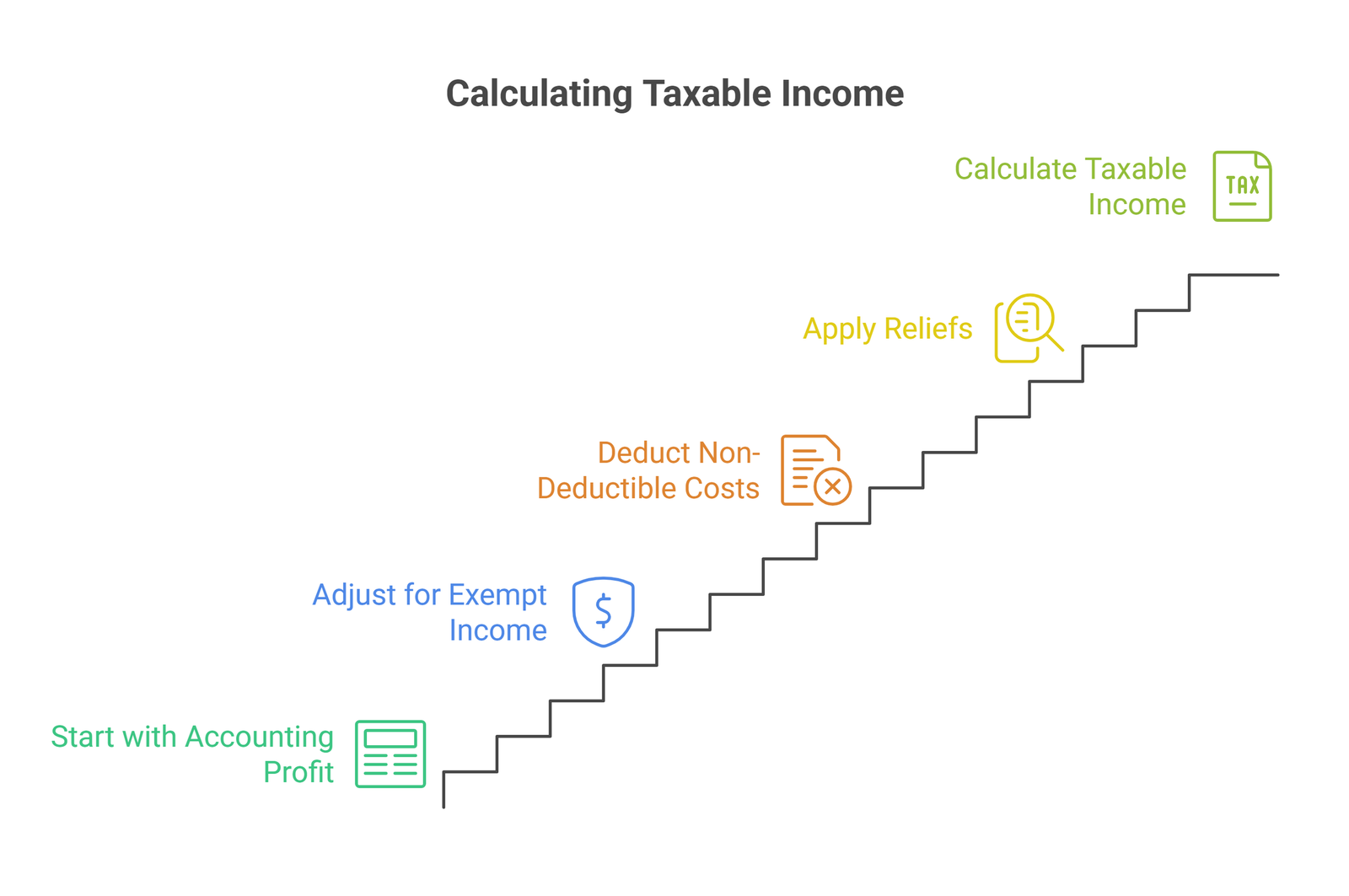
Taxable income starts with accounting profit under IFRS. The return then adjusts it for exempt income, non-deductible costs and reliefs.
Some income can be left out of the tax base:
- Dividends and gains from qualifying shareholdings. These are generally exempt where the business holds at least 5% of the company for 12 months. This is the participation exemption.
- Dividends from UAE subsidiaries. They are generally exempt at the parent level.
- Qualifying group transfers. Moving assets between group companies can be tax-neutral. The companies must be at least 75% commonly owned and use the same year end and accounting standards. Free zone persons that qualify for 0% cannot use this route.
Losses, deductions and reliefs also matter. A business that elects Small Business Relief gives up all of them for that period.
Foreign companies and tax treaties
A foreign company can be taxed in the UAE in three cases. It has a permanent establishment in the UAE. It is managed and controlled from the UAE. Or it earns UAE-sourced income.
Double tax treaties can reduce or remove double taxation. Foreign tax paid on income taxed in the UAE also earns a credit. The credit cannot exceed the UAE tax due on that income. Unused credit cannot be carried forward or back.
Groups with related-party dealings must price them at arm’s length. Large multinationals face the 15% minimum tax described above. Foreign owners should map their structure before the first return is due.
Corporate tax registration in the UAE
Every taxable person must register through EmaraTax and get a corporate tax registration number. This includes businesses that owe nothing and free zone companies at 0%. The AED 375,000 line sets the rate. It does not set the duty to register.
Registration deadlines follow the type of business:
- Companies licensed before 1 March 2024 had deadlines set by the month of licence issue. Those deadlines are long past.
- Companies formed on or after 1 March 2024 generally have three months from incorporation.
- Freelancers and sole proprietors register after their turnover crosses AED 1 million in a calendar year.
Businesses already registered for VAT can add corporate tax from their existing EmaraTax account. Keep licence and signatory details current first. Mismatches can slow approval.
Filing and payment deadlines
The return and the payment are both due within nine months after the tax period ends. For a company with a 31 December year end, the return for a given year is due on 30 September of the following year.
Businesses with a different year end must count nine months from their own date. There is no single national deadline.
Returns are filed electronically. Taxable income starts from accounting profit under IFRS. It is then adjusted for exempt income, non-deductible costs and reliefs.
Penalties for missing the rules
| Breach | Penalty |
| Late registration | AED 10,000, fixed |
| Late return | AED 500 per month or part month for the first 12 months, then AED 1,000 per month |
| Late payment | 14% a year on unpaid tax, charged monthly |
| Records not kept | AED 10,000, rising to AED 20,000 for a repeat within 24 months |
There is one useful relief for new registrants. An FTA initiative from April 2025 cancels the AED 10,000 late registration penalty if the first return is filed within seven months of the end of the first tax period. That is two months earlier than normal. Confirm the current status on tax.gov.ae.
Corporate tax vs VAT
Both taxes use the number AED 375,000. They measure different things.
| Corporate tax | VAT | |
| What it taxes | Profit | Taxable supplies |
| Rate | 0% up to AED 375,000, 9% above | 5% |
| AED 375,000 means | Taxable income where the 9% rate starts | Annual taxable supplies that trigger mandatory registration |
| Filing | Annual | Periodic |
A business can be registered for both. Oak’s guide to VAT registration in the UAE covers the VAT side. The UAE VAT calculator helps with quick checks. Figures on VAT and corporate tax returns should agree.
Common mistakes
- Treating a free zone licence as a tax exemption.
- Skipping registration because the business expects to pay 0%.
- Confusing revenue with taxable income.
- Missing the Small Business Relief election while it is still available.
- Mixing personal and business income in a freelance practice.
- Ignoring related-party pricing, which affects free zone status and groups.
How to prepare
- Confirm the tax period and year end.
- Register on EmaraTax, or check that the registration is active.
- Keep clean books that support an IFRS-based return.
- Test free zone status every year, including the de minimis check.
- Model both options if the business qualifies for Small Business Relief.
- Document related-party transactions at arm’s length prices.
Many owners get help at this stage. Oak explains what advisers do in its guide to tax consultancy services.
Frequently Asked Questions
What is the corporate tax rate in the UAE?
The rate is 0% on taxable income up to AED 375,000 and 9% on the amount above it. Large multinational groups face a 15% minimum effective rate.
Do free zone companies pay corporate tax?
They can. Free zone companies stay in scope. A qualifying free zone person pays 0% on qualifying income and 9% on the rest. A company that fails any condition pays 9% on all income for five years.
Do freelancers pay corporate tax in the UAE?
Only when business turnover exceeds AED 1 million in a calendar year. Salary and personal investment income do not count toward the test.
Do I need to register if my profit is below AED 375,000?
Yes. Registration is mandatory for taxable persons, even when the tax due is zero.
When is the corporate tax return due?
Nine months after the tax period ends. A 31 December year end means a 30 September filing date the following year.
What is the penalty for late registration?
AED 10,000. A waiver may apply if the first return is filed within seven months of the end of the first tax period. Check the current rules with the FTA.
Is Small Business Relief permanent?
No. It is a temporary relief. Under current law it applies only to tax periods ending on or before 31 December 2026. Check the FTA for updates.
Plan the tax before the year ends
The biggest savings in UAE corporate tax come from choices made early. Small Business Relief needs an election. Free zone status needs steady compliance. Neither can be fixed after the fact.
Oak’s accounting and bookkeeping team in Dubai handles corporate tax filing and FTA compliance. Clean books now make registration, filing and relief decisions simpler later.