CBAM Explained: What the EU’s Carbon Border Charge Actually Costs UAE and US
CBAM Costs: How the EU’s Carbon Border Charge Hits UAE and US Exporters Differently
The EU’s Carbon Border Adjustment Mechanism has moved past the paperwork stage. Certificates are now priced, purchases are mandatory, and the bill lands on whoever imports steel, aluminium, cement, fertiliser, hydrogen, or electricity into the bloc. But the party writing that check is rarely the one who feels it first. In practice, EU buyers push the cost of compliance back down the supply chain, onto the non-EU producer who has to prove, product by product, how much carbon went into making the goods. For a UAE aluminium smelter or a US steel mill selling into Europe, that means a real commercial choice: document your emissions precisely, or get charged the EU’s most conservative, most expensive default estimate instead.
This piece breaks down how CBAM actually works, and why its bite looks so different depending on whether you’re exporting from the UAE or the US.
What CBAM is, in plain terms
CBAM puts a carbon price on a short list of imported goods, calibrated to match what an EU producer already pays under the EU Emissions Trading System. It isn’t a blanket tariff and it isn’t tied to a country of origin. It’s tied to the product and the emissions embedded in making it. If a country already charges its own producers a comparable carbon price, that amount is deducted from what’s owed at the EU border. If it doesn’t, the importer pays the difference in full.
The mechanism launched with a reporting-only phase back in October 2023, giving importers time to build the data pipelines needed to track embedded emissions. That grace period is over. Since the start of this year, CBAM has moved into its definitive regime, as confirmed on the European Commission’s own CBAM regulatory page: authorised declarants must hold CBAM certificates and surrender enough of them each year to cover the emissions in what they’ve imported. Certificate prices track the EU ETS auction price on a rolling quarterly basis, so they move with the broader EU carbon market rather than sitting fixed.
What’s covered, and what isn’t
Six sectors fall under CBAM today: iron and steel, aluminium, cement, fertilisers, hydrogen, and electricity, along with a defined list of downstream products like bolts, screws, and certain semi-finished metal goods. The European Commission has said it intends to widen the scope over time, but for now, if your export doesn’t fall under one of the CN codes listed in the regulation’s annexes, it’s outside CBAM regardless of how carbon-intensive your production process actually is.
A mass-based exemption threshold also applies: importers bringing in less than 50 tonnes of covered goods a year are excused from the authorisation and certificate obligations, though this isn’t a blanket carve-out for smaller shipments across the board, since electricity and hydrogen are treated separately.
How the charge actually gets calculated
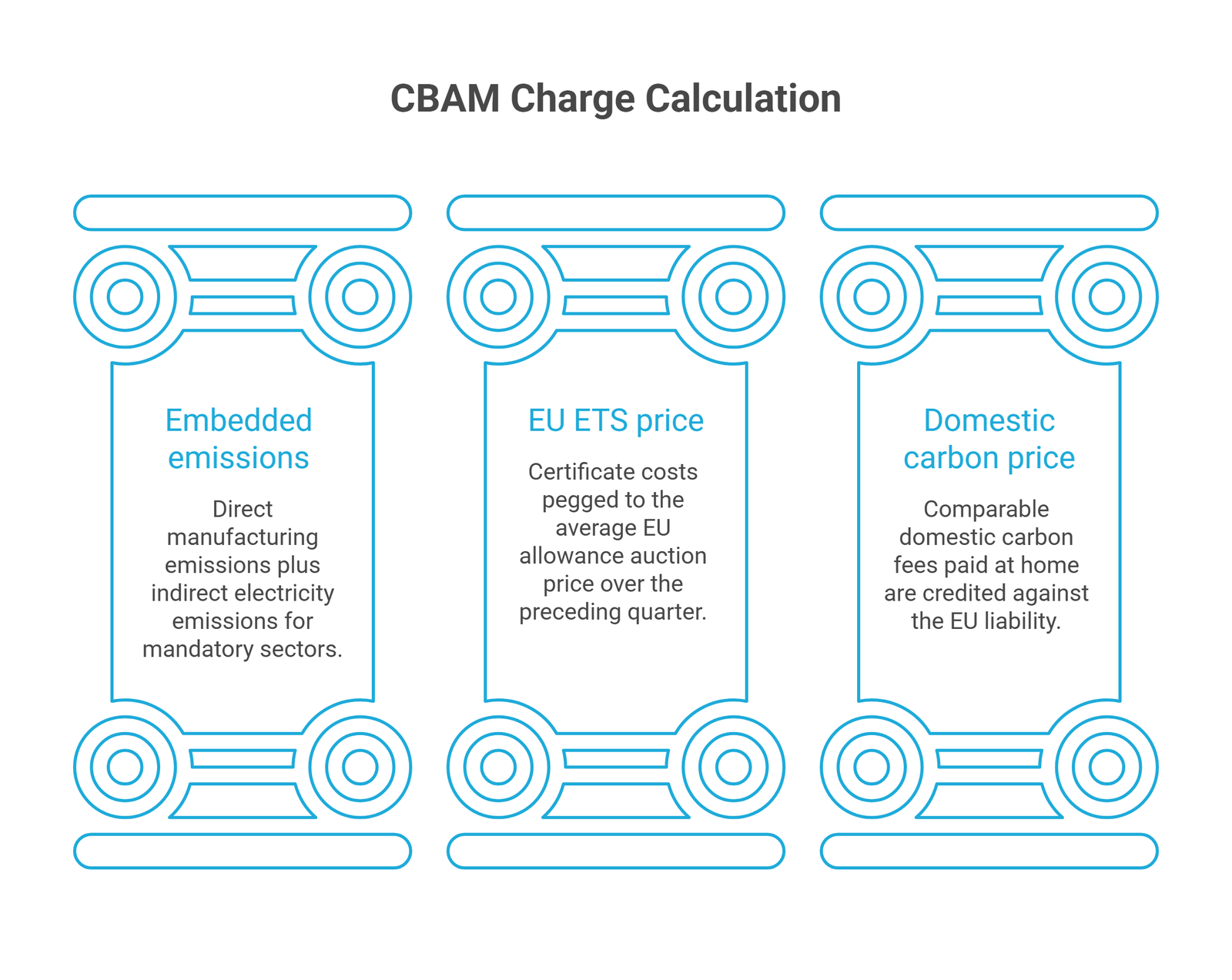
Three things determine the size of the bill:
- Embedded emissions. Direct emissions from the manufacturing process, plus indirect emissions from the electricity used to run it, for sectors where that’s mandatory.
- The EU ETS price. Certificate costs are pegged to the average EU allowance auction price over the preceding quarter, so a rise in EU carbon prices flows straight through to CBAM costs.
- Any carbon price already paid at home. If your country charges a comparable domestic carbon fee, that gets credited against the EU liability.
The part that catches exporters off guard is what happens without verified data. When an EU importer can’t get accurate, third-party-verified emissions figures from their supplier, the regulation applies a default value instead, and that default is deliberately set at the high end, with a markup, specifically to discourage relying on it. A UAE or US producer who never bothers to measure and share their actual carbon footprint effectively pays the worst-case rate on every shipment, even if their real production process is cleaner than the default assumes.
UAE exporters: concentrated exposure, mostly in one metal
For the UAE, CBAM exposure isn’t spread evenly across the economy. It’s concentrated almost entirely in aluminium. Aluminium accounts for roughly two-thirds to three-quarters of the UAE’s CBAM-covered exports to the EU, and among GCC states, the UAE and Bahrain carry the heaviest exposure both in absolute export value and as a share of GDP.
That concentration cuts both ways. Emirates Global Aluminium, the country’s largest industrial exporter after oil and gas, has invested in lower-carbon production, including aluminium made using solar power, which puts it in a stronger position than higher-emission competitors as CBAM certificate costs rise. Producers who can document a genuinely low carbon footprint stand to gain market share from dirtier competitors elsewhere, since buyers in the EU now have a direct financial reason to prefer them. But for smaller or less-documented UAE producers, especially those still reliant on gas-fired power for smelting, the certificate cost adds a real, rising line item to every tonne shipped to Europe, one industry estimates put in the range of an 8 to 15 percent cost increase without further decarbonisation.
Reporting obligations also sit heavily on the exporter’s side of the relationship, not just the EU importer’s. Even though the importer is the one legally submitting CBAM declarations, it’s the UAE producer who has to generate and hand over the underlying emissions data, broken down by direct and indirect sources, for every shipment. The UAE Ministry of Economy has already acknowledged this shift publicly, co-hosting industry sessions aimed at getting exporters ready for CBAM’s documentation demands.
US exporters: broad exposure, small dollar impact, bigger political story
The picture for US exporters looks almost the opposite. CBAM-covered goods make up a small slice of total US exports to the EU, with independent analysis putting the affected trade at somewhere between roughly 0.07 and 0.3 percent of the total. US steel and aluminium production is also relatively clean by global standards, which should mean lower certificate costs per tonne than for higher-emission competitors.
Where it gets complicated for US producers is default values. Exporters who don’t supply verified, product-specific emissions data get assessed at the EU’s conservative default rate, which can inflate the bill regardless of how efficient the actual mill or smelter is. The US International Trade Administration, part of the Department of Commerce, has flagged this directly, warning that the regulation creates uncertainty for US exporters and cargo operators who haven’t built out emissions documentation. The Congressional Research Service has tracked the same exposure gap in its ongoing briefing on border carbon adjustments, which lays out how little relief US exporters get without verified data to submit.
The bigger story for US exporters right now isn’t really CBAM in isolation. It’s CBAM colliding with US trade policy. Washington has run a flat, high tariff on imported steel and aluminium under Section 232 national security authority, while Brussels has written provisions into the current EU-US trade framework that let the EU suspend preferences for American exporters if those tariffs stay above an agreed threshold past a set deadline. CBAM and Section 232 are being justified on different grounds, one framed as climate policy, the other as national security, but they’re functionally two governments each protecting their own metals producers, and US exporters selling into Europe are caught in the middle of that standoff regardless of their own carbon footprint.
UAE vs US exposure, side by side
| UAE | US | |
| Primary exposed sector | Aluminium (roughly two-thirds to three-quarters of CBAM-covered exports) | Iron, steel, and aluminium, more evenly spread |
| Share of exports to EU affected | Meaningful share of GDP-relative export value, concentrated in a few large producers | A small fraction of total US-EU trade |
| Main cost driver | Emissions intensity of aluminium smelting, often gas-powered | Reliance on EU default values instead of verified emissions data |
| Strategic angle | Low-carbon producers can gain EU market share from dirtier rivals | CBAM compliance is tangled up with the separate Section 232 tariff dispute |
| Underlying trend | Accelerating industrial decarbonisation tied to national Net Zero targets | Relatively low emissions intensity, but limited domestic pressure to formalise carbon tracking |
What exporters should actually do now
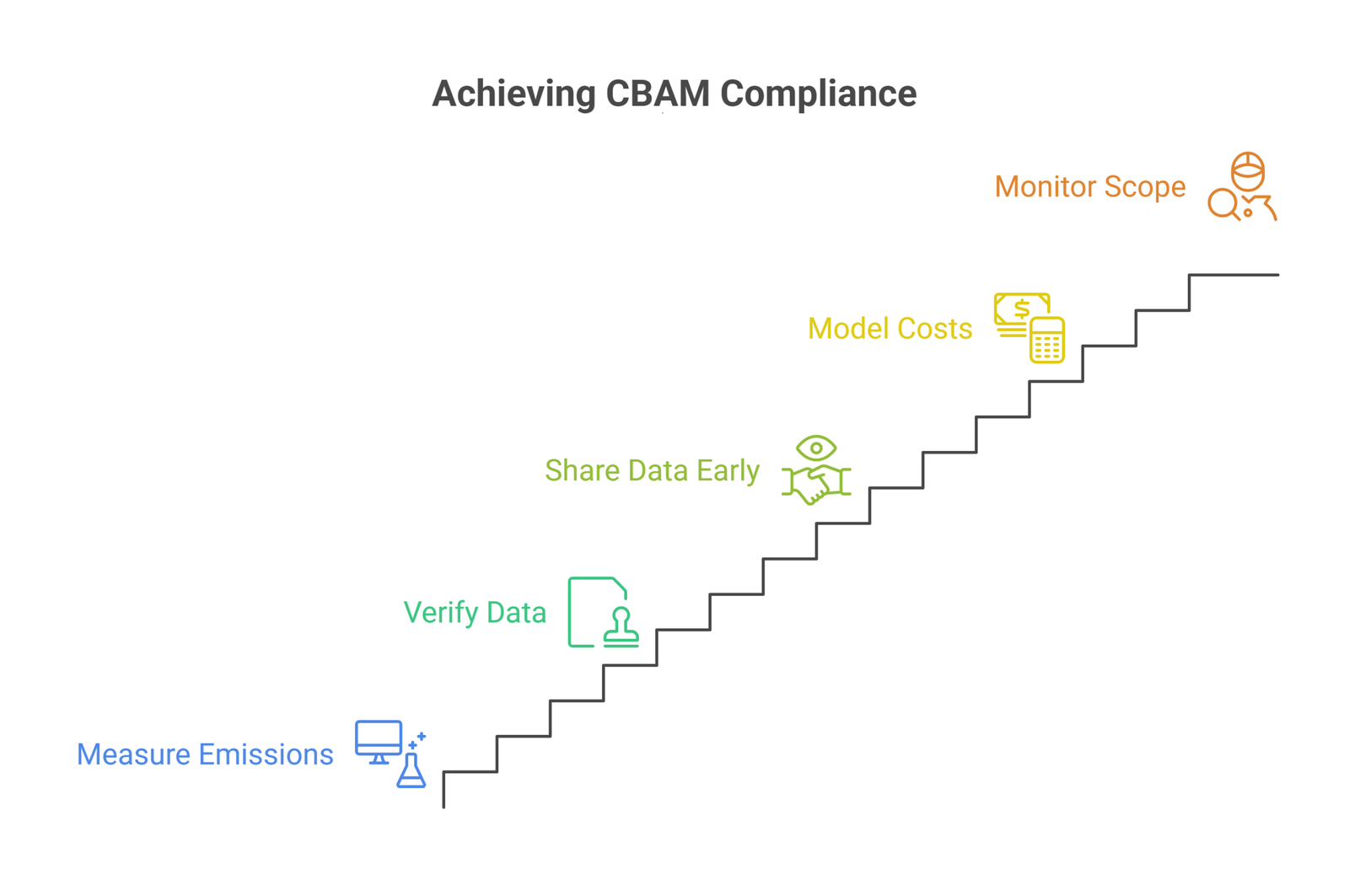
For either market, the practical response looks similar even if the stakes differ:
- Measure embedded emissions properly, both direct and indirect, rather than letting EU buyers default you into the worst-case rate.
- Get that data independently verified. A verified Environmental Product Declaration or Product Carbon Footprint carries far more weight with EU importers than a self-reported figure.
- Share the data early in the sales process, not after a shipment is already at the border, since importers need it to file quarterly.
- Model the certificate cost into pricing rather than treating it as a surprise line item passed on by the buyer.
- Watch the scope creep. The Commission has flagged organic chemicals and polymers as candidates for future CBAM coverage, so exporters in adjacent sectors shouldn’t assume they’re permanently outside the mechanism.
None of this is optional bookkeeping. It’s the difference between competing on your actual carbon footprint and getting priced as if you’re the dirtiest producer in your sector by default.
Frequently Asked Questions
Is CBAM a tariff?
Not technically. A tariff applies a flat rate regardless of how a good was made. CBAM’s charge is tied to the actual carbon emitted in production, minus any carbon price already paid in the country of origin, so two exporters of the same product can pay very different amounts.
Who pays the CBAM charge, the exporter or the EU importer?
Legally, the EU importer buys and surrenders the certificates. Commercially, that cost gets negotiated back into the price the exporter receives, which is why exporters who supply verified emissions data are in a stronger position than those who don’t.
Does the UAE or US have a domestic carbon price that offsets CBAM?
Neither country currently runs an economy-wide carbon pricing scheme comparable to the EU ETS, so exporters from both generally can’t claim a domestic-price deduction against their CBAM liability.
What happens if I don’t provide emissions data at all?
The EU importer must use the regulation’s default values, set deliberately high with an added markup, which almost always costs more than submitting verified actual data would.
Does CBAM apply below a certain shipment size?
Yes, a 50-tonne annual threshold exempts smaller importers from authorisation and certificate obligations, though electricity and hydrogen are handled under separate rules.
Will CBAM expand to cover more products?
The European Commission has indicated an intent to broaden coverage toward all EU ETS sectors over time, with organic chemicals and polymers flagged as likely candidates.
How is the certificate price set?
It’s benchmarked to the average auction price of EU ETS allowances over the prior quarter, so it moves with the EU carbon market rather than being fixed by CBAM itself.
Getting compliance-ready without guessing
CBAM rewards exporters who can prove their numbers and penalizes those who can’t. If your business ships aluminium, steel, or another covered good into the EU, the work now is building a defensible emissions record and pricing model before an EU buyer asks for one. Oak’s regulatory compliance team can help you build that documentation trail, and our CFO advisory services can model exactly how certificate costs and default-value exposure flow through your margins before they show up as a surprise on an invoice.