Business Setup in Dubai: A Comprehensive Guide
Setting up a business in Dubai: the ownership and tax rules that actually apply
Most guides to setting up a business in Dubai repeat the same two claims: you need a local Emirati partner to hold 51% of your mainland company, and Dubai has “no tax.” Neither is accurate anymore. The local sponsor requirement was removed for most mainland activities years ago, and the UAE has run a federal corporate tax since 2023. Getting these two facts wrong is the single most common reason founders overpay a formation agent or misjudge their tax exposure before they’ve even opened a bank account. Here’s what the rules actually say, and what you need to decide before you file anything.
Mainland or free zone: settle the ownership question first
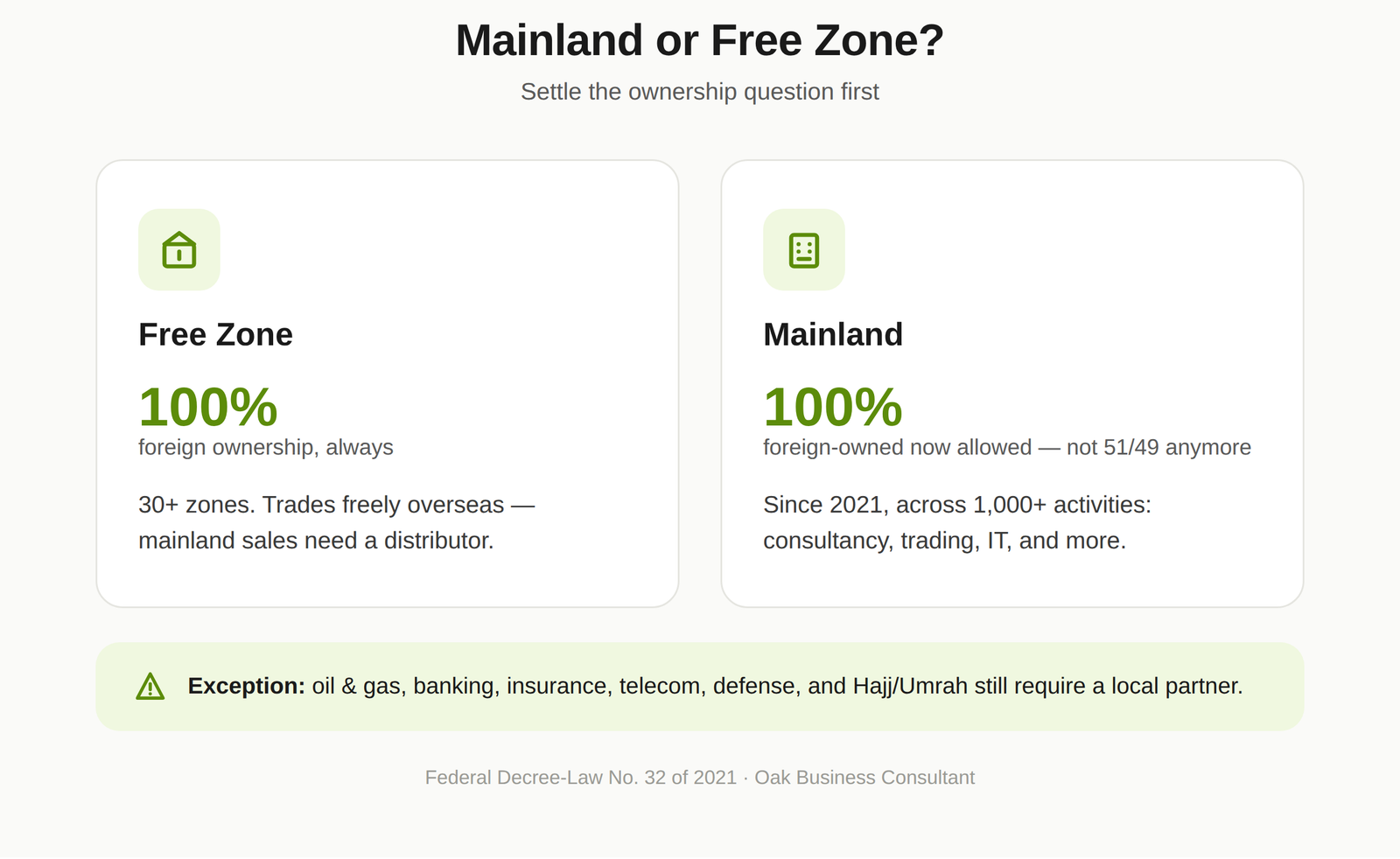
Every Dubai setup decision starts here, because it determines your market access, your ownership structure, and eventually your tax treatment.
Free zones
Free zones have always allowed 100% foreign ownership. There are more than 30 of them across the UAE, each tied to a regulatory authority and often a sector focus (DMCC for commodities, Dubai Internet City for tech, DIFC for financial services, and so on). A free zone company can trade freely with other free zone entities and overseas clients, but selling directly into the UAE mainland generally requires a local distributor or additional licensing.
Mainland companies
Mainland companies, registered through Dubai Economy and Tourism (formerly the DED), used to require a UAE national to hold 51% of the shares. That changed with Federal Decree-Law No. 26 of 2020, later consolidated into Federal Decree-Law No. 32 of 2021 on Commercial Companies. Full foreign ownership now applies to more than 1,000 commercial, industrial, and professional activities, covering most consultancy, trading, e-commerce, IT, and manufacturing businesses. A mainland company under one of these activities can be 100% foreign-owned with no local shareholder and no local service agent.
A local partner is still required for a defined list of “strategic impact” activities: oil and gas, banking and money exchange, insurance, telecommunications, defense, and Hajj and Umrah services. Separately, if you’re a non-GCC national setting up a one-person professional license (a sole establishment, not an LLC), you’ll still need a UAE national Local Service Agent on the license. An LSA holds no equity and no operational control; it’s a fixed annual fee, typically AED 5,000 to 15,000, not a profit-sharing arrangement.
The practical takeaway: check your specific activity against the current foreign-ownership list before assuming either a sponsor or a sponsor-free path applies. A consultant or an experienced formation agent can confirm this at the activity-selection stage, before you commit to a structure.
What you’ll actually pay in corporate tax
The UAE introduced federal corporate tax under Federal Decree-Law No. 47 of 2022, applying to financial years starting on or after 1 June 2023. Here’s how the numbers actually work.
| Situation | Rate |
| Taxable income up to AED 375,000 | 0% |
| Taxable income above AED 375,000 | 9% on the portion above the threshold |
| Qualifying Free Zone Person, on qualifying income | 0% |
| Free zone income that doesn’t qualify | 9%, no threshold relief |
| Multinational group, consolidated revenue over EUR 750 million | 15% top-up under the Domestic Minimum Top-up Tax |
A business earning AED 400,000 in taxable income pays 9% only on the AED 25,000 above the threshold, not on the full amount.
Free zone companies aren’t automatically tax-free. To get the 0% rate as a Qualifying Free Zone Person, a free zone entity must meet five conditions at once: maintain real substance in the free zone (staff, premises, and core activities actually happening there), earn income that counts as “qualifying” under Cabinet Decision No. 100 of 2023 (mostly transactions with other free zone persons or with clients outside the UAE), avoid electing into the standard regime, comply with transfer pricing documentation, and prepare audited financial statements. There’s also a de minimis allowance: non-qualifying revenue can’t exceed the lower of 5% of total revenue or AED 5 million, or the whole qualifying-income exemption is lost for that period and the following four.
Businesses of any structure with total revenue at or below AED 3 million can instead elect Small Business Relief and be treated as having zero taxable income for the period, which is simpler than tracking qualifying versus non-qualifying revenue. This relief has to be actively elected on every return; it isn’t automatic, and it currently applies only to tax periods ending on or before 31 December 2026 as a transitional measure, so it shouldn’t be built into any planning that runs past that point. Every taxable person, including ones expecting to owe nothing, still has to register with the Federal Tax Authority.
Personal income, including salary, dividends, and personal investment returns, remains outside the scope of this tax. It applies to business profits, not individuals.
VAT: when you need to register and what it costs your business
VAT has applied in the UAE since 2018, under Federal Decree-Law No. 8 of 2017, at a flat 5%, one of the lowest VAT rates anywhere. Registration becomes mandatory once your taxable turnover passes AED 375,000 in the past 12 months, or you expect to cross that figure in the next 30 days. Below that, voluntary registration is available from AED 187,500, which some early-stage businesses choose so they can reclaim VAT on setup costs and equipment.
Once registered, you charge 5% on most goods and services, file returns with the FTA on a set schedule, and can reclaim VAT paid on legitimate business expenses. A handful of sectors and free zones (designated zones, certain healthcare and education services) have different treatment, so it’s worth confirming your activity’s classification before you assume the standard rate applies.
Choosing your business activity and structure
Dubai licenses well over 2,000 distinct business activities, and the activity you select determines your license type and which authority approves you.
- Commercial license: trading and general commerce
- Professional license: consultancy, services, and skilled trades
- Industrial license: manufacturing and industrial processing
On structure, the common options are a Limited Liability Company (the standard choice for most foreign investors, mainland or free zone), a sole establishment or civil company (for individual professionals such as consultants, doctors, or lawyers), a branch office (for an existing foreign company extending into the UAE), and a free zone company (FZE for a single shareholder, FZCO for multiple). Each carries different capital, liability, and reporting implications, so it’s worth mapping this against your funding structure and long-term plans before registering a trade name.
The registration steps, in order
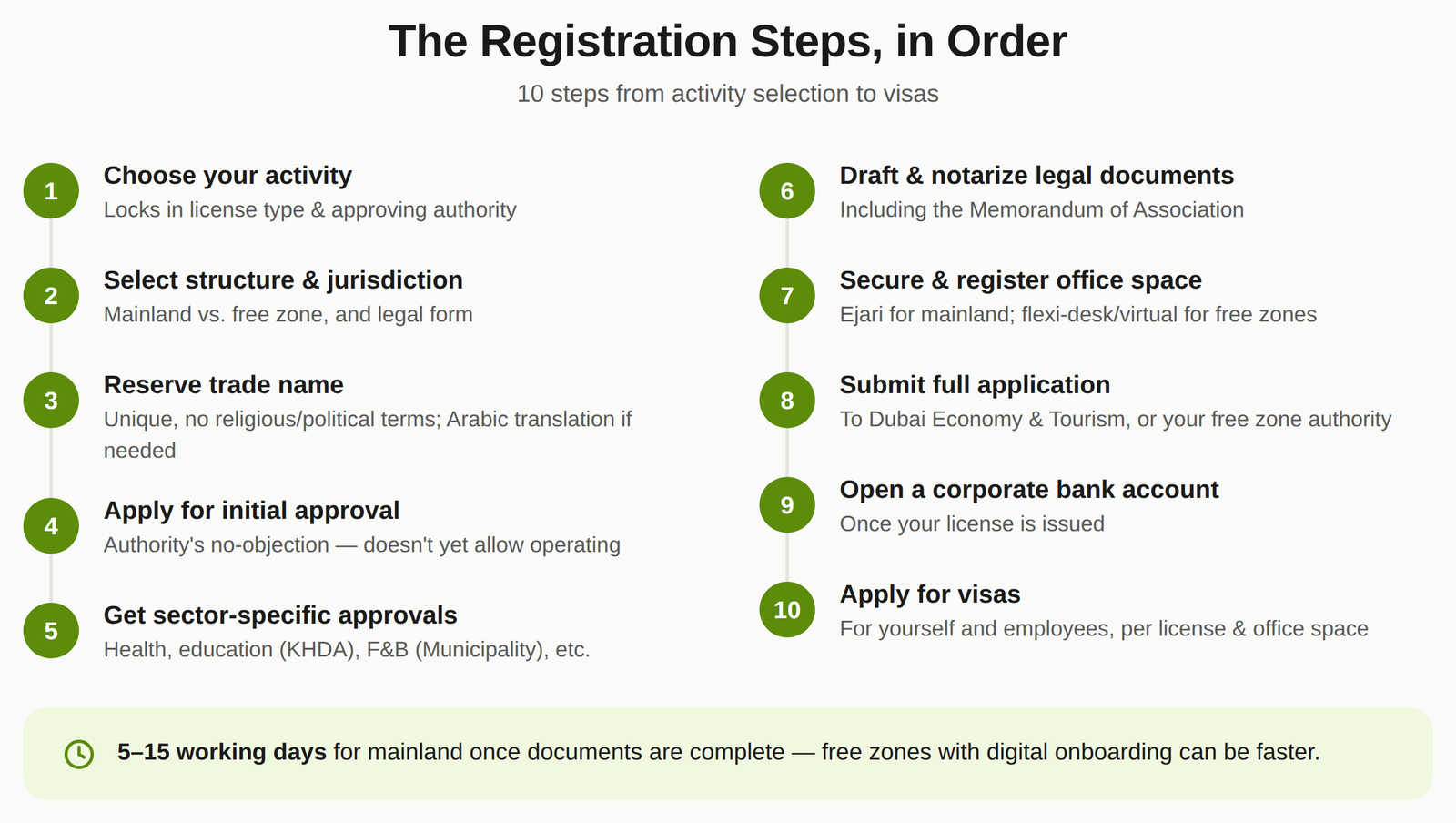
- Choose your business activity. This locks in your license type and the approving authority.
- Select your structure and jurisdiction. Mainland versus free zone, and the legal form that fits.
- Reserve your trade name. It must be unique, avoid religious or political references, and if it’s not in Arabic, needs an accurate Arabic translation. Names are typically held for a limited window while you complete the rest of the process.
- Apply for initial approval. This is the authority confirming it has no objection to your proposed activity; it doesn’t yet let you operate.
- Get sector-specific approvals if your activity needs them. Healthcare needs Ministry of Health sign-off, education needs KHDA, food and beverage needs Dubai Municipality, and so on.
- Draft and notarize your legal documents, including the Memorandum of Association where applicable.
- Secure your office space and register the lease. Mainland companies need a physical address registered through Ejari; many free zones offer flexi-desk or virtual office options.
- Submit your full application to Dubai Economy and Tourism (mainland) or your chosen free zone authority.
- Open a corporate bank account once your license is issued.
- Apply for visas for yourself and any employees, based on what your license and office space allow.
Most mainland applications, once documents are complete, take five to fifteen working days. Free zones with fully digital onboarding can sometimes issue a license within days.
What it costs and how long it takes
Total formation costs typically fall between AED 9,000 and AED 50,000, depending on jurisdiction, license type, and office arrangement, before visa and bank account costs. Free zones generally publish flat package pricing; mainland costs vary more with activity approvals and office rent. Budget separately for visa fees per person and, if your activity requires an LSA, that annual fee on top.
Free zone or mainland: which one actually fits
There’s no universal answer, only a fit for your client base:
- If most of your revenue will come from clients outside the UAE, or from other free zone companies, a free zone structure with QFZP status can deliver genuine 0% tax and full ownership.
- If you’re selling primarily to UAE mainland clients, retail, hospitality, or local services, a mainland company usually serves you better, even with the 9% rate above AED 375,000, because free zone companies face real restrictions on direct mainland trading.
- If your first-year revenue will stay under AED 3 million regardless of structure, Small Business Relief simplifies your first return either way, while that option remains available.
Frequently Asked Questions
Is Dubai really tax-free?
No, not since 2023. Corporate tax applies at 9% above AED 375,000 in taxable income, with 0% below that threshold and for Qualifying Free Zone Persons on their qualifying income. Personal income (salary, dividends) remains untaxed.
How long does business setup in Dubai take?
Typically five to fifteen working days for mainland once documents are complete, and often faster for free zones with digital onboarding. Sector approvals or complex ownership structures can extend this.
Do free zone companies pay any tax at all?
They’re taxable persons like any other UAE company, but can access a 0% rate on qualifying income if they meet all five Qualifying Free Zone Person conditions. Income that doesn’t qualify, including most direct mainland sales, is taxed at 9%.
Do I need to register for VAT immediately?
Only once your taxable turnover exceeds AED 375,000 in the past 12 months or is expected to in the next 30 days. Voluntary registration is available from AED 187,500 if reclaiming input VAT early is useful to you.
What’s the difference between a local sponsor and a Local Service Agent?
A local sponsor historically held equity, usually 51%, in a mainland company. A Local Service Agent holds no equity at all and is paid a fixed annual fee for administrative and licensing purposes. Most standard mainland LLCs need neither today; LSAs are now mainly required for sole establishments held by non-GCC nationals.
Conclusion
Setting up a business in Dubai is still genuinely fast and accessible compared with most jurisdictions, but the two assumptions that used to make the decision simple, mandatory local ownership and zero tax, no longer hold. What matters now is matching your activity to the correct ownership path and understanding exactly which of your income counts as qualifying, taxable, or exempt before you pick a jurisdiction. Get that sequence right and the rest of the registration process is genuinely straightforward.
Oak Business Consultant handles company registration in the UAE end to end, from activity selection through to your first corporate tax filing. If you’re also weighing up VAT registration timing, ongoing VAT return filing, visa and licensing support through our PRO services, or ongoing financial oversight once you’re operational through our Dubai CFO services, our team can walk you through the current rules for your specific activity before you file anything.