How to Start a Solar Panel Business: A Comprehensive Guide
Learn to Start a Solar Panel Business

Most guides to starting a solar business stop at “pick a niche and write a business plan.” They skip the part that actually determines whether you can legally operate and whether the math works: which license you need in your state, what a NABCEP certification is worth, what insurance a solar contractor actually carries, and what a residential installation really nets after costs. This guide covers all of it, with real profit ranges and the licensing and insurance steps most founders learn the hard way.
Why the solar panel business is still a strong bet
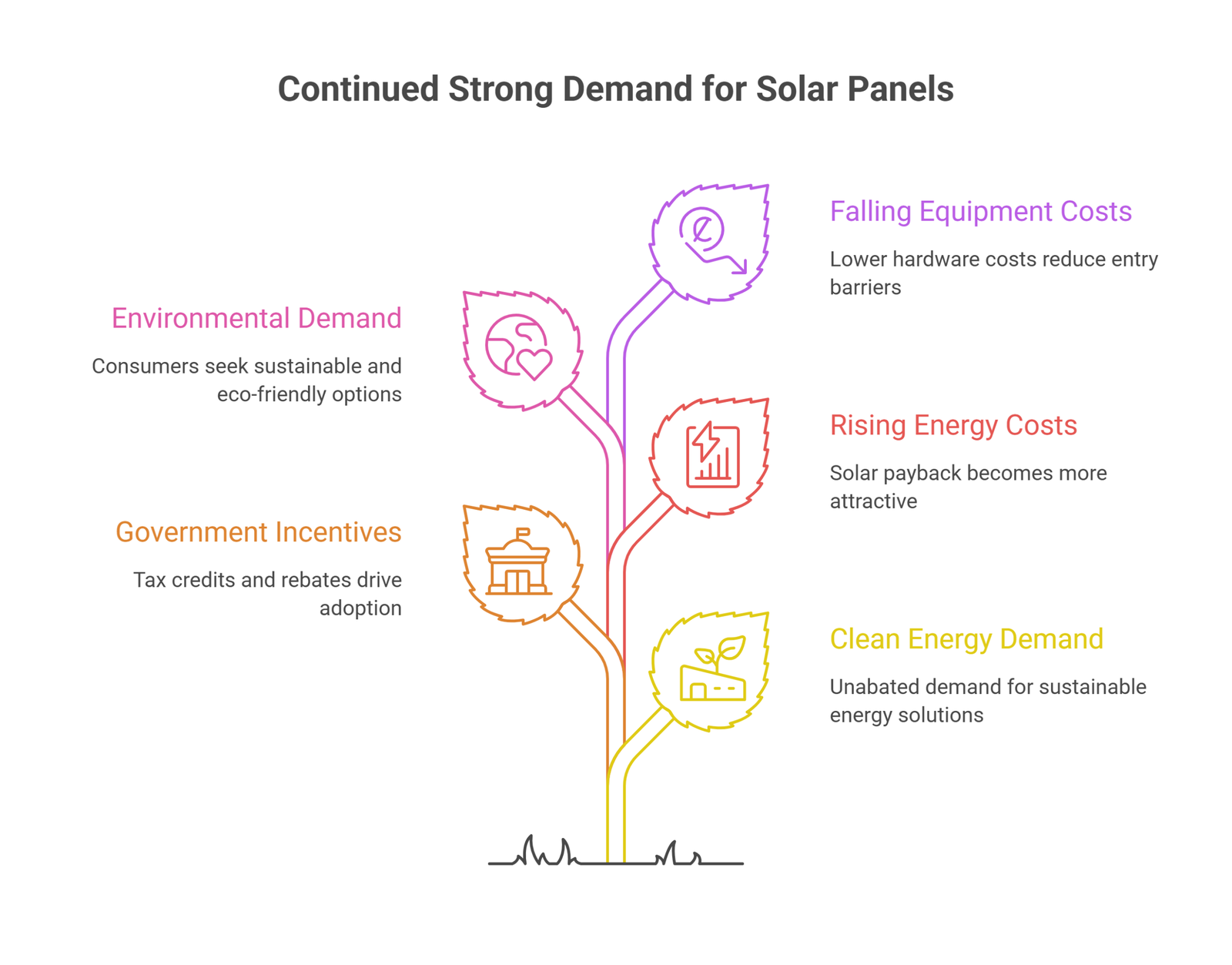
Demand for clean energy has not slowed down. Solar photovoltaic remains one of the fastest-growing segments of the energy sector, and both residential and commercial builders keep folding solar into new construction to meet efficiency standards and customer expectations. Governments continue to back the shift with tax credits, rebates, and financing programs that lower the up-front cost for buyers, which keeps the sales pipeline full for the businesses that install, finance, and maintain these systems.
Market growth
According to the Solar Energy Industries Association, U.S. solar capacity has grown enough in the past decade to power tens of millions of homes, and industry forecasts continue to point toward a rising share of U.S. homes carrying solar by the end of the decade. Solar installation work is also one of the fastest-growing trades in the country, which signals sustained demand for new entrants, not just established players.
Incentives that shape demand
Government incentives remain the single biggest driver of solar adoption. In the U.S., the federal Investment Tax Credit reduces the buyer’s tax bill by a percentage of system cost, and many states layer on their own rebates, solar renewable energy credits (SRECs), and property tax exemptions. In the UK, homeowners can access grant and interest-free loan schemes for solar and efficiency upgrades, along with zero-VAT treatment on solar installations in England, Scotland, and Wales. Because these programs change year to year and by jurisdiction, a serious solar business tracks them closely and uses them as a selling point in every pitch.
Rising energy costs and environmental demand
Electricity prices have trended upward for years, and supply shocks tied to geopolitical events have added further pressure. That makes the payback math on solar more attractive to homeowners and businesses alike. At the same time, a large and growing share of consumers say they actively look for sustainable options, even at a premium, which gives solar an audience that is not purely price-driven.
Falling equipment costs
Manufacturing scale, much of it concentrated in China, has pushed module prices down significantly since 2010 while improving durability and warranty coverage. Cheaper, more reliable hardware means lower barriers to entry for new installers and distributors, and stronger margins for businesses that negotiate well with suppliers.
Get a market analysis for your solar business before committing to a niche or a territory.
Types of solar panels for business purposes
Picking a panel type shapes your target customer, your price point, and your margins.
| Panel type | Advantage | Disadvantage | Lifespan | Best fit |
| Monocrystalline | Highest efficiency, sleek design, works in tight spaces | Higher install and setup cost | 25 to 40 years | Commercial buildings and urban homes with limited roof space |
| Polycrystalline | Lower cost, good for large arrays | Lower efficiency, shorter lifespan | 20 to 30 years | Solar farms, agricultural sites, businesses with ample space |
| Thin-film | Lightweight, flexible, cost-effective | Lowest efficiency, shortest lifespan | 10 to 20 years | Building facades, curved surfaces, portable devices |
You can build a business around one panel type and one customer segment, or diversify across all three depending on the niche you choose.
Business models: pick your lane in the solar industry
Solar businesses generally fall into a handful of models, and the one you choose determines your startup cost and your path to profit.
- Manufacturers design and produce panels, sourcing raw materials and managing certification across product lines. This is the most capital-intensive option but can carry the strongest margins at scale.
- Distributors and wholesalers buy in bulk from manufacturers and resell to retailers and installers, managing inventory and supplier relationships rather than end customers.
- Retailers sell finished panels directly to homeowners, businesses, or installers, focusing on marketing and customer acquisition rather than installation.
- Installers run a service business with no inventory to manage. This is usually the fastest and cheapest model to launch, provided you or your team hold the right electrical or solar contractor license.
- Solar energy consultants advise clients on system sizing, feasibility, and regulatory compliance without installing anything themselves.
- Solar financing companies offer loans, leases, or power purchase agreements (PPAs), in which the provider owns and maintains the system while the client pays a per-kWh rate below the utility price, typically over a 10 to 25 year contract.
- Solar software companies build design, monitoring, or maintenance-scheduling tools for the industry.
- Solar EPC firms (engineering, procurement, and construction) handle a project end to end, from needs assessment through commissioning.
Beyond these core categories, three niche add-ons are worth planning for from day one: off-grid systems for remote or rural customers, battery storage upsells for customers wanting energy independence, and EV charger installation, which can add meaningful revenue per job without requiring a new customer base.
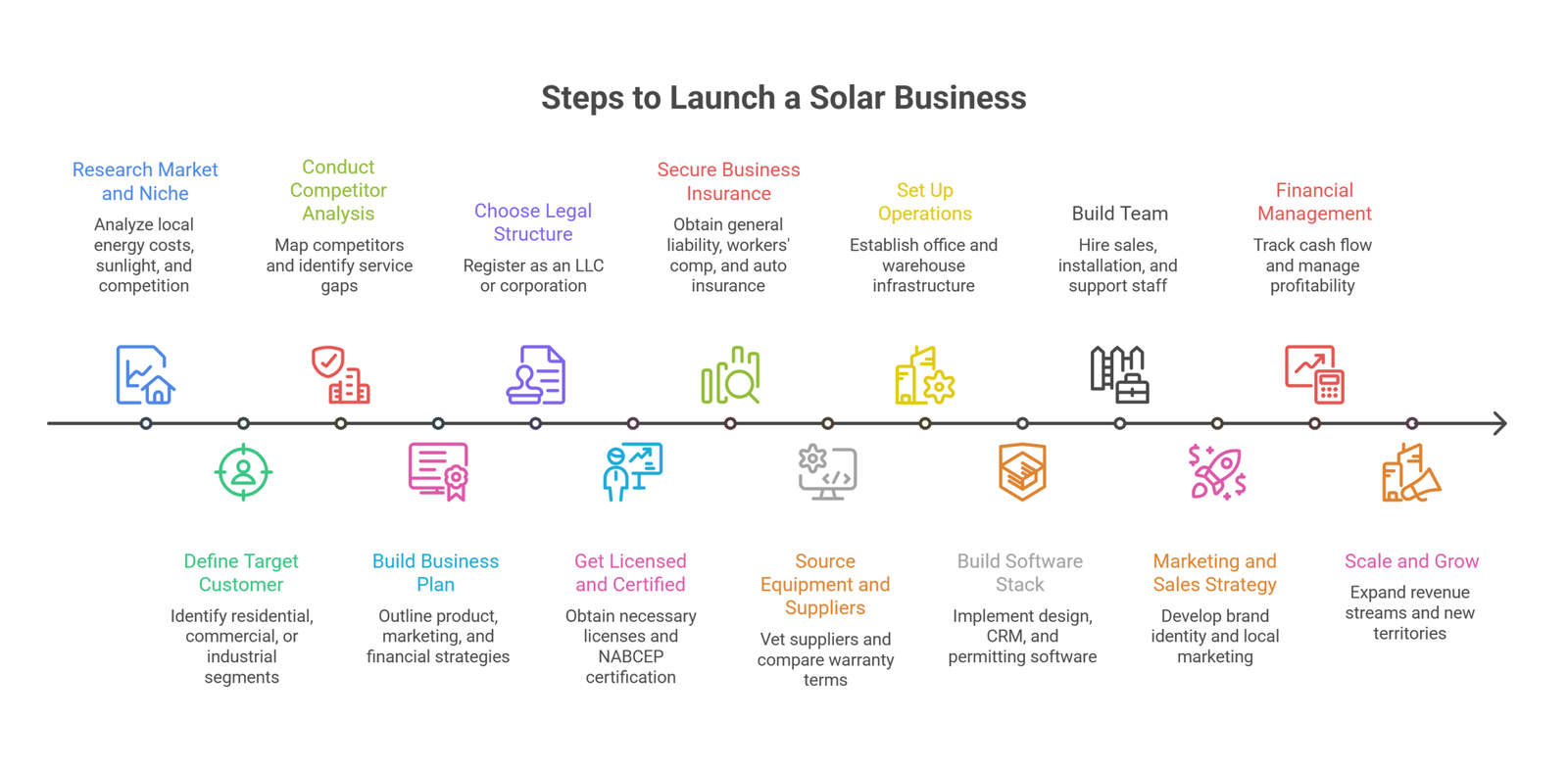
14 steps to launch a solar business
Step 1: research your market and pick a niche
Solar demand is high nationally, but viability is local. Look at your area’s energy costs, sunlight exposure, climate, and existing regulatory support before committing to a model. Study which segments are underserved. If your locality is saturated with residential installers, a commercial, industrial, or EPC angle may face far less competition.
Step 2: define your target customer
Startups do better focusing on one segment first, then expanding once established.
- Residential customers want lower electricity bills and energy independence.
- Commercial customers want to cut operating costs and strengthen their sustainability credentials, and often qualify for additional incentives.
- Industrial customers need large-scale systems and significant volume, with cost savings as the primary driver.
Step 3: run a real competitor analysis
Map every solar business already operating in your target area. Look at their pricing, their marketing channels, their reviews, and where their service clearly falls short. A gap in maintenance plans, financing options, or a specific niche (off-grid, EV charging, specific panel types) is often easier to win than trying to out-market an established player on price alone.
Step 4: build the business plan
A solar business plan needs to cover your product or service offering, target segments, marketing approach, sourcing and procurement, and a full financial section: startup costs, funding needs, and projected profit and loss. Investors and lenders will expect all of this before they commit capital, and it doubles as your own roadmap for the first 12 to 24 months.
Get a solar business plan template built around this exact structure.
Step 5: choose a legal structure and register the business
Most solar founders register as an LLC, which limits personal liability while remaining cheaper and simpler to run than a corporation. Setting one up generally means choosing a business name, filing articles of organization with your state, drafting an operating agreement, and applying for an Employer Identification Number (EIN) from the IRS, which is free and typically issued the same day online. After that, you will need any state-specific seller’s permits or business licenses before you can legally invoice a customer.
Step 6: get licensed and certified
This is the step most founders underestimate, and the one that determines whether you can legally install anything at all.
Licensing requirements vary by state. Many require a licensed electrician on staff, and some require a dedicated solar contractor license on top of that. If you plan to operate across state lines, you need to secure the correct license in every state where you take on work; a license in one state does not automatically transfer.
Beyond mandatory licensing, certification from the North American Board of Certified Energy Practitioners (NABCEP) is the recognized standard in the industry. NABCEP-certified installers and designers report meaningfully higher average earnings than uncertified peers, and certification builds trust with customers who are often making a five-figure purchase decision. Certified staff can also make it easier to expand into new municipalities, since some jurisdictions favor or require certified installers on permit applications.
Step 7: secure the right business insurance
Solar contracting carries real liability, both on the roof and in the equipment itself, and a solid insurance program should be in place before your first contract is signed. At minimum, plan for:
- General liability insurance, typically starting around $500,000 in coverage for contracting businesses
- Workers’ compensation for installation crews
- Commercial auto liability if staff drive to job sites
- Excess or umbrella liability for larger commercial projects
Manufacturer and workmanship warranties matter here too. A strong warranty program from your equipment suppliers, paired with your own workmanship guarantee, protects both your customer and your business from expensive callbacks.
Step 8: source equipment and suppliers
If you’re manufacturing, you’ll need raw material suppliers and the certifications tied to each panel type. If you’re distributing, retailing, or installing, focus on vetting suppliers directly: request ISO 9001 quality certification and IEC compliance documentation, compare warranty terms on both panels (typically 25-plus years) and inverters (10 to 25 years), and check each manufacturer’s financial stability so you’re not left supporting a warranty for a company that no longer exists. China remains the largest global source of panels, and many U.S. installers also work with established distributors like CED Greentech or WESCO for extended payment terms while they build working capital.
Step 9: set up operations
You’ll need an office for customer meetings and, depending on your model, a warehouse for inventory. Pick a location close to your primary customer base with easy transport access, and set up an inventory system that avoids both stockouts and excess capital tied up in unsold panels. Equip the office and warehouse for your specific workflow, and hire technical staff sized to your project volume rather than over-hiring before you have consistent monthly close rates.
Step 10: build a software stack
Soft costs, everything that isn’t hardware, make up over half the installed cost of a typical U.S. solar project, and permitting alone can account for a meaningful share of that. A modern solar business typically runs on:
- Design and production modeling software to size systems and forecast output
- A CRM to manage leads, proposals, and the customer journey from first contact to signed contract
- Permitting software or a dedicated permitting partner to track jurisdiction-specific requirements and reduce delays
- Digital proposal and e-signature tools to shorten the sales cycle
Some platforms bundle all of this into one system; others require stitching together separate tools for design, CRM, and permitting. Either way, budget for this stack from the start, since delayed permits and clunky proposals are two of the most common reasons early-stage solar businesses stall out.
Step 11: build your team
A solar business typically needs sales professionals, licensed installers, and, as you grow, dedicated project management, marketing, accounting, and customer service roles. Sales staff are usually paid on commission, as a percentage of contract value, which motivates performance but needs guardrails so reps don’t oversell systems customers don’t need. Prioritize NABCEP-certified hires where possible, and if your existing team isn’t certified, budget time and cost for them to get there.
Step 12: marketing and sales strategy
Build a clear brand identity and a simple, memorable business name, then invest in a professional, SEO-optimized website with a Google Business Profile listing. Local visibility matters more than broad brand awareness in this industry: most customers search for a solar company near them, not a national brand. Layer on print materials, community events, and referral incentives (“refer a friend” discounts work particularly well in solar), and make customer reviews part of your standard follow-up process, since testimonials do heavy lifting in a purchase this size.
Step 13: financial management and what solar businesses actually earn
Set up dedicated business banking, track cash flow closely, and build a financial model that reflects your actual project pipeline rather than optimistic averages.
On profitability: small to mid-sized solar installation companies typically run profit margins of 10 to 20 percent, with stronger incentive markets supporting margins closer to 25 to 30 percent. A single residential installation can generate $10,000 to $30,000 in revenue depending on system size, with $5,000 to $10,000 in profit per job once materials, labor, and overhead are covered. Commercial projects vary widely and can exceed $100,000 for larger jobs. Markets with higher electricity rates, generally $0.20 per kWh or above, tend to produce the best margins, since the customer’s savings case is stronger and price resistance is lower.
Factor these figures into every project quote and into your overall financial plan, not just your marketing pitch.
Model your solar business finances before you commit to a pricing strategy, and keep a close eye on cash flow, since solar projects often involve upfront material costs well before final payment lands.
Step 14: scale and grow
Once your core operation is stable, expand deliberately rather than all at once. Add adjacent revenue streams first: battery storage installations can add $10,000 to $25,000 to a project’s value, and EV charger installs typically add $1,500 to $3,000, both from your existing customer base. Understand net metering rules in every market you serve, since utility policy on crediting excess energy back to the grid directly affects your customer’s ROI pitch and can vary significantly between utilities in the same state. When you’re ready for new territory, expand zip code by zip code rather than jumping to a distant market, and confirm local permitting, licensing, and interconnection rules before signing your first contract there. Joint ventures with installers, real estate developers, or roofing contractors can also open new pipelines without the cost of building a new sales team from scratch.
Raise capital for expansion with a pitch deck built for solar-specific metrics and incentive programs.
Frequently Asked Questions
How does a solar photovoltaic system actually work?
Sunlight striking a semiconductor material in the panel knocks electrons loose, creating a direct current. An inverter then converts that direct current into the alternating current used in homes and businesses.
Do I need a special license to start a solar installation business?
It depends on your state. Many require a licensed electrician, some require a dedicated solar contractor license, and a few require both. Confirm requirements in every state or municipality you plan to serve before taking on work there.
Is NABCEP certification worth getting?
Yes, for most installers and designers. It’s the industry’s recognized credential, it’s linked to higher average pay, and it builds buyer confidence in a purchase that often runs into five figures.
What’s the difference between commercial and residential solar panels?
Commercial systems are larger, with higher power output for greater energy demands, and may include features like solar tracking. Residential systems are smaller and sized to household use.
How much profit can a solar business realistically make?
Small to mid-sized installers typically see 10 to 20 percent margins, rising toward 25 to 30 percent in strong incentive markets. A single residential job often nets $5,000 to $10,000 in profit.
What insurance does a solar business need?
At minimum, general liability, workers’ compensation, and commercial auto liability if staff travel to job sites. Larger commercial work often calls for umbrella liability on top of that.
What is net metering, and why does it matter for sales?
Net metering is the utility policy that credits customers for excess electricity their system sends back to the grid. Rules vary by utility and state, and they directly shape how strong a customer’s payback pitch looks, so know the local policy before you quote a project.
Conclusion
The solar panel industry still offers a real opportunity, but the businesses that succeed are the ones that treat licensing, insurance, and financial planning as seriously as they treat sales and marketing. Get the legal structure, certifications, and numbers right from day one, and the rest of the business has a real foundation to grow on.
Get the financial guidance your solar business needs with Oak Business Consultant. Contact Oak today to build the financial plan behind your launch.