Budget Analyst vs Financial Analyst: What’s the Difference?
Budget Analyst vs Financial Analyst
Two of the most in-demand finance careers, side by side. Here is everything you need to know before choosing one, hiring one, or becoming one.
Who Is a Budget Analyst?
A budget analyst is the person inside an organization who keeps the financial plan honest. Their job is to make sure that every dollar being spent lines up with what the organization actually planned to spend, and to raise a flag when things start to drift.
You will find budget analysts in government agencies, universities, hospitals, nonprofits, and large corporations. Anywhere that needs to track money coming in and going out against a predetermined plan, there is typically a budget analyst involved.
Their work is fundamentally internal. They are not watching the stock market or advising clients on portfolio allocations. They are watching the budget, department by department, month by month, making sure the organization’s spending reflects its priorities.
A good budget analyst is part number-cruncher, part detective, and part communicator. They need strong analytical skills to read the data accurately, but they also need to explain what they found to department heads and executives who may not be finance people.
Responsibilities of a Budget Analyst
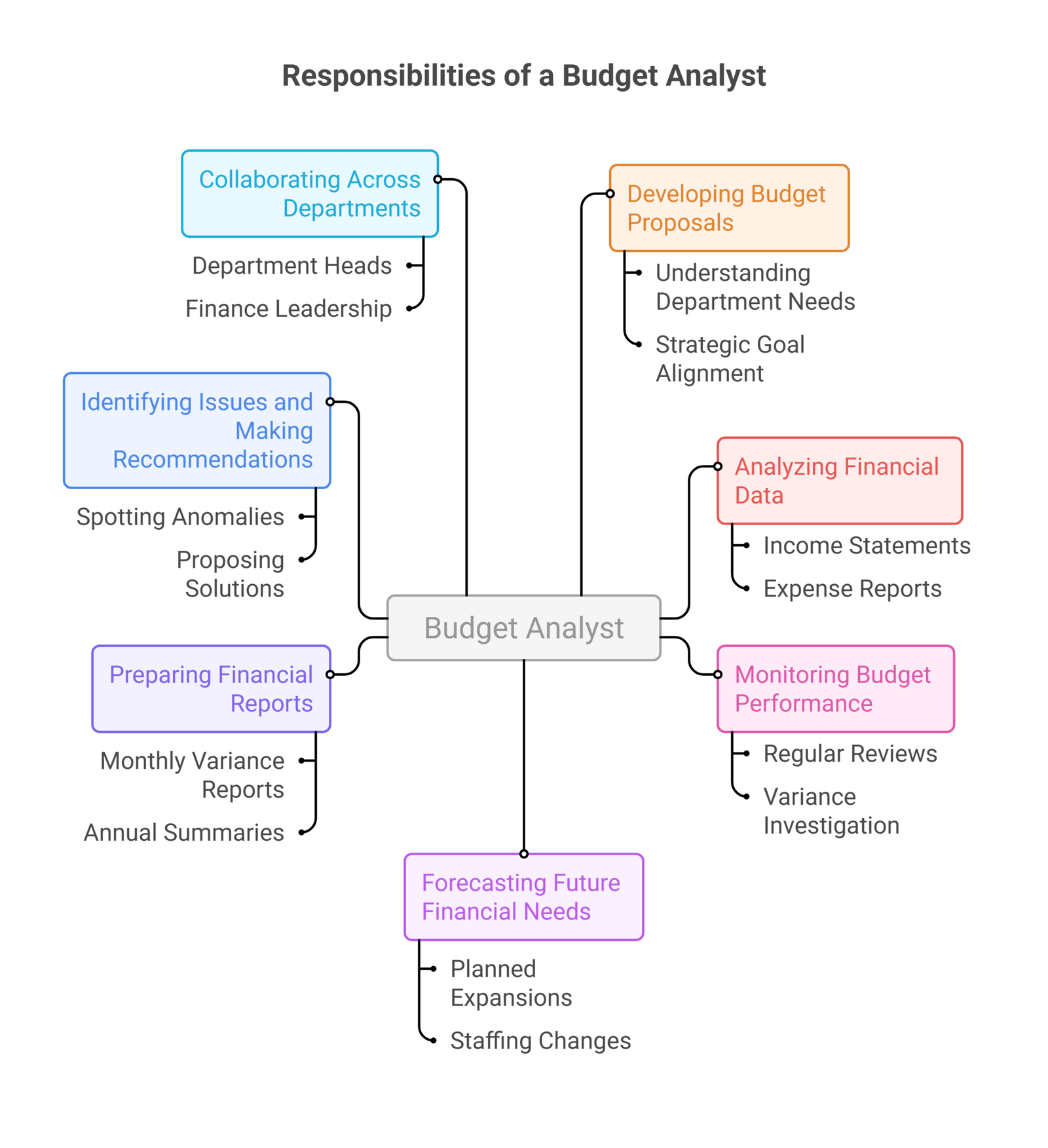
1. Developing Budget Proposals
The budget proposal is the foundation of everything a budget analyst does. Before a new fiscal year begins, the analyst works with department heads to understand what each team needs, what they are likely to spend, and what resources are realistically available.
This is not just a matter of copying last year’s numbers and adding a percentage. A strong budget proposal accounts for the organization’s current financial position, its strategic goals, and any anticipated changes in costs or revenue. The analyst has to ask hard questions: Is this spending actually necessary? Is there a more efficient way to achieve the same outcome? What happens if revenue comes in lower than projected?
Once the proposal is drafted, the analyst presents it to leadership for review and approval. This involves explaining the logic behind every major line item, fielding questions, and often going back to rework sections based on feedback.
2. Analyzing Financial Data
Budget analysts spend a significant portion of their time reviewing financial data: income statements, expense reports, historical spending patterns, and forecasts. The goal is to build a clear picture of where the organization stands financially and where it is heading.
This analysis is what makes forecasting possible. Without a thorough understanding of how money has moved through the organization in the past, any projection about the future is little more than a guess. Budget analysts turn historical data into insight, and insight into accurate planning.
Tools like Microsoft Excel, SAP, Oracle, and Workday are commonly used in this work. Advanced proficiency in spreadsheet modeling is often a minimum expectation for the role.
3. Monitoring Budget Performance
Creating the budget is only half the job. The other half is watching what actually happens versus what was planned.
Budget analysts review actual spending on a regular basis, sometimes monthly, sometimes quarterly, and compare it against budget targets. When variances appear, they investigate. Was the overspending a one-time event or a sign of something structural? Is a department consistently under-utilizing its budget in a way that suggests the allocation needs to be rethought?
This ongoing monitoring is what allows organizations to course-correct before small problems become large ones. A budget analyst who only checks in at year-end is not doing much good.
4. Forecasting Future Financial Needs
Looking forward is just as important as tracking what has already happened. Budget analysts develop financial forecasts that help leadership understand what the organization will need in the coming quarters and years.
These forecasts take into account things like planned expansions, expected changes in staffing, anticipated cost increases due to inflation or supplier changes, and shifts in revenue. The goal is to ensure the organization is never caught off guard by something that could have been anticipated.
5. Preparing Financial Reports
Budget analysts translate complex financial data into reports that are clear, accurate, and actionable. These might take the form of monthly budget variance reports, annual financial summaries, or presentations for senior leadership or board members.
The reports often include charts, graphs, and written narratives that give context to the numbers. A 15% variance in one department means very different things depending on the circumstances, and a good budget analyst makes sure that distinction comes through clearly in the reporting.
6. Identifying Issues and Making Recommendations
When something is wrong, the budget analyst is usually the first person to see it. They are trained to spot anomalies: unusual spending patterns, departments consistently exceeding their allocations, revenue that is tracking below projections.
Finding the issue is step one. Step two is figuring out why it is happening. Step three is recommending what to do about it. Budget analysts do not just report problems; they are expected to bring proposed solutions to the table.
7. Collaborating Across Departments
Budget work does not happen in isolation. A budget analyst regularly works with department heads, program managers, HR, procurement, and finance leadership to gather information, validate assumptions, and align the budget with operational reality.
This cross-departmental collaboration is what keeps the budget from being a document that lives in a spreadsheet and has no connection to what is actually happening in the organization. The more embedded the budget analyst is in the day-to-day operations of each team, the more useful and accurate the budget becomes.
Qualifications for a Budget Analyst
Education: A bachelor’s degree in accounting, finance, business administration, economics, or a related field is the standard minimum. Many employers, particularly in government and healthcare, prefer candidates with a master’s degree.
Technical skills: Proficiency in Excel is non-negotiable. Experience with financial planning software such as Adaptive Planning, Anaplan, Oracle Hyperion, or similar platforms is a strong asset.
Analytical ability: Budget analysts need to be comfortable working with large datasets and spotting patterns that are not immediately obvious.
Communication skills: This role requires presenting financial information to people who are not finance experts. Being able to explain a budget variance clearly and concisely is just as important as being able to calculate it.
Relevant experience: Entry-level budget analyst roles typically require one to three years of experience in finance or accounting. Senior roles often require significantly more.
Certifications: While not always required, credentials like the Certified Government Financial Manager (CGFM) or Certified Defense Financial Manager (CDFM) can be valuable, particularly in the public sector.
Who Is a Financial Analyst?
A financial analyst takes a broader view of money. Where a budget analyst is focused on an organization’s internal spending plan, a financial analyst is typically looking outward: at markets, investments, competitors, valuations, and long-term financial strategy.
Financial analysts work in a wide range of settings. You will find them at investment banks, asset management firms, private equity firms, hedge funds, corporate finance departments, and consulting firms. Their work directly influences decisions about where capital should go and why.
The core of the job is analysis: taking large amounts of financial data and using it to generate insights and recommendations. Those recommendations might be about whether to acquire another company, how to structure a capital raise, which investments belong in a portfolio, or how to optimize a company’s balance sheet.
Responsibilities of a Financial Analyst
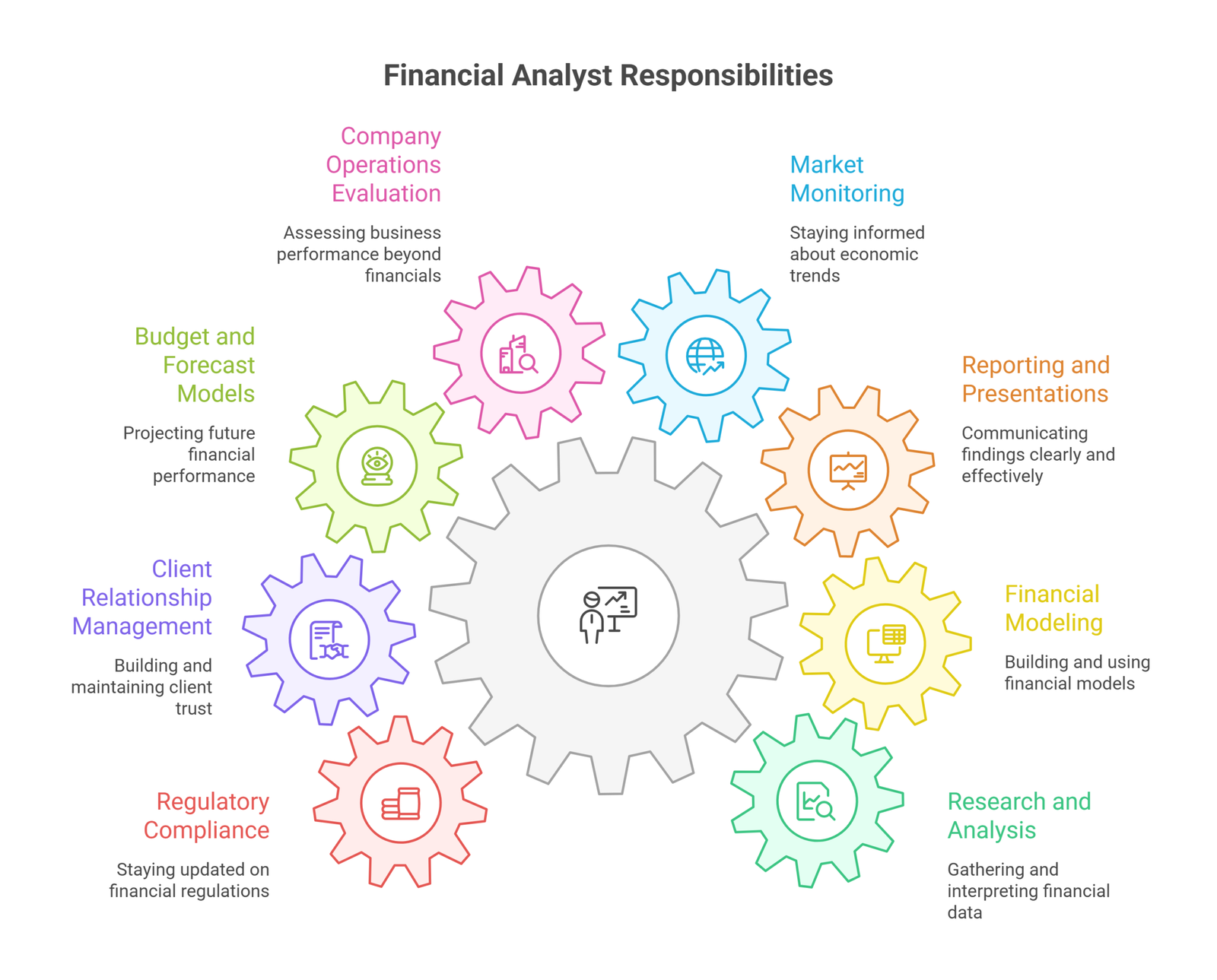
1. Research and Financial Analysis
Financial analysts spend a lot of their time researching: reading financial statements, studying industry reports, modeling company valuations, and analyzing macroeconomic data. The goal is to build a nuanced, evidence-based view of a company’s financial health or an investment opportunity’s potential.
This research process involves both quantitative and qualitative methods. Quantitative analysis includes building financial models, running discounted cash flow valuations, and analyzing ratios. Qualitative analysis means understanding the business, the competitive landscape, the management team, and the risks that do not show up cleanly in a spreadsheet.
2. Building Financial Models
Financial models are one of the most important tools in a financial analyst’s kit. A model might be a three-statement model connecting the income statement, balance sheet, and cash flow statement. It might be a discounted cash flow (DCF) model used to estimate the intrinsic value of a company. Or it could be a merger model used to evaluate whether an acquisition makes financial sense.
Building these models requires both technical Excel proficiency and a deep understanding of accounting and finance principles. A model is only useful if its assumptions are grounded in reality and its logic is sound.
3. Preparing Reports, Charts, and Presentations
Financial analysts communicate their findings through detailed reports and presentations. These documents need to be clear, well-structured, and compelling. They are often reviewed by senior executives, investment committees, or clients who have limited time and high standards.
Effective data visualization is increasingly important in this work. The ability to take complex financial data and present it in a way that tells a clear story is a skill that separates good analysts from great ones.
4. Monitoring Economic and Market Trends
Financial analysts keep a constant eye on the broader economic environment. Interest rates, inflation, currency movements, regulatory changes, industry disruptions: all of these can affect the financial performance of companies and the attractiveness of investments.
Staying informed requires reading widely, following market news, attending industry events, and maintaining a network of informed contacts. The best financial analysts develop a kind of sixth sense for spotting trends early and understanding their implications before they become obvious.
5. Evaluating Company Operations
When analyzing a business, financial analysts look beyond the financial statements. They evaluate the company’s operations, competitive position, management quality, customer base, and growth prospects. The goal is to understand not just how the business is performing today, but whether its underlying economics are strong enough to sustain performance over time.
6. Developing Budget and Forecast Models
Financial analysts also get involved in forecasting, particularly in corporate finance settings. They build models that project future revenues, costs, and cash flows based on a range of assumptions. These forecasts are used for planning, fundraising, valuation, and strategic decision-making.
Unlike the budget monitoring done by budget analysts, the financial analyst’s forecasting work tends to be more scenario-based and forward-looking, exploring multiple possible futures rather than tracking performance against a fixed plan.
7. Managing Client and Stakeholder Relationships
In client-facing roles, financial analysts are responsible for building and maintaining relationships. This means understanding what clients need, communicating findings clearly, and being responsive when questions arise. Relationship management is not just a soft skill here; it is a core part of delivering value.
8. Staying Current on Regulations and Laws
Financial markets are heavily regulated, and the rules change. Financial analysts need to stay up to date on relevant regulations, whether that involves securities law, accounting standards, tax rules, or industry-specific compliance requirements. Failing to account for regulatory changes can lead to significant errors in analysis and recommendations.
Qualifications for a Financial Analyst
Education: A bachelor’s degree in finance, accounting, economics, or a related quantitative field is the standard entry point. Many employers in investment banking and asset management strongly prefer or require an MBA or other advanced degree.
Technical skills: Advanced Excel modeling is essential. Proficiency with Bloomberg Terminal, Capital IQ, or similar financial data platforms is commonly expected. Knowledge of SQL, Python, or R is increasingly valued, particularly in quantitative roles.
Analytical thinking: Financial analysts need to be able to synthesize large amounts of information from multiple sources and arrive at clear, defensible conclusions.
Communication: The ability to write clearly and present findings persuasively is critical. Analysts who cannot communicate their analysis effectively will always be limited in their impact.
Relevant experience: Internships in finance during undergraduate study are often the entry point. Full-time analyst roles at banks or consulting firms typically require two to four years of experience before moving to more senior positions.
Professional certifications: The Chartered Financial Analyst (CFA) designation is widely regarded as the gold standard for investment-focused financial analysts. The CFA program covers portfolio management, equity analysis, fixed income, derivatives, and ethics, and passing all three levels requires several hundred hours of study. Other relevant credentials include the Certified Public Accountant (CPA), Certified Financial Planner (CFP), and Chartered Investment Counselor (CIC).
Key Differences: Budget Analyst vs Financial Analyst
Focus area: Budget analysts focus on the internal financial management of a specific organization. Financial analysts focus on external markets, investments, and broad financial strategy.
Time horizon: Budget analysts typically work on annual or quarterly budget cycles. Financial analysts often think in terms of multi-year projections and long-term value.
Who they work for: Budget analysts are most commonly found in government agencies, nonprofits, hospitals, and large corporations. Financial analysts tend to work for financial institutions, investment firms, banks, or in corporate finance departments.
Primary output: The budget analyst’s primary deliverable is a budget and the reports that track performance against it. The financial analyst’s primary deliverable is analysis, recommendations, and models that inform investment or strategic decisions.
Regulatory context: Financial analysts operate within a heavily regulated environment, particularly those working in securities. Budget analysts deal with financial regulations too, but their work is more tied to internal policy and accounting standards than to securities law.
Career trajectory: Budget analysts often move into roles like finance director, CFO of a mid-sized organization, or management consulting. Financial analysts who stay on the investment side may move into portfolio management, equity research, or private equity. Those in corporate finance often become finance managers, FP&A leads, or CFOs of larger organizations.
Side-by-Side Comparison Table
| Dimension | Budget Analyst | Financial Analyst |
| Primary focus | Internal budget management | Investment analysis and financial strategy |
| Typical employers | Government, nonprofits, hospitals, corporations | Banks, investment firms, corporate finance |
| Core output | Budget proposals, variance reports | Financial models, investment recommendations |
| Time orientation | Annual/quarterly cycles | Multi-year, long-term |
| Key tools | Excel, ERP systems, budget software | Excel, Bloomberg, Capital IQ, Python |
| Top certification | CGFM (government sector) | CFA, CPA, CFP |
| Average US salary | $79,000-$95,000 | $90,000-$130,000+ |
| Growth outlook | Steady, driven by public sector demand | Strong, driven by market complexity |
| Degree requirement | Bachelor’s (finance, accounting) | Bachelor’s; MBA often preferred |
Where They Overlap
Despite their differences, budget analysts and financial analysts share some important common ground.
Both roles require strong analytical skills and comfort working with large datasets. Both require the ability to translate complex financial information into clear, actionable communication for non-finance audiences. Moreover, both are expected to understand accounting principles, economic trends, and the financial drivers of organizational performance.
In many organizations, particularly smaller companies and startups, a single person is expected to cover both functions. Understanding both roles helps you understand what that person actually does day to day.
When budget analysts and financial analysts work together in larger organizations, the collaboration can be genuinely powerful. The budget analyst’s deep knowledge of internal spending patterns combines with the financial analyst’s external market perspective to give leadership a much more complete picture of where the organization stands and where it should be headed.
Which Role Does Your Organization Actually Need?
This is a practical question that many finance leaders and business owners face.
If your primary challenge is controlling costs, improving budget discipline, and making sure spending aligns with your strategic plan, you need a budget analyst. This is especially true if you are in a growth phase and struggling to keep departmental spending in check.
If your primary challenge is evaluating investment opportunities, raising capital, understanding your valuation, or analyzing competitors and markets, you need a financial analyst. This is especially relevant if you are preparing for a fundraising round, considering an acquisition, or entering a new market.
If your organization is large enough and complex enough, you may well need both. They serve different but complementary purposes, and the organizations that do financial management best tend to have strong capabilities in both areas.
Salary and Job Outlook
According to the U.S. Bureau of Labor Statistics, budget analysts earned a median annual salary of around $82,000 as of recent data, with the top 10% earning above $120,000. Employment in the field is projected to grow steadily, driven largely by ongoing demand in federal, state, and local government agencies.
Financial analysts earned a median annual salary of around $99,000, with significant variation depending on industry and specialization. Those working in investment banking, securities, and commodities tend to earn substantially more. Employment growth for financial analysts is projected to be healthy, driven by increasing complexity in global financial markets and the growing need for data-driven investment decisions.
Both roles offer strong long-term career prospects, though the financial analyst path tends to offer higher earning potential in the upper levels of the profession.
Frequently Asked Questions
Can a budget analyst become a financial analyst?
Yes, and it happens more often than you might think. Both roles share a foundation in financial analysis, and the skills built in budget analysis (modeling, reporting, data interpretation) transfer well. The main areas to develop when making that transition are investment analysis, financial modeling for valuation purposes, and market knowledge. Pursuing a CFA or MBA can help bridge the gap.
Which role is better for someone who wants to work in government?
Budget analysis is far more common in government settings. Federal agencies, state governments, and municipalities all employ large numbers of budget analysts to manage public funds and prepare budget justifications for legislative review. The CGFM certification is particularly relevant for this path.
Do budget analysts or financial analysts earn more?
Financial analysts typically earn more on average, particularly those working in investment banking, private equity, or asset management. However, senior budget analysts in large government agencies or corporations can earn very competitive salaries. The gap is most pronounced at the upper end of the pay scale.
What is the single biggest difference between the two roles?
The clearest way to think about it is this: a budget analyst looks inward, asking “Are we spending our money the way we planned to?” A financial analyst tends to look outward, asking “Where should we deploy our money and why?” One is about control and discipline; the other is about strategy and growth.
What industries hire the most financial analysts?
Financial services (banking, insurance, asset management) and technology are the largest employers of financial analysts. Healthcare, energy, and real estate also employ significant numbers, often in corporate finance or FP&A (financial planning and analysis) roles.
Conclusion
Budget analysts and financial analysts are both essential to the financial health of modern organizations, but they are doing fundamentally different work.
A budget analyst is focused on the inside of an organization: how money is being planned, spent, monitored, and reported. Their job is to ensure financial discipline and help leadership make informed decisions about resource allocation. They are most at home in environments where accountability, cost control, and compliance are priorities.
A financial analyst is focused more broadly: on markets, investments, valuations, and long-term financial strategy. Their job is to generate insight that drives growth and helps organizations make smart decisions about capital. They are most at home in environments where strategic thinking, market analysis, and investment decision-making are core activities.
For organizations, the key is understanding which set of challenges is most pressing. Cost control and budget discipline point toward a budget analyst. Investment decisions and financial strategy point toward a financial analyst. Many mature organizations need both, working in complementary ways.
For individuals considering a career path, both offer strong long-term prospects, competitive salaries, and meaningful work. The right choice depends on where your interests and strengths lie. If you are drawn to the detail of organizational spending and the satisfaction of keeping a complex budget on track, budget analysis is a rewarding career. If you are drawn to markets, valuation, and the thrill of making high-stakes investment recommendations, financial analysis is the path worth pursuing.
Either way, both roles demand intellectual rigor, strong communication skills, and a genuine passion for making sense of numbers. Get those foundations right, and either career is open to you.