Accounting for Entrepreneurs The Guide to Financial Success
Mastering Accounting for Entrepreneurial Growth
Most entrepreneurs start with passion and a good idea. Without solid financial knowledge, even the best idea can fail anyway. Accounting for entrepreneurs isn’t just about tracking expenses. It’s about understanding the financial language your business speaks every day, from the moment you register it.
Poor financial management is one of the top reasons small businesses fail. This guide walks through that, starting with the decisions you make before you’ve sent a single invoice, through to the statements and controls that matter once you’re raising capital. Whether you’re launching a startup or scaling an established company, mastering accounting for entrepreneurs gives you a real edge.
What is accounting for entrepreneurs?
Accounting for entrepreneurs is the process of recording, tracking, and analyzing your business finances. It covers everything from daily bookkeeping to long-term financial planning, and it helps you make smarter decisions, attract investors, and stay compliant with tax laws.
Unlike corporate accounting, entrepreneurial finance means wearing multiple hats. You’re the decision-maker and the financial analyst at the same time, which makes financial literacy your most important skill outside your core product or service.
Understanding your numbers isn’t optional. It’s survival.
Why financial literacy matters more than you think
Many founders underestimate the role of financial literacy in business growth. They focus on marketing and product development while ignoring cash flow, and that’s a costly mistake.
Financial literacy means you can read your financial statements with confidence. It means you understand when your business is healthy and when warning signs are flashing, and it means you can have meaningful conversations with your accountant, investors, and lenders without feeling lost.
Entrepreneurs who build financial literacy early in the company lifecycle make better hiring decisions, smarter pricing choices, and stronger growth strategies. The numbers tell a story. Your job is to learn how to read it.
Getting started: the decisions that come before your first invoice

Before you touch a spreadsheet, three decisions shape almost everything downstream: how your business is structured, where its money lives, and how it gets paid.
Choosing your business structure
How you register your business determines your tax obligations, your personal liability, and how complex your books will be from day one.
- Sole proprietorship: the simplest and cheapest option. There’s no legal separation between you and the business, so you report business income on your personal tax return, but you’re also personally liable for business debts.
- Limited liability company (LLC): separates your personal assets from business liabilities while still giving you flexibility in how you’re taxed, either as a pass-through entity or as a corporation.
- Partnership: works if you’re sharing ownership with someone else. Get a formal partnership agreement in place early; it’s far easier to write down roles and expectations before money is involved than after a disagreement.
- Corporation: the most complex and expensive structure to set up, but it offers the strongest liability protection and, depending on your situation, more favorable tax treatment on growth and reinvestment.
The right structure depends on your revenue level, industry, and growth plans, and it’s a decision worth revisiting as the business matures. A sole proprietorship that starts generating meaningful profit, for instance, often benefits from converting to an LLC or S-corp structure to reduce self-employment tax.
Separating business and personal finances
Open a dedicated business bank account before you take your first payment. If you don’t, you’ll lose track of business expenses, complicate every report you try to build, and in some structures, weaken the liability protection the structure was supposed to give you.
A business checking account is usually enough to start. Compare fees across banks, check that ATMs or branches are convenient if you handle cash, and confirm the account’s transaction limits actually fit your volume. Once it’s open, connect it to whatever bookkeeping tool or spreadsheet you’re using so transactions import automatically instead of getting keyed in by hand.
Setting up how you’ll get paid
Decide how clients or customers will pay you before you need the answer mid-sale. Options scale with your business: checks and cash work for the simplest setups, a point-of-sale system makes sense if you have a physical location, and online payment links or invoicing software cover most service businesses. Faster, more flexible payment options tend to get you paid faster too, so it’s worth setting this up properly rather than defaulting to whatever’s easiest on day one.
Cash-basis accounting vs. accrual-basis accounting
One of the first accounting decisions you’ll make is choosing your method. The two main options are cash-basis accounting and accrual-basis accounting.
Cash-basis accounting
With cash-basis accounting, you record revenue when cash is received and expenses when cash is paid. It’s simple and easy to manage, and it works well for freelancers, sole proprietors, and very small businesses.
The main advantage is clarity: you always know exactly how much cash you have on hand. The downside is that cash-basis accounting can give you an inaccurate picture of long-term profitability, since it ignores money you’ve earned but haven’t collected yet.
Accrual-basis accounting
Accrual-basis accounting records revenue when it’s earned and expenses when they’re incurred, regardless of when cash actually moves. It follows GAAP principles and is required for most incorporated businesses above a certain revenue threshold.
The benefit is accuracy: it matches income with the expenses that generated it, which makes your financial statements far more reliable for planning, reporting, and fundraising. For growth-oriented businesses, switching to accrual-basis accounting early sets you up for credible financial reporting when it matters most.
Core financial statements every entrepreneur must understand
Your financial statements are the scorecards of your business. Accounting for entrepreneurs requires you to not only produce these documents but understand what they reveal.
The income statement
The income statement shows your revenue, expenses, and net profit or loss over a specific period. It answers the fundamental question: is your business making money?
This is where you perform break-even analysis. Knowing your break-even point tells you the minimum revenue needed to cover all costs, which informs pricing, hiring, and expansion timing.
A strong income statement also helps you measure return on investment for marketing campaigns, new hires, or product launches, and it’s useful for calculating the payback period on major investments, how long it takes to recover the cost of a capital purchase from the profits it generates.
The balance sheet
The balance sheet is a snapshot of your business at a single point in time. It shows your assets, liabilities, and owner’s equity, and the balance across all three categories must always hold: assets equal liabilities plus equity.
Reviewing your balance sheet regularly shows you whether that balance is moving in the right direction over time. Lenders and venture capitalists will scrutinize it before offering any financing, and a clean, well-organized balance sheet builds investor confidence immediately.
The cash flow statement
The cash flow statement tracks every dollar entering and leaving your business, divided into operating, investing, and financing activities.
Many profitable businesses still fail because they run out of cash. Here’s how that happens in practice: a small retailer records a sale the moment an order ships, even though the customer has 60 days to pay. The income statement looks healthy all quarter. Meanwhile, payroll and supplier invoices are due in 15 and 30 days, well before that cash actually arrives. By the time the owner notices the gap on a bank statement, they’re already short for payroll. The cash flow statement is what would have shown the mismatch weeks earlier, which is why it should be reviewed at least monthly, not just glanced at when something feels off.
Pro forma financial statements
Pro forma financial statements are forward-looking projections, not historical records. They show what your finances are expected to look like based on specific assumptions about revenue, costs, and growth.
They’re critical when raising capital. Angel investors and venture capitalists expect to see pro forma statements before writing a check, and banks require them before approving loans. They’re also essential for internal planning, because building them forces you to think through scenarios before committing resources.
Build pro forma statements for at least three scenarios: conservative, base, and optimistic, and update them regularly as real data comes in. Well-constructed projections signal to every stakeholder that you’re running the business with discipline, not guesswork.
Accounts receivable and accounts payable
Accounts receivable is money owed to your business by customers. Accounts payable is money your business owes to suppliers and vendors. Both directly affect your cash flow.
Slow accounts receivable collection is one of the most common cash flow problems entrepreneurs face. Strong credit management, clear payment terms, and timely invoicing can dramatically reduce this risk. Monitoring accounts payable carefully ensures you never miss a payment that could damage a supplier relationship you need.
The accounting cycle explained
The accounting cycle is the repeatable process of recording and processing every financial transaction in your business. It starts with identifying a transaction and ends with producing your financial statements.
A clean accounting cycle means accurate books. Accurate books mean reliable data. Reliable data means better decisions. When entrepreneurs skip steps in the cycle, errors compound over time and become expensive to unwind.
Running a disciplined accounting cycle also prepares you for audits, investor due diligence, and tax filing with far less stress than trying to reconstruct months of records after the fact.
Financial planning and the cash budget
Financial planning is the process of setting financial goals and building a roadmap to reach them. For entrepreneurs, it covers everything from monthly expense projections to multi-year growth targets.
A cash budget is one of the most practical tools available. It forecasts your cash inflows and outflows over a future period, usually monthly or quarterly, and it prevents the common scenario where revenue looks good on paper while the bank account is empty.
Good financial planning also involves scenario analysis. What happens to cash flow if a major client leaves? What if a supplier raises prices 20%? Running these scenarios through your projections gives you options instead of surprises.
Financial planning isn’t a one-time event. It’s an ongoing process that keeps your business aligned with your goals and your cash flow in check.
Financial accounting and reporting standards
Financial accounting is the formal process of preparing financial statements for external users: investors, lenders, tax authorities, and regulators. It follows established standards to ensure consistency and comparability across businesses.
For US businesses, GAAP principles govern financial accounting. They ensure your statements are prepared consistently and that outside parties can trust what they read. As your business grows, GAAP compliance becomes increasingly important for credibility, compliance, and access to capital.
Financial reporting is the act of communicating your results to stakeholders. Clean, timely reporting builds trust across the board. It shows lenders you’re organized, shows investors you’re disciplined, and shows employees and partners the business is on solid ground.
Tax obligations entrepreneurs cannot ignore
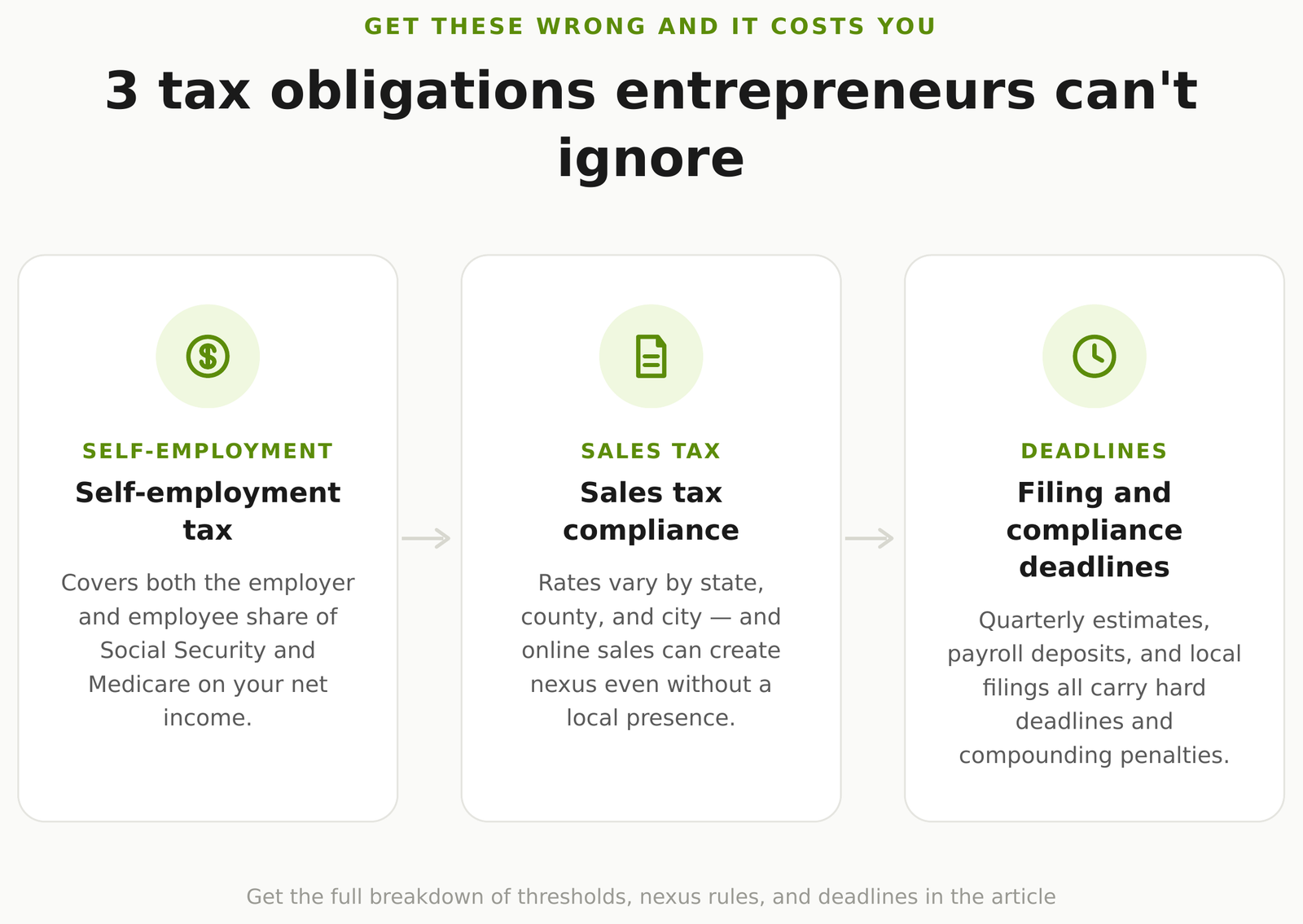
Taxes are one of the most consequential areas of accounting for entrepreneurs. Mistakes here create penalties, back taxes, and serious disruption to operations.
Self-employment tax
When you leave traditional employment and start a business, your tax obligations shift. Self-employment tax covers both the employer and employee portions of Social Security and Medicare. It applies to net self-employment income and represents a real cost that has to be factored into your financial planning from the start.
Sales tax compliance
If you sell taxable goods or services, sales tax compliance is mandatory. Rules vary by state, county, and even city, and economic nexus laws now mean selling online can create sales tax obligations in states where you have no physical presence.
Mismanaging sales tax creates real liabilities and triggers audits that consume time and resources. Build sales tax tracking and remittance into your accounting software from day one rather than trying to reconstruct compliance after the fact.
Tax filing and financial laws
Meeting tax filing deadlines is non-negotiable. Quarterly estimated taxes, payroll deposits, and annual returns all have hard deadlines, and missing them triggers compounding penalties that quietly drain your cash.
Beyond federal requirements, entrepreneurs must navigate state and local financial laws affecting business licenses, payroll taxes, and franchise fees. Staying compliant requires a clear system and, in most cases, professional support from someone who knows the rules in your jurisdiction.
Financing strategies for entrepreneurs
Your financial statements are your primary currency when seeking capital. Understanding financing strategies, and how accounting supports them, is where entrepreneurial finance becomes genuinely useful for growth.
Early-stage businesses often rely on personal savings and personal loans for initial funding. As traction develops, options expand to small business loans, business credit lines, and credit management tools that improve working capital efficiency.
More growth-oriented businesses pursue angel investors, venture capitalists, or private equity. Each audience has different reporting expectations. Angel investors want clean startup financials and realistic pro forma statements. Venture capitalists want detailed projections with clear evidence of scalable growth. Private equity requires audited financials and deep due diligence readiness.
Some entrepreneurs ultimately pursue an initial public offering, a path that requires years of clean, audited records and full GAAP compliance. Starting those habits early makes that eventual journey far smoother, even if it’s years away.
DIY accounting vs. hiring a professional
Many early-stage entrepreneurs manage their own books, and DIY accounting is genuinely cost-effective when transactions are simple and volume is low. Modern accounting software makes this more manageable than ever: it automates invoicing, tracks expenses, reconciles bank accounts, and generates financial statements with minimal manual effort. Automation tools take this further by integrating your accounting system with payroll, CRM, and inventory platforms, which reduces human error and gives you real-time visibility into your financial health.
DIY accounting has clear limits, though. As your business grows, the complexity of financial reporting, tax obligations, and financial controls exceeds what most founders can manage effectively alone. This is where a small business accountant or fractional CFO delivers value that far exceeds the cost.
Why financial controls are non-negotiable
Financial controls are the internal policies and procedures that protect your business from errors, fraud, and compliance failures. Strong controls include segregation of duties, regular account reconciliations, approval workflows for payments, and complete audit trails.
Without them, even well-intentioned businesses expose themselves to real risk. As you bring on employees and increase transaction volume, financial controls become critical infrastructure rather than a nice-to-have.
They also give investors and lenders confidence. When a potential partner sees clean books, documented processes, and strong controls, their trust in your management grows immediately.
Accounting for entrepreneurs across the company lifecycle
Accounting needs evolve as your business grows. Understanding accounting for entrepreneurs means recognizing how requirements change at each stage.
In the startup phase, the priorities are clean bookkeeping, basic financial statements, and cash budget management. In the growth phase, focus shifts to financial reporting, financial controls, and strategic planning. In the scaling phase, entrepreneurs need advanced pro forma statements, audit readiness, and support for complex funding strategies.
Each stage brings new exposure: sales tax in new states, payroll in new jurisdictions, increasingly complex tax liabilities. Planning for these transitions before they happen keeps your business ahead of compliance requirements rather than scrambling to catch up.
The entrepreneurs who plan ahead, build the right systems early, and seek expert support at the right moment are the ones who grow with clarity, confidence, and control.
Frequently Asked Questions
Should a startup use cash-basis or accrual-basis accounting?
Most startups begin with cash-basis accounting because it’s simpler. Switching to accrual-basis accounting early is advisable for any business planning to raise outside capital or grow significantly, since investors and lenders expect accrual-basis statements and GAAP requires it for most incorporated entities.
Which business structure is best for a new entrepreneur?
It depends on your liability exposure and growth plans, not a fixed rule. A sole proprietorship is cheapest and simplest if you’re testing an idea with minimal risk. An LLC is the common choice once you have real revenue or any meaningful liability exposure, since it separates personal and business assets while keeping tax filing relatively simple.
What are pro forma financial statements and why do entrepreneurs need them?
Pro forma financial statements are projections showing anticipated future performance. Entrepreneurs need them to attract investors, secure loans, plan major decisions, and stress-test their business model before committing resources.
How does accounting support business growth?
Accounting provides the data foundation for every major growth decision. Financial statements reveal where your margins are, which products are profitable, where cash is tied up, and when the business can afford to hire or expand. Growth without accurate accounting data is guesswork dressed up as strategy.
When should an entrepreneur hire a small business accountant?
When your accounting complexity exceeds your available time or knowledge. Key triggers include taking on employees, pursuing outside investment, dealing with multi-state sales tax, or preparing for an eventual sale or IPO. A professional accountant prevents costly errors and frees you to focus on building the business.
Conclusion
Running a successful business demands more than a great product or service. It demands financial clarity at every stage, starting with the structure you register on day one and continuing through the pro forma statements you’ll eventually build for a Series A raise.
If you’re ready to move beyond spreadsheets and guesswork, our fractional CFO and accounting advisory services are built specifically for founders. From building investor-ready projections to managing tax obligations, strengthening financial controls, and designing long-term financial planning, we give you the financial infrastructure your business deserves.
Take control of your numbers. Reach out today to learn how our CFO services can transform the way you run and grow your business.