Bookkeeping vs. Accounting: Understanding the Key Differences
Bookkeeping vs. accounting: which one does your business need right now?
“We already have someone doing our books” is one of the most common things founders say. It is often said right before they discover they have no real financial picture of their company. Bookkeeping and accounting get used interchangeably so often that many businesses do not realize they have one without the other. That gap tends to surface at the worst possible time: during a tax filing, an investor’s diligence request, or a bank loan application.
This guide breaks down what each function actually does, where the line between them sits, and how to decide which one your business needs right now.
Bookkeeping vs. accounting: the core distinction
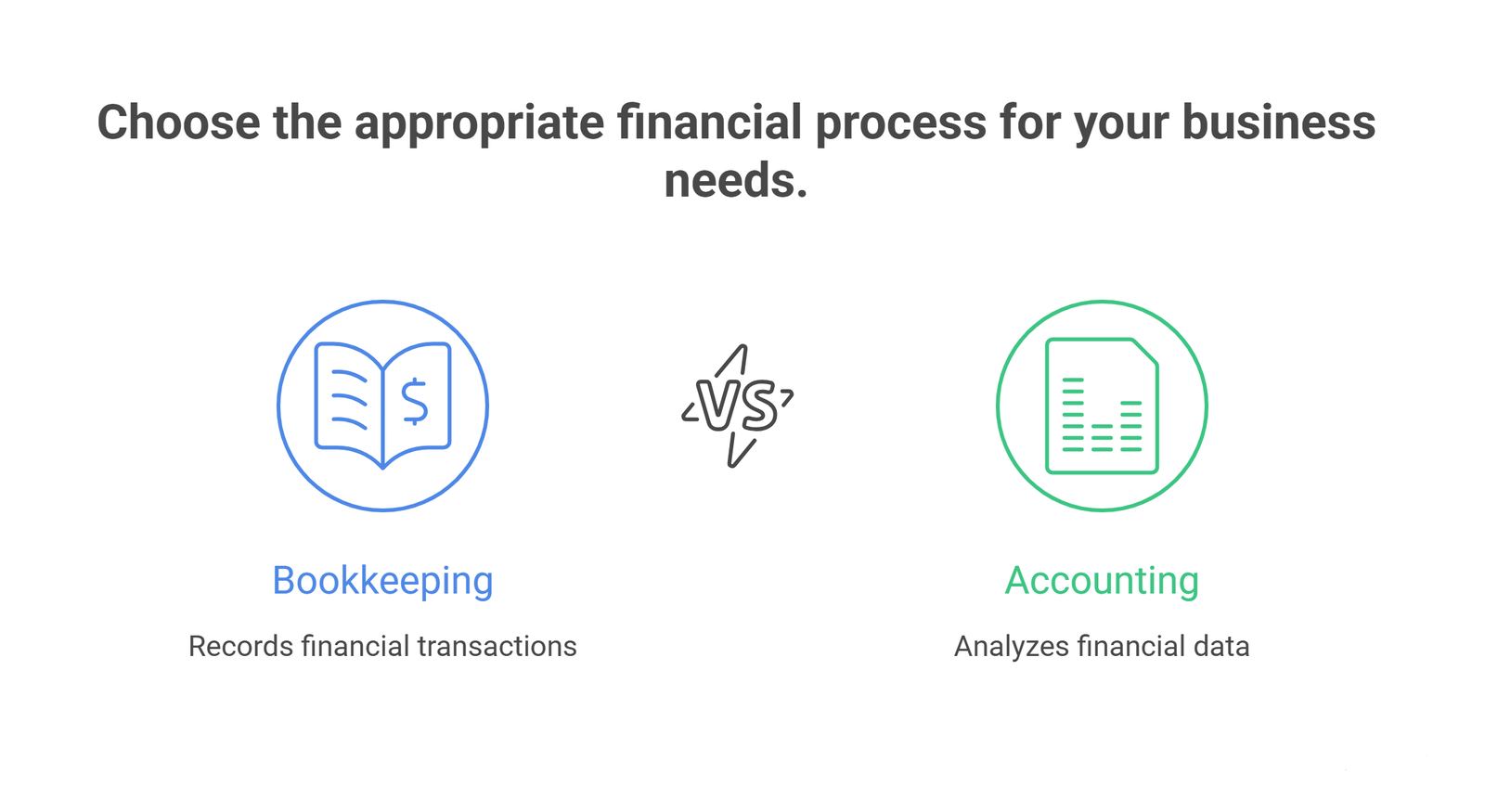
Bookkeeping is the daily process of recording, organizing, and maintaining every financial transaction a business makes. It is the data layer: sales, purchases, payroll, receipts, and bank activity, entered accurately and consistently so the numbers are always current.
Accounting takes that recorded data and turns it into something usable. It summarizes, analyzes, and interprets the numbers to produce financial statements, guide tax strategy, and support decisions about growth, pricing, and risk.
The simplest way to hold the distinction: bookkeeping records what happened. Accounting explains what it means and what to do next.
Side-by-side comparison
| Aspect | Bookkeeping | Accounting |
| Primary focus | Recording and organizing daily transactions | Analyzing data, reporting, and advising |
| Frequency | Daily or weekly | Monthly, quarterly, annually |
| Key deliverables | Ledgers, reconciled accounts, trial balances | Financial statements, tax filings, forecasts |
| Typical credentials | High school diploma, associate degree, or Certified Bookkeeper (CB) | Bachelor’s degree, often CPA, CMA, or CA |
| Typical monthly cost | $300-$1,500 for outsourced services | $1,000-$5,000+ per quarter for advisory work |
| Decision-making role | Keeps the business organized | Recommends action based on the data |
What bookkeepers actually do
Bookkeepers keep the transactional layer of the business accurate and current. Day to day, that means recording sales and purchases, managing invoices and receipts, and processing payroll. It also means reconciling bank statements against internal records and tracking accounts receivable and accounts payable. They also generate basic reports like trial balances, and they prepare the underlying records that accountants rely on at tax time and year-end close.
None of this involves interpretation. A bookkeeper’s job is accuracy and consistency, not judgment calls about what the numbers should mean for the business.
What accountants actually do
Accountants start where bookkeepers stop. They take the recorded transactions and turn them into financial statements, including the income statement, balance sheet, and cash flow statement. From there, they analyze margins, trends, and key performance indicators to assess whether the business is actually profitable and where it is leaking money.
Accountants also handle tax planning and filing, conduct internal and external audits, and build budgets and forecasts. They advise on financial strategy too: whether to raise prices, take on debt, or expand into a new market. This is the strategic layer, and it depends entirely on the bookkeeping underneath it being accurate.
How AI is changing the split
This is the part most comparisons written before 2025 miss entirely. Cloud accounting platforms now automate a large share of routine bookkeeping work, categorizing transactions and reconciling accounts with minimal manual entry. Industry estimates suggest AI now handles the bulk of routine bookkeeping tasks that used to require a person to key in every line.
That has not eliminated the need for either function. It has shifted where the human judgment sits. Bookkeeping has become more about reviewing and correcting what the software gets wrong than about manual data entry. Accounting has become more valuable, not less, because interpreting the numbers, catching what automation misses, and advising on strategy still requires a person who understands the business. If your current bookkeeping setup is still fully manual in 2026, that is usually a sign it is due for an upgrade. It is not a sign that bookkeeping itself is becoming obsolete.
A quick scenario
Consider an e-commerce business doing $150,000 a month in revenue. Bookkeeping handles the daily mechanics: logging sales from the storefront and payment processor, categorizing ad spend and shipping costs, reconciling deposits, and tracking vendor bills.
Accounting handles the interpretation. It notices that margins have quietly declined as ad costs crept up, forecasts cash needs ahead of a busy season, and identifies tax deductions the business is missing. It also advises on whether a supplier or pricing change makes sense. Clean books make that analysis possible. Without it, the accountant is working from guesswork instead of data.
Which one does your business need?
Most businesses need both eventually, but the order and urgency depend on stage.
Bookkeeping is the starting point for almost every business. Startups and small businesses need accurate transaction records from day one. That record-keeping helps manage cash flow, keeps you ready for tax season, and avoids the scramble of reconstructing a year of receipts later. Our bookkeeping and accounting services for startups are built around exactly this stage.
Accounting becomes necessary as complexity grows. That typically happens once a business is approaching or has passed six figures in revenue, is preparing to raise capital, or is dealing with tax obligations across more than one jurisdiction. A few concrete signs it is time to bring in accounting support alongside bookkeeping:
- You cannot answer, with confidence, whether last quarter was actually profitable.
- You are preparing a pitch deck or data room for investors.
- Tax filing has become complicated enough that mistakes carry real financial risk.
- You are making pricing or hiring decisions without a clear view of margins.
If any of these sound familiar, that is the point to consider adding virtual CFO or strategic advisory support. Layered on top of solid bookkeeping, it starts to pay for itself quickly.
Common myths
“They’re the same thing.” Bookkeeping feeds accounting. They are connected, but the skills, deliverables, and typical credentials differ.
“My business is too small to need accounting.” Even a small business benefits from knowing whether it is actually profitable, not just whether cash is coming in.
“Software replaces the need for either one.” Tools like QuickBooks and Xero automate data entry and flag anomalies. They do not replace the judgment needed for tax strategy, financial interpretation, or catching a mistake the software has no context to notice.
Frequently Asked Questions
Can a bookkeeper prepare financial statements?
Bookkeepers can prepare basic reports like trial balances. Full financial statements, including audited or investor-ready statements, are typically handled by an accountant.
What credentials does an accountant need?
Most accountants hold a bachelor’s degree in accounting or finance. Many also pursue further certification such as CPA, CMA, or CA for higher-level roles like tax strategy and audits.
Do bookkeepers and accountants need different skill sets?
Yes. Bookkeeping rewards attention to detail and consistency. Accounting requires analytical judgment, knowledge of tax law and accounting standards, and the ability to translate numbers into a recommendation.
Can one person handle both roles?
For a very small business or an early-stage startup, yes, often the founder or a single hire manages both. As transaction volume and complexity grow, most businesses split the roles to keep both accuracy and strategic advice at the level they need.
How much does each service typically cost?
Outsourced bookkeeping generally runs $300 to $1,500 a month depending on transaction volume. Accounting and advisory services tend to run $1,000 to $5,000 or more per quarter, depending on complexity and how much strategic work is involved.
The bottom line
Bookkeeping and accounting are not competing services. They are sequential ones. Bookkeeping is a business’s data collection, accounting is what turns that data into decisions. Getting the sequence right, and knowing when to add the second layer, keeps a growing business from finding a financial blind spot at the worst possible moment.
Need clean books and the financial insight to act on them? Talk to Oak Business Consultant about accounting and bookkeeping services built for your stage.