
Financial Analysis Certificate – The Complete List of 13 Certifications
Comprehensive List of 13 Certifications for Financial Analysis
Two analysts can have the same job title and completely different letters after their name. One holds a CFA and spent four years on it. Another finished an FMVA in under six months. Both are legitimate, and neither tells you which one you actually need.
If you’re thinking about a career in finance, a financial analysis certificate or certification can meaningfully increase your lifetime earnings, your credibility with employers, and your ability to actually do high-level economic analysis. This guide walks through the major finance certification programs and designations for anyone aspiring to work as a certified financial consultant, what each one actually requires, and what it’s good for.
Building the right skill set can help you stand out to employers, and in some finance roles, a specific credential is close to a hiring requirement. Which one is worth your time depends entirely on where you want to end up.
What does a financial analysis certificate entail?
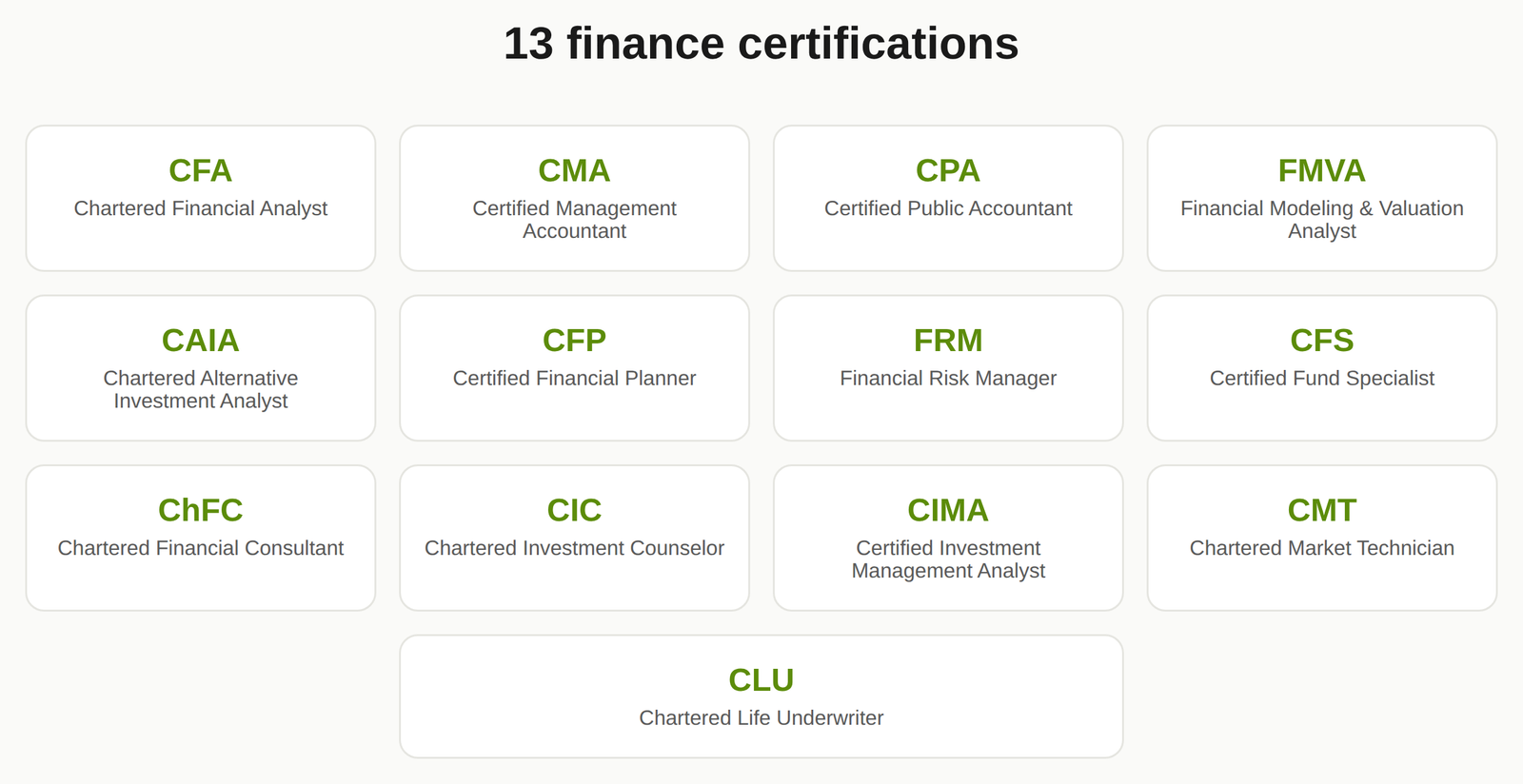
Finance certifications are credentials that demonstrate proven knowledge in a specific area. Completing the right one lets you offer employers and clients a certain level of investment expertise, and most financial professionals who complete these programs display the designation as initials after their name.
It’s worth being precise about the terminology, since the words get used loosely. A certificate typically means you completed a course or series of courses covering specific learning objectives, no standardized exam required. A certification means you passed an exam administered by an independent body, often alongside work-experience and continuing-education requirements. The CFA, CPA, and CFA are certifications. Many university-run “financial analysis certificate” programs are certificates. Both have value, but a certification generally carries more weight with employers because it’s independently tested and harder to obtain.
Comparing the major certifications at a glance
| Certification | Levels | Typical cost | Pass rate | Completion time | Work experience |
| CFA | 3 | $2,500-$3,500 | 30-50% per level | 3-5 years | ~4 years |
| CMA | 2 | $2,000-$2,500 | 40-50% per part | 6 months-2 years | 2 years |
| CPA | 4 sections | $1,500-$3,000 | ~45-50% per section | 18 months-2+ years | 1-2 years (varies by state) |
| FMVA | 1 | $497-$847 | ~70% | Under 6 months | None |
| CAIA | 2 | ~$3,000 | ~70% | 12-18 months | 1 year |
| CFP | 1 exam, multiple courses | ~$2,000 | ~67% | 18-24 months | 3 years (or apprenticeship) |
| FRM | 2 | ~$1,500 | 40-50% per part | Under 1 year | 2 years |
Costs and pass rates shift over time and vary by provider, so treat this as a starting point for comparison rather than a locked-in number, and confirm current figures on the issuing body’s site before you commit.
CFA (Chartered Financial Analyst) certification
The CFA Institute offers the Chartered Financial Analyst designation, and it’s one of the most demanding credentials in finance. Candidates must pass three sequential exams, each testing a different depth of the same core curriculum: ethical and professional standards, quantitative methods, economics, financial reporting and analysis, corporate finance, equity, fixed income, derivatives, alternative investments, and portfolio management.
You’ll also need a bachelor’s degree (or be in the final year of one) and roughly four years of combined work and higher-education experience by the time you finish. It typically takes three to five years to complete all three levels, and total cost runs $2,500 to $3,500 depending on how early you register and whether you need to retake an exam. Pass rates run 30-50% per level, which means the cumulative pass rate across all three is considerably lower.
Holding a CFA opens doors in portfolio management, equity research, and institutional investment analysis, where you’ll be expected to rate and research financial assets professionally.
Pros: globally recognized, required or strongly preferred for many wealth management and research roles, and completing it signals real discipline to employers.
Cons: it’s one of the most time-consuming finance credentials available, the curriculum leans heavily academic and portfolio-theory focused, and it does relatively little to build hands-on Excel or modeling skills.
CMA (Certified Management Accountant) certification
The Institute of Management Accountants (IMA) offers the CMA, and it’s a notable gap in a lot of “top certifications” lists because it’s consistently ranked among the best credentials specifically for financial analysts, not just accountants.
The CMA covers two parts: financial planning, performance, and analytics; and strategic financial management. You’ll need a bachelor’s degree, two continuous years of experience in management accounting or financial management, and IMA membership. Cost runs $2,000-$2,500 including membership and review materials, and most candidates finish in six months to two years. Pass rates run roughly 40-50% per part.
Where the CMA differs from the CFA is focus: it’s built for people doing internal financial analysis, budgeting, forecasting, and decision support inside a company, rather than external investment research.
Pros: strong fit for corporate finance and FP&A roles, faster and cheaper to complete than a CFA, and globally recognized in management accounting circles.
Cons: less brand recognition outside corporate finance and accounting, and it won’t carry much weight if your goal is investment banking or asset management.
CPA (Certified Public Accountant) certification
CPA stands for Certified Public Accountant, and it’s the standard credential for accounting professionals in the United States. The American Institute of CPAs (AICPA) oversees it, and the exam covers auditing and attestation, business environment and concepts, financial accounting and reporting, and regulation.
To sit for the exam, you typically need 150 credit hours of education (more than a standard bachelor’s degree in most states) plus a period of supervised work experience that varies by state board. Total cost runs $1,500-$3,000, and most candidates take 18 months to just over two years to pass all four sections, each of which has a pass rate around 45-50%.
If you want to expand from pure accounting into broader financial planning work, note that a CPA alone doesn’t cover that; you’d typically add a Personal Financial Specialist (PFS) credential on top of it.
Pros: close to a “must-have” for accounting careers, and a strong differentiator if you’re aiming for a CFO track.
Cons: narrower focus on accounting and compliance than on corporate finance or investment analysis, and the path to eligibility (credit hours, state licensing) can be a longer runway than the exam itself.
FMVA (Financial Modeling and Valuation Analyst) certification
A financial modeling certification like CFI’s FMVA is a newer, faster-growing option for financial analysts who want practical, applied skills rather than theory. The program covers building financial models from scratch, common valuation methods (DCF, comparables, precedent transactions), scenario and sensitivity analysis, and industry-specific modeling for real estate, e-commerce, and other sectors, all done hands-on in Excel.
Cost starts around $497 and can run up to $847 depending on the package. There’s no work-experience requirement, and most people complete it in under six months. The completion rate across the full program is roughly 70%.
This certification builds practical analyst skills: step-by-step financial model construction, business valuation methodologies, M&A modeling, and building the charts, dashboards, and presentations that go with a finished model.
Pros: fast, affordable, and directly applicable to day-to-day analyst work; no prior work experience required.
Cons: carries less brand weight than the CFA or CPA in more traditional finance circles, and it’s applied rather than theoretical, so it won’t substitute for the CFA curriculum if a role specifically asks for it.
CAIA (Chartered Alternative Investment Analyst) designation
The CAIA targets asset management and hedge fund professionals who work with investment alternatives: hedge funds, private equity, real assets, venture capital, and structured products. The curriculum also covers ethics, risk mitigation, and due diligence on fund managers.
It’s a two-level program costing around $3,000 total, and most candidates finish in 12-18 months. Pass rates run around 70% per level, notably higher than the CFA.
Pros: highly relevant if you’re working in alternative asset management specifically, complements a CFA or FMVA well, and the two-level structure with a decent pass rate makes it more achievable than some other designations.
Cons: the narrow focus makes it less flexible than a broad credential like the CFA or an MBA if you later want to pivot into traditional corporate finance.
CFP (Certified Financial Planner) certification
CFP stands for Certified Financial Planner, and it certifies broad competence across personal financial planning: investments, insurance, tax, retirement, and estate planning. Candidates study more than 100 topics through a required curriculum, then sit for a comprehensive exam.
The CFP Board of Standards oversees the program. You’ll need to complete the education requirement, pass the exam, and log 6,000 hours of professional financial planning experience (or 4,000 hours through an approved apprenticeship path) before you can use the designation. Cost is around $2,000, though it varies with how many course components you need. Pass rates run around 67%, and the full path typically takes 18 months to two years once you’re actively working through it, longer if you’re counting the experience requirement from scratch.
The role itself centers on working directly with individuals to help them understand and choose between financial options, which means trustworthiness and a professional bar matter as much as technical knowledge.
Pros: strong differentiator for careers in wealth management, private banking, and financial advisory work with high-net-worth clients.
Cons: narrow focus on personal finance, with limited transferability to corporate finance, investment banking, or capital markets roles.
FRM (Financial Risk Manager) certification
FRM stands for Financial Risk Manager, issued by the Global Association of Risk Professionals (GARP). It certifies expertise in managing risk across markets, credit, and operations, and it’s aimed at people pursuing careers as risk officers or risk analysts.
The program has two parts, costs around $1,500 total, and most candidates finish within a year. Pass rates run 40-50% per part.
Pros: a focused, efficient path if risk management is the specific career you want, and it carries real weight at banks and large financial institutions.
Cons: newer and less globally recognized than the CFA or CPA, and its relevance drops off quickly outside risk-specific roles.
Certified Fund Specialist (CFS)
The CFS credential demonstrates knowledge of mutual funds and the mechanics behind them: fund structures, share classes, and how to evaluate a fund against a client’s goals. Holders typically advise clients on which funds to invest in and, depending on their licensing, buy and sell funds on a client’s behalf.
Pros: a focused, relatively quick way to build credibility specifically around fund-based investment advice.
Cons: narrow in scope compared to broader designations, and the practical scope of what you can do with it depends heavily on what other licenses you hold alongside it.
Chartered Financial Consultant (ChFC) certification
The Chartered Financial Consultant, abbreviated ChFC, demonstrates broad experience across financial analysis and planning. The American College runs the program, and earning it requires passing exams covering financial planning, health coverage, income tax, real estate, and financing, plus at least three years of experience in a finance-related role.
With a ChFC, you’re typically positioned to help clients assess their current financial situation and build toward long-term goals, work that overlaps heavily with what a CFP does.
Pros: broader curriculum than the CFP in some areas (no exam-day time pressure, since it’s coursework-based), and a solid credential for financial planning careers.
Cons: less widely recognized by name than the CFP, so you may spend more time explaining what it is to employers or clients.
Chartered Investment Counselor (CIC) certification
The Investment Adviser Association issues the CIC. To sit for it, you generally need to already be a registered investment adviser. The program centers on portfolio management, and candidates must demonstrate high-level portfolio management experience, follow a strict ethics code, and provide character references.
CIC holders are typically trusted with a firm’s most significant clients, high-net-worth individuals and institutions, and the designation is well respected within investment counseling circles specifically.
Pros: signals a high level of trust and portfolio management experience, valuable if you’re already deep into investment advisory work.
Cons: the prerequisite of already being a registered investment adviser makes this inaccessible early in a career; it’s a credential for people already established in the field.
Certified Investment Management Analyst (CIMA)
The CIMA covers asset allocation, investment strategy, risk assessment, and performance evaluation. To pursue it, you need to already be a certified investment advisor plus roughly three years of relevant professional experience.
Unlike some one-and-done certifications, CIMA requires ongoing recertification: holders need at least 40 hours of continuing education every two years to keep the designation active. Most CIMA holders work in financial consulting, managing large sums for high-net-worth clients.
Pros: demonstrates advanced investment management expertise and signals ongoing commitment through the recertification requirement.
Cons: the continuing-education obligation is a real, recurring cost of time, and the prerequisite of prior certification and experience means it’s not an entry point.
Chartered Market Technician (CMT) certification
The Market Technicians Association (MTA) offers the CMT, which certifies expertise in technical analysis: chart patterns, indicators, and price-based forecasting rather than fundamental analysis. Candidates must follow the MTA’s code of ethics and typically work at an investment or asset management firm while pursuing it.
Pros: the clearest path if your work centers on trading or technical analysis specifically, an area most other finance certifications barely touch.
Cons: narrow and technique-specific, so it adds little if your role is fundamentals-driven analysis, corporate finance, or accounting.
Chartered Life Underwriter (CLU) certification
The American College also issues the CLU, aimed at insurance professionals. It requires completing ten courses and roughly 20 hours of assessments covering retirement savings, life insurance, health coverage, insurance law, investment taxation, financial planning, and estate planning group benefits.
Pros: the standard credential if your career is specifically in life insurance and the financial planning that surrounds it.
Cons: limited relevance outside insurance-adjacent roles; it won’t move the needle in corporate finance or investment analysis hiring.
Frequently Asked Questions
What’s the difference between a financial analysis certificate and a certification?
A certificate means you completed a course or series of courses covering specific material, with no standardized exam required. A certification means you passed an independently administered exam, usually alongside work-experience and continuing-education requirements. Certifications generally carry more weight with employers because they’re harder to obtain and independently verified.
Which certification is best for someone starting out in financial analysis?
FMVA is the fastest and cheapest entry point, since it has no work-experience requirement and takes under six months. It won’t replace a CFA or CMA long-term if you want a more established credential, but it builds real, immediately usable modeling skills while you figure out which direction to specialize in.
Is the CFA worth the time it takes?
If your goal is investment research, portfolio management, or asset management specifically, yes, it’s still the most recognized credential in that space. If your work is closer to corporate finance, FP&A, or general financial analysis, a CMA or FMVA may get you further for less time and cost.
Do I need a certification to work as a financial analyst?
No. Plenty of financial analysts work without any formal certification, especially early in their careers. A certification becomes more valuable as you aim for senior roles, specific niches like risk management or alternative investments, or employers who explicitly screen for one.
Can I hold more than one of these certifications?
Yes, and it’s common. An FMVA plus a CFA is a frequent combination, since FMVA covers the practical modeling skills the CFA curriculum doesn’t emphasize. A CPA plus a PFS credential is another common pairing for accountants moving into broader financial planning.
Conclusion
Finance certifications and certificates demonstrate proven knowledge in a specific field, and some programs offer financial aid to help cover the cost. Picking the right one for your career path can broaden your knowledge, prove your value to an employer, and in some roles, function as close to a requirement for being hired or promoted.
There’s no single “best” certification here. A CFA and an FMVA serve completely different purposes even though both put you closer to investment analysis work. A CMA and a CPA overlap in ways their titles don’t suggest. The right choice depends on whether you’re heading toward corporate finance, investment management, financial planning, risk, or accounting specifically, and how much time and cost you’re able to put in before you need the credential to pay off.
Contact us to talk through which of these fits your specific career goals and how it connects to the practical financial analysis work you’ll actually be doing.